
INTRODUCTION
Lymphoma refers to a clonal tumor arising from the malignant transformation of mature or immature lymphocytes (B cells, T cells, or natural-killer (NK) cells). It represents the most common hematologic malignancy, and is a heterogeneous disease, comprised of over 30 subtypes as classified by the World Health Organization (WHO).1 This diversity derives from the varied pathways leading to lymphoma, including the transformation of different lymphocyte types, at different developmental or differentiation stages, and through multiple molecular pathways. Lymphoma can be subdivided into two clinically distinct classes: Hodgkin lymphoma (HL) and non-Hodgkin lymphoma (NHL).
HODGKIN LYMPHOMA
GENERAL PRINCIPLES
HL is a clonal neoplasm derived from B lymphocytes. It accounts for 30% of lymphomas in the United States. It is defined by the presence of characteristic Hodgkin Reed–Sternberg (HRS) cells located in the appropriate cellular background.
Classification
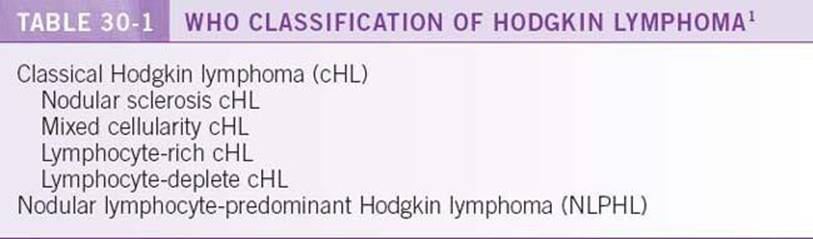
The WHO classification groups nodular sclerosis, mixed cellularity, lymphocyte-deplete, and lymphocyte-rich subtypes together as classical HL (cHL), based on pathologic and clinical similarities. Nodular lymphocyte-predominant HL (NLPHL) represents a distinct clinical entity with unique pathologic characteristics and a more indolent clinical course1 (Table 30-1).
Epidemiology
There are 160,000 patients living with HL in the United States, with an annual incidence rate of 2.8 per 100,000. cHL accounts for 95% of HL cases, and has a bimodal age distribution with a peak at 15 to 35 years and a second peak later in life. NLPHL accounts for 5% of HL, has a male predominance, and occurs most frequently in adults age 30 to 50.1
Pathophysiology
The malignant B cell in HL is the HRS cell, which is large, bi- or multinucleated, and expresses CD30 and CD15 cell surface antigens. NLPHL is characterized by a clonal B-cell population composed of lymphocytic and histiocytic cells (LHC) that express CD45, CD20, and CD79a.
Risk Factors
Epstein–Barr virus (EBV) is a clear risk factor for HL. Patients with a history of infectious mononucleosis have a higher incidence of HL, although the frequency of EBV positivity varies with geographic region. Human immunodeficiency virus (HIV) predisposes to the development of EBV-associated HL, likely through alterations in immune surveillance.
DIAGNOSIS
Clinical Presentation
HL typically presents as asymptomatic enlarged lymph nodes, with the disease originating in one lymph node group and spreading in a contiguous pattern. In older patients (>50 years), there may be a “skipped” lymph node segment. Sixty percent of patients present with localized (stage I-II) disease based on the modified Ann Arbor staging system. The most commonly involved lymph node groups are cervical (75%) and mediastinal (60%). Extranodal sites of involvement include the spleen (20%), bone marrow (5%), lung, and liver, and patients may present with symptoms specific to site of involvement. Systemic B symptoms of fever (>38.5°C), night sweats, and weight loss (>10% of body weight over 6 months) occur in up to 40% of patients. Patients with HIV associated HL usually present with advanced stage disease, extra-nodal site involvement, and B symptoms.
History
Painless lymphadenopathy is the hallmark of HL. Intense pruritus is reported in up to 25% of patients. Patients with mediastinal disease may report cough, chest pain, or shortness of breath. Other rare symptoms which may be elucidated from the history include pain in enlarged lymph nodes after alcohol ingestion and periodic fever. Performance status should be determined from the history.
Physical Examination
The physical examination should focus on the number, size, location, and character of palpable lymph nodes. The cervical nodes are most commonly involved, and the disease tends to spread in a contiguous pattern. The abdominal examination may reveal hepatosplenomegaly.
Differential Diagnosis
The differential diagnosis of suspected lymphoma typically includes other causes of lymphadenopathy. Infections, systemic rheumatologic disorders, or metastatic malignancies can also cause peripheral lymph node enlargement. For patients presenting with isolated splenomegaly, other etiologies include infection, portal hypertension, storage diseases, metastatic tumors, autoimmune disorders and myeloproliferative disorders.
Diagnostic Testing
A large excisional lymph node biopsy is preferred for the diagnosis of HL. In addition to morphologic evaluation, immunohistochemistry may be helpful in differentiating the CD15 +, CD30 + HRS of cHL from the CD45 +, CD20 + LHC cells of NLPHL. Bone marrow biopsy should be performed in advanced stage disease or in the presence of cytopenias or B symptoms.
Laboratories
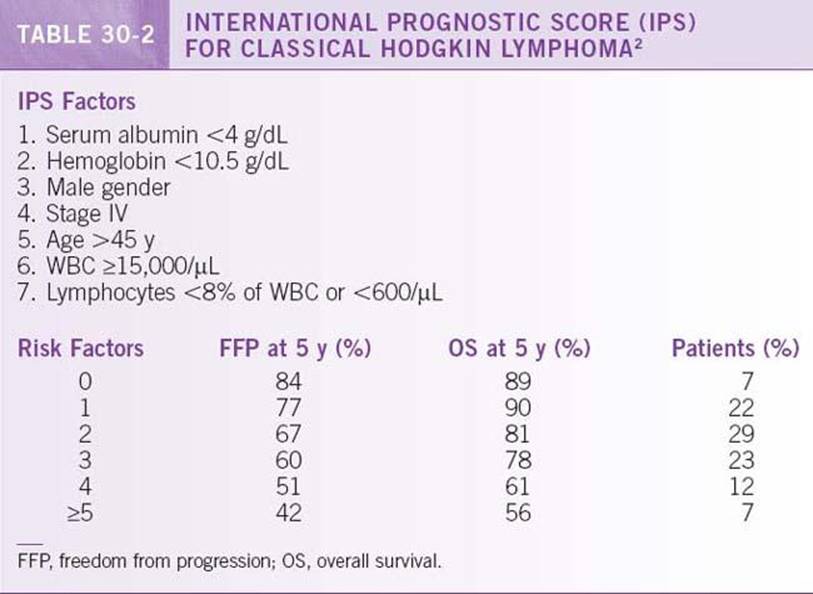
Complete blood cell count (CBC) with differential, erythrocyte sedimentation rate (ESR), and a complete metabolic panel (CMP) should be obtained at diagnosis. ESR, white blood cell and lymphocyte counts, hemoglobin, and albumin are important for calculation of a patient’s international prognostic score (IPS), which can be used to estimate survival in cHL (Table 30-2).2 Pregnancy testing in women of child-bearing age and HIV testing in at risk patients is indicated.
Imaging
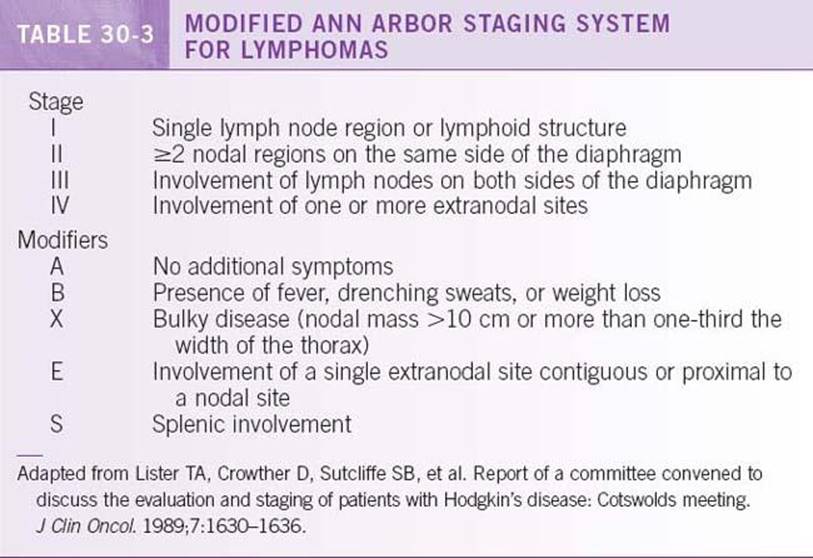
Positive emission tomography (PET) is preferred over computed tomography (CT) scan for initial imaging in HL. PET is more sensitive for detecting additional sites of disease and may improve the accuracy of the stage of disease as determined by the modified Ann Arbor staging system (Table 30-3). In some cases, serial PET imaging during therapy can be used to assess early response and prognosis, which can help guide clinicians in determining need for dose escalation and duration of therapy.3Pulmonary function testing should also be performed in patients who will receive chemotherapy containing bleomycin (see treatment, below).
TREATMENT
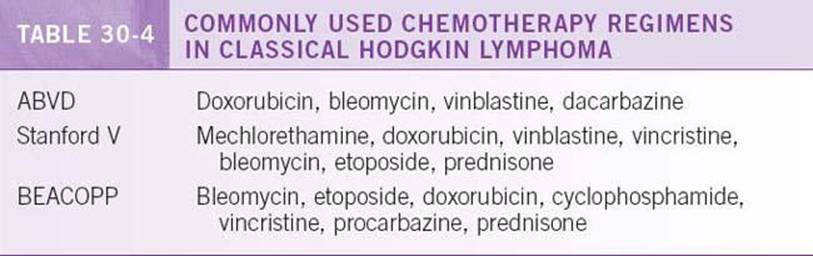
· Early stage cHL (stages I/II, no B symptoms, no bulky disease). Early stage cHL has a good prognosis when treated with standard therapy, with high rates of complete remission (CR) and 5 year overall survival (OS) greater than 90%.4 The focus of current clinical investigation is on maintaining excellent disease results while minimizing long-term complications of therapy. Standard treatment approaches (Table 30-4) include combined modality therapy with ABVD chemotherapy × 2 to 4 cycles plus involved field radiotherapy (IFRT) or chemotherapy alone with ABVD × 4 to 6 cycles. Recent evidence suggests that patients with early stage disease without adverse prognostic factors may receive reduced intensity radiotherapy with similar outcomes to full dose therapy. Patients at the highest risk for complications of IFRT (e.g., age <30 years, smokers, CAD risk factors, family history of early breast cancer) should be considered for treatment with chemotherapy alone.5
· Advanced-stage cHL (stages III/IV, B symptoms, bulky stage II). Standard treatment of advanced cHL includes systemic chemotherapy with ABVD × 6 to 8 cycles. Consolidative radiotherapy is typically recommended for all patients with bulky (>10 cm) disease. This approach results in 5- and 15-year failure-free survival rates of ~60% and ~45%, respectively, and 5- and 15-year OS rates of ~75% and ~60%. Alternative regimens include Stanford V and dose-escalated BEACOPP. These regimens are more intense with slightly higher CR rates, but increased toxicity, and may be utilized in patients with poor risk disease.6–8
· Relapsed cHL. The approach to patients with relapsed cHL takes into account the primary therapy and duration of remission. Historically, patients with early-stage HL were treated with radiation therapy alone; these patients are excellent candidates for standard systemic chemotherapy for cHL, which results in long-term DFS in 50% to 80%. Patients who received initial chemo-therapy and relapse late (>1 year after remission) may be considered for standard dose chemotherapy, resulting in 30% to 50% long-term DFS. Patients who relapse early (<1 year after remission) or those with poor prognostic factors (e.g., stages III/IV at relapse, B symptoms) should be treated with aggressive salvage chemotherapy (e.g., ICE, ESHAP) and be considered for high-dose chemotherapy with autologous stem cell transplant (SCT). This can result in long-term DFS in 40%. Patients who relapse after autologous SCT should be considered for clinical and, in appropriate candidates, allogeneic SCT.9
· NLPHL is a distinct HL subtype best characterized as an indolent B-cell lymphoma with a good prognosis. Most patients present with stage I disease, for which IFRT alone should be considered. Trials with single agent rituximab have also shown promising results. For advanced-stage presentation, treatment with systemic chemotherapy in combination with rituximab has favorable results.10
COMPLICATIONS
Short-term adverse effects depend on the chemotherapy regimen used. The most common short-term complication of ABVD is myelosuppression, leading to cytopenias and an increased risk of infections. Lung injury due to bleomycin or radiotherapy may occur acutely, and the highest risk is in patients who are older, smokers, or have underlying lung disease. Long-term toxicities include secondary malignancies, which occur in 25% of patients and may be delayed by decades; patients treated with radiation therapy are at the highest risk. Hypothyroidism occurs in 50% of neck radio-therapy patients at 1 to 20 years after treatment. The risk of CAD is highest in patients irradiated when <30 years of age. The risk of infertility and secondary MDS/leukemia is low with standard ABVD chemotherapy but higher in patients who receive dose-intensive regimens.
FOLLOW-UP
During the first 2 years after obtaining a complete CR, routine follow-up includes history and physical examination, CBC, ESR, and CMP at 3-month intervals. Imaging is performed at 1 and 2 years post-remission and as clinically indicated. After 2 years, office visits and laboratories may be spaced out to every 6 months for the first 5 years. Additional surveillance is required for patients who received radiation therapy. Thyroid screening tests should be performed annually in patients who received radiation involving the neck. Surveillance for solid tumors (cancers of the skin, soft tissue, breast, and lung) should begin 5 to 10 years following therapy and continue for the lifetime of the patient.
NON-HODGKIN LYMPHOMA
GENERAL PRINCIPLES
NHL is an umbrella diagnosis that encompasses all lymphomas which do not meet HL criteria. It is composed of a diverse group of diseases that range from indolent to aggressive in nature. Given this heterogeneity, a detailed discussion of each NHL subtype is beyond the scope of this chapter. This section will review general information about NHL, focusing on follicular lymphoma (FL) and diffuse large B-cell lymphoma (DLBCL). Together these two entities account for two-thirds of NHL. Other specific NHL subtypes of interest are described at the end of this section under “Special Considerations.”
Classification
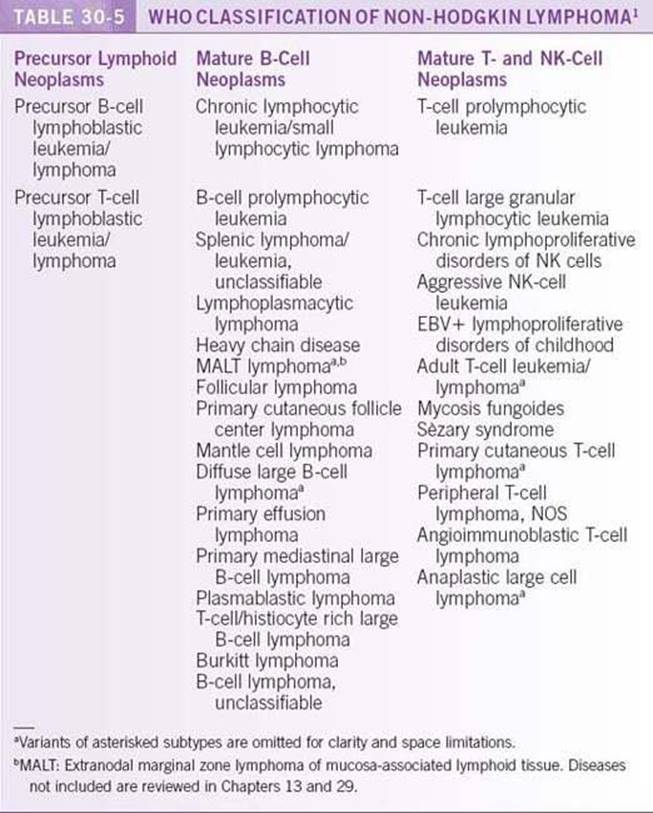
The WHO classification subdivides NHL based on morphologic, immunophenotypic, genetic, and clinical features. Subtypes are grouped into precursor lymphoid neoplasms, mature B-cell neoplasms, or mature T- and NK-cell neoplasms based on their resemblance to normal stages of lymphocyte differentiation (Table 30-5). Precursor neoplasms are primarily diseases of childhood. Mature T- and NK-cell neoplasms are uncommon diseases accounting for only 12% of NHL. Mature B-cell neoplasms (including FL and DLBCL) account for greater than 90% of lymphoid neoplasms worldwide, and are by far the most common type of NHL in adults.1
Epidemiology
There are an estimated 430,000 patients in the United States with NHL. The incidence has been rising over the last 30 years, with an annual incidence of 30 per 100,000 and a death rate of 7 per 100,000 in the United States. Most mature B-cell NHLs have median ages in the 6th to 7th decades of life, although a few subtypes (e.g., primary mediastinal lymphoma) occur at younger ages.1
Pathophysiology
The genetic hallmark of FL is the translocation t(14;18)(q32;q21), present in over 90% of cases. This translocation places the anti-apoptotic BCL-2 gene under in the influence of the immunoglobulin (Ig) heavy chain gene enhancer, resulting in increased expression of BCL-2. Accumulation of additional karyotypic abnormalities is common in FL. Mutation of the BCL-6 gene on chromosome 3q27 is the most frequent genetic aberration in DLBCL, occurring in 40% of cases. BCL-6 is a transcription factor that regulates the genes involved in lymphocyte development and apoptosis.
Risk Factors
HIV infection, immunosuppressant therapy, and primary immune deficiency are associated with an increased risk of NHL. Certain autoimmune diseases (e.g., Hashimoto’s thyroiditis) are also risk factors. Viral pathogens that have been linked to NHL subtypes include HIV, EBV, human herpresvirus-8, human T-cell leukemia virus type I, and hepatitis C virus. The most notable bacterial association is of Helicobacter pylori infection with gastric MALT lymphomas.
DIAGNOSIS
Clinical Presentation
Presenting symptoms in NHL vary with subtype and sites of involvement. Painless lymphadenopathy is the most common presentation. Systemic B symptoms are present in 33% of patients with DLBCL and 28% of patients with FL. Extranodal involvement, more common in DLBCL, may include bone marrow, skin, gastrointestinal tract, testes, salivary glands, liver, spleen, breast, adrenals, bone, sinuses, and CNS. Patients with bulky retroperitoneal disease may present with vague abdominal complaints.
Physical Examination
The physical examination should focus on the number, size, location, and character of palpable lymph nodes. Lymph node chains which should be examined include cervical, submental, supraclavicular, infraclavicular, axillary, epitrochlear, inguinal, and femoral as well as examination of Waldeyer ring (tonsils, oropharynx). The abdominal examination should include assessment for hepatic and splenic enlargement. Any patient with back pain or neurologic symptoms should have a complete neurologic examination to evaluate for cord compression or CNS involvement with lymphoma.
Differential Diagnosis
Other causes of peripheral lymphadenopathy include infection, rheumatologic disease, or other malignancy and may mimic NHL. See discussion in HL section.
Diagnostic Testing
When lymphoma is suspected, an incisional or excisional biopsy is preferred. An adequate biopsy specimen is critical for morphologic review and assessment of architecture by the pathologist. It also provides material for ancillary studies which may aid in subclassification, such as flow cytometry, immunohistochemistry, and genetic tests. Bilateral bone marrow biopsy and aspiration are required. If CNS involvement is suspected, lumbar punctureshould be performed.
Laboratories
CBC may reveal cytopenias suggestive of bone marrow involvement. A CMP should be ordered to assess creatinine and calcium and to establish baseline liver function. Lactate dehydrogenase (LDH) is an important prognostic indicator. If tumor lysis syndrome is suspected, particularly in highly aggressive lymphomas (e.g., Burkitt lymphoma), serial assessment of uric acid, potassium, calcium, phosphorus and creatinine is important during initial treatment.
Imaging
CT of the chest, abdomen, and pelvis should be performed with contrast to complete staging. Sites of lymph node involvement are classified by the modified Ann Arbor staging system (Table 30-3). An initial PET is useful for aggressive, potentially curable NHL subtypes such as DLBCL, as it may detect additional sites of disease. PET is not routinely recommended for indolent or incurable lymphomas, such as FL.3 If anthracycline-based chemotherapy is considered, assessment of left ventricular function with a multiple-gated acquisition (MUGA) scan or a transthoracic 2-D echocardiogram is warranted.
TREATMENT
· Follicular lymphoma (FL) is an indolent lymphoma with a median survival of 7 to 10 years in historical reports; survival is probably improving with modern therapy. Treatment with chemotherapy typically results in initial response followed by repeated relapses. Transformation to high-grade (large cell) NHL sometimes occurs. Given its indolent course, many patients with FL can be observed safely without treatment. Up to 20% of patients may never require therapy. The “watchful waiting” approach does not alter OS, but requires a reliable patient and clinical follow up every 3 to 6 months. Indications for treatment include symptomatic disease, bulky lymphadenopathy, threatened end-organ damage, cytopenias, and eligibility for clinical trials.
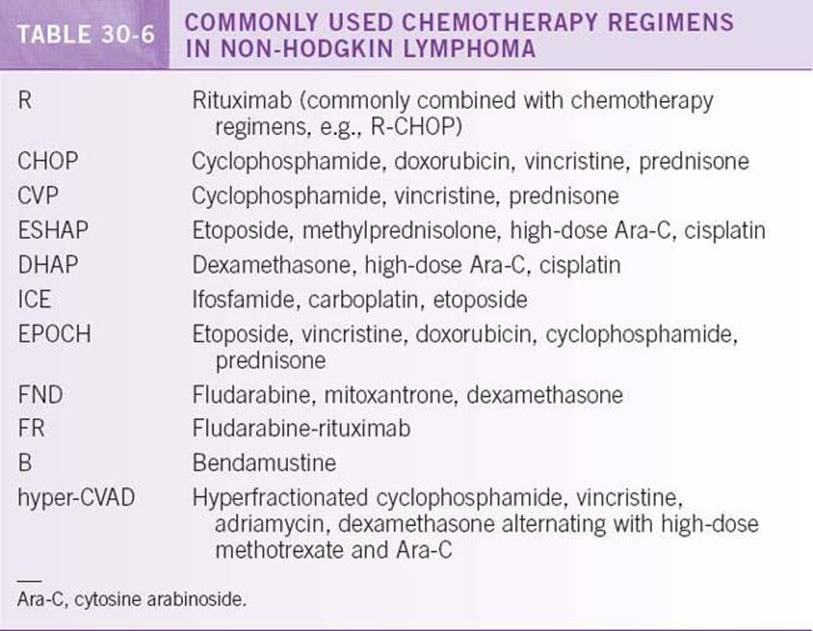
o Early stage (I/II) FL occurs in a minority of patients. It has a good prognosis when treated with IFRT alone, or in combination with immunochemotherapy such as R-CHOP (Table 30-6). Ten year OS ranges from 50% to 70%.11
o Advanced stage FL (III, IV or bulky stage II). Rituximab containing regimens improve PFS over chemotherapy alone in advanced stage FL. CHOP, CVP, FND, fludarabine or bendamustine plus rituximab are all effective, with three-year PFS ranging from 50% to 70%. Although there is no clear superiority of one regimen, R-CHOP and R-CVP are common initial choices, with high remission rates and long median PFS.12,13Recent data suggests that Bendamustine-R may have higher rates of PFS than R-CHOP. For elderly patients or those with poor performance status, single agent therapy with rituximab or chlorambucil may be used. Following induction chemotherapy, consolidation with radioimmunotherapy or maintenance rituximab may be considered.14
o Relapsed FL. Treatment of relapsed disease depends on prior therapies and the length of time since last treatment. Patients who initially receive R-chemotherapy and relapse less than one year from initial therapy are considered for aggressive salvage approaches. Alternative treatment regimens include other R-chemotherapy combinations, radioimmunotherapy, and autologous or allogeneic SCT.
· Diffuse large B-cell lymphoma (DLBCL) is an aggressive but potentially curable lymphoma. The majority of patients present with advanced disease, but a small number have limited disease on presentation.
o Advanced Stage (III/IV) DLBCL. Standard initial therapy for advanced stage disease includes combination immunochemotherapy with R-CHOP, typically administered for 6 to 8 cycles, resulting in 5-year OS rates of 58%.15 In contrast to FL, maintenance rituximab has no role in DLBCL. Patients with an increased risk of central nervous system relapse (involvement of testicular, paranasal sinus, epidural, bone marrow, or greater than two extra-nodal sites) should receive CNS prophylaxis.
o Limited Stage (I/II) DLBCL. Twenty-five percent of patients have limited disease at presentation. These patients have a good prognosis, with 5-year OS estimates of 70% to 80% with standard therapy. Treatment options include combined modality therapy with three cycles of RCHOP followed by IFRT, or R-CHOP for 6 to 8 cycles with or without IFRT. Patients with bulky stage II disease (tumor size greater than 10 cm in greatest dimension) have a worse prognosis and are often treated as advanced stage disease.16,17
o Relapsed DLBCL. Patients who relapse after CR should be considered for high dose chemotherapy and autologous SCT.18 Common salvage chemotherapy regimens include DHAP, ESHAP, and ICE with or without rituximab.
SPECIAL CONSIDERATIONS
· Transformation to aggressive lymphoma. Indolent NHL patients have a 1% to 3% per year risk of transforming into aggressive NHL (most commonly DLBCL). Transformation may manifest as rapid enlargement of a single lymph node group, sudden rise in LDH, decline in performance status, hypercalcemia, or new extranodal involvement. Transformed NHL can occur regardless of treatment approach for the indolent NHL and has a poor prognosis. The optimal therapy is unclear and these patients are encouraged to enroll in a clinical trial. If a trial is not available, they are typically treated similarly to patients with high-risk, relapsed DLBCL.
· Marginal zone lymphomas. These commonly present with localized disease (approximately two-thirds) involving the GI tract, thyroid, orbit/conjunctiva, lung, breast, or salivary glands. Gastric MALT lymphomas are associated with H. pylori, and complete responses are seen after antibiotic therapy aimed at eradicating the infection. At other sites, early-stage disease has an excellent prognosis with IFRT alone. Advanced-stage MALT lymphomas are treated with chemotherapy, similarly to FL. Splenic marginal-zone lymphoma also has an excellent prognosis, and first-line therapy involves splenectomy or single-agent rituximab, both of which may result in a high rate of CR and long-term DFS. Nodal and extranodal marginal-zone lymphomas are treated in a similar fashion to FL.
· Mantle cell lymphoma. Mantle cell lymphoma is an aggressive NHL characterized by t(11;14), a translocation that results in the overexpression of cyclin D1, a protein involved in cell cycle regulation. Most patients present with advanced disease. Cure rates are low with standard aggressive NHL therapy, and in appropriate candidates, aggressive chemotherapy regimens are warranted, preferably as part of a clinical trial. Typical off-study approaches include rituximab plus hyper-CVAD or autologous stem cell transplant.
· Burkitt lymphoma. Burkitt lymphoma/leukemia is a highly aggressive NHL that may be endemic (e.g., equatorial Africa), associated with immunodeficiency (HIV), or sporadic (most common in the United States). The sporadic form is characterized by overexpression of the c-myc proto-oncogene, usually via the t(8;14) translocation. This NHL is rapidly life-threatening without therapy, has a poor prognosis, commonly involves the bone marrow and CNS, and is treated with aggressive combination chemotherapy (e.g., hyper-CVAD regimen) with CNS prophylaxis.
· Lymphoblastic lymphoma. Lymphoblastic lymphoma is another highly aggressive NHL. This disease is treated identically to ALL, with intensive chemotherapy, and also requires CNS prophylaxis. Prognosis is good for early-stage disease and intermediate for advanced-stage disease, with ~80% and ~50% chance of long-term DFS, respectively.
· Small lymphocytic lymphoma. This is considered to be part of the same disease process as chronic lymphocytic leukemia, and is treated as such. See Chapter 29.
· Primary CNS lymphoma. This is an aggressive NHL that presents with isolated CNS disease and, if untreated, has a rapidly fatal natural history. Compared to systemic DLBCL, its prognosis is worse, and treatment approaches include radiation therapy and/or chemotherapy that penetrates into the CNS (e.g., high-dose methotrexate).
· Cutaneous T-cell lymphoma/mycosis fungoides. Cutaneous T-cell lymphomas typically present as erythematous plaques or exfoliation of skin but may progress to involve lymph nodes. They are treated with topical medications (steroids, retinoids, chemotherapy), local radiation, PUVA therapy, oral methotrexate and retinoids, interferon, and, at advanced stages, combination chemotherapy.
· Anaplastic large-cell lymphoma. This aggressive NHL typically involves both nodal and extranodal sites (e.g., skin, lung, bone, soft tissues) and is characterized by overexpression of anaplastic lymphoma kinase (ALK)-1, usually via a t(2;5) translocation. The presence of ALK-1 confers a much more favorable prognosis, compared with ALK-1-negative cases. Standard treatment is anthracycline-containing combination chemotherapy similar to DLBCL (e.g., CHOP), with 70% long-term DFS).
FOLLOW-UP
Follow-up for DLBCL during the first 2 years after obtaining a remission includes H&P, CBC, LDH, and complete metabolic panel at 3-month intervals, with imaging typically repeated at 1 and 2 years and as clinically indicated. After 2 years, follow-up intervals may be lengthened, and after 5 to 10 years without relapse, patients may be followed by their primary care physician. For indolent NHL, follow-up is typically every 3 to 4 months, with imaging repeated annually and as clinically indicated.
PROGNOSIS
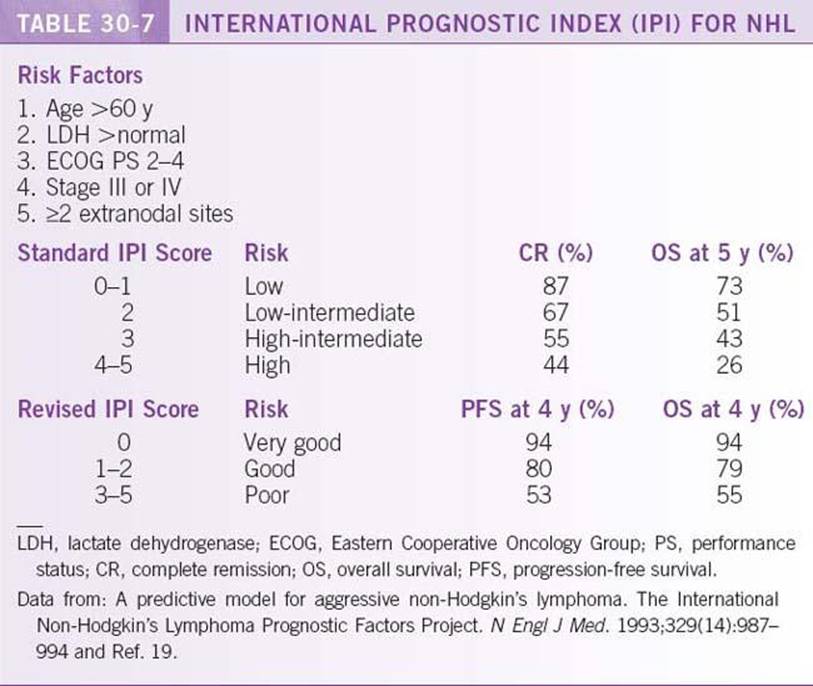
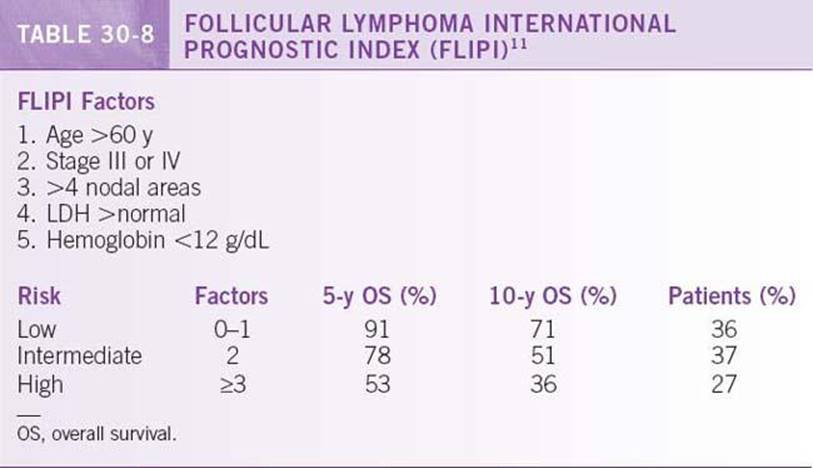
The prognosis of NHL is determined by multiple factors but starts with defining the subtype of NHL. In general, indolent NHLs are not considered curable, while aggressive NHL patients have a significant chance for long-term DFS after initial therapy. The international prognostic index (IPI) was developed to help predict CR and long-term survival in aggressive NHL such as DLBCL at a time when CHOP-like chemotherapy was standard treatment. The IPI factors were used to develop a revised IPI to provide prognostic information with current front-line treatment approaches that combine rituximab with CHOP chemotherapy (Table 30-7).19 The follicular lymphoma IPI (FLIPI)was developed to define overall prognosis in FL (Table 30-8), and results have shown that this index is useful in patients treated with current chemotherapy.11
REFERENCES
1. Swerdlow SH, Campo E, Harris NL, et al, eds. WHO Classification of Tumours of Haematopoietic and Lymphoid Tissues. Lyon, France: International Agency for Research on Cancer; 2008.
2. Hasenclever D, Dihl V. A prognostic score for advanced Hodgkin’s disease. N Engl J Med. 1998;339:1506–1514.
3. Cheson BD, Pfistner B, Juweid ME, et al. Revised response criteria for malignant lymphoma. J Clin Oncol. 2007;25:579–586.
4. Armitage JO. Current concepts: early-stage Hodgkin’s lymphoma. N Engl J Med. 2010;363:653–662.
5. Engert A, Plütschow A, Eich HT, et al. Reduced treatment intensity in patients with early-stage Hodgkin’s lymphoma. N Engl J Med. 2010;363:640–652.
6. Horning SJ, Hoppe RT, Breslin S, et al. Stanford V and radiotherapy for locally extensive and advanced Hodgkin’s disease: mature results of a prospective clinical trial. J Clin Oncol. 2002;20:630–637.
7. Diehl V, Sieber M, Rüffer U, et al. BEACOPP: an intensified chemotherapy regimen in advanced Hodgkin’s disease. The German Hodgkin’s Lymphoma Study Group. Ann Oncol. 1997;8:143–148.
8. Diehl V, Franklin J, Pfreundschuh M, et al. Standard and increased-dose BEACOPP chemotherapy compared with COPP-ABVD for advanced Hodgkin’s disease. N Engl J Med. 2003;348:2386–2395.
9. Schmitz N, Pfistner B, Sextro M, et al. Aggressive conventional chemotherapy compared with high-dose chemotherapy with autologous haemopoietic stem-cell transplantation for relapsed chemosensitive Hodgkin’s disease: a randomized trial. Lancet. 2002;359:2065–2071.
10. Ekstrand BC, Lucas JB, Horwitz SM, et al. Rituximab in lymphocyte-predominant Hodgkin disease: results of a phase 2 trial. Blood. 2003;101:4285–4289.
11. Solol-Cèligny P, Roy P, Colombat P, et al. Follicular lymphoma international prognostic index. Blood. 2004;104:1258–1265.
12. Hiddemann W, Kneba M, Dreyling M, et al. Frontline therapy with rituximab added to the combination of cyclophosphamide, doxorubicin, vincristine and prednisone (CHOP) significantly improves the outcome for patients with advanced-stage follicular lymphoma compared with CHOP alone: results of a prospective randomized study of the German low-grade lymphoma study group. Blood. 2005;106:3725–3732.
13. Marcus R, Imrie K, Belch A, et al. CVP chemotherapy plus rituximab compared with CVP as first-line treatment for advanced follicular lymphoma. Blood. 2005;105:1417–1423.
14. Van Oers MH, Marcus RE, Wolf M, et al. Rituximab maintenance improves clinical outcome of relapsed/resistant follicular non-Hodgkin lymphoma in patients both with and without rituximab during induction: results of a prospective randomized phase 3 intergroup trial. Blood. 2006;108:3295 –3301.
15. Coiffier B, Lepage E, Briere J, et al. CHOP chemotherapy plus rituximab compared with CHOP alone in elderly patients with diffuse large-B-cell lymphoma. N Engl J Med. 2002;346:235–242.
16. Miller TP, Dahlberg S, Cassady JR, et al. Chemotherapy alone compared with chemo-therapy plus radiotherapy for localized intermediate- and high-grade non-Hodgkin’s lymphoma. N Engl J Med. 1998;339:21–26.
17. Persky DO, Unger JM, Spier CM, et al. Phase II study of rituximab plus three cycles of CHOP and involved-field radiotherapy for patients with limited-stage aggressive B-cell lymphoma: Southwest Oncology Group Study 0014. J Clin Oncol. 2008;26:2258–2263.
18. Philip T, Guglielmi C, Hagenbeek A, et al. Autologous bone marrow transplantation as compared with salvage chemotherapy in relapses of chemotherapy-sensitive non-Hodgkin lymphoma. N Engl J Med. 1995;333:1540–1545.
19. Sehn LH, Berry B, Chhanabhai M, et al. The revised international prognostic index (R-IPI) is a better predictor of outcome than the standard IPI for patients with diffuse large B-cell lymphoma treated with R-CHOP. Blood.2007;109:1857–1861.