
Nardostachys grandiflora
Spikenard
Highly valued since Biblical times, spikenard was the substance used to anoint Jesus at the Last Supper, and was regarded as a rejuvenating tonic by the Moghul emperors. Known as jatamansi in India, it shares the sedative properties of its relative valerian, although it also has a more spiritual dimension – believed in Ayurvedic medicine to promote awareness and strengthen the mind. It is listed by CITES as endangered, and trade in the wild plant is permitted only under licence.
Character: Sweet, bitter, astringent.
Constituents: Volatile oil including borneol acetates.
Actions: Antifungal, antibacterial, relaxing nervine, carminative, laxative, anti-pasmodic, diuretic.
PARTS USED
ROOT AND RHIZOME
In India, jatamansi is used for a wide range of acute and chronic disorders including dysentery, consumption, bronchitis, smallpox, and menstrual and digestive upsets. It is used in Ayurveda to balance the humours (doshas) and promote spiritual awareness as a rejuvenating tonic. It is also an effective cardiac tonic and respiratory stimulant.
OIL
The oil is strongly antimicrobial and has sedative actions. It can be used in massage treatments for stress and nervous tension as well as added to external remedies for athlete’s foot and other skin infections.
AERIAL PARTS
The aerial parts can be collected from garden-grown specimens and used in infusions as a gentle sedative and antibacterial for infections and fevers.

APPLICATIONS
Root
Decoction: Simmer 1 teaspoon of dried root in a cup of milk as a restoring tonic for tension and nervous upsets. Use the standard decoction to strengthen and stimulate the digestive system in poor appetite, constipation, and sluggish digestion. Add a pinch of powdered cinnamon to each cup or combine with an equal amount of gotu kola infusion to enhance the action.
Syrup: Use the decoction as the base for a syrup and take 1-2 teaspoons for chesty coughs and bronchitis.
Maceration: The root can be macerated (as with valerian) as an alternative to the decoction and used as a calming sedative and tonic.
Tincture: Use as an alternative to valerian as a calming sedative or combine with gotu kola as a digestive and energy. Take up to 40 drops per dose.
Oil
Lotion: Add 1-2 drops of oil to 1 teaspoon of almond oil as a lotion for athlete’s foot and ringworm.
Aerial Parts
Infusion: Drink a cup as a calming and soothing tea after a stressful day.
Wash: Use the infusion to bathe cuts, grazes, and fungal skin infections, such as athlete’s foot.
Nelumbo nucifera
Lotus
The lotus, or padma, is revered as India’s most sacred plant: its unfolding petals symbolizing the growth of spiritual awareness. In the East, the plant holds much the same place as the rose in Western Europe – a potent symbol of love and compassion. The lotus is sacred to Lakshmi, the goddess of prosperity, and it is believed to bring both material and spiritual wealth. It has been used medicinally since ancient Egyptian times and almost all parts are used in China for a wide range of ailments.
Character: Most parts are cooling or neutral, sweet, and astringent; flower stems are warm, bitter and astringent. Leaves are also bitter.
Constituents: Rhizome nodes: asparagine, tannin, vitamin C; Seeds: carbohydrates (inc. raffinose), calcium, phosphorus, iron, proteins; Plumule/radicle: flavonoids, alkaloids; Stamens: flavonoids, alkaloids, glucosides; Penduncle: proteins, carbohydrates, carotene, riboflavin, ascorbic acid; Leaves: alkaloids, flavonoids, oxalic acid, citric acid, malic acid, tannin.
Actions: Aphrodisiac, astringent, stops bleeding, tonic, nervine.
PARTS USED
RHIZOME & RHIZOME NODE/ou jie
The root and rhizome are used in India as a rejuvenating tonic specifically for problems affecting the root chakra (including diarrhea, uterine disorders and hemorrhoids). In China, the nodes of the rhizome (ou jie) are used to stop bleeding.
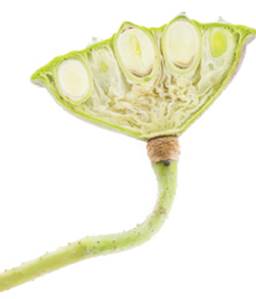
PENDUCLE/RECEPTACLE (flower stalk with receptacle)/lian fang
The flower stalk (lian fang) is used in Chinese medicine to disperse congealed blood and stop internal bleeding from gastric ulcers, abnormally heavy periods, blood in the stool, or post-partum haemorrhage.
STAMENS/lian xu
The stamens (lian xu) are believed in Chinese medicine to act on the heart and kidney.
SEED/lian zi
In China, the seeds (lian zi) are used as a tonic for the spleen and stomach to combat diarrhea and stimulate the appetite. They are a kidney tonic and act as a calming sedative for insomnia and palpitations. In India the seeds are taken in powder format with rice as a tonic for the heart and reproductive organs. They are believed to help the heart chakra and to encourage devotion, aspiration and concentration, as well as improve speech and help reduce stammering.
SEED PLUMULE & RADICLE/lian zi xin
The plumules and radicles (lian zi xin) from the seeds are specifically used to “sedate the fire of the heart.”
LEAVES/he ye & LEAF STEM/lian geng
The leaves (he ye) and leaf stems (lian geng) are mainly used in Chinese medicine as a cooling remedy for fevers associated with “summer heat.” They are given as a spleen tonic for weaknesses associated diarrhea and upsets following summer fevers.
APPLICATIONS
Leaves and Leaf stem
Infusion: Take a cup three times daily for summer colds and fevers.
Wash: Use as a wash to bathe the forehead and body in fevers.
Seed
Powder/capsules: Take 1–2 x 200 mg capsules or half a teaspoon of powder stirred into water as a tonic for heart and kidneys. In India, the same mix is used to strengthen the heart chakra and encourage devotion, aspiration, and concentration, as well as improve speech and help reduce stammering.
Decoction: Combine with dang shen and goldenseal for insomnia, palpitations, irritability, and urinary dysfunction associated with kidney and heart energy weakness.
Rhizome node
Tincture: Soak a swab in the tincture and use as a plug for nosebleeds.
Decoction: Combine with sheng di huang and elecampane for bronchitis and congestive coughs with blood streaked phlegm; seek professional help if symptoms continue for more than 24 hours.
Juice: Use 10 ml the fresh juice for blood in the urine or heavy periods, three times daily.
Penduncle/receptacle/flower stalk
Infusion: Combine with motherwort for heavy menstrual bleeding and irregularity; with shepherd’s purse for cystitis with blood in the urine.
Tincture: Use as the infusion.
CAUTIONS:
• Avoid in constipation.