
Zdenka Ulcova-Gallova1 and Petr Losan2
(1)
Reproductive Immunology and Gynecology, Genetics-Pilsen, and Department of Gynecology and Obstetrics of Medical Faculty of Charles University Pilsen, Parkova 1254/IIA, Pilsen, 326 00, Czech Republic
(2)
Genetics-Pilsen, Gynecology, Pilsen, Parkova 1254/IIA, Pilsen, 326 00, Czech Republic
Zdenka Ulcova-Gallova (Corresponding author)
Email: ulcova-gallova@email.cz
URL: http://www.ulcovagallova.cz
Petr Losan
Email: losan@genetika-plzen.cz
Abstract
Autoimmune and/or isoimmune infertility can be caused also by sperm antibodies, which are able to stop in vitro and in vivo sperm progressive penetration needed for fertility. This chapter covers all aspects concerning male and female antibody and cellular immunological disorders to spermatozoa complicating human fertility, and possible ways of the treatment. Regarding the incidence of sperm antibodies in an infertile population, which is 9 % of the men and 15 % of the women, it is necessary to define significant sperm antigens for desensitization of immunological infertility and/or for development of contraceptive treatment.
14.1 Introduction
Many different factors may cause human infertility, which is a serious problem for many people (about 15–20 %) wishing to have children. Impairment of semen quality in men, anovulation, endometriosis, as well as adhesions inside and outside Fallopian tubes, sperm, zona pellucida antibodies, antiphospholipid antibodies, and other immunological factors in women are frequent causes of decreased fertility. The presence of antibodies to spermatozoa (ASA) in men as well as in women is also considered an immunological problem of conception. High titers of ASA in serum, seminal plasma, or in ovulatory cervical mucus are associated with fertilization failure, and markedly reduce the likelihood of natural conception.
Sperm have been known to be antigenic for more than a century. The presence of ASA has long been suggested since the antigenicity of spermatozoa was first demonstrated by Landsteiner and Metchnikoff in 1899 [1, 2]. Positive levels of human ASA were first reported in 1969 when Fjallbrant [3] demonstrated that antibodies obtained either from infertile patients or from immunized rabbits were able to produce agglutination and thereby to block in vitro penetration of human spermatozoa into female cervical mucus. The principle of sperm agglutination depends on specificity of sperm antibody to sperm antigen coating sperm head, or midpiece, tail, or tail tip.
The immune response against sperm cells (spermatozoa) is genetically determined [4]. ASA occur in both men and women, and also in homosexual men [5]. It is supposed that testicular trauma (e.g., biopsy, torsion, accident during sports activity), varicocele, testicular cancer, infection such as orchitis during mumps, and vasectomy are associated with autoimmunity to spermatozoa in up to 70 % of men [6]. The majority of cases of sperm autoimmunity is spontaneous and idiopathic. Rational access for the origin of autoimmune ASA in men is the disturbance of hematotesticular barrier. In infertile women, ascendent and frequent isoimmunization during long lasting, unprotected coital experience is suspected.
Seminal plasma, as a natural medium for spermatozoa has many immunological properties influencing the fertilization capacity of reproductive cells. In the past, clinical significance of ASA in human infertility was supported by many investigators and authors [7–16].
14.2 Influences of ASA on Infertility Prognosis
The most valuable sign for infertility prognosis appears to be the local ASA activity (in seminal plasma in men, in cervical ovulatory mucus, endometrial, peritoneal, and follicular fluids in women). Our daily experience [17] shows that infertile women are able to produce local immune response to spermatozoa more often and more earlier than in serum. Their systemic reaction as ASA activity is proven later and, from that point, ASA are detected in both ovulatory cervical mucus and serum.
Generally, high titers of ASA are able to block initial stages of the reproductive process. Infertile patients with immunological cause are less likely to conceive because in some the ASA not only interfere with sperm migration, but also inhibit the fertilization process at various stages, and exhibit negative effect on the early embryo development. ASA can affect the mechanisms of transport of spermatozoa within the female genital tract, may alter sperm capacitation or acrosome reaction, can interfere with egg fertilization, or have postfertilization effects on the zygote and preimplantation embryo [18–26].
The reason for the investigation of ASA is to determine clinically significant sperm antibody titers and to estimate their role in iso-/autoimmune reactions leading to infertility. The levels of ASA also depend on character of spermiogrammes. We noticed the relationship between sperm antibodies in seminal plasma and with proteins of acute phase of inflammation [7]. Sperm-agglutinating antibodies are much more frequent in IgG and IgA class in seminal plasma and in IgG, as well as in IgM and IgE in sera. Interindividual findings of seminal levels of lactoferrin, albumin, C3, and C4 were reported [6, 7]. Secretory immunity plays important role in male infertility. Infertile men have significantly higher levels of lysosyme, C3, alpha-1-antitrypsin, alpha-2-macroglobulin, and beta-2-microglobulin in their seminal plasma. Immunological changes in seminal plasma caused by local inflammatory reactions and characterized especially by the presence of ASA or pathological levels of seminal proteins in acute phase of inflammation decrease sperm function. Contemporary trends in andrology also clarify pathology of acrosomal functions [14].
As reported earlier [15], ASA effectively block fertilization. Some mechanisms, such as the inhibition of sperm binding because of sperm agglutination, sperm immobilization or cytotoxic reaction, the inhibition of sperm penetration through the zona pellucida, and the fusion of the sperm plasma membrane with the vitelline membrane of the oocyte, have been described. ASA may block implantation or inhibit the development of early embryos [27–33].
14.3 Recent Research of the Cellular Reactivity of Peripheral Blood Mononuclear Cells (PBMCs) of Infertile Women, to Sperm Cells or Sperm Cell Lysate
We compared the cytokine response of peripheral blood mononuclear cells (PBMCs) from infertile female patients with or without ASA and healthy fertile women and teenage virgins (virgo intacta) [34]. We screened the supernatants for 40 cytokines by antibody array after cultivation of the PBMCs together with sperm antigens (whole cells or cell lysate). When stimulated with whole sperm cells, the PBMCs from patients with ASA produce less IL-3, IL-11, IL-13, ICAM-1, and GCSF and more IL-2, IL-4, and IL-12p70 as compared to healthy women. PBMCs from patients with ASA produce typically less IL-13, IL-7, IL-17, and MIG, and more MIP-1β and IL-8, compared to PBMCs from patients without ASA. In response to sperm cell lysate, PBMCs from infertile women without ASA respond initially by increase in production of growth factors (GCSF, GM-CSF, and PDGF-BB) followed by increase in chemokines (e.g., IL-8, MCP-1, and MIP-1β).
As compared to antigen-specific humoral immune response, the specific cellular immune responses to sperm cells or sperm antigens in humans is only rarely investigated [34, 35]. The interaction between T, B, and natural killer cells determine if the embryo is accepted or rejected [36]. The result of immune response to the sperm antigens is greatly influenced by cytokine environment at the time when immunocompetent cell encounters the antigen. Besides this crucial immunomodulatory function, cytokines are very important in implantation and embryo development. The disturbance in cytokine environment could thus play a significant role in mechanisms of the immune-mediated infertility either by disturbing the balance of immune system regulation or by directly interfering with fertilization process and early embryo development. Understanding the cytokine function during reproduction is also complicated by the pleiotropy and redundancy of cytokine action and by the fact that overall cytokine environment mediates the effects of individual cytokines.
We found that sperm antigens influence the cytokine response in infertile women with ASA differently, as compared to fertile women, or to infertile women without ASA. These changes were in cytokines characteristic for distinct functional T cell subsets, including typical Th1-type (IL-2), Th2- or NK-T-type (IL-4 and IL-13), and Th17-type (IL-17) cytokines. Moreover, we found changes in proinflammatory cytokines and chemokines (e.g., eotaxins, MIPs, IL-8, IL-12p70, and TNF-α), and in growth factors (e.g., IL-7, GCSF, and GM-CSF). These pronounced changes suggest quite extensive dysregulation of immune response to sperm in infertile women involving several types of cells, and indicate the involvement of several pathogenic mechanisms including enhancement of the immune reactivity with slight shift towards Th2-type of response and lag of the embryo implantation and its growth.
The increase in IL-2 and IL-4 production by whole sperm cells-stimulated PBMCs of infertile patients with ASA, as compared to controls, could create the environment that leads to generation of Th2-type of response resulting in antibody production. This change could be the basis of the main pathogenic feature – ASA. PBMCs from infertile women with ASA produce less IL-11 early upon stimulation with sperm cells as compared to healthy women. IL-11 is a pleiotropic cytokine from the IL-6 family that stimulates hematopoiesis and has an important role in embryo implantation [36, 37].
Decreased production of ICAM-1 by PBMCs of infertile women with ASA as compared to healthy controls is of particular interest, suggesting more complex interplay of factors involved in diapedesis. ICAM-1 is a glycoprotein expressed on the surface of several cell types, including leukocytes and endothelial cells, that binds to the lymphocyte function-associated antigen-1 (LFA-1), expressed on leukocytes, thus mediating leukocyte extravasation and interaction. High levels of soluble (s) ICAM-1, a shedding form of ICAM-1, can disturb the adhesions that occur between immune cells and their targets and thereby prevent an immunological reaction. Therefore, its low production by PBMCs from patients with ASA could result in higher ability of reactive leukocyte to exit the blood stream and initiate the immune response in tissues, resulting in shift towards inflammation.
PBMCs from our patients with ASA produce less IL-13 and more IL-12 after their cultivation with sperm cells, as compared to healthy controls. As a key inducer of Th1-type inflammatory responses, IL-12 is involved in autoimmune tissue destruction. IL-13, on the other hand, is described as an anti-inflammatory cytokine, which inhibits the production of inflammatory cytokines by LPS-activated macrophages [38]. This change in patients with ASA could result in deregulated inflammation with subsequent infertility. Moreover, decrease in IL-13 could be also lead to impairment in angiogenesis.
There is a striking difference in cytokine response to sperm cell by PBMCs from infertile patients with ASA as compared to those from patients without ASA. When we compared cytokine spectra between both groups of infertile patients, we found that, e.g., IL-13, IL-7, IL-17, and MIG are higher in patients without ASA, and IL-8 and MIP-1β are higher in patients with ASA. This suggests that these forms of infertility differ in antigen-specific immune response to sperm cells not only on humoral but also on cellular level.
PBMCs from infertile patients without ASA produce significantly higher amounts of IL-7 after their cultivation with whole sperm cells-antigen, as compared to either unstimulated or sperm cell lysate-stimulated PBMCs. The role of IL-7 in the physiological reproduction is not well documented; it believes that due to its general growth promoting activities it stimulates folliculogenesis during in vitro fertilization [35–37]. Its high production by PBMCs from infertile patients without ASA could lead to more aggressive cellular response in these patients, which can compensate for the lack of above-mentioned pathogenetic role of ASA in these women. We found the response to whole sperm cells is generally less diverse than response to sperm cell lysate. These antigens induce high production of IL-8, MCP-1, TNF-α, and MIP-1β, but not IL-7, as compared to either nonstimulated or whole sperm-stimulated PBMCs, which corresponds to protective immune response. These differences also point out the differences between the response to extracellular and to intracellular antigens.
There are several mechanisms involved in immune response to sperm cells in infertile women with ASA, and the presence of ASA is only one of them. We described PBMCs from infertile women with ASA producing different cytokines when encountering sperm cells, as compared to healthy controls. This type of cytokine response could contribute to proinflammatory environment, Th2 favorable conditions, or impairment of angiogenesis leading to infertility. Some of these cytokines could influence the cell proliferation and recruitment or participate in the sperm cell-specific immune response. We showed that cellular response to sperm cells is different in infertility with and without ASA, suggesting that cellular response differs between these two types of infertility. The dysregulation of the immune response with shift towards Th2-type of response suggest how the initial disturbance in cellular immune response could result in ASA.
14.4 Recent Research of Female Patient’s Immunoglobulin Reaction to Seminal Antigens
Semen is defined as a complex fluid containing sperm cells, cellular vesicles, enzymes, ions, proteins, peptides, hormones, cytokines, and other cells migrating leucocytes or spermatogenic cells [6, 7, 38, 39]. Each component could immunize the female genital tract.
We focused on the characterization of seminal proteins to illustrate the IgG, IgA, and IgE immune responses of 31 infertile women. The biochemical characterization was performed by one-dimensional sodium dodecyl sulphate polyacrylamide gel electrophoresis and isoelectric focusing, both of which were followed by immunoblotting analyses. IgG mainly recognized the antigens with relative molecular masses (Mr) 95 and 183 kDa and isoelectric points ranging from 6.9 to 7.0. The immunodominant antigens recognized by IgA had 35 kDa and isoelectric points ranging from 6.2 to 7.2. The reactivity of IgE was not confirmed within our group of patients. The seminal IgG- and IgA-binding patterns were analyzed immunochemically to determine the characteristics of possible seminal proteins associated with female immune infertility [39, 40].
14.5 Coitus Condomatus and Steroid Treatment of Patients with ASA
Recent evidence and simple field experience suggest that immunocompetent cells in immunological anti-sperm mechanisms could be influenced by condom blocking effect, by oral corticosteroids [17, 41–49], by local hydrocortisone application to ectocervix [17], or by plasmapheresis [49]. One of our earlier studies [49] showed good therapeutic effect of oral prednisone in infertile men with ASA in seminal plasma. It succeeded to reduce sperm-agglutinating levels in seminal plasma. Treatment scheme of oral prednisone adopted in 19 selected patients with high titers of ASA in seminal plasma only was as follows: prednisone at dose 20 mg (in the morning) − 20 mg (at noon) − 20 mg (in the evening) daily for the first week, 20-10-10 mg for the second week, 15-10-5 mg for the third week, 10-5-5 mg for a fourth and fifth weeks, 5-5-5 mg for the sixth and seventh weeks, 5-5-0 mg for the 8th–12th weeks. The levels of sperm-agglutinating antibodies estimated by direct MAR-test (mixed anti-immunoglobulin reaction test) in IgG, sIgA, IgM, and IgE before the prednisone treatment, and after 2, 4, and 6 weeks during the above-mentioned scheme of therapy are shown in Fig. 14.1. Individual decrease of ASA level is well recognizable after 6 weeks of the treatment. Patients JK1, JH, PK, JK3, and FR became fathers. Reduction in activity and levels of ASA was observed especially in immunoglobulin class A and G. The dynamics of seminal ASA as mean values of MAR tests can be also seen in Fig. 14.1. After 6 weeks of prednisone treatment, individual sensibility to corticosteroids was observed. In 10 patients, ASA were not detected any more in any of the patients, the wives of patients JK1, JH, JK3 became pregnant by the end of their husband’s treatment, and the wives of PK and FR became pregnant within 6 months. Impact of immunosuppressive treatment of immunocompetent cells creating ASA is evident from the fertility outcome.
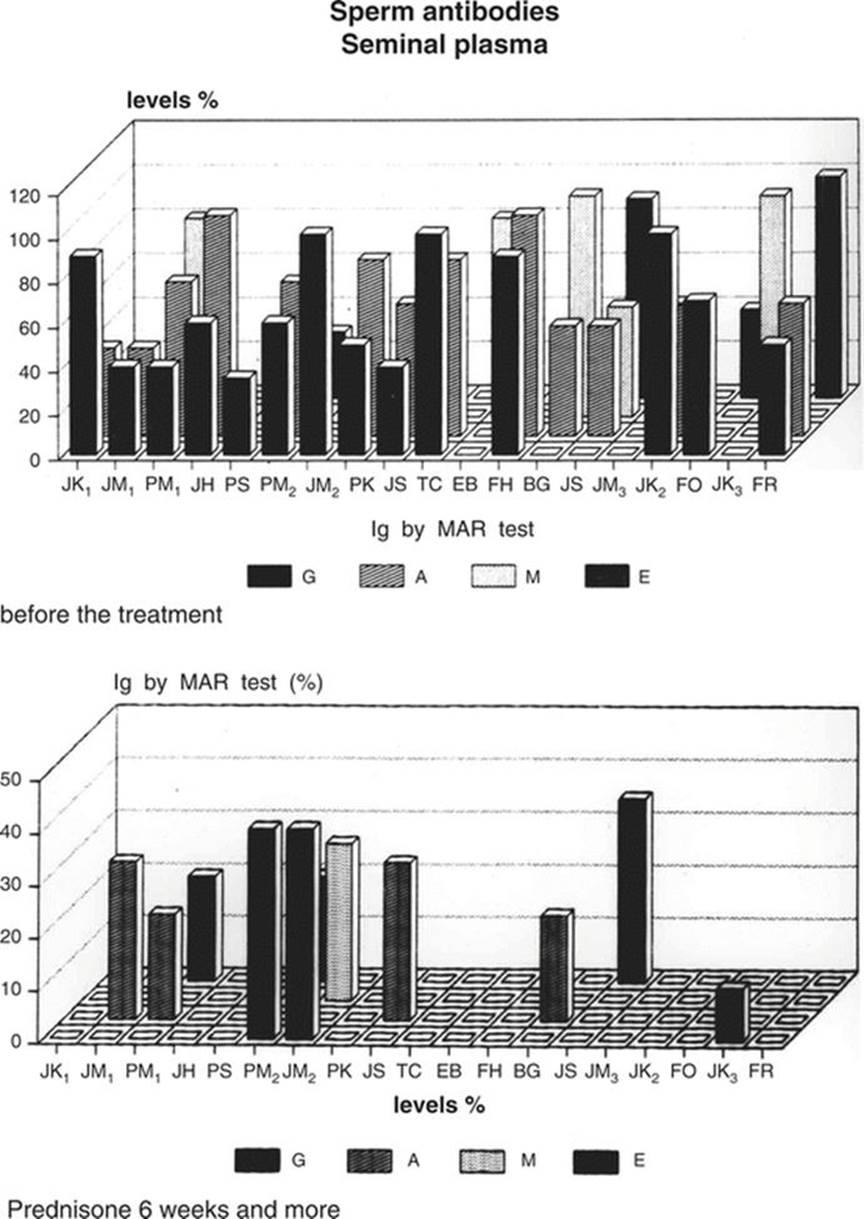
Fig. 14.1
The effect of prednisone on immunocompetent cells in men with positive sperm-agglutinating antibodies in seminal plasma
Increased pregnancy rate after various schemes of prednisone dosages is referred between 11 and 56 % [41–49]. At every consultation of our patients, blood pressure was measured and anamnestic data were screened. No unwanted systemic effects were registered during the oral prednisone treatment, although some nonspecific side effects such as aseptic necrosis hip, exacerbation of incipient duodenal ulcers, or cardiovascular effects were described [43, 44].
Highly individualized sensitivity and mechanisms responsible for the influence of immunocompetent cells producing ASA are supposed to exist. In treated patients, we monitored the ASA in seminal plasma three times during the corticosteroid therapy. When pregnancy is not observed in time of the husband’s treatment, in vitro fertilization (IVF) is planned, as a logical way in long lasting “unexplained” infertility, in three stimulated ovulations of their wives. Our experience shows that in some men better treatment is the parenteral administration of corticosteroids timed 24 or 12 h (depending on the levels of ASA) before the collection of semen for IVF.
As we know, ASA impair sperm transport within the female genital tract. Sperm penetration and progressive motility through cervical mucus are stopped or decreased [6, 8, 12, 50]. When all sperm cells are coated with antibodies, the cervical ovulatory mucus has no motile spermatozoa [24, 48]. ASA are detected not only in semen, but also in ovulatory cervical mucus owing to ascendent female immunization by sperm antigens. IgG and/or IgA have been found in the cervix uteri [15, 17, 24, 33]. Sperm head directed antibodies, mainly those in IgA class, and/or IgA and IgG class antibodies directed against antigens on the principal piece of the sperm tail severely impair the ability of spermatozoa to penetrate mucus [24, 48]. In the second mechanism of sperm transport impairment, complement-mediated IgG and/or IgM antibodies are able to activate the complement cascade, which results in target cell lysis [8]. Complement-mediated sperm immobilization within cervical mucus does not act immediately after sperm penetration into the cervical mucus, but requires 4–8 h. High decrease of sperm immobilization was observed in IgG. Practically all antibodies that are formed against sperm are designed to immobilize them.
The next mechanism of interference with fertilization by ASA acts via antibody dependent cell-mediated cytotoxicity [22, 26], which impairs the process of capacitation (calcium dependent biochemical and structural changes, namely acrosomal reaction – exposure of enzymes as acrosin, trypsin like proteinase, and hyaluronidase allowing contact with egg plasma membrane) [14, 41]. Sperm-egg interaction could be also influenced by the attack of ASA, which can alter fertilization by affecting the ability of spermatozoa to bind to the zona pellucida as well as to the egg plasma membrane. The evidence suggests that ASA may interfere with sperm recognition of the zona pellucida in humans (see also [4]. The isotypes of ASA bound to the head may be important in determining the degree of impairment of sperm-zona pellucida binding. It was found [26] that IgA sperm antibodies were more inhibitory than IgG. Mahoney et al. [27] found that antibodies directed against the sperm head can affect zona binding, but not in every case. This suggests that impairment of zona pellucida binding depends on the antigens against which antibodies are directed, that is, whether they are the functional epitopes of a zona receptor ligand.
14.6 ASA Influences on Pregnancy Rate
The presence of ASA in the IVF culture medium results in an impairment of fertilization. Immunoglobulins of the IgA class appeared to be more effective in impairing fertilization than IgG. More critical examination of the results of IVF in women with isoimmunity to sperm revealed both diminished fertilization rate and diminished embryonic cleavage rate, and reduced chance of pregnancy as shown by the study of Vasquez-Levin [25]. On the other hand, significant pregnancy rates can be achieved despite the presence of ASA. These antibodies cannot be eliminated from the egg by washing. Pagidas et al. [31] claimed that IVF is not significantly affected by the presence of ASA in female sera used to supplement the culture media or by antibodies bound to inseminated sperm. Inhibition of IVF fertilization may be caused by a synergistic effect of IgG and/or IgA classes of ASA. In IVF trials, other authors did not find any differences between antibody positivity and antibody negativity in the outcome of the IVF embryo transfer attempt [28].
Menge and Naz [9] suggested three mechanisms by which ASA can affect embryo survival. The first mechanism consists of the possibility that sperm surface antigens are incorporated into the zygotic membrane at fertilization. Fertilization involves the possibility of sperm made oolemma plasma membranes moving to a mixture of antigens. The second mechanism proposed is that similar epitopes are present on spermatozoa and embryos. Several common antigens have been found. The last proposed mechanism to account for postfertilization reproductive loss mediated by ASA is via an indirect effect of antibodies on embryo development.
A woman whose partner has ASA following a vasectomy, inflammation process, or testicular tumors often produces also ASA [10, 16, 29]. In humans, clinical evidence of an association between early pregnancy loss and immunity to sperm is not definitively clear. Approximately 15 % of women produce antibodies to sperm in the cervical mucus and in the blood. Over 50 % of men with low sperm motility have been found to carry these antibodies in semen plasma and in serum. Sperm cells have unique surface antigens that elicit an immune response.
Beer also speculated [10] about the rising incidence of ASA in women. It may be due to delaying pregnancy until late in life, by which time they will probably have had several sexual relationships. This increases the risk of immune sensitization. If ASA in woman are present that agglutinate and/or immobilize partner’s sperm and those from any sperm donor, we consider non partner-specific ASA. Beer studied [10] ASA levels in over 100 prostitutes and compared them with those of 40 age-matched women. More than 40 % of prostitutes had ASA compared with just 5 % among the control group. Over 60 % of these women who had never used any form of contraception became infertile within 9 years.
The same author also observed [10] that ASA can be associated with antibodies to phospholipids. They are strong indication that the woman will have anti-DNA antibodies in addition to elevated levels of circulating natural killer cells and CD19+/5+ B-cells that produce the ASA. Such a problem can manifest itself as repeated IVF failure where embryo is implanted, but later it leads to very early miscarriage. Immunotherapy is an effective way of treating women with antibodies to sperm who experience this problem. A number of autoimmune and/or isoimmune conditions of the reproductive system are associated with poor fertility. Several topics [13, 23] have described the relationship between ASA and pregnancy prognosis. Also allergies to heavy metals can negatively influence reproduction, because in sensitive persons they are able to alter the immune reactions including production of autoantibodies. The altered immune reaction can then cause infertility. In patients with metal intolerance diagnosed by the MELISA test, the release of metal ions from dental materials can be one of the stimulating factors which may adversely affect fertility [11]. An Italian group [50] studied the presence of ASA in 190 patients with testicular cancer 1 month after orchiectomy and before radiotherapy or chemotherapy. The results support the hypothesis that testicular cancer is not a cause of ASA and infertility. Marconi et al. [29] did not find any relationship between ASA detected by mixed agglutination reaction or immunobead test and chronic inflammation and infection of the seminal tract.
14.7 ASA and Pathology Such as Azoospermia and Severe Oligospermia
Presence of sperm antibodies connected or not connected with pathology in semen such as azoospermia and severe oligospermia (oligoasthenospermia) is a reason to make examination of genetic causes of male infertility. Our genetic laboratory investigates karyotype, on an exclusion of Y chromosome microdeletions in AZF area, and on exclusion of mutations in the CFTR gene. If chromosomal aberrations and DNA mutations in our patients are found, their offsprings will be at an increased risk of transmitting genetic alterations. We recommend to perform preimplantation genetic diagnosis (PGD) to select embryos without genetic changes. Nowadays, the most commonly used method PGD/PGS (preimplantation genetic screening) includes the examination of cells of trophectoderm of early embryo, which is taken on the fourth to fifth days of the development stage of blastocyst in vitro. DNA isolation from trophectoderm follows. The VeriSeq PGS Kit offers a highly sensitive screening of all 24 chromosomes for selection of euploid embryos. We exclude by the VeriSEq PGS method both numerous and extensive structural aberrations, but also to detect microdeletions and microduplications. If genetic cause in male patient exists we use sperm cells from healthy and anonymous donor without ASA. The examination of ASA in donors is required.
In men with severe obstructive oligospermia and/or azoospermia, we use the surgical sperm retrieval option such as microsurgical epididymal sperm aspiration (MESA), testicular sperm aspiration (TESA), or percutaneous sperm aspiration (PESA).
Conclusion
In earlier reports, an incidence of ASA in an infertile population is 9 % of the men and 15 % of the women was published [41]. ASA play an important role in the etiology of immune infertility. Circulating and local ASA may be markers for disorders of the reactivity of the immune system and may be involved in iso- and autoimmune process. ASA testing is important in cases with explained or unexplained infertility, but without pregnancy success in repeated procedures of IVF. Today effort is necessary to define sperm antigens with significance for fertility. The association of the ASA with infertility demands their detection and couples with these immunological findings have to be treated appropriately. As these antibodies can induce infertility, they have the potential to induce the development for contraceptive purposes in humans [49].
Acknowledgment
This work was supported by the Charles University Research Fund (project number P36).
References
1.
Landsteiner K (1899) Zur Kenntnis der spezifisch auf Blutkoprochen wirkenden Sera. Zbl bakt 25:546–551
2.
Metchnikoff S (1900) Etudes sur la spermatoxine. Ann Inst Pasteur 14:561–577
3.
Fjallbrant B (1969) Cervical mucus penetration by human spermatozoa treated with anti-spermatozoal antibodies from rabbit and man. Acta Obstet Gynecol Scand 48:71–77CrossRefPubMed
4.
O’Rand MG (1977) The presence of sperm specific isoantigens on the egg following fertilization. J Exp Zool 202:267–293CrossRefPubMed
5.
Wolf H, Schill WB (1985) Antisperm antibodies in infertile and homosexual men; relationship to serologic and clinical findings. Fertil Steril 44:673–677CrossRef
6.
Shulman S, Bronson P (1969) Immunochemical studies on human seminal plasma. J Reprod Fertil 18:481–491CrossRefPubMed
7.
Ulcova-Gallova Z (1997) Immunological findings in seminal plasma from men of infertile couples. Andrologia 2:5–9
8.
Isojima S, Tsuchiya K, Koyama K, Tahala C, Naka O, Adachi H (1972) Further studies on sperm-immobilizing antibody found in sera of unexplained cases of sterility in women. Am J Obstet Gynecol 112(2):199–207CrossRefPubMed
9.
Menge AC, Naz RK (1988) Immunologic reactions involving sperm cells and preimplantation embryo. Am J Reprod Immunol Microbiol 18:17–20CrossRefPubMed
10.
Beer AE, Kantecki J, Reed J (2006) Is your body baby-friendly? Independent Pub Group, Paperback, pp 1–483
11.
Podzimek S, Prochazkova J, Bultasova L, Bartova J, Ulcova-Gallova Z, Mrklas L, Stejskal VD (2005) Sensitization to inorganic mercury could be a risk factor for infertility. Neuro Endocrinol Lett 26:277–282PubMed
12.
Bronson RA, Fusi FF (1995) The reproductive immunology of fertilization failure. Assist Reprod Rev 5:14–25
13.
Eggert-Kruse W, Christmann M, Bernard I, Pohl S, Klina K, Runnebaum B (1989) Circulating antisperm antibodies and fertility prognosis: prospective study. Hum Reprod 4:513–520PubMed
14.
Peknicova J, Chladek D, Hozak P (2005) Monoclonal antibodies against sperm intra-acrosomal antigens as markers for male infertility diagnostics and estimation of spermatogenesis. Am J Reprod Immunol 53(1):42–49CrossRefPubMed
15.
Bronson RA, Cooper GW, Rosenfeld D (1984) Sperm antibodies: their role in infertility. Fertil Steril 42:171–175CrossRefPubMed
16.
Alexander NJ, Anderson DJ (1979) Vasectomy: consequences of autoimmunity to sperm antigens. Fertil Steril 32:253–259CrossRefPubMed
17.
Ulcova-Gallova Z, Mraz L, Planickova E, Macku F, Ulc I (1990) Three years experience with local hydrocortisone treatment in women with immunological cause of infertility. Ztrb fur Gynacol 112:867–873
18.
Alexander NJ (1984) Antibodies to human spermatozoa impede sperm penetration of cervical mucus or hamster eggs. Fertil Steril 41:433–439CrossRefPubMed
19.
Chamley LW, Clarke GN (2007) Antisperm antibodies and conception. Semin Immunopathol 29(2):169–184CrossRefPubMed
20.
Mathur S, Baker ER, Williamson HO (1981) Clinical significance of sperm antibodies in infertility. Fertil Steril 36:486–495CrossRefPubMed
21.
Jung SM, Matson PL, Yovich JM, Yovich TJ (1986) The fertilization of human oocytes by spermatozoa from men with antispermatozoal antibodies in semen. J In Vitro Fertil Embryo Transf 3:350–357CrossRef
22.
D’Cruz OJ, Haas GG Jr (1995) Beta2 integrin (C11b/CD18) is the primary adhesive glycoprotein komplex involved in neutrophil-mediated immune injury to human sperm. Biol Reprod 53:1118–1130CrossRefPubMed
23.
Kobayashi S, Bessho T, Shigeta M, Koyama K, Isojima S (1990) Correlation between quantitative antibody titers of sperm immobilizing antibodies and pregnancy rates by treatment. Fertil Steril 54:1107–1113CrossRefPubMed
24.
Kremer J, Jager S (1980) Characteristics of anti-spermatozoal antibodies responsible for the shaking phenomena with special regard to immunoglobulin classe and antigen- reactive sites. Int J Androl 3:143–152CrossRefPubMed
25.
Vasquez-Levin M, Kaplan P, Guzan I, Grunfeld L, Garrisi GJ, Navot D (1991) The effect of female antisperm antibodies on in vitro fertilization, early embryonic development and pregnancy outcome. Fertil Steril 56:84–90CrossRef
26.
Tsukui S, Noda Y, Yano J, Fukuda A, Mori T (1986) Inhibition of sperm penetration through human zona pellucida by antisperm antibodies. Fertil Steril 46:92–96CrossRefPubMed
27.
Mahoney MC, Alexander NJ, Bronson RA (1991) Inhibition of human sperm -zona pellucida tight binding in the presence of antisperm antibody positive polyclonal patient sera. J Reprod Immunol 19:287–291CrossRef
28.
Sukcharoen N, Keith J (1995) The effect of the antisperm autoantibody-bound sperm on in vitro fertilization outcome. Andrologia 27:281–289CrossRefPubMed
29.
Marconi M, Nowotny A, Pantke P, Diemer T, Weidner W (2008) Antisperm antibodies detected by mixed agglutination reaction and immunobead test are not associated with chronic inflammation and infection of the seminal tract. Andrologia 40(4):227–234CrossRefPubMed
30.
Nakov LS (1998) Genetics of the immune response against sperm antigens. Centr Eur J Immunol 2:16–24
31.
Pagidas K, Hemmings R, Falkone T, Miron P (1994) The effect of antisperm auto antibodies in male or in female partners undergoing in vitro fertilization-embryo transfer. Fertil Steril 62:363–369CrossRefPubMed
32.
Rumke P (1954) The presence of sperm antibodies in the serum of two patients with oligozoospermia. Vox Sang 4:135–140
33.
Wang C, Gordon Baker HW, Jennins MG, Burger HG, Lutjen P (1985) Interaction between human cervical mucus and sperm surface antibodies. Fertil Steril 44:484–488CrossRefPubMed
34.
Kverka M, Ulcova-Gallova Z, Bartova J, Bibkova K, Micanova Z, Tlaskalova-Hogenova H (2012) Sperm C induce distinct cztokine response in peripheral mononuclear cells from infertile women with serum anti-sperm antibodies. PLoS One 7(8):1–6CrossRef
35.
McShane PM, Schiff I, Trentham DE (1985) Cellular immunity to sperm in infertile women. JAMA 253:3555CrossRefPubMed
36.
Chaouat G, Dubanchet S, Ledee N (2007) Cytokines: important for implantation? J Assist Reprod Genet 24:491–505CrossRefPubMedPubMedCentral
37.
Ostanin AA, Aizikovich BI, Aizikovich IV, Kozhin AY, Chernykh ER (2007) Role of cytokines in the regulation of reproductive function. Bull Exp Biol Med 143:75–79CrossRefPubMed
38.
Rodriguez-Martinez H, Kvist U, Ernerudh J, Sanz L, Calvete JJ (2011) Seminal plasma proteins: what role do they play? Am J Reprod Immunol 66:11–22CrossRefPubMed
39.
Brazdova A, Zidkova J, Senechal H, Peltre G, Cibulka J, Ulcova-Gallova Z (2012) Female serum immunoglobulins G, A, E and their immunological reactions to seminal fluid antigens. Folia Biol (Praha) 58(6):251–255
40.
Brazdova A, Vermachova M, Zidkova J, Senechal H, Poncet P, Ulcova-Gallova Z, Peltre G (2013) Immunodominant semen proteins II: contribution of seminal proteins to female immune infertility. Folia Biol (Praha) 59(5):198–203
41.
Shulman S (1972) Immunological barrier to fertility. Obstet Gynecol Survey 27:553–606CrossRef
42.
D’Almeida M, Soufir JC (1977) Corticosteroid therapy for male with autoimmune infertility. Lancet 2:815–821CrossRef
43.
Shulman S, Harlin B, Davis P, Reyniak JV (1978) Immune infertility and new approaches to treatment. Lancet 1:309–319
44.
Shulman S, Shulman J (1982) Methylprednisolone treatment of immunologic infertility in male. Fertil Steril 38:5–12CrossRef
45.
Hendry WF, Stedronska J, Hughes L (1979) Steroid treatment of male subfertility caused by antisperm antibodies. Lancet 1:498–502CrossRef
46.
Alexander JN, Sampson JH, Fugham DL (1983) Pregnancy rates in patients treated for antisperm antibodies with prednison. Int J Fertil 28:63–66PubMed
47.
Ulcova-Gallova Z, Mardesic T (1994) Effect of prednisone therapy on infertile men with spermantibodies in seminal plasma. Andrologia 2:7–13
48.
Ulcova-Gallova Z, Opatrny K, Krauz V, Panzner P, Zavazal V (1990) Plasmapheresis – a new therapeutic method of immunological infertility. Cas Lek Ces 129:104–112
49.
Yanagimachi R (1988) Sperm-egg vision. Curr Top Membr Transport 32:3–43CrossRef
50.
Paoli D, Gilio B, Piroli E, Gallo M, Lombardo F, Dondero F, Lenzi A, Gandini L (2008) Testicular tumors as a possible cause of antisperm autoimmune response. Fertil Steril 25:123–134