
Walter K. H. Krause1
(1)
Department of Dermatology and Allergology, Philipp University, Marburg, 35033, Germany
Walter K. H. Krause
Email: krause@med.uni-marburg.de
Abstract
Antisperm antibodies (ASA) may interfere with different steps of the fertilization process. The dysfunction evolving depends on the cognate antigens of the ASA. The usual technique for their identification is 2D-Western blot and MALDI protein analysis. A great variety of antigens are responsible for sperm agglutination, sperm apoptosis and inhibition of sperm motility. Impairment of migration in the cervix mucus appears mostly to be independent from the cognate antigens of ASA, but to be a consequence complement activation and cell lysis. Influences of ASA on acrosome reaction reveal a special problem, since a large variety of cognate antigen are liberated only after acrosome reaction. The cognate antigens of ASA inhibiting zona binding and oolemma binding are the most promising structures for immunocontraception. Also pronucleus formation may be influenced by ASA, but the clinical relevance of the antigens involved remains unclear.
Identification of cognate antigens of ASA has a number of practical consequences: (i) ASA inhibiting the fertilization process may be identified by an ELISA or a RIA using specific proteins or peptides; (ii) the identification of functionally relevant antigens is a prerequisite for treatment options; (iii) the identification of immunogenic proteins facilitates studies on immune contraception.
An overview over the sperm antigens involved in the steps of the fertilization process which were identified as cognate antigens of ASA gives Table 4.1. They are further reviewed in the following chapters.
Table 4.1
Defined antigens of naturally occurring human ASA
|
Antigen |
Localization |
Source of ASA |
Effect of ASA |
Authors |
|
Acrosin |
Acrosome |
Infertile women |
Inhibition of acrosin effects |
Veaute et al. (2009) [58] |
|
ACTL7a |
Acrosome |
Vasectomized men |
Agglutination |
Fu et al. (2012) [22] |
|
Calpastatin |
Acrosomal region, partly flagellum |
Infertile women |
Inhibition of hamster-oocyte penetration, no inhibition of motility, agglutination |
Koide et al. (2000) [31] |
|
Caspase 3 |
Sperm surface |
Seminal fluid |
Induction of apoptosis |
Bohring et al. (2001a) [8] |
|
Catsper1 |
Sperm surface |
Experimentally |
Agglutination, motility |
Li et al. (2012) [38] |
|
Clathrin, heavy chain |
Sperm tail |
Female patient with lupus erythemasus |
Agglutination |
Domagala et al. (2011) [18] |
|
CD52 |
Sperm surface, inserted into the sperm membrane during the epididymal passage |
Infertile women |
Inhibition of motility |
Hasegawa and Koyama (2016) [25] |
|
c-kit |
Acrosomal region |
Polyclonal rabbit |
Agglutination, inhibition of acrosome reaction |
Feng et al. (2005) [20] |
|
CRISP-2 (TPX-1) |
Equatorial section |
Infertile women |
Inhibition of penetration of zona-free hamster oocytes |
Brunner-Agten et al. (2013) [10] |
|
ER60, disulfidisomerase |
Acrosomal region |
Seminal fluid |
Acrosome reaction |
Bohring et al. (2001a) [8] |
|
FA-1 |
Sperm surface, specifically reacting with zona protein 3 (ZP3) |
Infertile women |
Inhibition of capacitation and acrosome reaction |
Menge et al. (1999) [43] |
|
hSMP-1 (PubMed locus U12978) |
Acrosome, sperm surface |
Infertile women |
Agglutination, inhibition of acrosome reaction, inhibition of zona binding |
Koide et al. (2000) [31], Cheng et al. (2007) [15] |
|
HSP60 |
Sperm surface |
Inhibition of cervix-mucus penetration |
||
|
HSP70 |
Sperm surface |
Seminal fluid |
Apoptosis |
Bohring et al. (2001a) [8], Naaby-Hansen and Herr (2010) [44] |
|
LDH-C4 |
Sperm surface |
Seminal fluid |
Unknown |
Bohring et al. (2001a) [8] |
|
Izumo |
Acrosomal region following acrosome reaction |
Infertile women |
Inhibition of sperm-oocyte fusion, highly conserved |
Inoue et al. (2005) [28] |
|
NASP (human nuclear autoantigenic sperm protein) |
Sperm surface |
Vasectomized men |
Unknown |
Batova et al. (2000) [5] |
|
Peptide NT (80 kDa-HSA) |
Sperm surface |
Infertile women |
Agglutination of epididymal sperm |
Bandivdekar et al. (2001) [2] |
|
P36 (triosephosphate isomerase) |
Acrosomal membrane |
Seminal fluid |
Inhibition of penetration of zona-free hamster oocytes |
Auer et al. (2004) [1] |
|
PH-20, glycerolphosphatidyl-inositol-linked hyaluronidase |
Sperm surface |
Experimentally |
Inhibition of zona binding, inhibition of penetration of zona-free hamster eggs |
Chan et al. (1999) [14] |
|
Proteasome complex |
Seminal fluid |
Seminal fluid |
Inhibition of motility |
Bohring et al. (2001) [8] |
|
SLLP-1 |
Acrosomal region |
Experimentally |
Inhibition of hamster-oocyte penetration |
Wang et al. (2004) [61] |
|
SP10 |
Acrosomal membrane |
Experimentally |
Inhibition of sperm-oocyte fusion, highly conserved |
Hamatani et al. (2000) [26] |
|
Sp17 |
Testis, head and tail of ejaculated spermatozoa |
Vasectomized men |
Inhibition of acrosome reaction, highly conserved |
Lea et al. (1997) [35] |
|
SPAG6 |
Sperm tail |
Infertile male |
Inhibition of motility |
Neilson et al. (1999) [48] |
|
SPRASA |
Acrosome |
Infertile male |
Inhibition of acrosome reaction |
Chiu et al. (2004) [16] |
|
YLP12 |
Acrosomal region |
Infertile women |
Agglutination, immobilization, inhibition of penetration of zona-free hamster oocytes |
Naz et al. (2000) [47] |
|
YWK II |
Equatorial region |
Infertile women |
Agglutination, inhibition of sperm-oocyte fusion, inhibition of zygote development |
Koide et al. (2000) [31] |
4.1 Sperm Agglutination
Influence of ASA on sperm agglutination seems feasible, since observation of agglutination is a proven method of ASA detection. A first investigation of cognate antigens binding sperm agglutinating ASA was published by Koide et al. [31]. The ASA were obtained from the blood serum of infertile women. Among the antigens identified were:
1. (i)
2. (ii)
Domagala et al. [17] described agglutination between sperm tail tips by antibodies from an infertile female patient suffering from systemic lupus erythematosus. Using proteomic analysis, the cognate antigen was identified as the heavy chain of clathrin, the main structural coat protein of coated vesicles which play a key role in the intracellular transport between membranous organelles. By immunofluorescence, it was localized in the principal piece and the cytoplasmatic droplets.
A polyclonal antibody from the rabbit against the human c-kit peptide was able to inhibit acrosome reaction in human sperm and to increase sperm agglutination. By immune fluorescence, the localization of the c-kit peptide in the acrosomal region was demonstrated, but the staining was absent in acrosome reacted sperm. Thus the c-kit peptide may be involved in acrosome reaction ([19]; Fig. 4.1).

Fig. 4.1
Immunolocalization of c-kit receptor in human spermatozoa by electron microscopy. (a) The immunogold particles were located on the plasma membrane (PM) surface (arrows) of the acrosomal regions in the acrosome intact spermatozoa. (b) After the acrosome reaction, gold particles remained associated with the acrosomal vesicles (arrows), presumably in the PM components of the vesicles. (c) No gold label was observed on the acrosome-intact spermatozoa in incubated with normal rabbit serum sperm (c). Bar 0.5 mm (Reproduced from Feng et al. [19]; with permission)
Norton et al. [50] engineered a recombinant single-chain variable fragment (scFv) antibody binding to a tissue-specific carbohydrate epitope located on human sperm agglutination antigen-1 (SAGA-1), the sperm glycoform of CD52. The recombinant anti-sperm antibody (RASA) was expressed in E. coli HB2151 cells. RASA aggregated human spermatozoa in a tangled (head-to-head, head-to-tail, tail-to-tail) pattern of agglutination [64]. For further details of CD52, see Chap. 11.
Bandivdekar et al. [2] described antibodies binding to a human sperm-specific antigen of about 80 kDa, which agglutinated epididymal spermatozoa. The partial N-terminal amino acid sequence of 80 kDa HSA (peptide NT) and its peptides obtained by enzymatic digestion with endoproteinase Lys-C (peptides 1, 2, 3 and 4) and Glu-C (peptides 5 and 6) did not show sequence homology with any of the proteins in Gene database. In a further study, the authors showed that antibodies from the rabbit against this protein could cause infertility in mice [3].
Fu et al. [21] demonstrated a marked reduction of fertility in female mice by autoantibodies to ACTL7a from vasectomized men. The protein ACTL7a plays an important role in spermiogenesis, in particular in the morphogenesis of spermatozoa, but its functional role was not yet described. In spermatids, it forms a complex with other components of the cytoskeleton. In human spermatozoa, this protein has been located in the acrosome. The antibodies caused a marked agglutination of sperm in vitro.
Antibodies to Catsper1, one of the proteins of the cationic channel of sperm, experimentally induced sperm agglutination and inhibited fertility in the mouse [38]. Since Catsper1 is clearly associated with sperm functions, ASA against Catsper1 might be able to impair fertility. Evidence for this mechanism, however, is lacking up to now [55].
4.2 Sperm Apoptosis
Several proteins of the signal transduction pathways of apoptosis are present on the sperm surface, e.g. the externalization of phosphatidylserin, CD 95, and some caspases [51]. On the other hand, spermatozoa do not stain with Fas protein antibodies [12], thus it is questionable whether the complete instruments of apoptosis are present in spermatozoa and whether these proteins are functionally active.
Inflammasome components and end-product cytokines are present in semen. Caspase-1 in sperm fractions and apoptosis-associated speck-like protein containing a caspase activation and recruitment domain (ASC) in seminal plasma and sperm fractions could be identified. Immunocytochemistry revealed that ASC was located in the acrosome, equatorial segment, and midpiece, and caspase-1 in the midpiece [67].
Reports on ASA binding to functional proteins involved in apoptosis in the literature are scarce. A binding of ASA to the inactive form of caspase-3 and to HSP70 as cognate antigens were demonstrated in our group [8]. Naaby-Hansen and Herr [45] described antibodies to HSP70 that blocked fertilization in vitro.
4.3 Sperm Motility
A special feature concerns sperm immobilizing ASA. They were demonstrated exclusively in the sera of infertile women. They appear to activate the complement system; their presence is frequently associated with impaired penetration of the cervical mucus. The antigen was identified as human CD52 antigen, which is inserted into the sperm membrane during the epididymal passage. Details on this topic are discussed in Chap. 11.
In general, it is hard to explain how other ASA will interfere with sperm motility, since it is likely that ASA bind to antigens of sperm membranes, while sub-cellular structures will not be reached by ASA in the living cell.
Neilson et al. [49] used serum from an infertile male with high titers of ASA to identify a novel human sperm antigen (SPAG6) by screening of a testis expression library. The human gene encodes 1.8- and 2.8-kb mRNAs highly expressed in testis but not in other tissues tested. The deduced amino acid sequence of the full-length cDNA revealed striking homology to the product of the Chlamydomonas reinhardtii PF16 locus, which encodes a protein localized to the central pair of the flagellar axoneme. Antibodies raised against the peptide sequences localized the protein to the tails of permeabilized human sperm.
The results of Inaba et al. [26] using immune electron microscopy suggested that flagellar movement of sperm is also modulated by proteasomes, which regulate the activity of outer dynein arm by cAMP-dependent phosphorylation of the 22 kDa dynein light chain. In our group, we were able to demonstrate ASA binding to the component 2 and to the zeta chain of the proteasome complex [7]. Complement regulatory proteins such as C1-INH, CD55, CD46, and CD59 has been found to be expressed on sperms [29]. IgG antibodies to these proteins significantly reduced sperm motility in general and other parameters of motility.
Applying Catsper1-antibodies to spermatozoa, as already mentioned in the previous chapter, was able to inhibit total motility and progressive motility. The mechanism of this inhibition remained unclear. CatSper1 expression has been found to be positively related to progressive and hyperactivated (HA) motility, men with asthenozoospermia showed a reduced expression of CatSper1 in the spermatozoa [39]. Also antibodies binding to the voltage-gated anion channel protein (VDAC) showed impact on sperm motility, possibly by influencing the Ca+ influx into the cells [40]. However, there is no evidence of ASA binding to the two channel proteins up to now.
4.4 Cervix Mucus Penetration
Immunglobulin concentrations in the cervix mucus are generally low, thus ASA are rarely detected. Kamieniczna et al. [30] described a frequency of 3.2 % in infertile women, compared to 10.4 % of seminal samples of infertile men. In particular, women with immobilizing antibodies may display different titers also in the cervix mucus, which inhibit sperm migration [54] and result in poor post-coital test and reduced fertility.
However, the impairment of sperm penetration into the ovulatory cervical mucus is largely independent from ASA. During their residence in the cervical mucus, spermatozoa are exposed to complement activity, although the complement activity in cervical mucus amounts only to approximately 12 % of that in serum [23]. Immunoglobulins attached to the sperm surface activate the complement cascade, initiating cell lysis and a phagocytotic process. The complement-induced cell lysis depends on the immunoglobulin class of the antibody concerned, IgM is far more effective than IgG, while some IgA subclasses are unable to interact with the early complement components.
Another mechanism explaining the impairment of cervical mucus penetrating ability and the induction of the shaking phenomenon by ASA, in particular those of the IgA class, appears to be mediated through the Fc portion of the IgA [16], [28]. Sperm recovered after mucus penetration displayed a reduced binding to IgA immunobeads [61]. Experimentally, Bronson et al. [9] showed that IgA bound to the sperm surface, which was degraded by an IgA protease from Neisseria gonorrhoeae did no longer inhibit mucus permeation.
4.5 Acrosome Reaction
The loss of the acrosome including the release of the acrosomal content in order to enable the spermatozoa to permeate through the zona pellucida is called acrosome reaction. There is a large data pool on antigens involved in acrosome reaction and antibodies to these antigens.
In general, the majority of ASA increase the number of acrosome-reacted spermatozoa. In our group we showed that a number of spontaneous occurring ASA was able to enhance the number of acrosome reacted sperm [7], but none of them was able to inhibit acrosome reaction in vitro. In our study all patients, whose ASA bound to the acrosome region of the donor sperm, showed abnormal acrosin activity in their own spermatozoa, indicating a functional relevance of the cognate antigens. In contrast, Feng et al. [18] could not demonstrate an increase in the rate of acrosome reacted spermatozoa after incubation with ASA-containing serum.
When seminal plasma samples containing ASA or spermatozoa loaded with ASA were adsorbed with fertilization antigen-1 (FA-1), the percentage of immunobead-free swimming sperm increased on an average of 50 % [44]. The rate of spermatozoa undergoing acrosome reaction as induced by the calcium ionophore A23187 showed improvement in 78 % of the sperm samples after FA-1 adsorption.
Calpastatin, a 17.5 kDa protein, is an integral part of the acrosomal cytoplasma. Using polyclonal antibodies to calpastatin, immunstaining was seen over the acrosomal region and slightly on the tail. The calpastatin gene was found to be transcribed only in spermatids. The inhibition of calpastatin leads to a premature acrosome reaction [31]. Calpastatin binds calpain, a Ca-dependent cysteine endopeptidase, fromwhich at least two isotypes exist. Antibodies to calpain bound to the region between the plasma membrane and the outer acrosomal membrane of sperm. Following the acrosome reaction, the anti-calpain antibodies labeled the acrosomal shroud presenting acrosomal contents, suggesting that calpain is located in the cytoplasmic area between the two outer sperm membranes. Calpain is relocated from cytoplasm to plasma membrane, where it cleaves spectrin, one of the proteins of the cytoskeleton, and thus facilitating the acrosome reaction [4].
Auer et al. [1] isolated a protein P36 as a cognate antigen of ASA, which was identified as a glycolytic enzyme. P36 was not detectable at the surface of live non acrosome-reacted sperm cells. It was characterized as human triosephosphate isomerase (TPI), which catalyzes the interconversion of dihydroxyacetone phosphate and D-glyceraldehyde 3-phosphate. Its functional role is unclear, but may be independent of the catalytic activity, as demonstrated already for other sperm enzymes (moonlighting proteins, see following section).
Cheng et al. [14] found ASA from an infertile female patient being specific for a human sperm membrane protein (hSMP-1, PubMed locus U12978), a testis-specific protein. Polyclonal antibodies against a fragment of the mouse protein homologue showed intense hSMP-1 immune reactivity on the acrosome of human sperm. hSMP-1 is also active in the zona binding (see below).
Wang et al. [60] described the sperm lysozyme-like protein 1 (SLLP-1), which is a unique nonbacteriolytic, c-lysozyme–like protein and is present in the acrosome of human spermatozoa. Antisera to SLLP1 were shown to block binding of sperm to hamster oocytes. The occurrence of ASA binding to this antigen was not described up to now.
Chiu et al. [15] described two men with high concentrations of ASA, which bound to a novel protein localized in the acrosome called SPRASA. They were able to determine the peptide sequence of the protein by MALDI-MS and could show that it was a theoretical protein, XP-085564 encoded by the lysozyme/alpha-lactalbumine gene family. Only ASA from infertile men reacted with SPRASA, suggesting that this novel protein may be important in the processes of fertility. Later, it was demonstrated that SPRASA is also expressed in ovarian follicles and corpora lutea. Spontaneous antibodies to SPRASA were found only in infertile women, but not in fertile women, indicating its role also in female immune infertility [58].
A very interesting protein localized in the acrosome reaction is sperm protein 17 (Sp17). It is a highly conserved protein localized in the testis and in the head and tail of ejaculated spermatozoa, but also in other cilia within the fibrous sheath, which contains A-kinase anchoring protein (AKAP) 3 and 4 (Fig. 4.2). Sp17 was additionally localized in human neoplastic cell lines, thus it is designated as a cancer testis antigen [37]. Sp17 was sequenced and cloned from human sperm [36], and from baboon, mice, rabbit, and rat sperm [22, 32]. There is a high degree of homology within these species. It is a three-domain protein that contains: (1) a highly conserved N-terminal domain that is 45 % identical to the human type II alpha regulatory subunit (RII alpha) of protein kinase A (PKA); (2) a central sulphated carbohydrate-binding domain; and (3) a C-terminal Ca++/calmodulin (CaM) binding domain. Epitopes of SP17 appear to be suitable for the development of vaccines in cancers which express the antigen (lung, ovarian, hepatocellular; [63]).
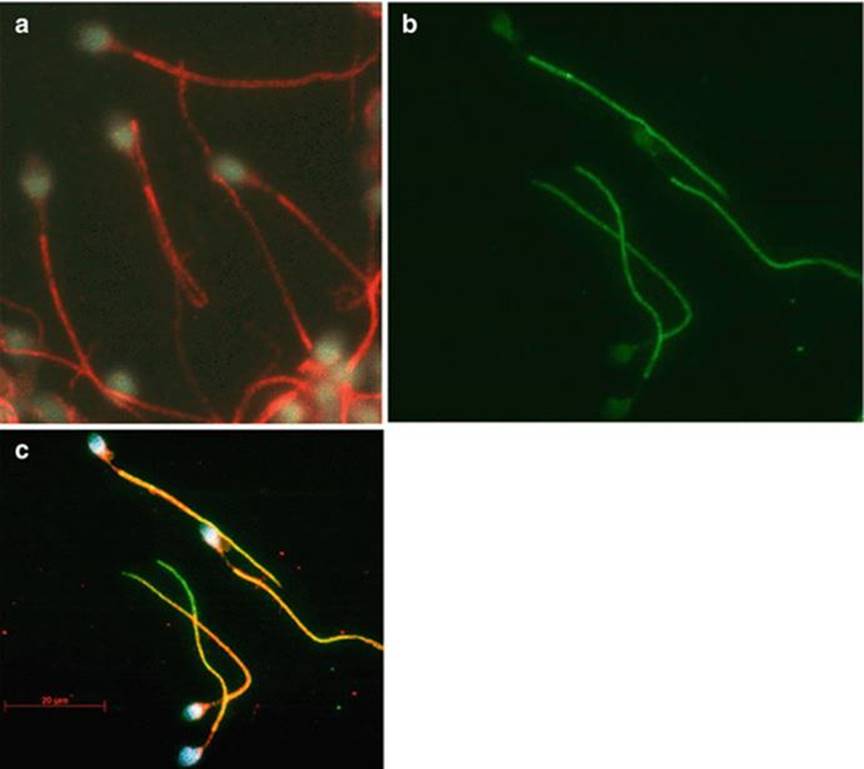
Fig. 4.2
Immunofluorescence localization of Sp17 and AKAP3. (a) Immunofluorescent localization of Sp17 in human spermatozoa. Sp17 is found in the principal piece, middle piece, and in scattered patches throughout the head region. The nuclei are DAPI stained. (b) Immunofluorescent localization of AKAP3 in human spermatozoa. AKAP3 is located predominantly in the principal piece of the flagella. The nuclei are DAPI stained. (c) Co-localization of Sp17 and AKAP3 in human spermatozoa. AKAP3 (green), located in the principal piece, co-localizes with Sp17 in some areas (yellow) of the principal piece but not in others. Sp17 (red) is also located in the middle piece of the tail and head regions. The nuclei are DAPI stained. Scale bar is 20 μm for a–c (Reproduced from Lea et al. [36]; with permission)
Sp17 is a cognate antigen to naturally occurring ASA. Lea et al. [35] constructed an ELISA using recombinant human Sp17 for the determination of Sp17-ASA in serum of men following vasectomy. Addionally, the B cell epitopes of Sp17 were determined. The sera from men after vasectomy contained ASA against Sp17, the linear B cell epitopes were found to be amino acids 52–79 and 124–136. Eleven percent of infertile men and women displaying sperm antibodies (ASA) were positive for anti-SP17 antibodies in an ELISA [65].
The epididymal protease inhibitor (Eppin) is located in the acrosome and the sperm tail. Antibodies to eppin inhibited significantly the acrosome reaction in a dose-dependent manner. Spontaneaous ASA binding to eppin was not described until now [66].
4.6 Zona Binding
The binding of the spermatozoa to the zona pellucida (ZP) occurs via specific receptors localized over the head region of the spermatozoa. Immunologic characterization and reports on ASA of zona-binding proteins is available in the literature.
Mahony et al. [42] observed patient expressing ASA in their sera that bound to the sperm surface, most specifically the head region, and that reduced zona pellucida tight binding of spermatozoa as assessed by the hemizona assay (HZA). The responsible protein was not characterized. Liu et al. [41] described similar results. In their study, they confirmed that ASA of the patients studied interfered predominantly with sperm-zona pellucida binding. They concluded from their observations that the inhibition of oolemma binding may not be the major cause of failed fertilization with sperm autoimmunity.
One of the possible antigens involved in zona penetration is PH-20, a glycerolphosphatidyl-inositol-linked hyaluronidase. In the guinea pig, two regions of this enzyme (res. 94-119 and res. 424-444) were highly immunogenic. Since PH-20 is present in the spermatozoa of many species and also in the human, it may be a cognate antigen of ASA in the human [13]. However, these potential ASA were not described up to now.
Naz et al. [48] described a dodecamer sequence, designated as YLP (12) that is involved in sperm-ZP recognition/binding. Anti-YLP(12) Fab’ antibodies of natural occurring ASA recognized a protein band of approximately 72 ± 2 kDa only in the lane of testis homogenates. In a later study, 29/67 ASA from the serum of infertile women reacted positively with the YLP12 dodecamer peptide [62].
In mice, a sperm antigen designated as fertilization antigen 1 (FA-1) was identified [68]. The authors cloned and sequenced the cDNA and were able to translate a protein, which was a novel protein not included in protein databases up to that time. The protein specifically reacted with zona protein 3 (ZP3) of oocyte zona pellucida. When polyclonal antibodies were generated, they completely blocked sperm-zona pellucida interaction in mice. Similar results were found in the human system. In the same study as quoted above [62], 41.8 % of the sera from immunoinfertile women reacted positively with the peptide 82-97aa derived from hFA-1.
Human sperm membrane protein (hSMP-1), a testis-specific protein expressed during human sperm development (see above), was immunologically localized in the acrosome. Naturally occurring antibodies against hSMP-1 were found in the sera of infertile women. The treatment of mice with antibodies against a recombinant protein significantly decreased the average number of sperms bound to each egg in the process of fertilization. This observation indicated a role of hSMP-1 in zona binding [14].
The analysis of proteins binding to ASA which compromise the zona binding of spermatozoa is complicated by the fact that several candidates have multiple function, they are moonlighting proteins [53]. This holds true for phosphokinase type3 (PK3), enolase 1 (ENO1), glyceraldehyde-3-phosphate dehydrogenase (GAPDH), aldolase A (ALDOA) and triose phosphate isomerase (TPI), GSTM, phospholipid hydroperoxide glutathione peroxidase (PHGPx) 4, voltage-dependent anion channel 2 (VDAC2).
Veaute et al. [57] found anti-acrosin antibodies in about 20 % of sera of infertile women. The specifity of the antibodies was proven with an ELISA using recombinant peptides from human proacrosin.
4.7 Oolemma Binding and Sperm-Egg Fusion
Several antigenic proteins are involved in the process of sperm-egg fusion. The knowledge on these proteins mainly originates from the experimental binding of human spermatozoa to zona-free hamster oocytes.
Francavilla et al. [20] studied the effect of ASA on the hamster egg penetration assay. They added ASA from patients to motile donor sperm, but they did not found ASA with the ability to reduce the rate of acrosome reacted sperm as well as ASA with the ability to reduce the hamster egg penetration rate.
Hamatani et al. [24] isolated and characterized SP-10, a sperm intra-acrosomal protein, which is produced specifically in the testis, but expressed in human spermatozoa only after acrosome reaction. A mAb to this protein inhibited sperm-oolemma binding in the zona-free hamster egg penetration test, but it did not inhibit sperm-zona binding in the hemizona assay. Margalit et al. [43] demonstrated that SP-10 is a member of the prostate and testis expression (PATE)-like proteins (Fig. 4.3). A polyclonal antibody against the PATE protein did not influence zona binding, but inhibited sperm-oolemma fusion in an appropriate assay. A vaccine evolved against several recombinant human acrosomal proteins including SP-10 was able to reduce fertility in female macaces [34]. PPT Margalit downloaded

Fig. 4.3
Expression and localization of PATE, PATE-B, and PATE-M on acrosome intact (AI) and acrosome-reacted (AR)-ejaculated human sperm cells. Sperm cells were incubated with polyclonal antibodies directed against each PATE-like protein and with PSA-FITC (green color) for acrosome staining. Antibodies that bound the PATE-like proteins were detected with rhodamine-conjugated secondary Ab (red). The acrosome was considered to be intact when the anterior half of the head of a sperm cell was fluorescent bright green. Relevant negative controls (pre-immune sera) for the rabbit anti-sera and mouse anti-sera are shown. A band-like pattern was detected in the equatorial zone for PATE and PATE-M and at the post-acrosomal region for PATE-B in AR and in the AI sperm cells. No similar staining of PATE-like proteins was seen in the control cells, and only a non-specific smear was occasionally seen in the heads of control sperm cells. Magnification ×1000 (Reproduced from Margalit et al. [43]; with permission)
Testicular protein TPX-1, also known as CRISP-2, is a cysteine-rich secretory protein specifically expressed in the male reproductive tract. After in vitro capacitation and ionophore-induced AR, TPX-1 is demonstrable in the equatorial segment of the acrosome. When a hamster-oocyte penetration test was performed in the presence of anti-TPX1, the percentage of penetrated hamster oocytes was decreased, without affecting sperm motility [11]. Brunner-Agten et al. [10] described a surprising co-incidence: the ASA binding to CRISP-2 cross-reacted with a specific venom of wasps (VES v5).
The Izumo protein is a specific integral part of spermatozoa, which was firstly shown to be an essential sperm membrane protein for sperm-egg-fusion. Inoue et al. [27] identified a new antigen by separation of the crude extracts from mouse sperm by two-dimensional gel electrophoresis and subsequent immunoblotting with a monoclonal antibody that specifically inhibited the sperm-oocyte fusion process. It was a testis (sperm)-specific 56.4-kDa antigen, the corresponding protein in humans had a size of 37.2-kDa. They termed the antigen ‘Izumo’ after a Japanese shrine dedicated to marriage. The registered DNA sequence was confirmed by sequencing after polymerase chain reaction with reverse transcription (RT–PCR) with total RNA prepared from the testis. A human homologue was found as an unverified gene in the NCBI database (accession number BC034769). The gene encodes a novel immunoglobulin superfamily (IgSF), type I membrane protein with an extracellular immunoglobulin domain. By immunofluorescence, the Izumo protein was not detectable on the surface of fresh sperm, but only after the acrosome reaction. When a polyclonal anti-human Izumo polyclonal antibody was added, no fusion of human spermatozoa to zona-free hamster eggs was observed. The folate receptor 4 (folr4) was identified as the counterpart for binding of Izumo in the mouse egg, and it was proposed to denominate it as Juno [6].
The relevance of the Izumo protein for fertilization was underlined by the experiments of Naz [47], who was able to show that immunization of female mice with peptides derived from Izumo and other sperm-specific proteins were able to induce antibodies exerting a long-term contraceptive effect.
4.8 Pronucleus Formation
Oocytes fertilized with ASA-bound sperm demonstrated abnormal cleavage of the embryos. The antigens involved had a low molecular weight of 14, 18, and 22 kD [46]. At gamete fusion, the sperm tail is incorporated into the ooplasm, and the centriolar region forms the sperm aster. ASA against proteins of the centrioles may be responsible for mitotic arrest [52].
The testis form of the human nuclear antigenic sperm protein (tNASP) is a testicular histone-binding protein of 787 amino acids to which most vasectomized men develop ASA. In a study using recombinant deletion mutants spanning the entire protein coding sequence 20/21 sera had ASA to one or more of the NASP fusion proteins. These may be the cognate antigens of ASA in vasectomized men. The clinical relevance of this antigen as well of their antibodies remains unclear [5].
The antibody against NASP may result in reproductive failure. In the mouse, ASA inhibited sperm-egg binding and fusion and there was a significant antifertility effect of these ASA in vivo [59].
Conclusions
As practical consequences of the research on ASA related sperm proteomic those ASA will be identified, which decrease male fertility by inhibiting sperm functions that are essential for fertilization (Fig. 4.4). The presence of antibodies in a biological substrate (serum, seminal plasma) that bind to specific antigens may be visualized by an ELISA or a RIA. In contrast to the earlier immunoassays, however, the antigens used will be defined proteins or peptides. Since ASA of an individual patient bind to up to ten different proteins, in a patient with a significantly positive MAR test or IBT up to ten different ELISA’s have to be performed in order to decide whether the patient suffers from immune infertility.

Fig. 4.4
The identification of sperm antigens relevant to fertilization by the binding of naturally occurring ASA in semen, follicular fluid, or serum contribute to the understanding of the molecular basis of fertilization, an improvement in the diagnosis and treatment of immunoinfertility, as well as to the development of contraceptive methods (Reproduced from Vazquez-Levin et al. [56]; with permission)
The identification of functionally relevant antigens is a prerequisite for treatment options. At time, no antibody-specific treatment of autoimmune diseases is possible, but the treatment is based on the suppression of antibody production in general. Increasingly, however, the use of monoclonal antibodies in autoimmune diseases is described. It may be speculated that this procedure also may be adapted to the treatment of autoimmune infertility.
The analysis of the cognate antigens of ASA involved in the process of fertilization is important from another point of view: it improves the identification of immunogenic proteins being candidates for immune contraception, i.e. which allow the artificial induction of antibodies in male or female inhibiting fertilization. Some of the possible approaches will be discussed in Part 4 of this book.
References
1.
Auer J, Camoin L, Courtot AM, Hotellier F, De Almeida M (2004) Evidence that P36, a human sperm acrosomal antigen involved in the fertilization process is triosephosphate isomerase. Mol Reprod Dev 68(4):515–523CrossRefPubMed
2.
Bandivdekar AH, Vernekar VJ, Moodbidri SB, Koide SS (2001) Characterization of 80kDa human sperm antigen responsible for immunoinfertility. Am J Reprod Immunol 45:28–34CrossRefPubMed
3.
Bandivdekar AH, Vernekar VJ, Kamada M, Raghavan VP (2005) Antifertility effect of passive administration of antibodies to 80 kDa human sperm antigen and its synthetic peptides in male and female rats. Am J Reprod Immunol 54(6):332–341CrossRefPubMed
4.
Bastian Y, Roa-Espitia AL, Mújica A, Hernández-González EO (2010) Calpain modulates capacitation and acrosome reaction through cleavage of the spectrin cytoskeleton. Reproduction 140(5):673–684CrossRefPubMed
5.
Batova IN, Richardson RT, Widgren EE, O’Rand MG (2000) Analysis of the autoimmune epitopes on human testicular NASP using recombinant and synthetic peptides. Clin Exp Immunol 121:201–209CrossRefPubMedPubMedCentral
6.
Bianchi E, Doe B, Goulding D, Wright GJ (2014) Juno is the egg Izumo receptor and is essential for mammalian fertilization. Nature 508(7497):483–487CrossRefPubMedPubMedCentral
7.
Bohring C, Skrzypek J, Krause W (2001) Influence of antisperm antibodies on the acrosome reaction as determined by flow cytometry. Fertil Steril 76(2):275–280CrossRefPubMed
8.
Bohring C, Krause E, Habermann B, Krause W (2001a) Isolation and identification of sperm membrane antigens recognized by antisperm antibodies, and their possible role in immunological infertility disease. Mol Hum Reprod 7:113–118
9.
Bronson RA, Cooper GW, Rosenfeld DL, Gilbert JV, Plaut AG (1987) the effect of an IgA1 protease on immunoglobulins bound to the sperm surface and sperm cervical mucus penetrating ability. Fertil Steril 47:985–991CrossRefPubMed
10.
Brunner-Agten S, Pavlovic R, Müller L, Horn MP, Huber AR, Stadler BM, Vogel M (2013) Increased level of antibodies cross-reacting with Ves v 5 and CRISP-2 in MAR-positive patients. Int Arch Allergy Immunol 160(1):47–55CrossRefPubMed
11.
Busso D, Cohen DJ, Hayashi M, Kasahara M, Cuasnicú PS (2005) Human testicular protein TPX1/CRISP-2: localization in spermatozoa, fate after capacitation and relevance for gamete interaction. Mol Hum Reprod 11(4):299–305CrossRefPubMed
12.
Castro A, Parodi D, Morales I, Madariaga M, Rios R, Smith R (2004) Absence of Fas protein detection by flow cytometry in human spermatozoa. Fertil Steril 81(4):1019–1025CrossRefPubMed
13.
Chan CP, Gupta S, Mark GE (1999) Identification of linear surface epitopes on the guinea pig sperm membrane protein PH-20. Life Sci 64:1989–2000CrossRefPubMed
14.
Cheng GY, Shi JL, Wang M, Hu YQ, Liu CM, Wang YF, Xu C (2007) Inhibition of mouse acrosome reaction and sperm-zona pellucida binding by anti-human sperm membrane protein 1 antibody. Asian J Androl 9(1):23–29CrossRefPubMed
15.
Chiu WW, Erikson EK, Sole CA, Shelling AN, Chamley LW (2004) SPRASA, a novel sperm protein involved in immune-mediated infertility. Hum Reprod 19(2):243–249CrossRefPubMed
16.
Clarke GN (1985) Induction of the shaking phenomenon by IgA class antispermatozoal antibodies from serum. Am J Reprod Immunol Microbiol 9:12–14CrossRefPubMed
17.
Domagala A, Pulido S, Kamieniczna M, Kurpisz M, Herr JC (2011) An isoimmune response to human sperm clathrin in an infertile woman with systemic lupus erythematosus. J Reprod Immunol 89(1):95–102CrossRefPubMed
18.
Feng HL, Han YB, Sparks AE, Sandlow JI (2008) Characterization of human sperm antigens reacting with anti-sperm antibodies from an infertile female patient’s serum. J Androl 29(4):440–448CrossRefPubMed
19.
Feng HL, Sandlow JI, Zheng LJ (2005) C-kit receptor and its possible function in human spermatozoa. Mol Reprod Dev 70(1):103–110CrossRefPubMed
20.
Francavilla F, Romano R, Santucci R (1991) Effect of sperm-antibodies on acrosome reaction of human sperm used for the hamster egg penetration assay. Am J Reprod Immunol 25:77–80CrossRefPubMed
21.
Fu J, Wang Y, Fok KL, Yang D, Qiu Y, Chan HC, Koide SS, Miao S, Wang L (2012) Anti-ACTL7a antibodies: a cause of infertility. Fertil Steril 97(5):1226–33.e1–8CrossRefPubMed
22.
Grizzi F, Chiriva-Internati M, Franceschini B, Hermonat PL, Soda G, Lim SH, Dioguardi N (2003) Immunolocalization of sperm protein 17 in human testis and ejaculated spermatozoa. J Histochem Cytochem 51(9):1245–1248CrossRefPubMed
23.
Haas GG Jr (1987) Immunologic infertility. Obstet Gynecol Clin North Am 14:1069–1085PubMed
24.
Hamatani T, Tanabe K, Kamei K, Sakai N, Yamamoto Y, Yoshimura Y (2000) A monoclonal antibody to human SP-10 inhibits in vitro the binding of human sperm to hamster oolemma but not to human Zona pellucida. Biol Reprod 62(5):1201–1208CrossRefPubMed
25.
Hasegawa A, Shigeta M, Shibahara H (2016) Sperm immobilizing antibody and its target antigen. Immune Infertility [Epub ahead of print]
26.
Inaba K, Morisawa S, Morisawa M (1998) Proteasomes regulate the motility of salmonid fish sperm through modulation of cAMP-dependent phosphorylation of an outer arm dynein light chain. J Cell Sci 111:1105–1115PubMed
27.
Inoue N, Ikawa M, Isotani A, Okabe M (2005) The immunoglobulin superfamily protein Izumo is required for sperm to fuse with eggs. Nature 434(7030):234–238CrossRefPubMed
28.
Jager S, Kremer J, Kuiken J, van Slochteren-Draaisma T, Mulder I, de Wilde-Janssen IW (1981) Induction of the shaking phenomenon by pretreatment of spermatozoa with sera containing antispermatozoal antibodies. Fertil Steril 36(6):784–791
29.
Jiang H, Pillai S (1998) Complement regulatory proteins on the sperm surface: relevance to sperm motility. Am J Reprod Immunol 39:243–248CrossRefPubMed
30.
Kamieniczna M, Domagała A, Kurpisz M (2003) The frequency of antisperm antibodies in infertile couples – a Polish pilot study. Med Sci Monit 9(4):CR142–CR149PubMed
31.
Koide SS, Wang L, Kamada M (2000) Antisperm antibodies associated with infertility: properties and encoding genes of target antigens. Proc Soc Exp Biol Med 224:123–132CrossRefPubMed
32.
Kong M, Richardson RT, Widgren EE, O’Rand MG (1995) Sequence and localization of the mouse sperm autoantigenic protein, Sp17. Biol Reprod 53(3):579–590CrossRefPubMed
33.
Kuang Y, Yan YC, Gao AW, Zhai YM, Miao SY, Wang LF, Koide SS (2000) Immune responses in rats following oral immunization with attenuated Salmonella typhimurium expressing human sperm antigen. Arch Androl 45:169–180CrossRefPubMed
34.
Kurth BE, Digilio L, Snow P, Bush LA, Wolkowicz M, Shetty J, Mandal A, Hao Z, Reddi PP, Flickinger CJ, Herr JC (2008) Immunogenicity of a multi-component recombinant human acrosomal protein vaccine in female Macaca fascicularis. J Reprod Immunol 77(2):126–141. Epub 2007 Jul 23CrossRefPubMed
35.
Lea IA, Adoyo P, O’Rand MG (1997) Autoimmunogenicity of the human sperm protein Sp17 in vasectomized men and identification of linear B cell epitopes. Fertil Steril 67(2):355–361CrossRefPubMed
36.
Lea IA, Richardson RT, Widgren EE, O’Rand MG (1996) Cloning and sequencing of cDNAs encoding the human sperm protein, Sp17. Biochim Biophys Acta 1307(3):263–266CrossRefPubMed
37.
Lea IA, Widgren EE, O’Rand MG (2004) Association of sperm protein 17 with A-kinase anchoring protein 3 in flagella. Reprod Biol Endocrinol 2:57CrossRefPubMedPubMedCentral
38.
Li H, Ding X, Guo C, Guan H, Xiong C (2012) Immunization of male mice with B-cell epitopes in transmembrane domains of CatSper1 inhibits fertility. Fertil Steril 97(2):445–452CrossRefPubMed
39.
Li HG, Liao AH, Ding XF, Zhou H, Xiong CL (2006) The expression and significance of CATSPER1 in human testis and ejaculated spermatozoa. Asian J Androl 8(3):301–306
40.
Liu B, Tang M, Han Z, Li J, Zhang J, Lu P, Song N, Wang Z, Yin C, Zhang W (2014) Co-incubation of human spermatozoa with anti-VDAC antibody reduced sperm motility. Cell Physiol Biochem 33(1):142–150CrossRefPubMed
41.
Liu DY, Clarke GN, Baker HW (1991) Inhibition of human sperm-zona pellucida and sperm-oolemma binding by antisperm antibodies. Fertil Steril 55:440–442CrossRefPubMed
42.
Mahony MC, Blackmore PF, Bronson RA, Alexander NJ (1991) Inhibition of human sperm-zona pellucida tight binding in the presence of antisperm antibody positive polyclonal patient sera. J Reprod Immunol 19:287–301CrossRefPubMed
43.
Margalit M, Yogev L, Yavetz H, Lehavi O, Hauser R, Botchan A, Barda S, Levitin F, Weiss M, Pastan I, Wreschner DH, Paz G, Kleiman SE (2012) Involvement of the prostate and testis expression (PATE)-like proteins in sperm-oocyte interaction. Hum Reprod 27(5):1238–1248CrossRefPubMedPubMedCentral
44.
Menge AC, Christman GM, Ohl DA, Naz RK (1999) Fertilization antigen-1 removes antisperm autoantibodies from spermatozoa of infertile men and results in increased rates of acrosome reaction. Fertil Steril 71:256–260CrossRefPubMed
45.
Naaby-Hansen S, Herr JC (2010) Heat shock proteins on the human sperm surface. J Reprod Immunol 84(1):32–40. doi:10.1016/j.jri.2009.09.006. Epub 2009 Dec 3CrossRefPubMed
46.
Naz RK (1992) Effects of antisperm antibodies on early cleavage of fertilized ova. Biol Reprod 46:130–139CrossRefPubMed
47.
Naz RK (2008) Immunocontraceptive effect of Izumo and enhancement by combination vaccination. Mol Reprod Dev 75(2):336–344CrossRefPubMed
48.
Naz RK, Zhu X, Kadam AL (2000) Identification of human sperm peptide sequence involved in egg binding for immunocontraception. Biol Reprod 62:318–324CrossRefPubMed
49.
Neilson LI, Schneider PA, Van Deerlin PG, Kiriakidou M, Driscoll DA, Pellegrini MC, Millinder S, Yamamoto KK, French CK, Strauss JF 3rd (1999) cDNA cloning and characterization of a human sperm antigen (SPAG6) with homology to the product of the Chlamydomonas PF16 locus. Genomics 60:272–280CrossRefPubMed
50.
Norton EJ, Diekman AB, Westbrook VA, Flickinger CJ, Herr JC (2001) RASA, a recombinant single-chain variable fragment (scFv) antibody directed against the human sperm surface: implications for novel contraceptives. Hum Reprod 16:1854–1860CrossRefPubMed
51.
Paasch U, Grunewald S, Glander HJ (2002) Presence of up- and downstream caspases in relation to impairment of human spermatogenesis. Andrologia 34:279–280, abstract
52.
Palermo GD, Colombero LT, Rosenwaks Z (1997) The human sperm centrosome is responsible for normal syngamy and early embryonic development. Rev Reprod 2:19–27CrossRefPubMed
53.
Petit FM, Serres C, Auer J (2014) Moonlighting proteins in sperm-egg interactions. Biochem Soc Trans 42(6):1740–1743CrossRefPubMed
54.
Shibahara H, Shiraishi Y, Hirano Y, Kasumi H, Koyama K, Suzuki M (2007) Relationship between level of serum sperm immobilizing antibody and its inhibitory effect on sperm migration through cervical mucus in immunologically infertile women. Am J Reprod Immunol 57(2):142–146CrossRefPubMed
55.
Tamburrino L, Marchiani S, Vicini E, Muciaccia B, Cambi M, Pellegrini S, Forti G, Muratori M, Baldi E (2015) Quantification of CatSper1 expression in human spermatozoa and relation to functional parameters. Hum Reprod 30(7):1532–1544. doi:10.1093/humrep/dev103. Epub 2015 May 15CrossRefPubMed
56.
Vazquez-Levin MH, Marín-Briggiler CI, Veaute C (2014) Antisperm antibodies: invaluable tools toward the identification of sperm proteins involved in fertilization. Am J Reprod Immunol 72(2):206–218CrossRefPubMed
57.
Veaute C, Furlong LI, Bronson R, Harris JD, Vazquez-Levin MH (2009) Acrosin antibodies and infertility. I. Detection of antibodies towards proacrosin/acrosin in women consulting for infertility and evaluation of their effects upon the sperm protease activities. Fertil Steril 91(4):1245–1255CrossRefPubMed
58.
Wagner A, Holland OJ, Tong M, Shelling AN, Chamley LW (2015) The role of SPRASA in female fertility. Reprod Sci 22(4):452–461CrossRefPubMed
59.
Wang M, Shi JL, Cheng GY, Hu YQ, Xu C (2009) The antibody against a nuclear autoantigenic sperm protein can result in reproductive failure. Asian J Androl 11(2):183–192CrossRefPubMedPubMedCentral
60.
Wang Z, Zhang Y, Mandal A, Zhang J, Giles FJ, Herr JC, Lim SH (2004) The spermatozoa protein, SLLP1, is a novel cancer-testis antigen in hematologic malignancies. Clin Cancer Res 10(19):6544–6550CrossRefPubMed
61.
Wang C, Baker HW, Jennings MG, Burger HG, Lutjen P (1985) Interaction between human cervical mucus and sperm surface antibodies. Fertil Steril 44:484–488CrossRefPubMed
62.
Williams J, Samuel A, Naz RK (2008) Presence of antisperm antibodies reactive with peptide epitopes of FA-1 and YLP12 in sera of immunoinfertile women. Am J Reprod Immunol 59(6):518–524CrossRefPubMed
63.
Xiang SD, Gao Q, Wilson KL, Heyerick A, Plebanski M. Mapping T and B cell epitopes in sperm protein 17 to support the development of an ovarian cancer vaccine. Vaccine. 2015. 33(44):5950–5959. pii: S0264-410X(15)01098-1
64.
Xu B, Copolla M, Herr JC, Timko MP (2007) Expression of a recombinant human sperm-agglutinating mini-antibody in tobacco (Nicotiana tabacum L.). Soc Reprod Fertil Suppl 63:465–477PubMed
65.
Zhang CH, Li FQ, Yang AL, Sun W, Miao JW (2007) Detection of anti-Sp17 antibodies in infertile patients’ serum and its clinical significance. Zhonghua Nan Ke Xue 13(1):27–29PubMed
66.
Zhang J, Ding X, Bian Z, Xia Y, Lu C, Wang S, Song L, Wang X (2010) The effect of anti-eppin antibodies on ionophore A23187-induced calcium influx and acrosome reaction of human spermatozoa. Hum Reprod 25(1):29–36CrossRefPubMed
67.
Zhang X, Ibrahim E, de Rivero Vaccari JP, Lotocki G, Aballa TC, Dietrich WD, Keane RW, Lynne CM, Brackett NL (2013) Involvement of the inflammasome in abnormal semen quality of men with spinal cord injury. Fertil Steril 99(1):118–124CrossRefPubMed
68.
Zhu X, Naz RK (1997) Fertilization antigen-1: cDNA cloning, testis-specific expression, and immunocontraceptive effects. Proc Natl Acad Sci U S A 944:704–709