
Nervous System: Overview
Fig. 39.1 Central and peripheral nervous systems
The nervous system is divided into the central (CNS) and peripheral (PNS) nervous systems. The CNS consists of the brain and spinal cord, which comprise a functional unit. The PNS consists of the nerves emerging from the brain and spinal cord (cranial and spinal nerves, respectively).

Fig. 39.2 Neurons (nerve cells)
The nervous system is composed of neurons (nerve cells) and supporting neuroglial cells, which vastly outnumber them (10 to 1). Each neuron contains a cell body (soma) with one axon (projecting segment) and one or more dendrites (receptor segments). The release of neurotransmitters at synapses creates an excitatory or inhibitory postsynaptic potential at the target neuron. If this exceeds the depolarization threshold of the neuron, the axon “fires,” initiating the release of a transmitter from its presynaptic knob (bouton).

Fig. 39.3 Myelination
Certain glial cells with lipid-rich membranes may myelinate axons (nerve fibers). Myelination electrically insulates axons, thereby increasing impulse conduction speed. In the CNS, one oligodendrocyte myelinates multiple axons; in the PNS, one Schwann cell myelinates one axon.

Fig. 39.4 Gray and white matter in the CNS
Nerve cell bodies appear gray in gross inspection, whereas nerve cell processes (axons) and their insulating myelin sheaths appear white.


Fig. 39.5 Embryonic development of the brain
Left lateral view.

Fig. 39.6 Adult brain
See Fig. 39.12 for lobes of the cerebrum. CN = cranial nerve.

Telencephalon
Fig. 39.7 Divisions of the telencephalon
Coronal section, anterior view. The telencephalon is divided into the cerebral cortex, white matter, and basal ganglia. The cerebral cortex is further divided into the allocortex and isocortex (neocortex).

Fig. 39.8 White matter
A special preparation technique was used to show the fiber structure of the superficial layer of white matter.

Fig. 39.9 Basal ganglia
Transverse section, superior view. The basal ganglia are an essential component of the motor system (see p. 615).

Fig. 39.10 Allocortex
The three-layered allocortex consists of the olfactory cortex (blue) and the hippocampus (pink).

Fig. 39.11 Isocortex: Columnar organization
Morphological considerations divide the isocortex into six horizontal layers; functional considerations divide it into cortical columns.

Fig. 39.12 Lobes in the cerebral hemispheres
The isocortex also may be functionally divided into association areas (lobes).

Telencephalon & Diencephalon
Fig. 39.13 Hippocampal formation
The hippocampus, fornix, and amygdala are the major components of the limbic system (see p. 621).
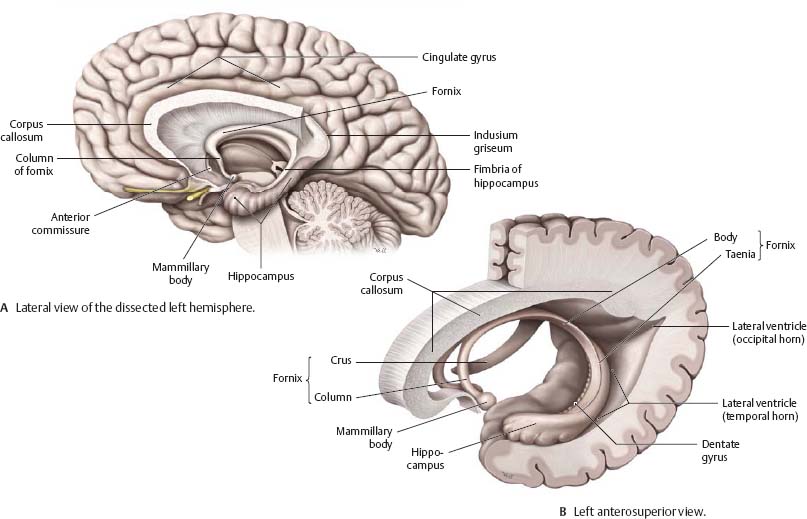
Fig. 39.14 Diencephalon
Midsagittal section, medial view of the right hemisphere. The major components of the diencephalons are the thalamus, hypothalamus, and hypophysis (anterior lobe). See p. 598 for the extracted diencephalon.


Fig. 39.15 Telencephalon and diencephalon: Internal structure
Coronal section.


Diencephalon, Brainstem & Cerebellum
Fig. 39.16 Diencephalon, brainstem, and cerebellum
Left lateral view.
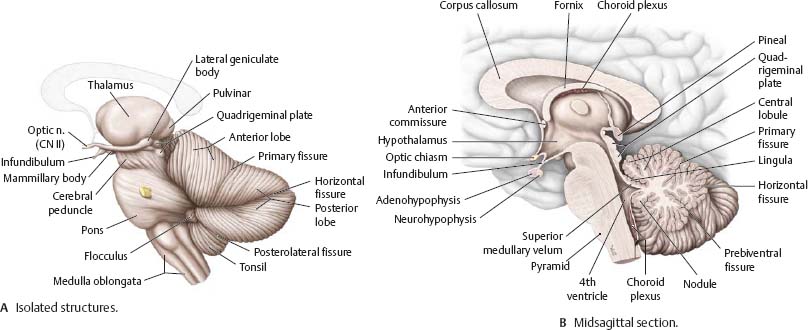
Fig. 39.17 Cerebellum

Fig. 39.18 Cerebellar peduncles
Tracts of afferent (sensory) or efferent (motor) axons enter or leave the cerebellum through cerebellar peduncles. Afferent axons originate in the spinal cord, vestibular organs, inferior olive, and pons. Efferent axons originate in the cerebellar nuclei.

Fig. 39.19 Brainstem
The brainstem is the site of emergence and entry of the 10 pairs of true cranial nerves (CN III-XII). See p. 470 for an overview of the cranial nerves and their nuclei.

Spinal Cord
Fig. 39.20 Spinal cord and segments
The spinal cord consists of 31 segments innervating a specific area in the trunk or limbs (see Fig. 39.22). Afferent (sensory) posterior rootlets and efferent (motor) anterior rootlets form the posterior and anterior roots, respectively. The two roots fuse to form a mixed spinal nerve, which then divides into various branches.

Fig. 39.21 Spinal cord in situ
Posterior view with vertebral canal windowed.

Fig. 39.22 Segmental innervation and spinal cord lesions
The spinal cord is divided into four major regions: cervical, thoracic, lumbar, and sacral. Spinal cord segments are numbered by the exit points of their associated spinal nerves. (Note: This does not necessarily correlate numerically with the nearest skeletal element.)

Fig. 39.23 Spinal cord in situ: Transverse section
Superior view.

 Clinical
Lumbar puncture
A needle introduced into the dural sac (lumbar cistern) generally slips past the spinal nerve roots without injuring the spinal cord. Cerebro-spinal fluid (CSF) samples are therefore taken between the L3 and L4 vertebrae (2), once the patient has leaned forward to separate the spinous processes of the lumbar spine.

Anesthesia
Lumbar anesthesia may be administered in a similarfashion (2). Epidural anesthesia is administered by placing a catheter in the epidural space without penetrating the dural sac (1). This may also be done by passing a needle through the sacral hiatus (3).
Fig. 39.24 Cauda equina
In adults, the spinal cord ends at approximately the level of L1. Below this, ventral and dorsal roots course through the vertebral canal, uniting in the intervertebral foramen to form the spinal nerve (see p. 36).

Meninges
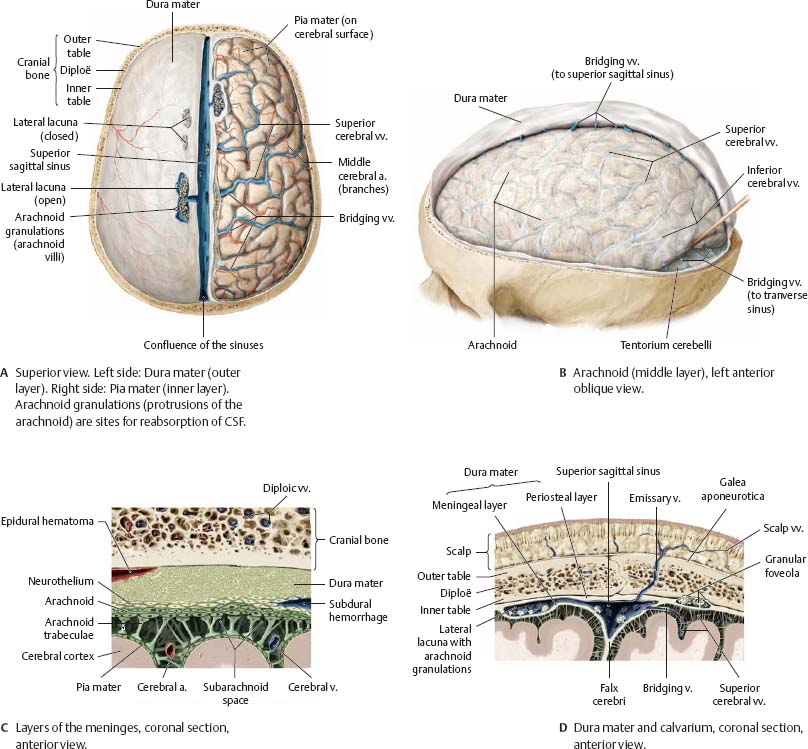
 The brain and spinal cord are covered by membranes called meninges. The meninges are composed of three layers: dura mater (dura), arachnoid (arachnoid membrane), and pia mater.
The subarachnoid space, located between the arachnoid and pia, contains cerebrospinal fluid (CSF, see p. 604). See p. 601 for the coverings of the spinal cord.
Fig. 39.25 Meninges
See p. 606 for the veins of the brain.
Clinical
Extracerebral hemorrhages
Bleeding between the bony calvarium and the soft tissue of the brain (extracerebral hemorrhage) exerts pressure on the brain. A rise of intracranial pressure may damage brain tissue both at the bleeding site and in more remote brain areas. Three types of intracranial hemorrhage are distinguished based on the relationship to the dura mater. See p. 608 for the arteries of the brain.
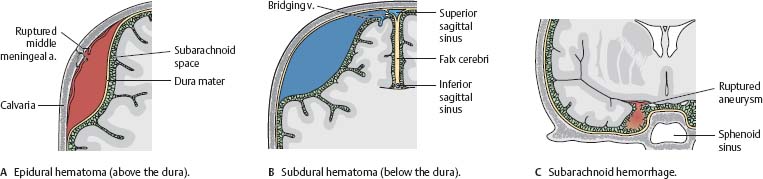
Fig. 39.26 Dural septa
Left anterior oblique view. The major dural reflections are the falx cerebri, tentorium cerebelli, and falx cerebelli (not shown). The dural septa separate the regions of the brain from each other.

Fig. 39.27 Innervation of the dura mater
Superior view. Removed: Tentorium cerebelli (right side).

Fig. 39.28 Arteries of the dura mater
Midsagittal section, left lateral view. See p. 608 for the arteries of the brain.

Ventricles & CSF Spaces
Fig. 39.29 Circulation of cerebrospinal fluid (CSF)
The brain and spinal cord are suspended in CSF. Produced in the choroids plexus, CSF occupies the subarachnoid space and ventricles of the brain.

Fig. 39.30 Ventricular system
The ventricular system is a continuation of the central spinal canal into the brain. Cast specimens are used to demonstrate the connections between the four ventricular cavities.

Fig. 39.31 Ventricular system in situ
Left lateral view.
