
Ejaaz A. Kalimullah and Steven E. Aks
Phenytoin is one of the most commonly utilized anticonvulsants and has been commercially available in the United States since 1938. Initially known as diphenylhydantoin, phenytoin was first synthesized by Heinrich Blitz in 1908 (1). In 1938, Merritt and Putnam described the anticonvulsant properties of phenytoin, making it one of the earliest known anti-epileptics after the bromide salts and phenobarbital. Today, phenytoin remains in use for the treatment of tonic–clonic seizures, for the treatment of partial complex seizures, in the setting of traumatic brain injury, and in the setting of neurosurgical procedures. Although phenytoin has also been used with varying success for trigeminal neuralgia and neuropathic pain, it appears to be less effective for toxin-induced or alcohol withdrawal seizures (2).
Phenytoin is available in many forms, including extended- and immediate-release capsules, chewable tablets, suspension, and phenytoin sodium injection solution. The injection solution contains a 40% propylene glycol and 10% ethanol diluent which is adjusted to a pH of 12 using sodium hydroxide. Infusion-related cardiotoxicity and local tissue injury from extravasation and intramuscular (IM) injection are caused by the propylene glycol–containing alkaline diluent. Fosphenytoin is a phosphate ester prodrug of phenytoin approved for use in 1996. Fosphenytoin has a pH of 8.6 to 9.0, is more water soluble, lacks the propylene glycol diluent, and allows for both intravenous (IV) and IM administration. To avoid potential conversion errors, fosphenytoin is dosed using phenytoin equivalents (PE), where 1.5 mg fosphenytoin is equal to 1.0 mg phenytoin. Therapeutic phenytoin plasma levels (10 to 20 μg/mL) can usually be achieved with an IV loading dose of 15 to 20 mg/kg of phenytoin or PE units of fosphenytoin. Because of propylene glycol cardiotoxicity, IV phenytoin should not be infused at a rate in excess of 50 mg/min (0.5 to 1.0 mg/kg/min in neonates and children). Fosphenytoin can be administered at a maximum rate of 150 PE units/min in adults or 3 PE units/kg/min in children. The adult maintenance dose of phenytoin is typically 4 to 6 mg/kg/d in divided doses.
In therapeutic oral use, peak plasma concentrations occur in 1.5 to 3 hours, with extended-release formulations producing peak levels at 4 to 12 hours (1). Oral overdoses may have erratic, incomplete, markedly delayed, and prolonged absorption (3). As with other drugs, ingested quantity, chronic therapy, co-ingestants, gut motility, and bezoar formation all influence toxicokinetics.
Fosphenytoin is converted to phenytoin by phosphatases in the blood and liver with a conversion half-life of approximately 15 minutes. Although peak serum levels of IV administered phenytoin are obtained at the end of the infusion, phenytoin levels should not be monitored following fosphenytoin infusion until conversion is complete at approximately 2 hours afterward (3). IM fosphenytoin is well absorbed and produces more sustained, albeit lower, blood levels when compared to IV therapy.
Phenytoin rapidly diffuses into tissues, particularly the central nervous system (CNS) and CNS levels equilibrate with the plasma compartment within 10 minutes of IV infusion (1). Phenytoin is 90% protein bound, primarily to albumin. Because only the 10% of free drug is active, altered plasma protein binding or decreased plasma protein concentrations as may occur with malnutrition or cirrhosis may reduce the threshold for toxicity. The apparent volume of distribution ranges from 0.4 to 0.6 L/kg in adults and is probably increased in overdose.
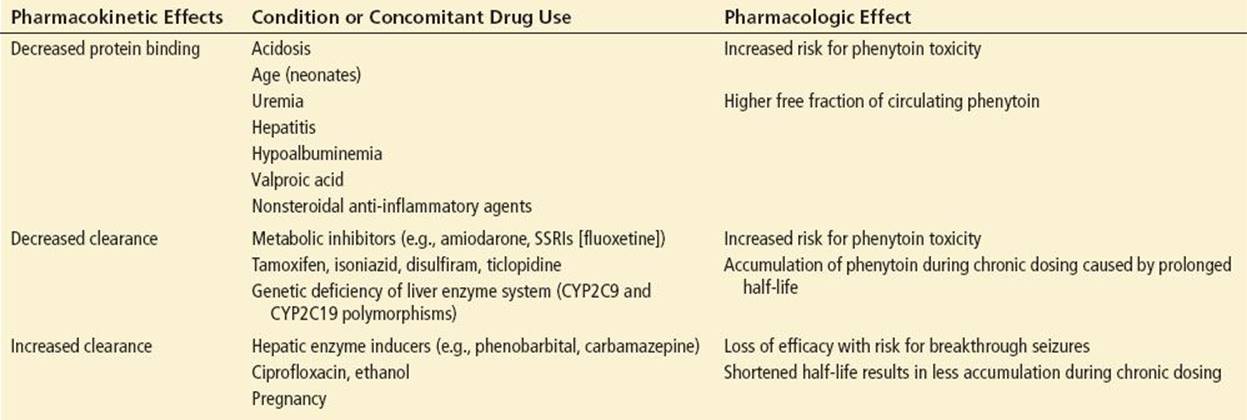
Phenytoin is metabolized by hepatic microsomal enzymes, primarily CYP2C9, resulting in the production of the inactive 5-(p-hydroxyphenyl)-5-phenylhydantoin (p-HPPH) metabolite. Phenytoin also undergoes enterohepatic recirculation. Cytochrome-P450–mediated drug interactions can result in significant changes in phenytoin levels and result in toxicity (Table 311.1). The metabolism of phenytoin is a saturable process. At concentrations <10 μg/mL, there is first-order metabolism, with a fixed proportion being metabolized per unit of time and an approximate half-life of 6 to 24 hours (1). At concentrations in the high therapeutic range, the metabolic pathways become saturated, resulting in zero-order kinetics where a fixed amount of drug is metabolized per unit of time, and the “apparent half-life” increases as the concentration increases. This saturation most likely accounts for the wide range of “apparent half-lives” (7 to 60 hours) reported with therapeutic use and the prolonged elimination observed after overdose (4).
TABLE 311.1
Factors Influencing Phenytoin Kinetics
The mechanisms of the therapeutic and toxic effects of phenytoin are not fully understood. Phenytoin’s anticonvulsant effects most likely arise from inhibition of neuronal high-frequency firing by reducing the ability of Na+channels to recover from inactivation. This use-dependent effect is caused by preferential binding to the inactivated state of the Na+ channel.
Phenytoin toxicity occurs in a number of settings. Acute overdose can result from deliberate or unintentional oral ingestion, generally of >20 mg/kg. Exposure to phenytoin may also occur from the adulteration of illicit drugs, such as crack cocaine, and from the use of imported medications containing undisclosed anticonvulsants. In such cases, nystagmus, ataxia, and vomiting may provide valuable clues to suggest phenytoin poisoning. Acute overdose also follows the iatrogenic infusion of excessive doses of phenytoin or fosphenytoin. Errors in prescribing or administering, as well as changes in dosing or formulation, may lead to inadvertent toxicity during chronic oral therapy.
Given the central role of cytochrome P450 enzymes in metabolizing phenytoin, a number of drugs (Table 311.1) can cause toxicity by altering the clearance of phenytoin. Amiodarone, cimetidine, cotrimoxazole, disulfiram, fluconazole, metronidazole, and various antidepressants can decrease clearance of phenytoin. In contrast, medications that induce the cytochrome-P450 system, such as alcohol, barbiturates, carbamazepine, theophylline, and rifampin, can increase the clearance of phenytoin. Failure to adjust maintenance doses of phenytoin downward when stopping therapy with a cytochrome-P450 inducer may cause phenytoin intoxication.
CLINICAL PRESENTATION
The predominant signs and symptoms of acute or chronic oral phenytoin overdose are related to CNS dysfunction. Effects such as nystagmus, nausea, vomiting, tremor, ataxia, diplopia, and dysarthria often reflect cerebellar and vestibular impairment; toxicity usually correlates with increasing plasma concentrations. Although some patients may tolerate and therapeutically require phenytoin levels >20 μg/mL, patients with underlying brain disease may become toxic at only slightly elevated drug levels. Although nystagmus is common as concentrations rise >20 μg/mL, the absence of nystagmus does not rule out toxicity. Horizontal, vertical, bidirectional, or alternating nystagmus can be noted with significant poisoning, but may disappear as CNS depression and depth of coma increase (4). At levels >30 μg/mL, ataxia, slurred speech, and tremor are common. As levels rise to >40 μg/mL, confusion, lethargy, and stupor may occur. Although progressive CNS depression is typical, fluctuating agitation and lethargy have also been described. With levels >50 μg/mL, marked CNS depression and coma predominate; profound CNS depression is associated with hyporeflexia and depression of cranial nerve reflexes. Infrequently encountered CNS findings include choreo-athetosis, ballismus, opisthotonus, and dystonias (5). Focal neurological deficits may occur in patients with prior hypoxic or ischemic brain injury. Rare “paradoxical” seizures have been noted with phenytoin levels >30 to 50 μg/mL, typically in the setting of a pre-existing seizure disorder. In the setting of acute overdose, seizures should prompt a search for co-ingestants or physiologic derangements.
Cardiovascular toxicity is not a clinical concern following oral overdose (6), but is the major toxicity seen with rapid administration of IV phenytoin. Hypotension, apnea, bradycardia, asystole, and ventricular dysrhythmias occur at rates in excess of 50 mg/min (rates as low as 25 mg/min have been recommended for patients >50 years of age). Associated electrocardiographic (ECG) changes may include ST segment and T wave changes, as well as atrioventricular blocks. Although the propylene glycol diluent in phenytoin injection solution is believed to be the primary mediator of cardiovascular toxicity, there may be other mechanisms. Bradyasystolic arrest has occurred in infants following several-fold overdoses of IV fosphenytoin, which does not contain propylene glycol. Although the cardiotoxicity associated with IV phenytoin is usually transient and expected to dissipate after the infusion is stopped, the potential for sudden life-threatening toxicity is greatest within this setting.
Extravasation of phenytoin can cause skin and soft-tissue necrosis, compartment syndrome, gangrene, and may lead to limb loss. “Purple glove syndrome,” which consists of progressive limb edema, bluish discoloration, pain, and blistering, may follow IV administration of phenytoin on a delayed basis, even in the absence of evidence of extravasation. Risk factors for “purple glove syndrome” include advanced age, use of large repeated doses, small gauge IV catheter use, and use of the same infusion site for multiple doses (7). This syndrome has not been reported with fosphenytoin.
An idiosyncratic anticonvulsant hypersensitivity syndrome may develop in patients taking phenytoin, typically developing weeks to months after the initiation of therapy. This syndrome often produces multisystem involvement and may present with fever, rash, hepatitis, eosinophilia, blood dyscrasias, pneumonitis, myositis, vasculitis, and/or nephritis. Anticonvulsant hypersensitivity syndrome is thought to occur from the generation of toxic arene metabolites of aromatic anticonvulsants (carbamazepine, phenobarbital, and phenytoin) and is potentially life-threatening (8). Additional adverse effects of phenytoin include Stevens–Johnson syndrome, toxic epidermal necrolysis, and drug-induced lupus.
Death is rare after acute oral overdoses of phenytoin. Most fatalities involve co-ingestants or respiratory failure and its associated complications, and many of the deaths reported in the medical literature predate modern intensive care and supportive care (5). Fatal cases are usually associated with phenytoin levels in excess of 120 μg/mL (3).
DIFFERENTIAL DIAGNOSIS
The differential diagnosis of phenytoin intoxication includes other illnesses that can produce the typical constellation of nystagmus, ataxia, dysarthria, and mental status changes. Other anticonvulsants can produce similar signs and symptoms and are often utilized by patients with epilepsy. Similarly, an overdose of sedative-hypnotic agents, ethanol, muscle relaxants, or psychiatric medications such as lithium, cyclic antidepressants, or the SSRIs can produce a comparable clinical presentation. CNS pathology, particularly cerebellar infarction, hemorrhage, or neoplasm, should also be considered. Other diagnostic considerations include hypoglycemia, Wernicke encephalopathy, extrapyramidal disorders, seizure disorders, and postictal states.
ED EVALUATION
The time and quantity of ingestion should be the primary focus, but a history of seizure disorder and other medication use should also be sought. The examination should focus on the neurological system. The clinician should note the presence or absence of altered mentation, nystagmus, slurred speech, and ataxia.
Serum glucose and an ECG should be obtained in patients with an altered mental status or when there may be a co-ingestion of other substances. ECG screening may provide additional information when ingestion of psychotropic or cardioactive agents is being entertained. If the patient has a known seizure disorder but is taking unknown medications, phenytoin, phenobarbital, carbamazepine, and valproic acid are commonly prescribed medications for which blood levels can be measured. If medications are known, levels of the specific agents should be ordered. When levels are positive and the patient is either unreliable or may have attempted suicide, serial levels can establish a peak and declining trend. These levels should be clinically correlated with the patient’s condition. Serum albumin level may be helpful in patients with nephrotic syndrome, malnutrition, or liver failure or who are otherwise at risk since hypoalbuminemic patients may exhibit toxicity at normal or minimally elevated phenytoin levels. Acetaminophen and salicylate levels are typically obtained in suicidal overdoses, as these agents are common co-ingestants. Routine laboratory studies and a pregnancy test in females of childbearing age may help for general supportive care.
KEY TESTING
• Blood glucose if altered mental status
• Serum phenytoin level(s)
• Serum albumin level in at-risk patients
• ECG in symptomatic patients
ED MANAGEMENT
Patients who develop hypotension or bradycardia during IV infusion should have the drip immediately discontinued. The drip rate and concentration should be checked. When vital signs are normalized, a slower infusion rate can then be continued with cardiac monitoring.
For oral overdose, the patient’s airway, breathing, and circulation (ABCs) should be monitored and stabilized appropriately. Oral phenytoin overdose is rarely fatal with attentive supportive care, and cardiovascular toxicity is unlikely. An initial ECG should be obtained to establish normal intervals, and cardiac monitoring should be initiated if there are any abnormalities. If there is significant ataxia or nystagmus or gait abnormalities, the patient should be protected from falls and should have frequent neurological reevaluations.
A single dose of activated charcoal is a reasonable method for gastric decontamination following oral exposure in patients without significantly depressed mentation. The use of multiple doses of charcoal, although of theoretical value, remains of unclear clinical utility (9). If the patient has an underlying seizure disorder, phenytoin should be administered to avoid allowing the phenytoin level to decreasing to less than the therapeutic range.
Although extracorporeal removal of phenytoin is rarely necessary given the efficacy of standard supportive care measures, high-flux hemodialysis may provide significant drug removal in selected cases of severe poisoning (10).
CRITICAL INTERVENTIONS
• Establish a peak and declining trend by following serial phenytoin levels in all potentially significant exposures.
• When loading phenytoin IV, the patient should have continuous cardiac monitoring, and extravasation must be avoided.
• Infusions should be stopped if there is evidence of bradycardia or hypotension.
DISPOSITION
Patients with no or minimal toxicity after a suicidal ingestion and a therapeutic peak phenytoin concentration can be cleared for psychiatric evaluation. Patients with elevated peak phenytoin levels and moderate to severe symptoms, such as ataxia, tremor, confusion, or stupor, require hospitalization. Patients admitted after oral phenytoin overdose can be admitted to nontelemetry settings (6), but should go to a setting where fall precautions can be instituted and frequent neurological checks can be performed. Only rare severely intoxicated patients will require an intensive care setting.
Nonsuicidal patients with mild symptoms and a reliable family support system can be discharged home with instructions to prevent falls. The family should also be counseled on holding doses for the next day or two as appropriate. More seriously intoxicated patients should be admitted to the hospital as above for supportive treatment.
Common Pitfalls
• Exceeding phenytoin IV infusion rates of 25 to 50 mg/min, causing hypotension and/or bradycardia.
• Causing phenytoin toxicity by not checking a drug level prior to giving a loading dose.
• Admitting all oral phenytoin overdoses to a telemetry setting. Cardiac toxicity is extremely rare, and this is generally not necessary.
• Failing to consider phenytoin toxicity and proceeding with imaging evaluation for other acute neurological conditions.
• Failing to recognize the anticonvulsant hypersensitivity syndrome.
• Failing to recognize the purple glove syndrome.
REFERENCES
1. McNamara JO. Pharmacotherapy of the epilepsies (Chapter 21). In: Brunton LL, Chabner BA, Knollmann BC, eds. Goodman & Gilman’s The Pharmacological Basis of Therapeutics. 12th ed. New York: McGraw-Hill Medical; 2011. Available online at: http://www.accesspharmacy.com/content.aspx?aID=16665458. Accessed February 2014.
2. Shah AS, Eddleston M. Should phenytoin or barbiturates be used as second-line anticonvulsant therapy for toxicological seizures? Clin Toxicol (Phila). 2010;48(8):800–805.
3. Craig S. Phenytoin poisoning. Neurocrit Care. 2005;3(2):161–170.
4. LoVecchio F. Phenytoin. In: Brent J, Wallace KL, Burkhart KK, et al., eds. Critical Care Toxicology. 1st ed. Philadelphia, PA: Elsevier, Mosby; 2005:553–558.
5. Mellick LB, Morgan JA, Mellick GA. Presentations of acute phenytoin overdose. Am J Emerg Med. 1989;7(1):61–67.
6. Wyte CD, Berk WA. Severe oral phenytoin overdose does not cause cardiovascular morbidity. Ann Emerg Med. 1991;20(5):508–512.
7. Chokshi R, Openshaw J, Mehta NN, et al. Purple glove syndrome following intravenous phenytoin administration. Vasc Med. 2007;12(1):29–31.
8. Morkunas AR, Miller MB. Anticonvulsant hypersensitivity syndrome. Crit Care Clin. 1997;13(4):727–739.
9. Skinner CG, Chang AS, Matthews AS, et al. Randomized controlled study on the use of multiple-dose activated charcoal in patients with supratherapeutic phenytoin levels. Clin Toxicol (Phila).2012;50(8):764–769.
10. Ghannoum M, Troyanov S, Ayoub P, et al. Successful hemodialysis in a phenytoin overdose: Case report and review of the literature. Clin Nephrol. 2010;74(1):59–64.