
Louis Ling
Since 1870, botulism has been the term used to describe the illness associated with food contaminated with Clostridium botulinum and its toxin. C. botulinum is an anaerobic, spore-forming, gram-positive bacillus. The spores are ubiquitous and can be found in soil, water, and air. Spores are usually dormant and can tolerate 2 hours of boiling at 100°C. Germination of the spores, with resultant toxin formation, requires certain environmental conditions: pH >4.5 and sodium chloride content <3.5%. Unlike the spores, the toxin is heat-labile and can be destroyed by boiling for a few minutes or if heated for 5 minutes at 85°C. Low pH does not inactivate or destroy any preformed toxin.
Botulinum toxin is considered the most lethal substance known, with an estimated oral LD50 of 1 μg/kg in humans. Botulinum toxin enters presynaptic nerve terminals via endocytosis, where it irreversibly prevents the release of acetylcholine by inhibiting calcium-dependent exocytosis (1). The net result is a decrease in the acetylcholine concentration within the synaptic cleft both in the autonomic nervous system, resulting in anticholinergic symptoms (muscarinic and nicotinic) and yielding a flaccid paralysis at neuromuscular junctions.
Eight different serotypes of botulinum toxin have been identified (types A–H). Of these, subtypes A, B, and E are of clinical concern and have distinctive geographic distributions. Type A is found predominantly west of the Mississippi, type B predominantly east of the Mississippi, and type E in the Pacific Northwest, especially in Alaska (2). During summer 2007, an outbreak of type A botulism affected eight patients from Indiana, Ohio, and Texas, who all ate contaminated commercial hotdog chili sauce that was improperly canned in Georgia. However, the vast majority of foodborne botulism is from ingesting home-processed foods (2).
Types A and B are typically found in improperly processed meats and vegetables (3). The food usually appears foul and may have an odor. By contrast, type E does not alter the smell or appearance of food. Human intoxications have been well documented with serotypes A, B, E, and rarely F. Type A accounts for more than one-third of the foodborne cases. Types C cause disease in birds, Type D in cattle, and disease with type G has yet to be documented in either humans or animals in the United States. Type H was identified along with type B in 2013 from an infant and its impact is yet unknown (4).
There are about 145 reported cases of botulism in the United States each year. Classically, there are four distinct diseases as a result of C. botulinum: (a) foodborne (adult) botulism occurs after consumption of preformed toxin and accounts for 15% of botulism cases. Smoked or salted meats and fish as well as canned vegetables are typical sources. Mortality ranges from 5% to 10%. (b) Infant botulism, under 1 year of age, occurs after ingestion and propagation of C. botulinum in the intestinal tract and accounts for 65% of cases. The vast majority of cases are a result of serotypes A (47%) or B (52%). It follows the ingestion of C. botulinum with toxin formation and absorption in the gut lumen (5). The gastrointestinal tracts of infants lack some of the bile acids and gastric acids that normally inhibit clostridial growth. Honey and corn syrup have been identified as sources of C. botulinum spores. Vacuum cleaner dust and soil have also been implicated. In the food samples tested, no preformed toxin has been identified, only clostridium spores. About 70% of cases are in breast-fed infants; presumably these infants have different gut flora when compared with their formula-fed counterparts. Almost half the cases reported over the past 30 years have been from California (2). (c) Wound botulism accounts for about 10% of cases and occurs after a wound that is contaminated with spores that germinate and produce toxin over time. Most cases are associated with black tar heroin made in Mexico, affecting the western United States with the preponderance from California. In one report, only 1 out of 102 cases of wound botulism did not occur in a drug user (6). (d) Botulism of undetermined origin is the adult version of infant botulism, in which no food vehicle can be identified and there is no evidence of wound botulism in a patient older than 1 year of age. This type is rare and usually results from intestinal colonization in an adult.
The World Health Organization describes three more types of botulism in addition to the four classic forms (1): (e) Inhalational botulism is a potential threat if the toxin is aerosolized as a biologic weapon. (f) Waterborne botulism is only a theoretical concern, as water-treatment processes inactivate the toxin. (g) Iatrogenic botulism stems from the use of botulinum toxin for therapeutic or cosmetic purposes (11).
CLINICAL PRESENTATION
The initial symptoms of foodborne botulism are predominantly gastrointestinal, including nausea, vomiting, abdominal pain, and distention, likely a result of pathogenic agents or toxins in the contaminated food other than C. botulinum. Symptoms usually develop within 12 to 36 hours but may develop as early as 4 hours or as late as 10 days. Other initial symptoms are often mild and include fatigue, weakness, and vertigo. Additional symptoms include sore throat, dry mouth, and poor visual accommodation. If the toxin exposure is minimal, patients gradually recover. Otherwise, symmetric, descending flaccid paralysis with prominent bulbar palsies such as diplopia, dysarthria, dysphonia, and dysphagia develops. Physical examination may reveal weakness or paralysis of the upper extremities; dilated, nonreactive pupils; and ophthalmoplegia. The patient may be drooling and have difficulty speaking. Deep tendon reflexes are preserved, and ataxia is absent. Weakness of the extremities and paralysis of respiratory muscles are the most concerning symptoms. Patients maintain a normal mental status and are afebrile. Autonomic instability, such as orthostatic hypotension, also occurs and may be the predominant or only symptom on presentation, confounding the diagnosis.
Infant botulism is characterized by constipation followed by neuromuscular paralysis. Cranial nerves are affected first, and paralysis progresses to peripheral and respiratory musculature. The term “floppy infant syndrome” best describes the presentation. Symptoms can vary from mild lethargy with poor feeding to hypotonia with respiratory compromise.
The neurologic symptoms of wound botulism are identical to that of foodborne botulism; however, gastrointestinal symptoms are absent. Wounds are typically in avascular areas, with crush injuries, and most often, in patients injecting black tar heroin subcutaneously (skin popping). Iatrogenic cases may vary from mild symptoms to profound respiratory compromise requiring intubation. Botulinum toxin is used therapeutically for spasticity, cervical dystonia, blepharospasm, and hyperhidrosis, as well as for cosmetic purposes. The history of recent botulinum toxin injection will make the diagnosis (7).
DIFFERENTIAL DIAGNOSIS
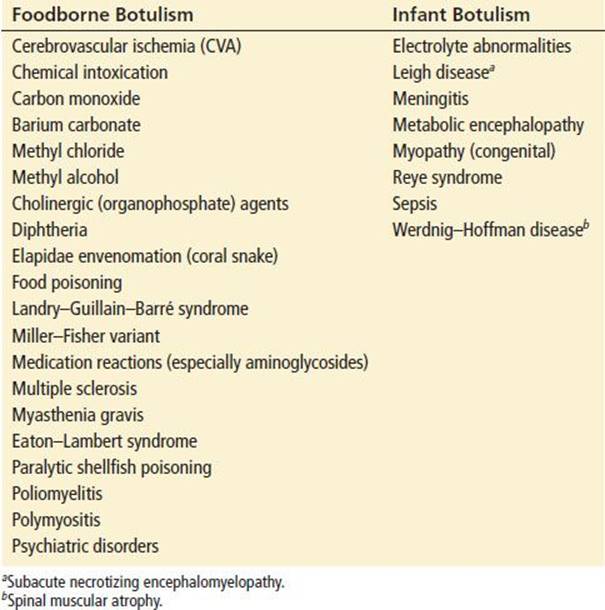
Regardless of the type of botulism, the neurologic manifestations are similar. The diagnosis is easier with large outbreaks; however, the majority of cases involve single patients. As a result, the diagnosis is often missed. Botulism should be considered in a patient presenting with gastrointestinal, autonomic, and cranial nerve dysfunction or in an infant with diminished sucking, feeding, and crying ability. The differential diagnosis for foodborne and infant botulism is listed in Table 352.1. Psychiatric illness should be a diagnosis of exclusion. Misdiagnosis as such has been fatal.
TABLE 352.1
Differential Diagnosis for Botulism
The gastrointestinal symptoms of botulism are nonspecific and do not demonstrate a distinctive pattern. Patients at this stage of the disease are often discharged with a diagnosis of food poisoning. Fever is absent in patients with botulism but can be present in certain types of food poisoning. A history of the consumption of canned foods, especially home-canned foods, may be helpful in arriving at the diagnosis.
Landry–Guillain–Barré syndrome usually results in ascending weakness or paralysis. In the Miller–Fisher variant of this syndrome, patients have bulbar palsies (diplopia, dysarthria, dysphonia, and dysphagia) and descending weakness or paralysis, making it extremely difficult to distinguish clinically from botulism. Gastrointestinal symptoms are lacking in Landry–Guillain–Barré syndrome, unless they are part of the associated antecedent viral syndrome.
Myasthenia gravis may present as weakness, ptosis, and ophthalmoplegia; however, gastrointestinal symptoms are absent. A Tensilon (edrophonium) test may be necessary to differentiate myasthenia gravis from botulism (see Chapter 160). Edrophonium blocks the metabolism of acetylcholine in the synapse and has less effect in botulism, in which there is decreased neurotransmitter release, although some degree of clinical improvement may occasionally be seen.
The Centers for Disease Control and Prevention (CDC) criteria for the diagnosis of botulism requires a patient who presents with descending paralysis to have one of the following: C. botulinum isolated from stool or wound specimens; botulinum toxin in serum, stool, or implicated food samples; or a compatible illness in a person who is epidemiologically linked to a case confirmed by the previous methods (7). Although not included in the CDC diagnostic criteria, electromyography demonstrating findings typical of botulism may be required in order for antitoxin to be released. Botulism demonstrates a typical pattern on repetitive stimulation test (20 to 50 Hz) (8). Although this pattern is not pathognomonic for botulism, when it is combined with other clinical data it can be used to make the diagnosis.
ED EVALUATION
The history should include the time of onset; nature, progression, and severity of symptoms; and questions concerning diet, crush injuries, skin wounds, and injected drugs. The physical examination should focus on neurologic evaluation, particularly cranial nerve function, muscle strength, deep tendon reflexes, pupil size and reactivity, extraocular motor function, swallowing, and phonation. As death from botulism is from respiratory insufficiency, patients should have frequent assessments of vital capacity and negative inspiratory force.
Cell counts, serum electrolytes, and plain radiographs are usually normal in patients with botulism but may be helpful to exclude other diagnoses. Normal cerebrospinal fluid or slightly elevated spinal fluid protein may be seen in botulism and distinguishes it from other disease states such as meningitis. Landry–Guillain–Barré syndrome may reveal elevated protein without pleocytosis, but early in that syndrome the spinal fluid may be normal. Brain imaging (computed tomography [CT] or magnetic resonance imaging [MRI]) is normal in patients with botulism but may yield the diagnosis of cerebral or cerebellar infarct.
The Tensilon test can help differentiate myasthenia gravis from botulism.
When botulism is suspected, electromyography should be performed as soon as possible.
Stool, serum, or wound cultures should be sent for C. botulinum to the state health department laboratory or the CDC. Serum and stool samples and wound tissue should also be sent for detection of botulinum toxin. In one study, at least one of these laboratory tests was positive in 65% of patients diagnosed with botulism. Stool and sera should be refrigerated but not frozen. Wound specimens should be placed in an anaerobic device. Suspected food should be left in their original containers and placed in sterile unbreakable containers if possible. Currently, the mouse bioassay used to detect botulinum toxin is complicated, and results are often delayed. Rapid assays under development may allow for more rapid confirmation (5).
KEY TESTING
• Supportive care testing for electrolytes, complete blood count (CBC), calcium, magnesium
• Lumber puncture (LP), Tensilon test, and brain imaging to investigate other potential causes
• Electromyography (EMG) is the fastest test to suggest botulism
• Send serum, stool, wound, and food samples to state laboratory or CDC for confirmation
ED MANAGEMENT
Supportive care is the mainstay of treatment. Endotracheal intubation with mechanical ventilation is recommended for patients with a vital capacity <30% of predicted (or <12 mL/kg). Fluids should be given to replete any gastrointestinal losses, and parenteral analgesics can be given for the pain associated with abdominal distention.
Despite the delay from ingestion of contaminated food to presentation, gastric decontamination should be considered in cases of foodborne botulism. Gastric lavage may remove any remaining toxin or contaminated food from the stomach. Activated charcoal has been shown to reduce morbidity and mortality in animals (9). Only sorbitol-based cathartics should be used, as magnesium may exacerbate weakness. Although whole-bowel irrigation can aid in removal of toxin from the gut, this has not been evaluated in a formal study.
A heptavalent (types A–G) botulism antitoxin (HBAT) has been developed by the US Army and was approved by the FDA in 2013 to replace previous monovalent and bivalent antitoxin preparations for patients older than 1 year (10). The equine-derived antitoxin is distributed by the CDC to nine local repositories in the United States and is available by contacting the state health department. Antitoxin is most effective when given within 24 hours of symptom onset and should be administered as soon as the diagnosis of botulism is suspected, without waiting for laboratory confirmation. The antitoxin does not reverse symptoms already present on administration. It can only prevent symptom progression, further stressing the necessity of early administration.
The initial dose of HBAT is one vial diluted 1:10 given intravenously, slowly to observe for allergy and adverse effects. The benefits of antitoxin therapy must be weighed against the potential adverse effects. Because antitoxin is an animal-derived biologic product, its use can result in anaphylaxis, hypersensitivity reactions, and serum sickness. It is not recommended to administer a test dose to assess hypersensitivity, because botulism can be fatal and antitoxin is the only available therapy. Clinicians should be prepared to handle any adverse reactions and should have appropriate medications (e.g., epinephrine) readily available.
A human botulism immune globulin (Baby-BIG) was approved by the FDA in 2013 but it is in use for many years for infant botulism. It is only available from the California Department of Health Services Infant Botulism Treatment and Prevention Program.
Antibiotics should be administered for wound botulism. Penicillin G is usually the first-line agent, although many antibiotics have been shown to be effective against C. botulinum. Early surgical consultation should also be obtained for cases of wound botulism because debridement is considered a primary therapeutic intervention (8).
In contrast, antibiotics are not generally recommended for infant botulism. Aminoglycosides have been demonstrated both clinically and experimentally to potentiate neuromuscular blockade. Use of antibiotics in infant botulism can exacerbate the condition, as lysis of intraluminal C. botulinum may increase the amount of toxin absorbed (2). The benefit of antibiotic therapy for foodborne botulism has not been demonstrated and it is thus not recommended.
CRITICAL INTERVENTIONS
• Consider adult botulism when there is a history of ingestion of smoked, salted, or canned food.
• Consider infant botulism in a floppy baby with respiratory insufficiency.
• In cases of suspected wound botulism, consult a surgeon regarding debridement.
• Assess the vital capacity in patients with suspected botulism and perform endotracheal intubation on those with a vital capacity <30% of predicted (<12 mL/kg).
• Contact the state department of health or the CDC (770-488-7100) and administer botulism antitoxin as soon as possible.
DISPOSITION
Any patient suspected of having botulism should be admitted to a critical care setting. This allows for observation, frequent neurologic examinations, assessments of respiratory status, and monitoring for anaphylaxis, which is a risk with the administration of the antitoxin.
Consultants from infectious disease, toxicology, critical care, and neurology may aid in diagnosis and assumed care. Patients need frequent respiratory evaluations and should be admitted to an intensive care unit. Early surgical consultation should be obtained for cases of wound botulism because debridement is considered a primary therapeutic intervention (8). Contact with the state health department or CDC Emergency Operations Center (770-488-7100, available 24 hours a day) is also required as soon as possible to allow for early administration of antitoxin.
Prolonged admission is the usual course, as the recovery period can last from weeks to months and occasionally up to a year, but mortality has fallen from 50% to less than 5% currently for untreated cases. Patients who receive early and aggressive supportive care usually do well. Although patients can make a complete recovery, long-term sequelae are common and range from fatigue to persistent muscle weakness and dyspnea.
Common Pitfalls
• Failure to consider the diagnosis of botulism in patients with diplopia, dysphagia, dysphonia, and weakness, or in infants with constipation, feeding problems, and hypotonia.
• Failure to adequately monitor for respiratory insufficiency.
• Failure to appreciate that electromyography is the most rapidly available diagnostic test.
• Failure to appreciate that early antitoxin administration is the best therapy.
• Failure to administer antitoxin pending results of a test dose to assess for hypersensitivity.
ACKNOWLEDGMENTS
The author would like to thank Dr. Adhi Sharma for his contributions to previous editions of this chapter.
REFERENCES
1. Kao I, Drachman DB, Price DL. Botulinum toxin: Mechanism of presynaptic blockade. Science. 1976;193(4259):1256–1258.
2. Centers for Disease Control and Prevention. Botulism in the United States 1899–1996: Handbook for Epidemiologists, Clinicians and Laboratory Workers. Atlanta, GA: Centers for Disease Control and Prevention; 1998.
3. Poppof MR, Botulinum neurotoxins: More and more diverse and fascinating topic proteins. J Infect Dis. 2014;209:168–169.
4. Barash JR, Arnon SS. A novel strain of clostridium botulinum that produces type B and type H botulinum toxins. J Infect Dis. 2014;209:183–191.
5. Arnon SS, Midura TF, Clay SA, et al. Infant botulism. Epidemiological, clinical, and laboratory aspects. JAMA. 1977;237(18):1946–1951.
6. Werner SB, Passaro D, McGee J, et al. Wound botulism in California 1951–1998: Recent epidemic in heroin injectors. Clin Infect Dis. 2000;31(4):1018–1024.
7. Centers for Disease Control and Prevention. Case definitions for infectious conditions under public health surveillance. MMWR Recomm Rep. 1997;46(RR-10):1–55.
8. Valli G, Barbieri S, Scalato G. Neurophysiological tests in human botulism. Electromyogr Clin Neurophysiol. 1983;23(1–2):3–11.
9. Gomez HF, Johnson R, Guven H, et al. Adsorption of botulinum toxin to activated charcoal with a mouse bioassay. Ann Emerg Med. 1995;25(6):818–822.
10. U.S. Department of Health & Human Services. FDA approves first Botulism Antitoxin for use in neutralizing all seven known botulinum nerve toxin serotypes. http://www.fda.gov/newsevents/newsroom/pressannouncements/ucm345128.htm. Acessed August 7, 2014.
11. Anonymous. Botulism–nformation from the World Health Organization. J Environ Health. 2003;65(9):51–52.