
Jeffrey R. Suchard
Several dozen scorpion species are found in the United States. Envenomation from almost all of these species causes only local pain and inflammation, which respond well to minimal supportive therapy. The Arizona bark scorpion, Centruroides sculpturatus (alternately C. exilicauda by an older taxonomy), is the only native species known to produce a potentially life-threatening envenomation. This scorpion is found throughout Arizona and in parts of some neighboring states and northern Mexico (1). Stings may occasionally occur elsewhere, as scorpions have been reported to stow away in a person’s belongings (e.g., shoes, duffel bags) and be transported long distances before encountering their victims. Mild-to-moderate systemic effects have been reported in a minority of stings by the common striped scorpion, Centruroides vittatus, found in the Southwest and Texas and into southern Indiana and Illinois (2).
C. sculpturatus specimens generally measure about 5 cm (range, 1.3 to 7.6 cm) in length, have a thin tail and claws, and are a uniform tan, yellow, or light brown (Fig. 371.1). The last tail segment contains a venom apparatus and stinger. The bark scorpion prefers to reside in or near trees but may also hide in ground debris, camping equipment, clothing left unattended in natural desert areas, or even in areas long inhabited by humans. Scorpions are most active at night in warm weather, lying quietly while waiting to ambush prey. In defending themselves, they grasp the victim’s flesh with pincers and repeatedly sting by thrusting their tails over their bodies.

FIGURE 371.1 The sixth tail segment of C. Sculpturatus (bark scorpion) contains venom apparatus and stinger.
Although a sting from any scorpion can produce local pain, C. sculpturatus venom contains protein neurotoxins that cause repetitive firing of neurons by binding to sodium channels and preventing channel inactivation (1). Prolonged and excessive firing of parasympathetic, sympathetic, and somatic motor neurons produces various autonomic effects and uncoordinated, spontaneous activity in skeletal muscle. No destructive enzymes are present in the venom, so there is no inflammation or necrosis.
Scorpion stings are fairly common in endemic areas. Several thousand C. sculpturatus stings are reported annually to poison control centers in Arizona (3), although the majority of envenomations are not serious enough to require medical attention. Death from direct venom effects has not been reported in Arizona for several years; the lack of recent fatalities probably reflects advances in supportive medical care.
Severe envenomations by C. sculpturatus occur in 15% to 20% of children younger than age 10 who are stung and almost all severe envenomations occur in this age group. In contrast, 95% of envenomations in those older than age 10 result in only mild-to-moderate effects. The life-threatening effects (myocarditis, pulmonary edema, shock) associated with dangerous scorpion species in other parts of the world have not been reported with species found in the United States.
CLINICAL PRESENTATION
C. sculpturatus envenomation results in the immediate onset of a painful tingling or burning sensation at the sting site. Tapping the sting site may produce severe pain, although no lesion is usually visible. Over minutes to several hours, pain and paresthesias may become generalized. Victims may complain of “thick tongue” and “trouble swallowing” yet lack objective abnormalities on examination. Young children frequently rub their noses, eyes, and ears and may present with unexplained crying.
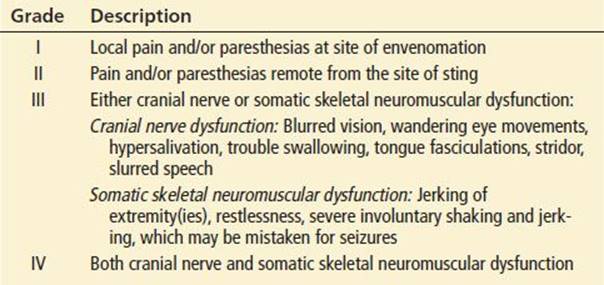
Autonomic dysfunction is characterized by tachycardia, excessive secretions and, occasionally, vomiting and wheezing. Somatic motor abnormalities include roving eye movements, blurred vision, fasciculations (especially of the tongue), and poor control of pharyngeal muscles. Continuous jerking of extremities may be noted and misinterpreted as restlessness, seizures, or hysteria. The combination of uncoordinated pharyngeal musculature and muscles of respiration, increased secretions, and occasional wheezing may produce stridor, hypoxia, aspiration, and respiratory arrest in severe cases. Mild hyperthermia may also be noted, probably related to motor hyperactivity.
Envenomations can be graded on the basis of signs and symptoms (Table 371.1). In serious envenomations, abnormal motor activity may last 10 to 20 hours (1,4). Paresthesias may last up to 2 weeks.
TABLE 371.1
Scorpion Envenomations: Signs and Symptoms
DIFFERENTIAL DIAGNOSIS
Bites and stings from other arthropods should be considered. The pain at the site of envenomation may appear similar to that seen after a black widow spider bite. However, patients severely ill from scorpion stings appear unable to lie still, whereas those bitten by black widow spiders can maintain a position for short periods before moving in an attempt to become comfortable. Black widow envenomations do not produce abnormal eye movements, fasciculations, and paresthesias. Tapping over the site of envenomation produces severe pain in the patient stung by a scorpion but not in someone bitten by a spider. Black widow spider bites frequently produce a characteristic halo lesion at the site of the bite; no lesion is usually visible after C. sculpturatus stings.
Tachycardia, excessive secretions, wheezing, and respiratory distress accompanying serious scorpion stings may be mistaken for asthma, airway obstruction from a foreign body, or poisoning with cholinergic agents such as organophosphate insecticides. Without a witnessed scorpion sting, other entities to be considered include central nervous system infections, seizures, and intoxication with sympathomimetics, phencyclidine, and nicotine. Methamphetamine toxicity is sometimes mistaken for C. sculpturatus envenomation in scorpion-endemic areas when young children present with unusual neurologic findings such as agitation or choreiform movements, occasionally leading to the inappropriate use of antivenom.
ED EVALUATION
If a sting was not witnessed, it should be determined whether there are scorpions near where the patient became ill. Physical examination should focus on vital signs, the airway, and neuromuscular function. No specific diagnostic tests are available. In patients with suspected aspiration, chest radiography is indicated, and arterial blood gas analysis should be considered. Rarely, severe envenomations can cause pancreatitis, rhabdomyolysis, and myocarditis, which would warrant obtaining baseline laboratory tests including serum amylase and/or lipase, creatine kinase, and an electrocardiogram.
KEY TESTING
• If signs of systemic illness: Pulse oximetry
• There is no confirmatory test available and patients without systemic illness require no specific testing
ED MANAGEMENT
Advanced life-support measures, with particular attention to airway management, should be instituted as necessary. Patients with grade I or II envenomations are treated symptomatically. Application of ice or oral analgesics is effective in most cases, but parenteral analgesia may sometimes be needed. As with any puncture wound, the patient’s tetanus immunization status should be addressed.
Several therapeutic interventions have been used historically, although few have been rigorously tested and are not generally recommended. Except for very rare cases of anaphylaxis in patients previously sensitized to scorpion venom, there is no demonstrable benefit from steroids, epinephrine, or antihistamines. Respiratory distress associated with hypersalivation has been treated with atropine, sometimes obviating the need for aggressive airway interventions (5). The ideal dosing of atropine has not been determined nor is this practice considered a standard of care.
The marked motor hyperactivity seen in young children with high-grade envenomations has been treated with IV sedatives. Barbiturate infusion was a former mainstay of therapy, although continuous midazolam infusions in the pediatric intensive care unit (ICU) have had good results. The median length of stay was just over 15 hours, and only 4 patients of 104 had transient hypoxemia (6). Sedation in a closely monitored setting has become the default therapy for high-grade scorpion envenomations since local production of a goat-derived Centruroides antivenom ceased in 2001 and the last vials expired in 2004 (3).
An equine-derived Centruroides (Scorpion) Immune F(ab’)2 antivenom product was approved by the US FDA in 2011 and is indicated for high-grade envenomations (7). It is available at a limited number of hospitals in the desert Southwest, primarily in Arizona, but also some in Nevada and Utah. Initial dosing is 3 vials IV diluted in normal saline to 50 mL and given over 10 minutes; additional 1 vial doses may be given as needed every 30 to 60 minutes (8). Patients need close monitoring with attention to airway control and the possibility of needing to treat severe allergic reactions. The great majority of patients (95%+) treated with this antivenom have resolution of systemic findings within 4 hours. Antivenom-treated patients should be advised that serum sickness may occur within a few weeks, which usually responds well to typical doses of steroids and antihistamines. The cost of scorpion antivenom therapy in the United States can be tremendous, with some reports of patients being charged tens of thousands of dollars.
CRITICAL INTERVENTIONS
• Airway control is of primary importance. Severely envenomated patients may require airway interventions as a result of hypersalivation and poor control of the oropharyngeal musculature.
• ICU admission for close observation is often necessary when complication such as aspiration pneumonia have occurred.
• Antivenom therapy can be effective in rapidly reversing toxicity in patients with severe systemic findings.
DISPOSITION
Patients with local pain and inflammation from a non-Centruroides scorpion sting should only require symptomatic treatment and can be discharged home.
Patients with grade I or II Centruroides envenomations should be observed for 3 to 4 hours after a sting for evidence of progression of symptoms. Those who do not manifest increased envenomation severity can be discharged to home with oral analgesics and follow-up with their personal physician as needed.
Antivenom therapy should be considered for patients with more severe Centruroides envenomations. If successful, these patients may be discharged home after ED observation with information about serum sickness and a treatment plan should it occur. In the absence of antivenom, children with grade III or IV envenomations should be admitted to an ICU. Adults without respiratory difficulties who require admission for pain control may be admitted to an unmonitored bed. Adults with more severe envenomations generally require intensive care.
Common Pitfalls
• Mistaking symptoms of severe envenomation for hysterical or uncooperative behavior or for seizures, especially in children.
• Relying on the absence of a visible lesion at the site of the sting to rule out scorpion envenomation.
REFERENCES
1. Curry SC, Vance MV, Ryan PJ, et al. Envenomation by the scorpion Centruroides sculpturatus. J Toxicol Clin Toxicol. 1983;21(4–5):417–449.
2. Stipetic ME, Lugo A, Brown B, et al. A prospective analysis of 558 common striped scorpion (Centruroides vittatus) envenomations in Texas during 1997. J Toxicol Clin Toxicol. 1998;36:461.
3. Riley BD, LoVecchio F, Pizon AF. Lack of scorpion antivenom leads to increased pediatric ICU admissions. Ann Emerg Med. 2006;47:398–399.
4. Rimsza ME, Zimmerman DR, Bergeson PS. Scorpion envenomation. Pediatrics. 1980;66:298–302.
5. Suchard JR, Hilder R. Atropine use in Centruroides scorpion envenomation. J Toxicol Clin Toxicol. 2001;39:595–598.
6. Gibly R, Williams M, Walter FG, et al. Continuous intravenous midazolam infusion for Centruroides exilicauda scorpion envenomation. Ann Emerg Med. 1999;34:620–625.
7. Boyer LV, Theodorou AA, Berg RA, et al. Antivenom for critically ill children with neurotoxicity from scorpion stings. N Engl J Med. 2009;360:2090–2098.
8. Anascorp®. Centruroides (Scorpion) Immune F(ab’)2 (Equine) Injection package insert. Rare Disease Therapeutics, Inc. 2011.