
Robin R. Hemphill
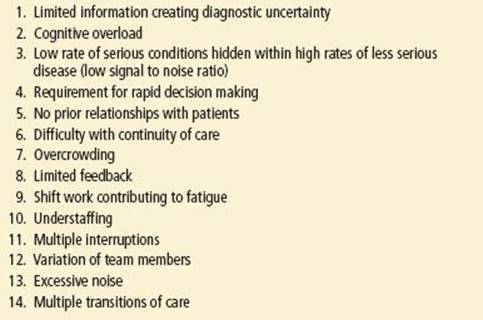
Patient safety may be defined as those events that should never happen to patients as they interact with the health system. Put more eloquently, patient safety is a dynamic nonevent. Despite increased attention, patients continue to be harmed by the very system that intends to heal them. The emergency department (ED) setting is a particularly challenging arena and is prone to errors for a variety of reasons (Table 379.1).
TABLE 379.1
ED Conditions Conducive to Errors
Opportunity to improve may come from those industries that are recognized as High Reliability Organizations (HROs). These organizations are ones that are at high risk for hazard, yet have lower rates of accidents and adverse events than one would expect given the complexity of their operations. Examples include the airline industry, aircraft carriers, and nuclear and chemical plants. Weick and Sutcliff (1) have studied such organizations and find that all have five things in common: preoccupation with failure, reluctance to simplify, sensitivity to operations, commitment to resilience, and deference to expertise.
While the healthcare system is not identical to any of the industries mentioned, a framework can be developed to help operationalize these concepts (Fig. 379.1). A successful journey to high reliability must balance across all of the elements in this diagram.
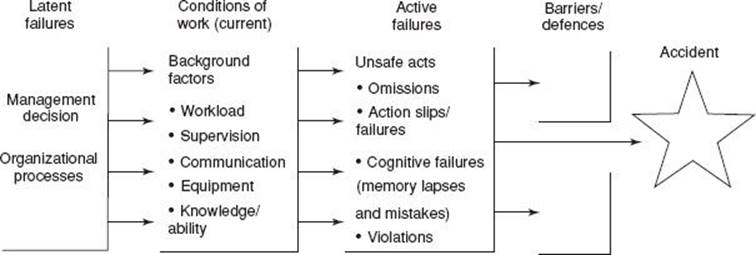
FIGURE 379.1 Anatomy of a complex accident. (Reproduced with permission from Vincent C, Taylor-Adams S, Stanhope N. Framework for analysing risk and safety in clinical medicine. BMJ. 1998;316(7138):1154–1157.)
FRAMEWORK FOR HIGH RELIABILITY IN HEALTH CARE
Culture of Safety
Put simply, a safe culture is one in which those in charge are willing to hear bad news and act appropriately. Developing such a culture is a central element of efforts to improve both the safety and the quality of care provided to patients (2).
Just Culture
A Just Culture is one in which the line between acceptable and unacceptable behavior is clearly stated. It recognizes that individuals make mistakes and acknowledges that even the most committed professionals will develop unhealthy norms (short cuts, rule violations, etc.), but has no tolerance for behaviors that are repeatedly or purposefully harmful (3).
When an error or adverse event occurs, rather than asking “who is at fault,” a Just Culture asks “why did this happen.” Human error can be viewed in one of two ways: (1) It is the fault of the people working in the system (violations of procedure or policy, loss of situational awareness, careless or poorly trained individuals) or (2) it is a symptom of a system that has latent vulnerabilities dispersed throughout it. Latent failures are faults created by policies, directives, or decisions that have been made remote from immediate patient care settings. These latent failures typically occur at higher levels in the organization and they may be difficult to see until such time that they combine with other active failures and triggering factors that together combine to overwhelm barriers put in place to protect patients. This results in a near miss or actual harm. Examples of latent failures specific to the ED setting include hospital policies that impact patient flow in the ED, high patient volume resulting in cognitive overload, multiple interruptions, limited patient information, inadequate staffing, frequent overtime or long shifts, complex medical equipment, limited standardization of medical equipment, and challenging computer interfaces, among others.
If the assumption is made that individuals do not come to work with the intent to cause harm, then it is important to move beyond blaming the individual and instead look for the system vulnerabilities (latent errors) that have contributed to the adverse event. HROs do not look for the first or most simple answer found when considering adverse events; they dig below the obvious to find and correct the latent problems within the system that if uncorrected will likely cause another similar adverse event in the future. If the individual involved is blamed and punished for the error, it is unlikely that underlying contributing factors will be found. Furthermore, others who witness the punitive action will be unlikely to disclose their own errors or near misses. Opportunities will be lost to focus on and understand failures and near misses and we will continue to blame people who find themselves at the end of a series of events (environmental and design, and occasionally policy) that make it very easy to do the wrong thing.
It is important to note that a Just Culture does expect accountability for acts that are indeed blameworthy. Individuals who purposely violate policies intended to protect patients should be counseled and disciplined appropriately. Furthermore, accountability in a Just Culture expects managers and supervisors to address problem employees before they make an error that harms a patient, rather than waiting to act until a problem employee makes an error that might have been prevented.
It is questionable whether we can fully understand the intention of an individual when an adverse event has occurred. When reviewing an error that has harmed a patient, it is almost impossible to avoid “hindsight bias” (i.e., once the outcome is known, overestimating the clarity of events to those involved at the time) and some events can be seen to rise to the level of a willful disregard for patient safety. But such confident leaps should be approached cautiously. Iatrogenic harm is not necessarily caused by the random collision of independent failures, human errors, and intentional behaviors. Rather, it often results from a systematic migration of organizational behavior caused by the stress of operating in an underresourced and demanding environment where cutting corners to improve efficiency is not only valued, but openly celebrated. The more success that is attained at this limit of safe operating capacity, the more accepted (and even expected) it will become until a tragedy occurs. This is called the normalization of deviance, and is difficult to appreciate as it is happening. Only in hindsight is it clear that limits were being pushed well beyond what was safe. At that point there is often a single individual who appears to be at fault.
Engaged Leadership
Leadership is the driving force behind a safety culture and senior leaders have the responsibility as well as the authority to make safety a priority. It is critical for leadership to make safety part of the daily discussion and a center point of major meetings and strategy sessions (4). Frontline staff will believe that safety is important to the organization’s senior leadership if those leaders visit the departments where the work occurs (leadership walk or sit rounds) and engage directly with the staff about what they see and what their concerns are. This allows for a cyclical flow of information (5) from staff to leaders and back. Leadership in the ED should also show support for directives and policies that enhance safety (time outs, checklists, follow-through on actions after root cause analyses (RCAs), daily safety huddles, etc.). It is also important for leadership to support the transparent reporting of adverse events to affected patients and families. Finally, leadership will determine the response to adverse events and should establish nonpunitive reporting systems, as well as help providers recover from the emotional distress they may feel after being involved in an event that harmed a patient.
High Functioning Clinical Teams
Medical training is competitive and not necessarily conducive to the development of team behaviors. The assumption that individuals will by themselves emerge from their training environment with team skills is not justified. Developing truly high functioning teams takes training and practice.
Health care is provided by teams of individuals with specialized knowledge, skills, and roles but who should share a common goal in patient care. They are dependent upon one another and their actions need to be coordinated to achieve the desired goal. Members of the team must have a shared mental model that allows each person to maintain situational awareness, the continuous perception of the team in relation to its dynamic environment, and the perceived ability to make adjustments. It includes being aware of critical information, comprehending the meaning of this information, and planning for future possibilities (6).
Much of the recent work in improving team performance in the medical environment has been based upon the aviation model of Crew Resource Management (CRM). Multidisciplinary training in CRM teaches behaviors to help manage human error. This includes team practice behaviors to avoid error (marking a site, conducting a briefing, checklists), team practice behaviors to trap error (closed loop communication such as read-backs, redundant double-checks, and timeouts as a final check that ensure that the message transmitted is the message heard and acted upon), and team practice behaviors to mitigate the consequences if an error affects the patient (immediate reporting of errors which act to reduce the impact of an error). Achieving such levels of performance requires individuals to learn both leadership and follower behaviors, including an understanding of how leadership styles can impact team performance as well as skills to bring critical information to the attention of team members. In the operating room, these behaviors along with a checklist-guided team briefing that precedes every operation have been a cornerstone of improved outcomes. Critical information is shared, reviewed, and confirmed by the team. Any concerns or questions can be addressed prior to the start of the case. Potential complications can be reviewed and anticipated. In the operating room these briefings have resulted in improved perceptions of teamwork, prophylactic administration of antibiotics, and deep venous thrombosis treatment (7), as well as decreased operative mortality (8). While much of the work thus far has been in the surgical literature, success has been noted in a variety of clinical settings. These techniques may also be applied to the ED setting (9,10). For example, in cases of care delivered to a critically ill patient, the provider can discuss what the diagnosis is thought to be, the treatment options chosen, and a brief review of what the team should see if the patient responds, as well as what might occur if the early diagnosis is incorrect.
Understanding Complexity and Improving the Environment of Care
Health care is complex. This means that it consists of interdependent and diverse components that adapt to changes in the environment and is distinct from complicated systems that are not able to adapt to change. For example, one’s car is complex and has many interdependent parts, but if it runs out of gas, it cannot adapt in some way to keep running. The ED on the other hand has many interdependent parts, but if it is poorly staffed, it does not shut down, it adapts. This means that even the best of intended changes can ripple through the system and manifest in unexpected, and occasionally harmful, ways. If one understands that the components of the healthcare system will interact with and adapt to changes and barriers, it should be clear that a culture that values the reporting of errors, concerns, risks, or near misses is imperative to prevent or mitigate harms that may emerge in this system. The only way to identify these harms, however, is for the organization to be willing to discuss and face its problems. This is why the Just Culture is so critical if we are to improve patient safety. If individuals are punished for errors, the problem may appear to have been solved, but organizational failures almost never have a single cause. Unless the latent errors that contributed to the problem are uncovered, adverse events will likely recur. When near misses or error occur, these incidents should be understood to present opportunities to learn from the event. Tools such as RCA may be used to more fully understand and identify the system vulnerabilities that may have contributed to an adverse event or near miss. The RCA process helps identify root and contributory factors that led to the event and then recommends strategies to reduce future similar events. Other tools, such as healthcare failure and effect analysis (HFMEA), offer opportunities to assess for system vulnerabilities before a close call or adverse event occurs. This tool allows a team to map out a high-risk process and assess its vulnerabilities so that mitigation steps can be built into the system. Each of these tools offers the possibility of recognizing contributors of harm and responsing with efforts to improve the environment of care. In the case of RCA, the lessons learned are retrospective but can still be very helpful. Over time these reporting systems can help identify problems at the macro system level and so large-scale improvements can be considered. Such improvements should be informed by the use of human factor techniques when possible, so that the system is designed taking into account an understanding of the causes of human error and an emphasis on making it easier to do the right thing. For example, a common error in anesthesia practice was to accidentally attach the tubing designed to deliver oxygen to the patient to the wall valve that delivered only air. When the valve was redesigned to make it difficult to attach oxygen tubing to the air valve, the problem was largely eliminated. While such redesigns of systems present distinct challenges and are not always possible, this type of solution should be the goal. Interventions such as training programs and letters of reprimand will not improve safety comparably over the long term.
CHALLENGES TO MEASURING SAFETY
The Centers of Medicare and Medicaid Services has defined “never events” and it is fair to classify these as breakdowns in safety. At a single institution such cases are thankfully rare. Thus, it can be challenging to answer the simple question as to how safe an individual ED is. A recent framework to help measure safety has been suggested and consists of five broad classes (11):
• Past harm: This considers whether patients have been safe in the past and might include mortality statistics, use of a global trigger tool (12), incident reports, RCA collections, and other sources indicative of past harm.
• Reliability: This asks whether clinical systems, processes, and behaviors are reliable. Examples include compliance with hand washing, medication error rates, or percentage of patients who are appropriately consented prior to a procedure.
• Sensitivity to operations: This attempts to determine how safe care is today and relies on individuals and teams maintaining awareness. Strategies to achieve this include safety walk rounds (13), the designation of patient safety officers, and operational meetings, among others.
• Anticipation and preparedness: This attempts to determine whether care will be safe in the future. Examples include surgical checklists which force a period of reflection in which problems associated with the procedure can be reviewed, HFMEAs, and a focus on creating a culture of safety.
• Integration and learning: The focus here is on responding and improving. Examples of this might be the review of common contributors to errors found through RCAs used to improve processes or tools to reduce recurrence of similar errors.
Approaches to Improving Patient Safety
• Make a discussion of safety and quality of a part of every ED staff meeting.
• Commit to a Just Culture where adverse events and near misses are freely discussed without punishment and accountability processes are clearly defined.
• Engage in team training to enhance communication and to increase team situational awareness.
• Focus on improving the environment of care using human factors approaches to make it easier to do the right thing.
• Complexity is the enemy of safety—focus on ways to minimize unneeded hand-offs and process steps (e.g., transcribing physician orders into a computer increases the risk of error more than having the physician enter orders directly).
• Reduce reliance on memory—use checklists, algorithms, and clinical pathways, and allow easy access to current references.
• Standardize processes when appropriate.
• Focus on developing measures to determine how safe the care in the ED is.
• Review recent literature on safety strategies that are ready for adoption now and tailor those that are appropriate to the ED setting (14).
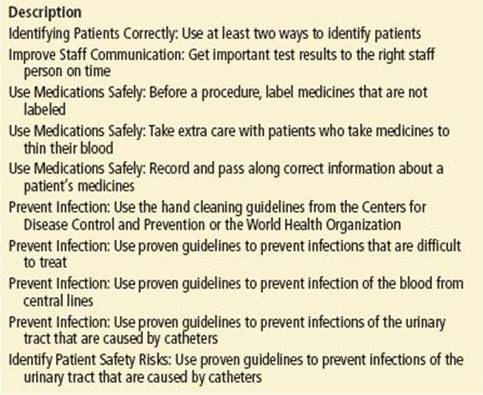
• Be familiar with The Joint Commission National Patient Safety Goals for 2013 and develop strategies to address those relevant to the ED (see Table 379.2) (15).
TABLE 379.2
2013 Joint Commission Patient Safety Goals Relevant to EM
Common Pitfalls
• Failure of leadership—failure to commit to development of culture and team development. Safety is not a person, it is an ongoing value that infuses all aspect of clinical practice.
• Resistance to standardization.
• Burying patient safety in the system—bad news needs to get to the top.
• Failure to understand that safety and efficiency are in tension—in our efforts to push the system to be more efficient we can begin to compromise safety. Many things seen as duplicative and wasteful are redundancies built into the system to maintain safety.
• Settling for easy answers rather than understanding.
• Overreliance on technology. Advances in technology have enhanced safety in many areas, but technology may add layers of complexity that increase the risk of errors.
• Failure to engage the patient. Patients and their families can be effective in identifying errors. They should be informed about the expected course of their ED visit and encouraged to ask questions and speak up when they perceive that something is not consistent with the plan that was discussed.
REFERENCES
1. Weick KE, Sutcliffe KM. Managing the Unexpected: Assuring High Performance in an Age of Complexity. San Francisco, CA: Jossey-Bass; 2001.
2. Weaver SJ, Lubomski LH, WIlson RF, et al. Promoting a culture of safety as a patient safety strategy: A systematic review. Ann Intern Med. 2013;158(5 Part 2):
369–374.
3. Reason J. Achieving a safe culture: Theory and practice. Work Stress. 1998; 12:293–306.
4. Botwinick L, Bisognano M, Harden C. Leadership Guide to Patient Safety. IHI innovation Series white paper. Cambridge, MA: Institute for Healthcare Improvement; 2006.
5. Frankel A, Graydon-Baker E, Neppl C, et al. Patient safety leadership walkrounds. Jt Comm J Qual Saf. 2003;29:16–26.
6. St. Pierre M, Hofinger G, Buerschaper C. Crisis Management in Acute Care Settings. Berlin: Springer-Verlag; 2008.
7. Paull DE, Mazzia LM, Wood SD, et al. Briefing guide study: Preoperative briefing and postoperative debriefing checklists in the Veterans Health Administration medical team training program. Am J Surg.2010;200:620–623.
8. Neily J, Mills PD, Young-Xu Y, et al. Association between implementation of a medical team training program and surgical mortality. JAMA. 2010;304:
1693–1700.
9. Sculli GJ, Fore AM, West P, et al. Nursing Crew Resource Management: A follow up report from the Veterans Health Administration. J Nurs Adm. 2013;43:122–126.
10. Wolk S, Paull DE, Mazzia LM, et al. Simulation-Based Team Training for Staff. Irvine, CA: Association of VA Surgeons; 2011.
11. Vincent C, Burnett S, Carthey J. The Measurement and Monitoring of Safety. Health Foundation; 2013. Available online at: http://www.health.org.uk/publications/the-measurement-and-monitoring-of-safety/.
12. Classen DC, Resar R, Griffen F, et al. Global trigger tool shows that adverse events in hospitals may be ten times greater than previously measured. Health Aff (Millwood). 2011;30:581–589.
13. Schulman PR. General attributes of safe organizations. Qual Saf Health Care. 2004;13(suppl 2):ii39–44.
14. Shekelle PG, Pronofost PJ, Wachter RM, et al. The top patient safety strategies that can be encouraged for adoption now. Ann Int Med. 2013;158(5 Pt 2):
365–368.
15. The Joint Commission. 2013 National Patient Safety Goals. Available online at: http://www.jointcommission.org/assets/1/18/NPSG_Chapter_Jan2013_HAP.pdf. Accessed May 15, 2013.