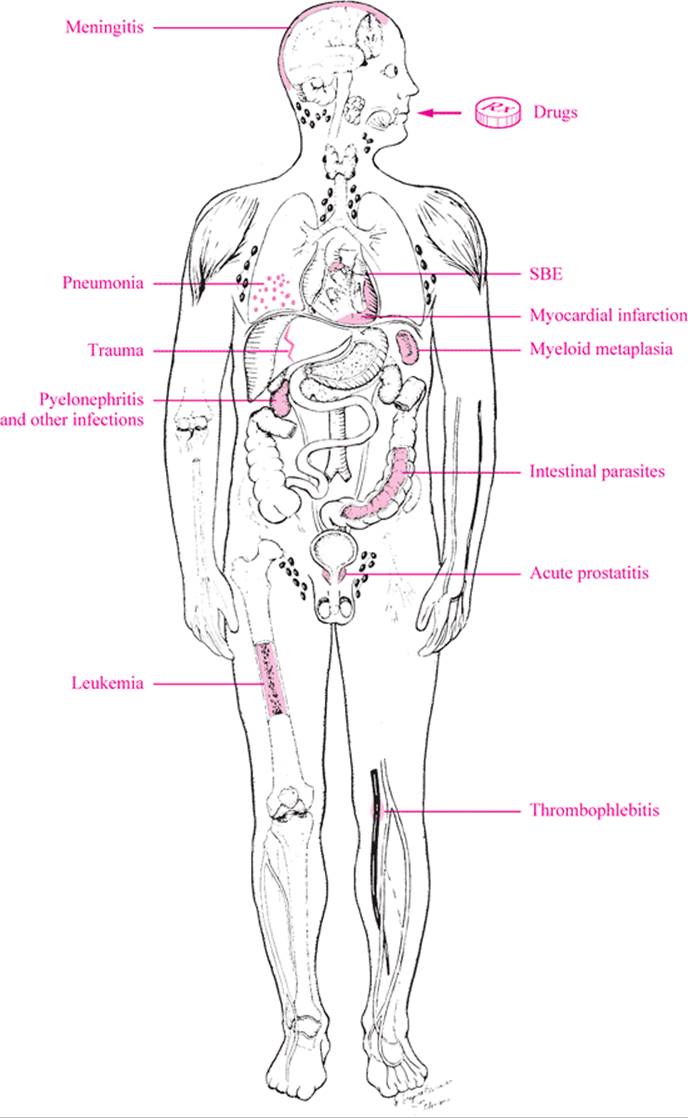
Numerous disorders cause leukocytosis. How can we recall all possibilities in the differential? The mnemonic VINDICATE would seem to be the answer.
|
|
|
Leukocytosis (obscure causes) |
· V—Vascular would call to mind myocardial infarction, pulmonary infarction, cerebral vascular accident, and thrombophlebitis.
· I—Inflammation should bring to mind bacterial infections anywhere in the body, but especially septicemia. Parasitic infections would cause an eosinophilia. Severe systemic fungal infections would also cause leukocytosis. Viral infections are not usually associated with leukocytosis but there are notable exceptions, such as infectious mononucleosis.
|
TABLE 44. Leg Pain |
||||||||||||||||||||||||||||||||||||||||||||||||||||||||||||||||||||||||||||||||||||
|
||||||||||||||||||||||||||||||||||||||||||||||||||||||||||||||||||||||||||||||||||||
· N—Neoplasm would of course prompt the recall of acute and chronic leukemias and agnogenic myeloid metaplasia.
· D—Degenerative disorders do not prompt the recall of any important disorder.
· I—Intoxication would bring to mind various drugs that are associated with a leukocytosis, such as lithium, corticosteroids, and lead.
· C—Congenital would bring to mind Down syndrome.
· A—Allergic and Autoimmune would prompt the recall of anaphylactic shock, asthma, and other diffuse hypersensitivity reactions as well as polyarteritis nodosa and dermatomyositis.
· T—Trauma reminds us that burns, fractures, massive hemorrhage, or contusions of various parts of the body cause a leukocytosis.
· E—Endocrine causes Cushing syndrome, and exogenous corticosteroids cause a leukocytosis. Pregnancy thyroid storm and diabetic ketoacidosis are also associated with a leukocytosis.
Approach to the Diagnosis
Because infection is the most common and often the most life-threatening cause, the history and physical are of most importance in locating a source. All suspicious body fluids should be analyzed and cultured. Urinalysis, urine culture, blood cultures, and spinal fluid cultures are just a few. It is important to look at the blood smear and differential count. If the count is very high, a pathologist or hematologist should be called in without delay. An infectious disease specialist may be necessary.
Other Useful Tests
1. CBC (leukemia)
2. Sedimentation rate (infection)
3. Chemistry panel (liver disease, kidney disease, infarction)
4. Antinuclear antibody (ANA) analysis (collagen disease)
5. Blood smear for malarial parasites (malaria)
6. Monospot test (infectious mononucleosis)
7. Anti-streptolysin O (ASO) titer (rheumatic fever)
8. Bone marrow examination (leukemia)
9. Liver–spleen scan (neoplasm, myeloid metaplasia)
10. Bone scan (metastasis)