|
|
|
Red eye |
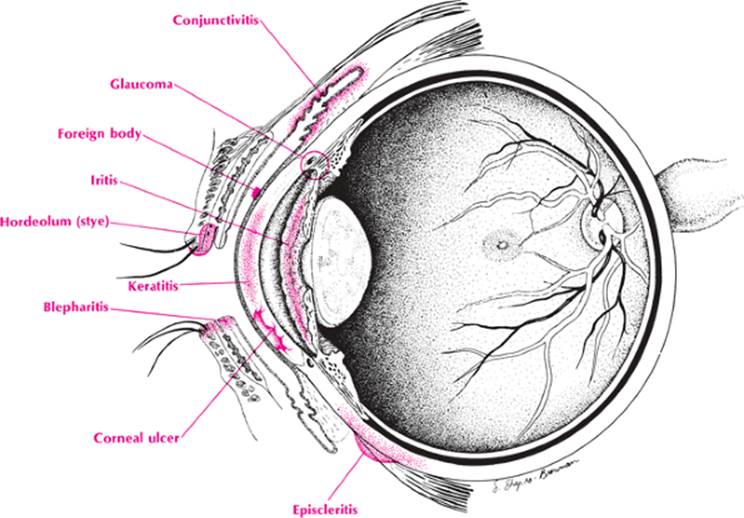
Most textbooks consider the causes of red eye to be conjunctivitis, iritis, or glaucoma, but it may be the result of taking the night plane from Los Angeles to New York. If these are all the causes you can remember, you will be sadly mistaken in some cases. Most of the causes can be quickly recalled by simply considering the anatomy of the eye, because trauma or inflammation is the usual cause.
Beginning with the eyelids, one recalls blepharitis and hordeolum. The conjunctiva suggests conjunctivitis. The cornea may be involved by a foreign body or keratitis; corneal ulcers should also be looked for. Proceeding to deeper layers, the physician should consider iritis, scleritis, or injury to these structures. Finally, between the cornea and iris is the canal of Schlemm, which recalls glaucoma. The vascular supply suggests a cavernous sinus thrombosis.
Another method that will bring to mind even more of the possibilities is to use the mnemonic FOREIGN. The word and the first letter signify foreign bodies. The O suggests otolaryngologic conditions such as upper respiratory infections. The R brings to mind refractive errors and astigmatism. The E suggests the exanthema and the conjunctivitis of measles. It will also help recall episcleritis and scleritis. I should signify iritis, conjunctivitis, and other inflammatory lesions. The G suggests glaucoma. Finally, the N should indicate neoplasms of the orbit.
Approach to the Diagnosis
Pinning down the diagnosis of a red eye is usually not difficult because most causes will be evident to the naked eye. However, a careful search for a foreign body with a magnifying glass and for a corneal abrasion using fluorescein will be necessary in some cases. The association of other signs and symptoms will be invaluable. Diffuse erythema of the eye usually indicates trauma, conjunctivitis, or scleritis, whereas circumcorneal injection suggests iritis or glaucoma. A dilated pupil suggests glaucoma, whereas a constricted or distorted pupil suggests iritis. A slit lamp will differentiate keratitis and obscure foreign bodies. Tonometry is useful in differentiating glaucoma from other conditions. A smear and culture will help differentiate infectious conjunctivitis from allergic conjunctivitis, but the latter is usually bilateral whereas the former is usually unilateral. An ophthalmologist should be consulted immediately if there is any doubt about the diagnosis.
Case Presentation #78
A 17-year-old black boy presents to the emergency room with redness of his left eye. He denies a history of trauma or foreign body. His left pupil is slightly constricted but reacts to light and accommodation. Your initial examination fails to reveal a foreign body.
Question #1. Utilizing your knowledge of anatomy, what is your differential diagnosis at this point?
Further questioning reveals that he has had intermittent bloody diarrhea for several months.
Question #2. What is your diagnosis now?