

• Usually without symptoms until stone becomes lodged in a ureter
• Excruciating intermittent radiating pain originating in the flank or kidney
• Nausea, vomiting, and abdominal distension
• Chills, fever, and urinary frequency if infection is present
• Diagnosed by ultrasound
Stone formation in the urinary tract has been recognized for thousands of years, but during the last few decades we have seen changes in the pattern and frequency of the disease. In the past, stone formation occurred almost exclusively in the bladder, whereas today most stones form in the kidneys. The frequency of stones has increased dramatically as well. It is now estimated that 10% of all American men will experience a kidney stone during their lifetime, with 0.1 to 6.0% of the general population having one in any given year. In the United States, 1 out of every 1,000 hospital admissions is for kidney stones. This increase in frequency parallels the rise in other diseases associated with the typical Western diet, including heart disease, high blood pressure, and diabetes.
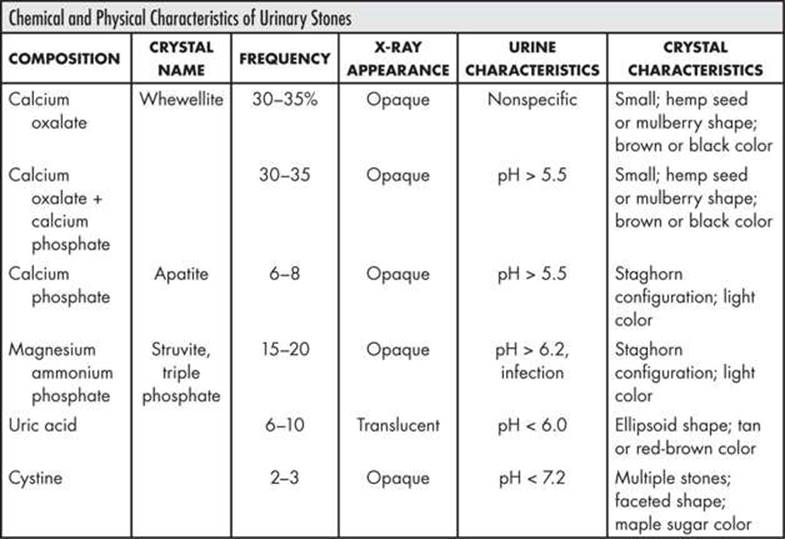
In the United States, most kidney stones (75 to 85%) are composed of calcium salts, while 5 to 8% are uric acid stones and another 10 to 15% are magnesium ammonium phosphate stones. The prevalence of different types of stones varies geographically, reflecting differences in environmental factors, diet, and drinking water. Men are affected more than women, and most patients are over 30 years of age.
Components in human urine normally remain in solution due to pH control and the secretion of substances that inhibit crystal growth. However, where there is an increase in the substances that make up stones or a decrease in protective factors, these substances can form a tiny crystal, which can then grow in size to what we call a kidney stone. There are a number of metabolic diseases that can lead to kidney stones, so it is important to have your doctor rule out such conditions as hyperparathyroidism, cystinuria, Cushing’s syndrome, and sarcoidosis.
Diagnostic Considerations
Diagnosing the type of stone is critical to determining the appropriate therapy. Careful evaluation of a number of criteria (diet; underlying metabolic or disease factors; urinalysis; urine culture; and blood levels of calcium, uric acid, creatinine, and electrolytes) will usually allow a physician to determine the composition of the stone if one is not available for chemical analysis.
Conditions favoring stone formation can be divided into two groups: factors increasing the concentration of the substances that make up stones, and factors favoring stone formation at normal urinary concentrations. The first group includes reduction in urine volume (dehydration) and an increased rate of excretion of stone constituents. The second group of factors is related to stagnation of urine flow (urinary stasis), pH changes, foreign bodies, and reduction in levels of substances that normally keep stone constituents from forming crystals.
Therapeutic Considerations
The high frequency of calcium-containing stones in affluent societies is directly associated with the following dietary patterns:
• Low fiber intake1
• High consumption of refined carbohydrates2,3
• High alcohol consumption4
• Consumption of large amounts of animal protein4,5
• High fat consumption6
• High consumption of soft drinks7
• Excessively acid-forming diet
Today conventional medicine classifies most stones as having an “unknown cause” (idiopathic), but this ignores the dietary factors that lead to stone formation. The cumulative effect of these dietary factors is undoubtedly the reason for the rising incidence of kidney stones.
As a group, vegetarians have a decreased risk of developing stones.5,8 Studies have shown that even among meat eaters, those who ate higher amounts of fresh fruits and vegetables had a lower incidence of stones.8 Adding bran to the diet and changing from white bread to whole wheat bread are two measures that have been shown to lower urinary calcium.9
|
Causes of Excessive Excretion of Relatively Insoluble Urinary Constituents |
||
|
CONSTITUENT |
CAUSE OF EXCESS EXCRETION |
LAB FINDINGS OR CAUSE |
|
Calcium (>250 mg excreted per day) |
Absorptive hypercalciuria |
Low serum PO4 |
|
Renal hypercalciuria (renal tubular acidosis) |
High serum PTH, high urinary cAMP |
|
|
Primary hyperparathyroidism |
High serum calcium, high calcitriol |
|
|
Hyperthyroidism |
||
|
High vitamin D intake |
High serum calcium |
|
|
Excess intake of milk and alkali |
||
|
Aluminum salt intake |
Low serum phosphate, high calcitriol |
|
|
Destructive bone disease |
||
|
Sarcoidosis |
||
|
Prolonged immobility |
||
|
Consumption of an excessively acid-forming diet |
||
|
Oxalate |
Familial oxaluria (rare) |
|
|
Ileal disease, resection, or bypass |
||
|
Steatorrhea |
||
|
High oxalate intake |
||
|
Ethylene glycol poisoning |
||
|
Vitamin C excess (extremely unlikely) |
Vitamin B6 deficiency or abnormal oxalate metabolism |
|
|
Methoxyflurane anesthesia |
||
|
Uric acid (>750 mg excreted per day) |
Gout |
|
|
Idiopathic hyperuricosuria |
||
|
Excess purine intake |
||
|
Anticancer drugs |
Rapid cell destruction |
|
|
Myeloproliferative disease |
||
|
Cystine |
Hereditary cystinuria |
|
Dietary factors may also play a role in acidifying or alkalinizing urine. Depending on the type of stone, this ability to alter urinary pH may help prevent and treat stones.10 In one study, 12 healthy men were given a standardized diet plus either cranberry, blackcurrant, or plum juice, then had their urine tested.11 The researchers found that cranberry juice decreased urinary pH (made the urine more acidic) and significantly increased the excretion of oxalic acid, leading to a higher concentration of uric acid. Blackcurrant juice increased urinary pH (made the urine more alkaline), leading to excretion of citric acid and loss of oxalic acid. Plum juice demonstrated no effects. These results indicate that blackcurrant juice could support the prevention and treatment of uric acid and oxalate stones, while cranberry juice could be useful in the treatment of oxalate stones as well as magnesium ammonium phosphate stones.
Another study showed that cranberry juice reduced the amount of calcium in the urine by over 50% in patients with recurrent kidney stones.12 Since high urinary calcium levels greatly increase the risk of developing a kidney stone, it appears that cranberry juice may offer significant benefit. Because most cranberry juice products on the market are loaded with sugar, it might be better to take a cranberry extract. For prevention of kidney stones in those at high risk, take the equivalent of 16 fl oz cranberry juice or follow dosage recommendations given on the product’s label.
Drinking more water has long been recognized as one of the main approaches to preventing kidney stones. Increasing the urine volume results in a decrease in stone prevalence. Numerous clinical trials have found that consumption of more than about 48 fl oz of water per day lowers the long-term risk of kidney stone recurrence by approximately 60%.13
Another dietary recommendation is to decrease salt consumption. Urinary calcium excretion increases approximately 40 mg for each 2,300 mg increase in dietary sodium in normal adults; those who form kidney stones have an even greater increase in urinary calcium with an increase in salt intake. The best approach is to combine increased water intake with decreased sodium intake.14
Weight Control and Sugar Intake
Weight control and correction of carbohydrate metabolism are important, since excess weight and insulin insensitivity lead to increased urinary excretion of calcium and are high risk factors for stone formation.15,16 A meal high in sugar is particularly detrimental, since urinary calcium levels rise following sugar intake, an effect that is exaggerated in most people (approximately 70%) with recurrent kidney stones.17 Obviously people with recurrent kidney stones should avoid sugar; sports drinks are especially problematic, because they combine sugars and salt.
Magnesium and Vitamin B6
A magnesium-deficient diet is one of the quickest ways to cause kidney stones in rats.18 Adequate levels of magnesium have been shown to increase the solubility of calcium oxalate and inhibit the formation of both calcium phosphate and calcium oxalate stones.18–20 A low urinary magnesium-to-calcium ratio is an independent risk factor in stone formation, and supplemental magnesium alone has been shown to be effective in preventing recurrences of kidney stones.20–22 However, when it is used in conjunction with vitamin B6, an even greater effect is noted.23,24
Many patients with recurrent oxalate stones show laboratory signs of vitamin B6 deficiency. As with magnesium, vitamin B6 deficiency also results in kidney stones. Supplemental vitamin B6 is known to reduce the production and urinary excretion of oxalates.25,26 Supplementing the diet with additional vitamin B6 is very important in preventing recurrent kidney stones.
Calcium
Most conventional doctors tell their patients with kidney stones to avoid calcium supplements; the thinking is that because calcium-containing stones are so common, restricting the amount of calcium in the diet will help reduce the formation of stones. However, studies show that calcium supplementation (300 mg per day of calcium, given as calcium carbonate, citrate, or malate) actually reduced oxalate absorption and excretion, and thus would help to prevent stone formation. Taking 300 to 1,000 mg calcium per day may be a useful preventive strategy.27
Citrate
Citric acid (citrate) has the ability to reduce the concentration of calcium oxalate and calcium phosphate in the urine, thus retarding the formation and growth of stones. Potassium or sodium citrate has been shown to be quite effective in the treatment of patients with recurrent calcium oxalate stones, with nearly 90% of patients showing improvement.28–31 For example, in one study, potassium citrate supplementation in recurrent stone formers resulted in a drop of stone formation from 0.7 to 0.13 per year.30 In another study, which tracked 57 people with a history of calcium stones and low urinary citrate levels, those given potassium citrate developed fewer kidney stones over a period of three years than they had previously.31 In comparison, the group given a placebo had no change in their rate of stone formation. However, it appears that magnesium citrate (rather than potassium or sodium citrate) offers the greatest benefit.
Another reason citrates decrease calcium oxalate stones is that they help reverse the acidification effects of the typical Western diet. One of the key ways the body works to neutralize excessive acid in the blood is by taking calcium from bone. Alkalinizing the diet decreases the excretion of calcium in the urine, suggesting that less calcium is being taken from the bones. For more information, see Appendix C, “Acid-Base Values of Selected Foods.”
Vitamin K
Vitamin K is necessary in the manufacture of a molecule that is a powerful inhibitor of kidney stone formation.32 The presence of vitamin K in green leafy vegetables may be one reason vegetarians have a lower incidence of kidney stones.33
Uric Acid Metabolism
The level of dietary purine consumption is directly related to the rate of urinary uric acid excretion.34 This fact is important, since elevations in the uric acid content of urine are a causative factor in recurrent uric acid stones. People with uric acid stones should entirely avoid foods high in purine, including organ meats, other red meats, shellfish, yeast (brewer’s and baker’s), herring, sardines, mackerel, and anchovies. They should also watch their consumption of foods with moderate levels of purine, including dried legumes, spinach, asparagus, other types of fish, poultry, and mushrooms.
Low-Oxalate Diet
Dietary oxalate may be responsible for as much as 80% of the urine oxalate in some people with recurrent kidney stones, indicating that restricting dietary oxalate intake may have a protective action.35–37 In one clinical trial, men with recurrent calcium oxalate stones who ate a diet that had normal amounts of calcium (1,200 mg per day), low amounts of animal protein, and low amounts of salt showed a significant reduction in oxalate excretion and a lower incidence of recurrent stones compared with men on a low-calcium diet (400 mg per day).37 It appears that people with recurrent kidney stones have a tendency to absorb higher levels of dietary oxalates compared with normal subjects not prone to kidney stones. A low-oxalate diet is usually defined as one containing less than 50 mg oxalate per day, so foods that have high or moderate levels of oxalate should be avoided.
Oxalate Content of Selected Foods
Very high oxalate, >50 mg per serving
• Vegetables
 Beets (greens or root)
Okra
Spinach
Swiss chard
• Fruits
Figs, dried
Rhubarb
• Grains
Buckwheat
• Nuts and seeds
Almonds
Peanuts
Peanut butter
Sesame seeds
High oxalate, >10 mg per serving
• Vegetables
Celery
Collards
Dandelion greens
Eggplant
Escarole
Green beans
Kale
Leeks
Parsley
Parsnips
Peppers, green
Potatoes
Pumpkin
Squash, yellow summer
Sweet potatoes
Tomato sauce, canned
Turnip greens
Watercress
• Fruits
Concord grapes
Kiwi
Lemon peel
Lime peel
Orange peel
• Grains
Bread, whole wheat
Oatmeal
Popcorn
Spelt
Wheat bran
Wheat germ
Whole wheat flour
• Legumes
Garbanzo beans
Lentils
Soybeans and all soy products
• Nuts and seeds
Brazil nuts
Hazelnuts
Pecans
Sunflower seeds
• Miscellaneous
Beer
Chocolate
Cocoa
Soy sauce (1 tbsp)
Tea, black or green
Moderate oxalate, 6 to 10 mg per serving
• Vegetables
Asparagus
Artichokes
Broccoli
Brussels sprouts
Carrots
Cucumber
Garlic
Lettuce
Mushrooms
Mustard greens
Onions
Pumpkin
Radishes
Snow peas
Tomato, fresh
Tomato sauce, canned (1/4 cup)
• Fruits
Apples
Apricots
Blackberries
Blueberries
Cherries, sour
Cranberries, dried
Currants, black
Oranges
Peaches
Pears
Pineapple
Plums
Prunes
Red raspberries
Tangerines
• Grains
Bagel (1 medium)
Barley, cooked
Bread, white (2 slices)
Corn
Corn tortilla (1 medium)
Cornbread
Cornmeal, yellow (1 cup dry)
Cornstarch (1/4 cup)
Pasta
Rice, brown
Spaghetti
White flour
• Legumes
Lima beans
Split peas
• Nuts and seeds
Cashews
Flaxseed
Walnuts
• Herbs
Basil, fresh (1 tbsp)
Dill (1 tbsp)
Ginger, raw, sliced (1 tsp)
Malt powder (1 tbsp)
Nutmeg (1 tbsp)
Pepper (1 tsp)
• Miscellaneous
Coffee
Red wine
Sardines
Tea, rose hip
Low oxalate, 2 to 5 mg per serving
• Vegetables
Acorn squash
Arugula
Ketchup (1 tbsp)
Onions
Peppers, red
Zucchini
• Fruits
Avocado
Cantaloupe
Cherries, sweet
Cranberries
Grapes
Lemons
Limes
Raisins
• Grains
Rice, white
Rice, wild
Rye bread
• Legumes
Peas, green
• Nuts and seeds
Coconut
• Herbs
Cinnamon, ground (11/2 tsp)
Ginger, powdered (1 tbsp)
Mustard, Dijon (1/4 cup)
Thyme, dried (1 tsp)
• Miscellaneous
Beef
Chicken
Corned beef
Eggs
Fish (haddock, plaice, and flounder)
Ham
Lamb
Pork
Turkey
Venison
Nutritional Supplements
Vitamin C
Vitamin C is often cited in the medical literature as a potential factor in the development of calcium oxalate kidney stones. However, numerous studies have now clearly demonstrated that high doses of vitamin C do not cause kidney stones. Studies have shown that vitamin C ingestion of up to 10 g per day does not have any effect on urinary oxalate levels.38,39 While some studies showed that taking high dosages of vitamin C increased oxalate excretion;40,41 it looks as if the vitamin C was converted to oxalates during the analytical process.39
Inositol Hexaphosphate
Inositol hexaphosphate is a naturally occurring compound found in whole grains, cereals, legumes, seeds, and nuts. One trial showed that 120 mg inositol hexaphosphate significantly reduced the formation of calcium oxalate crystals in the urine of people with a history of kidney stone formation, in only 15 days.42
Botanical Medicines
Compounds known as anthraquinones, isolated from herbs such as senna and aloe vera, bind calcium and significantly reduce the growth rate of urinary crystals when used in oral doses lower than the doses that cause a laxative effect.43,44 Our recommendation is to use aloe vera or senna at levels that produce no laxative effect.
QUICK REVIEW
• Up to 10% of all American men will develop a kidney stone during their lifetime.
• Kidney stones have been linked to the typical Western diet.
• Magnesium and vitamin B6 supplementation can help prevent calcium oxalate kidney stones.
• Citrate supplementation stops calcium oxalate stone formation in nearly 90% of patients.
• Cranberry juice has been shown to reduce the amount of calcium in the urine by over 50% in patients with recurrent kidney stones.
• People who have uric acid stones should avoid foods high in purines.
• Drink at least 48 fl oz water per day.
TREATMENT SUMMARY
Prevention of recurrence is the therapeutic goal in the treatment of kidney stones. Since dietary management is effective, relatively inexpensive, and free of side effects, it is the treatment of choice. The specific treatment is determined by the type of stone and may include reducing urinary calcium, reducing purine intake, avoiding high-oxalate foods, increasing foods high in magnesium-, and increasing foods rich in vitamin K.
For all types of stones, increasing urine flow to dilute the urine is vital. Drink at least 48 fl oz of water per day.
Note: In acute cases, surgical removal or breaking up the stone with sound waves (lithotripsy) may be necessary.
For Calcium Stones
Diet
Follow the general recommendations given in the chapter “A Health-Promoting Diet.” In particular, increase fiber, complex carbohydrates, and green leafy vegetables, and decrease simple carbohydrates and foods high in purines (meat, fish, poultry, yeast). Increase consumption of magnesium-rich foods (barley, bran, corn, buckwheat, rye, soy, oats, brown rice, avocados, bananas, cashews, coconut, peanuts, sesame seeds, lima beans, potatoes). If you have calcium oxalate stones, reduce foods high in oxalate.
Nutritional Supplements
• Key individual nutrients:
Vitamin B6: 25 to 50 mg per day
Vitamin K: 1 to 2 mg per day
Magnesium (bound to aspartate, citrate, fumarate, malate, or succinate): 150 to 200 mg three times per day
Vitamin D3: 2,000 to 4,000 IU per day (ideally, measure blood levels and adjust dosage accordingly)
• Fish oils: 1,000 mg EPA + DHA per day
• One of the following:
Cranberry extract: equivalent of 16 fl oz cranberry juice per day or follow label instructions
Grape seed extract (>95% procyanidolic oligomers): 100 to 300 mg per day
Pine bark extract (>95% procyanidolic oligomers): 100 to 300 mg per day
Inositol hexaphosphate: 120 mg per day
Botanical Medicines
• Aloe vera or senna at a dosage just below the level that produces a laxative effect (this level will vary from one person to the next)
Other Considerations
• Avoid aluminum compounds and antacids
For Uric Acid Stones
Diet
• Decrease intake of purines
Nutritional Supplements
• See the chapter “Gout”
Other Considerations
• Alkalinize urine with citrate (see Appendix C)
For Magnesium Ammonium Phosphate Stones
• Eradicate any infections; see the chapter “Cystitis and Interstitial Cystitis/Painful Bladder”
• Acidify urine: ammonium chloride (100 to 200 mg three times per day).
For Cystine Stones
• Avoid methionine-rich foods (soy, wheat, dairy products, fish, meat, lima beans, garbanzo beans, mushrooms, and all nuts and seeds except coconut, hazelnuts, and sunflower seeds)
• Alkalinize the urine by eating an alkaline-rich diet and taking magnesium citrate (250 mg elemental magnesium three times daily): optimal pH is 7.5 to 8.0