
As a prerequisite to entering residency training in the United States, all U.S. and Canadian medical students as well as international medical graduates (IMGs) are required to pass a clinical skills exam known as the United States Medical Licensing Examination (USMLE) Step 2 Clinical Skills (CS)—a test involving clinical encounters with “standardized patients.”
Even if you are a pro at taking standardized exams such as the USMLE Step 1 and Step 2 Clinical Knowledge (CK), you may find it challenging to prepare for the USMLE Step 2 CS, which distinguishes itself from other USMLE exams by using live patient actors to simulate clinical encounters. Common mistakes medical students and IMGs make in preparing for the Step 2 CS include the following:
■ Panicking because of the unfamiliar format of the test
■ Not practicing enough with mock patient scenarios before taking the actual exam
■ Not developing a logical plan of attack based on patient “doorway information”
■ Failing to understand the required objectives for each patient encounter
■ Managing time poorly during patient encounters
■ Becoming flustered by challenging questions or situations
■ Taking unfocused histories and physical exams
■ Failing to understand how to interact with a patient appropriately
■ Neglecting to carry out easy but required patient interactions
This book will guide you through the process of efficiently preparing for and taking the Step 2 CS with five organized sections:
■ Section 1 introduces you to the Step 2 CS.
■ Section 2 reviews critical high-yield steps to take during the patient encounter.
■ Section 3 provides high-yield minicases for common doorway chief complaints to help you rapidly develop focused differentials during the exam.
■ Section 4 offers full-length practice cases to help you simulate the real thing.
■ Section 5 rates other resources that help you prepare for the Step 2 CS.
Introduction
Like other USMLE exams, the USMLE Step 2 CS is sponsored by the National Board of Medical Examiners (NBME) and the Federation of State Medical Boards (FSMB). According to the USMLE Web site (www.usmle.org), “Step 2 of the USMLE assesses the ability of examinees to apply medical knowledge, skills, and understanding of clinical science essential for the provision of patient care under supervision, and includes emphasis on health promotion and disease prevention. Step 2 ensures that due attention is devoted to the principles of clinical sciences and basic patient-centered skills that provide the foundation for the safe and effective practice of medicine.”
An impressive statement, but what does it mean? Let’s dissect the statement so that you can better understand the philosophy underlying the Step 2 CS and anticipate the types of questions and scenarios you may encounter on test day.
■ “Assesses the ability of examinees to apply medical knowledge, skills, and understanding of clinical science”: This refers to anything and everything you have learned in medical school so far.
■ “Essential for the provision of patient care”: This alludes to the minimum level of knowledge and skills needed to provide patient care.
■ “Under supervision”: This signifies that as an intern, you’ll typically have a resident and an attending watching over you.
■ “Includes emphasis on health promotion and disease prevention”: Roughly stated, this means that it’s not all about acute MIs, trauma, or sepsis, but also about enabling patients to take control of their own health.
■ “Attention is devoted to the principles of clinical sciences and basic patientcentered skills that provide the foundation for the safe and effective practice of medicine”: Here again, emphasis is placed on the bare-bones clinical science knowledge and communication skills needed to help reduce morbidity and mortality.

In summary, the test designers want to evaluate your application of clinical knowledge and your ability to communicate well enough to work with other house staff on a joint mission to help keep patients alive and healthy.
But precisely how does one demonstrate the ability to manage disease and promote good health by communicating? The answer is simple: practice. Do this by examining as many patients and colleagues as you can. Then logically synthesize what you uncovered by communicating your findings. For IMGs, we must emphasize that this practice should be done in English, ideally with native English speakers.
The underlying philosophy of the Step 2 CS, therefore, is not to cover the same factual knowledge tested on the Step 1 or Step 2 CK. Rather, its primary objective is to test your ability to apply a fundamental knowledge base by communicating with mock patients toward the goal of extracting enough information to generate a basic differential diagnosis and workup plan. So the best one can do to prepare for the exam is become familiar with its format, practice focused history taking and patient interactions, and present cases in a logical and well-rehearsed fashion.
What Is the USMLE Step 2 CS?
The USMLE Step 2 CS is a one-day exam whose objective is to ensure that all U.S. and Canadian medical students seeking to obtain their medical licenses—as well as all IMGs seeking to start their residencies in the United States—have the communication, interpersonal, and clinical skills necessary to achieve these goals. To pass the test, all examinees must show that they can speak, understand, and communicate in English as well as take a history and perform a brief physical exam. Examinees are also required to exhibit competence in written English and to demonstrate critical clinical skills by writing a brief patient note (PN), follow-up orders, and a differential diagnosis.
The Step 2 CS simulates clinical encounters that are commonly found in clinics, physicians’ offices, and emergency departments. The test makes use of “standardized patients” (SPs), all of whom are laypersons who have been extensively trained to simulate various clinical problems. The SPs give the same responses to all candidates participating in the assessment. When you take the Step 2 CS, you will see 12 SPs over the course of about an eight-hour day, including a 30-minute break for lunch. Half of the cases are performed before the lunch break and half afterward. SPs will be mixed in terms of age, gender, ethnicity, organ system, and discipline.
For quality assurance purposes, a video camera will record all clinical encounters, but the resulting videotapes will not be used for scoring. The cases used in the Step 2 CS represent the types of patients who are typically encountered during core clerkships in the curricula of accredited U.S. medical schools. These clerkships are as follows:
■ Internal medicine
■ Surgery
■ Obstetrics and gynecology
■ Pediatrics
■ Psychiatry
■ Family medicine
■ Emergency medicine
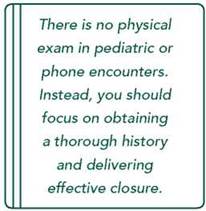
Examinees do not interact with children during pediatric encounters. Instead, SPs assuming the role of pediatric patients’ parents recount patients’ histories, and no physical exam is required under such circumstances.
How Is the Step 2 CS Structured?
Before entering a room to interact with an SP, you will be given an opportunity to review some preliminary information. This information, which is posted on the door of each room (and hence is often referred to as “doorway information”), includes the following:
■ Patient characteristics (name, age, gender)
■ Chief complaint and vitals (temperature, respiratory rate, pulse, blood pressure)
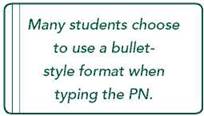
You will be given 15 minutes (with a warning bell sounded after 10 minutes) to perform the clinical encounter, which includes reading the doorway information, entering the room, introducing yourself, obtaining an appropriate history, conducting a focused physical exam, formulating a differential diagnosis, and planning a diagnostic workup. You will also be expected to answer any questions the SP might ask, discuss the diagnoses being considered, and advise the SP about any follow-up plans you might have. After leaving the room, you will have 10 minutes to type a PN. Examinees will not be permitted to handwrite the PN unless technical difficulties on test day make the typing program unavailable.
If you happen to finish a clinical encounter early, there is no need for you to rush out the door. Once you leave the examination room, you may not reenter it. So if you find yourself running ahead of schedule, you might consider telling the patient that you are organizing your notes, as one or two last-minute questions might pop into mind.
How Is the Step 2 CS Scored?
Of your 12 patient encounters, 10 will be scored. Two people will score each encounter: the SP and a physician. The SP will evaluate you at the end of each encounter by filling out three checklists: one for the history, a second for the physical exam, and a third for communication skills. The physician will evaluate the PN you write after each encounter. Your overall score, which will be based on the clinical encounter as a whole and on your overall communication skills, will be determined by the following three components:
1. Integrated Clinical Encounter (ICE) score. The skills you demonstrate in the clinical encounter are reflected in your ICE score. This score will reflect your data-gathering and data interpretation skills.
■ Data gathering. SPs will evaluate your data-gathering skills by documenting your ability to collect data pertinent to the clinical encounter. Specifically, they will note whether you asked the questions listed on their checklists, successfully obtained relevant information, and correctly conducted the physical exam (as indicated by your performance of the procedures on their checklists). If you asked questions or performed procedures that are not on an SP’s checklist, you will not receive credit—but at the same time will not lose credit—for having done so.
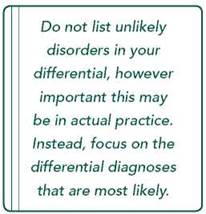
■ Data interpretation. To demonstrate your data interpretation skills, you will be asked to document, as part of the PN, your analysis of a patient’s possible diagnoses and your assessment of how such diagnoses are supported or refuted by the evidence obtained from the history and physical exam. Although in actual practice physicians must develop the ability to recognize and rule out a range of disorders, you will be asked to record only the most likely diagnoses along with the positive and negative findings that support each. Physicians who score the PN make a global assessment based on documentation and organization of the history and physical exam; the relevance, justification, and order of the differential diagnosis; and the initial testing modalities proposed. Your final score will represent the average of your individual PN scores over all 10 scored clinical encounters.
2. Communication and Interpersonal Skills (CIS) score. In addition to assessing your data-gathering abilities, SPs will evaluate your communication and interpersonal skills. According to the USMLE, these include fostering a relationship with the patient, gathering and providing information, helping the patient make decisions, and supporting the patient’s emotions. You will be evaluated on your ability to tailor your questions and responses to the specific needs of the case presented and on your capacity to react to the patient’s concerns. Overall, the CIS subcomponent focuses on your ability to conduct a patient-centered interview (discussed at length in Section 2) in which you identify and respond to the broader scope of the patient’s concerns beyond just the diagnosis. The CIS performance is documented by SPs with checklists.
3. Spoken English Proficiency (SEP) score. This component scores you on pronunciation, word choice, and the degree of effort the SP must make to understand your spoken English. The SEP score is based on SP evaluations that make use of rating scales.
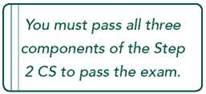
The grade you receive on the Step 2 CS will be either a “pass” or a “fail.” Your report will include a graphic representation of your strengths and weaknesses on all three components of the exam. Unlike Step 1 or Step 2 CK, you will not receive a numerical score. To pass the Step 2 CS overall, candidates must pass all three individual components. The good news is that most U.S. and Canadian medical students pass (see Table 1-1). However, the failure rate is higher among IMGs, with approximately one in four examinees failing.
Relatively few U.S. students fail the CIS, and even fewer fail the SEP component. If U.S. students fail the exam as a whole, it is most likely due to poor ICE scores. For IMGs, the CIS is the most likely component to cause failure. The SEP is more of a challenge for IMGs compared to U.S. students but is still the least likely component to cause failure. Few IMGs fail all three subcomponents.
How Do I Register to Take the USMLE Step 2 CS?
Applicants can register directly for the Step 2 CS without having passed any other USMLE Step. However, registration information and procedures are constantly evolving. For the most current information on registering for the Step 2 CS, go to www.usmle.org or check with your dean’s office. IMGs should also refer to the Web site of the Educational Commission for Foreign Medical Graduates (ECFMG) at www.ecfmg.org.
U.S. students must register using the NBME’s interactive Web site for applicants and examinees (click the appropriate link at www.nbme.org). IMGs can either apply online using the ECFMG’s Interactive Web Application (IWA) at https://iwa2.ecfmg. org/gradoverview.asp or download the paper application from the ECFMG Web site and mail it to the ECFMG with the registration fee. Although there is no specific application deadline, you should apply early to ensure that you get your preferred test date and center.

After your application has been processed, you will receive a scheduling permit by e-mail. Orientation manuals and videos of sample encounters are available at www.usmle.org or can be obtained on CD when you register. The video is an excellent preparation resource that shows exactly how the Step 2 CS is administered as well as how you should conduct yourself during the exam. Once you have received your scheduling permit, you are eligible to take the Step 2 CS for one year, starting from the date your application was processed. Your scheduling permit will list your eligibility period, scheduling instructions, and identification requirements for admission to the exam. You can schedule the test through the NBME or ECFMG Web site or by telephone. Access information will be included with your registration materials. Note that test centers offer both morning and afternoon sessions. You may be offered an afternoon session if you select a date and center for which morning sessions are already filled. Try to select a date and center that offer you a morning session, when you are likely to be fresher and more relaxed (unless you are an inveterate night owl).
TABLE 1-1. Step 2 CS Pass Rates
|
2010-2011 2011-2012 |
|||
|
No. Tested |
Passing No. Tested |
Passing |
|
|
U.S./Canadian |
18,361 |
98% 17,164 |
97% |
|
IMGs |
15,042 |
77% 13,780 |
77% |
Although you cannot extend your eligibility period for the Step 2 CS, you can cancel or reschedule your examination date. You will not be charged a fee if you cancel or reschedule 14 calendar days before your scheduled test date, not including the day of the test. However, a fee of $150 will be levied if you cancel or reschedule at any time during the 14-day period before (but not including) your scheduled test date. You will need to pay $400 if you miss an appointment without canceling or rescheduling. These fees are subject to change, so please check the USMLE Web site (www.usmle.org) for the current fee schedule.
Finally, a word of caution regarding the exchange of scheduled test dates. Some applicants have been known to post requests on online forums to swap their appointment with another applicant. The Step 2 CS scheduling system does not allow anyone to schedule or reschedule an appointment on behalf of another applicant. In addition, the system works on a first-come, first-served basis—so if you cancel your appointment in anticipation of such an exchange, your test date might be claimed by someone else who happens to be logged onto the system at the same time. Applicants are therefore advised to avoid such exchanges and instead to reschedule test dates only within the formal protocols. If you have registered late and your only options are later than you would like, be sure to check back frequently for openings closer to your desired date.
Where Can I Take the Exam?
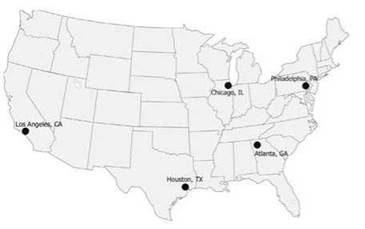
The Step 2 CS will be administered at five regional sites called Clinical Skills Evaluation Collaboration centers (see Figure 1-1). Additional centers are currently under consideration.
For detailed information about cities, hotels, and transportation, please refer to the USMLE Web site (www.usmle.org), the ECFMG Web site (www.ecfmg.org), and the Section 1 Supplement to this text.
How Long Will I Wait to Get My Scores?
Step 2 CS results are posted to your On-line Applicant Status and Information System (OASIS) account on the ECFMG/NBME Web site. An e-mail is sent to you once your score report has been uploaded onto your account page. A fixed schedule of score-reporting periods is published on the USMLE Web site well in advance of your test date. Most examinees who take the Step 2 CS receive their scores on the first day of the corresponding reporting period, which is usually 1-3 months from the date of the test. If you do not receive your results within that time, you must send a written request for a duplicate report to the NBME or the ECFMG. Again, the score report you receive indicates only whether you passed or failed the exam. Your numerical score is not disclosed to you or to any of the programs to which you apply. Once you pass the Step 2 CS, your passing score remains valid for the purpose of applying for residency training.
FIGURE 1-1. Step 2 CS Test Centers
What If I Fail?
If you fail the Step 2 CS, you can retake it, but not more than three times within any 12-month period. In addition, each time you take the exam you must submit a new application and an appropriate fee.
If for some reason you think that you received a failing score unfairly, you may be able to appeal and request a rescoring of your exam. However, doing so is unlikely to change your overall exam results, and little information is provided to explain exactly how or why you may have failed. Even if you feel your results are unjustified, it may be best to begin preparation to retest. Use the knowledge and experience you gained from your first attempt to optimize your preparation and improve your performance. It is worth recognizing that even though the NBME tries hard to design a test that is fair and accurate, the exam will always have a subjective component. Costly fees acknowledged, the most effective response to what you perceive may be an inaccurate assessment of your true clinical skills is to practice more and give it another shot. Check your orientation manual or the USMLE and/or ECFMG Web sites for the latest reexamination and appeal policies.
In preparing for the Step 2 CS, keep in mind that you will need to demonstrate certain fundamental but critical clinical skills in order to pass. These skills include the following:
■ Interacting with patients in a professional and empathetic manner
■ Taking a good medical history
■ Performing an appropriate and focused physical exam
■ Counseling and delivering information
■ Typing a logical and organized PN that includes a reasoned differential diagnosis
In this section, we will briefly explore a few of these skills. Section 2 reviews these skills in greater detail in addition to the mechanics of the clinical encounter and PN.
Ability to Interact with Patients in a Professional Way
There are several elements of the CIS component that you must incorporate into each encounter. These are simple and easy to learn but require practice.
■ Introduce yourself to the patient. When you first meet a patient, be sure to smile, address the patient by his or her last name (eg, “Mr. Jones”), introduce yourself clearly, shake hands firmly, and establish good eye contact.
■ Actively listen to the patient. Allow the patient to express his or her concerns without interrupting or interjecting your own thoughts. Your demeanor should be curious, nonjudgmental, and compassionate.
■ Wash your hands. It is probably best to wash your hands just before the physical exam. Hand washing also gives you an opportunity to briefly reflect and perhaps ask a confirmatory question or two. It is acceptable to use gloves as an alternative.
■ Use “draping manners.” Always keep the patient well draped. You can cover the patient at any time before the physical exam, but it is better to do so at the beginning of the encounter. Do not expose large portions of the patient’s body at the same time; instead, uncover only the parts that need to be examined, and only one at a time. Be sure to ask permission before you uncover any part of the body and explain why you are doing so. You should also ask permission to untie the patient’s gown and should tie the gown again when you are done.
■ Be mindful of appearance. In your encounters, you should appear confident, calm, and friendly as well as serious and professional. Wear a clean white lab coat over professional-looking but comfortable clothes. Do not wear shorts or jeans. Men should wear slacks, a shirt, and a tie. Women should consider slacks and low-heeled shoes and should avoid wearing skirts above the knee.
■ Maintain appropriate body language. During the clinical encounter, look the patient in the eye, smile when appropriate, and show compassion. When trying to console a patient, you may place your hand on his or her shoulder or arm but not on the leg or hand. Do not exaggerate your facial expressions in an effort to convince the patient that you empathize with him or her. Never talk to a patient while standing somewhere he or she cannot see you, especially during the history and closure.
■ Focus your concentration on the patient. Ask permission before you examine any part of the patient’s body, and explain what you intend to do. Pay attention to everything the patient says and does, because the behavior is most likely purposeful. It is more important to maintain good rapport than to perfect the nuances of your physical exam technique. You can show concern by doing the following:
■ Keep the patient comfortable. Help the patient sit up, lie down, and get onto and off the examination table. Do not repeat painful procedures.
■ Show compassion for the patient’s pain. If the patient does not allow you to touch his or her abdomen because of severe pain, say, “I know that you are in pain, and I want to help you, but I need to examine you to locate the source of your pain and give you the right treatment.”
■ Show compassion for a patient’s sadness. To demonstrate empathy, you may take a brief moment of silence and place your hand lightly on the patient’s shoulder or arm. You may then say something like “You must feel sad. Would you like to tell me about it?”
■ Respect the patient’s beliefs. Do not reject a patient’s beliefs even if they sound incorrect to you. A patient may tell you, “I am sure that the pain I have is due to colon cancer.” You may respond to this with something like “That may be one possibility, but there are others that we need to consider as well.”
Ability to Take a Good Medical History
The interviewing techniques you use should allow you to collect a thorough medical history. It is true that you can prepare a list of questions to use for every system or complaint. However, be aware that you will not be able to cover everything. Therefore, you should ask only those questions that are relevant to the specific case; your goal is to direct each interview toward exploring the chief complaint and uncovering any hidden complaints. Remember that a good survey of the chief complaint with a goal of uncovering and acknowledging salient positives and negatives is more important than covering every single detail.
If you feel that a patient is not following your line of questioning, be careful, as this may indicate that you are drifting away from the correct diagnosis. You should also bear in mind that physical findings may be simulated and may not look the same as real ones (eg, simulation of wheezes during chest auscultation). In such circumstances, you should pretend that the findings are real.
Do not be intimidated by angry patients. Remember that SPs are only actors, so stay calm, firm, and friendly. Ask about the reason for a patient’s anger or complaint, and address it appropriately. Do not be defensive or hostile.
If you do not understand what a patient has said or recognize a drug that has been prescribed, do not hesitate to ask, “Can you please repeat what you said?” or “What is the name of that drug again?”
Finally, remember to use the summary technique at least once during the interview. This technique, which involves briefly summarizing what the patient has just told you, often using the patient’s own words, may be used either after you finish taking the history or after the physical exam. Summarizing will help ensure that you remember the details of the history before you leave the room to write the PN.
Ability to Counsel and Deliver Information
At the end of each encounter, you will be expected to tell the patient about your findings, offer your medical opinion (including a concise differential diagnosis), describe the next step in diagnosis, and outline possible treatments. In doing so, you should always be clear and honest. Tell the patient only the things you know, and do not try to render a final diagnosis.
Before you leave, ask the patient if he or she still has any questions. After you respond, follow up by asking, “Did that answer your question?” Make sure the patient understands what you are saying, and avoid the use of complex medical jargon. It is much simpler to ask patients to gently lie back than to tell them to assume a reverse Trendelenburg position.
When counseling a patient, always be open. Tell the patient what you really think is wrong, and explain that the final diagnosis can be made only after some tests have been ordered. You should also explain some of the tests you are planning to conduct. Address any concerns the patient may have in a realistic manner, and never offer false reassurances.
The Step 2 CS is a one-day exam. Bring a stethoscope and a white coat. A limited number of stethoscopes will be provided if you happen to forget yours. Tendon hammers, tongue depressors, tuning forks, and pen lights are provided in the rooms. You will be scheduled for either the morning or the afternoon session. The duration of the Step 2 CS, including orientation, testing, and breaks, is approximately eight hours. Once you have entered the secured area of the assessment center for orientation, you may not leave that area until the exam has been completed. During this time, the following conventions should be observed:
■ You may not use watches (analog or digital), cell phones, or beepers at any time during the exam. A locker will be provided to secure your items.
■ The morning session starts at 8 a.m. and the afternoon session at 3 p.m. Test proctors will generally wait up to 30 minutes for latecomers, so the actual exam usually does not begin until 8:30 a.m. or 3:30 p.m. Nonetheless, you should plan to arrive 30 minutes before your session is scheduled to begin.
■ Do not come to an afternoon session early in an attempt to meet candidates from the morning session, as they are not allowed to leave until you are safely secured in the exam room.
■ Bring a government-issued photo ID (eg, a U.S. driver’s license or a passport) that carries your signature.

■ Be sure to bring your admission permit! You will not be admitted to the test center without it.
After the 30-minute waiting period has ended, the staff will give you a name tag, a numbered badge to be worn around your arm, a pen, and a clipboard. There is no need to bring a pen of your own; in fact, you are not allowed to use anything other than the pen provided at the exam site.
If you are traveling with luggage, do not bring it to the test site, as the staff cannot store it for you. You will be provided only with a coat rack and a small storage locker for belongings that you are not allowed to carry during the encounter, such as watches, cell phones, purses, and handbags. If you are planning to travel immediately after the exam, you can keep your luggage at the front desk of your hotel.
At the beginning of your session, you will be asked to sign a confidentiality agreement. An orientation session will then be held to introduce you to the equipment that you will find in the examination rooms. Examine and become familiar with this equipment, especially the bed, foot extension, and head elevation. Do not hesitate to try each piece of equipment made available to you during this session.
You will be given two breaks during the exam. The first break lasts 30 minutes and takes place after the fourth encounter. During this break, the staff will serve you a meal. The second break lasts 15 minutes and takes place after the eighth encounter. Use the bathroom during these breaks, as you will not have time to do so during the encounters. Finally, remember that smoking is strictly prohibited not only during the exam but also during breaks. You cannot leave the center during break periods.
In the break room, you will be assigned a seat and a desk. You can keep your food or drink on this desk so that it will be accessible during break time. Although the testing staffi will provide you with one meal, you may want to bring some high-energy snacks for your breaks. Also remember that your personal belongings will not be accessible to you until the end of the exam—so if you do plan to bring food with you, keep it on your assigned desk, not in the storage area.

The Step 2 CS is not a social event, so when you meet with other candidates during breaks, do not talk about the cases you encountered. During breaks (and, of course, during the encounters), speak only in English; doing otherwise will be considered irregular and may be questioned.
Finally, remember that even though all your encounters are videotaped, these tapes are not used for scoring purposes. To the contrary, they are used only to ensure the safety of the SPs and candidates and to ensure quality. So don’t worry about the camera, and don’t try to look for it during the encounters. Act as you would on a regular clinic day.
Some Final Words
The following general principles will help you excel on the Step 2 CS:
■ Remember to rest before the exam. Try to give yourself a few days to overcome jet lag, eat well, and get exercise. A sluggish affect and a cloudy mind can lead to inefficiency and poor rapport. This is especially important if you are scheduled for an afternoon session, which can run as late as 11 p.m.
■ Think about the present, not the past. Clear your head before proceeding to your next encounter. Thinking about what you should have done or should have asked will only distract you from your current encounter.
■ Passing does not require perfection. You need not be perfect. In fact, given the time constraints involved, the Step 2 CS rewards efficiency and relative completeness over perfection.
■ There is a reason for everything you see. If a patient is wearing a sombrero, inquire why this is the case. He might have been in Mexico, and the diarrhea he presents with may be a simple traveler’s diarrhea. Similarly, a prominently placed tattoo might suggest certain risk behaviors, not just a keen appreciation of body art.

If you are an IMG candidate seeking to pass the Step 2 CS, you must take a number of variables into account, from plotting a timetable to mastering logistical details to formulating a solid test preparation strategy.
Determining Eligibility
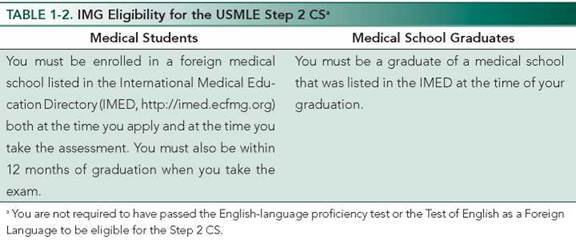
Before contacting the ECFMG for a Step 2 CS application, you must first take several preliminary steps. Begin by ascertaining whether you are eligible (see Table 1-2). Check the ECFMG Web site for the latest eligibility criteria.
Once you have established your eligibility to take the exam, you will need to factor in the residency matching process (the “Match”). If you are planning to apply for a residency in the United States, your timetable should reflect that and should be carefully planned at least one year in advance.
You are allowed to register (pay the fee) for the Match regardless of your ECFMG status. To participate in the Match, however, the National Residency Matching Program (NRMP) requires that you be ECFMG certified (or that you meet ECFMG requirements for certification even if you have not received your certificate) by the rank-order-list deadline (typically in February of each year). Applicants who do not meet these requirements will automatically be withdrawn from the Match. Therefore, you should take the Step 2 CS no later than October in the year before your target Match Day (see Figure 1-2).
There is a significant advantage to obtaining ECFMG certification by the time you submit your application for residency in the fall. Should you do so, residency programs are likely to consider you a ready applicant and may favor you over other candidates who have yet to take the Step 2 CS—even if such candidates have more impressive applications. In addition, if you are certified early, you can take Step 3 and get your results back before the rank-order-list deadline. A good score on Step 3 can provide a perfect last-minute boost to your application and may also make you eligible for the H-1B visa. In summary, take the Step 2 CS as soon as you are eligible (see Table 1-2), but not before you are confident that you are fully prepared. Remember that to get ECFMG certification, you need to pass the Step 1, Step 2 CK, and Step 2 CS within a seven-year period. In deciding when to apply for the Step 2 CS, when to take it, and whether you are ready for it, keep the following points in mind:
■ Scheduling your test date can be difficult during busy seasons. Apply at least three months before your desired examination date. Ideally, you should aim to take the Step 2 CS in June or July in order to be certified when you apply for residency.
■ Schedule your exam on the date that you expect to be fully prepared for it. For IMGs, preparation for the exam typically requires anywhere between 1 and 12 weeks, factoring in your level of English proficiency as well as your medical knowledge and skills.
FIGURE 1-2. Typical Step 2 CS Timeline for IMGs

■ If you choose to apply for the Step 2 CS using a paper application, it will take up to four weeks to receive your notification of registration, but it may take as few as 10 days to receive this information if you use the ECFMG’s IWA.
Some residency programs use the Step 2 CS as a screening tool to select IMG applicants for interviews, so it is ideal to meet the deadline for the Match.
If you are an IMG living outside the United States, you must also factor in the time it may take to obtain a visa. You do not need a visa to come to the United States if you are a U.S. or Canadian citizen or a permanent resident. Citizens of countries participating in the Visa Waiver Program (such as European Union countries) may not need to obtain a visa either. You are responsible for determining whether you need a visa and, having done so, for obtaining that visa (regardless of how time-consuming and difficult this process may be). Before you apply to take the Step 2 CS, you should therefore complete the following tasks:
■ Check with the U.S. embassy in your country to determine whether you need a visa.
■ Determine how long it will take to get an appointment at the embassy.
■ Find out how long it will take to get the visa and whether a clearance period is required.
■ Check travel availability to the cities in which the exam centers are located.
As proof of the reason for your visit to the United States, the ECFMG will send you a letter to present to the U.S. consulate in your country. This letter will be sent to you only after you apply to take the Step 2 CS (ie, after you have paid the fee) and will not guarantee that you will be granted a visa. For this reason, it is wise not to schedule your actual exam day until you have arrived in the United States or have at least obtained your visa.
Application Tips
When you receive your application to take the Step 2 CS, be sure to read it carefully before filling it out. You do not want your application returned to you—thus wasting valuable time—simply because you forgot to answer a question or made a careless mistake. Applications that contain the following common errors will be returned:
■ An application that is not written in ink or is illegible
■ An incomplete application
■ An application that is not the original document (ie, faxed or photocopied)
■ An application that contains a nonoriginal signature or photograph
■ An application that contains a photograph of the applicant that was taken more than six months before the date the application was submitted
■ An application in which the signature of the medical school official or the notary public is more than four months old
■ An application in which the medical school or notary public seal or stamp does not cover a portion of your photograph
■ An application that does not explain why it was signed by a notary public but not by your medical school official
■ An application that does not include full payment
Commonly encountered errors specific to IMGs include the following:
■ Failure to send the ECFMG a copy of your medical school diploma with two full- face photographs
■ Failure to send the ECFMG an English translation of your medical school diploma if the original is not in English
■ Failure to staple together your medical school diploma and its English translation or to ensure that the translator’s stamp covers both the original and the translation
Once you have completed your application and have double-checked it for errors, make every effort to send it by express mail or courier service. To check the status of your application online, you can use OASIS (https://oasis2.ecfmg.org).
Improving Your English Proficiency
For many IMGs taking the Step 2 CS, a critical concern lies in the demonstration of proficiency in spoken English. In Step 2 CS terms, this refers to the ability to speak English clearly and comprehensibly and to understand English when the SP speaks to you.
You may not have a problem with English proficiency if you are a native English speaker, have studied in a U.S. or other English-speaking school, have learned medicine in English in your medical school, or have spent at least a few months or years of your life in an English-speaking country. English proficiency may, however, be the main obstacle facing IMGs at the other end of the spectrum. The good news is that most IMGs who have already passed the USMLE Step 1 have the basic English language skills needed to pass the Step 2 CS. For such candidates, the key to passing the Step 2 CS lies in organizing these skills and practicing. Your spoken English proficiency is based on the following components:
■ The ability to speak in a manner that is easy for the SP to follow and understand. Toward this goal, choose phrases that are simple, direct, and easy both for you to remember and for the SP to understand. Speaking slowly will also make it easier for SPs to understand you and will minimize the effect your accent has on your comprehensibility.
■ The correct use of grammar. The key to mastering this element is to be familiar with commonly used statements, transitions, and questions and to practice them as much as possible. This will minimize the chance that you will make significant grammatical errors.
■ Comprehensible pronunciation. Again, the key to good pronunciation lies in practicing common statements and questions, repeating them to yourself aloud, and asking someone (preferably a native English speaker) to listen to you and correct your mistakes. The more you practice, the better your chances will be of reaching an acceptable and even a superior level of clear, comprehensible English.
■ The ability to correct and clarify your English if necessary. You may find it difficult to prepare for a situation in which an SP does not understand you and asks you for the meaning of something you have just said. Here again, you can avoid this situation by practicing common statements, questions, and transitions; speaking as slowly and clearly as possible; and using nontechnical words instead of complicated medical terms. If an SP still cannot understand something you have said, simply repeat the phrase or question, or restate it in simple lay terms.

Make every effort to remain calm throughout your clinical encounters. Nervousness can cause you to mumble, making it difficult for the SP to understand you. Likewise, if you become nervous and start looking at the clock and rushing, you will further increase the likelihood of making mistakes. So remain calm, concentrate, and take your time.
Fifteen minutes may seem like a short time to do and say all the things you think are necessary, but it will be more than enough if you follow an organized plan. Most of the things you have to say in the exam are the same in each encounter, so by thoroughly studying common cases and medical conditions (see Sections 3 and 4), you can minimize this obstacle.
If you are still unsure about your English proficiency, the ECFMG suggests that you take the Test of Spoken English (TSE) to get a measure of your abilities. If you score higher than 35 on this exam, you have likely attained the level of English proficiency necessary for the Step 2 CS. You may also consider taking the Test of English as a Foreign Language (TOEFL) before you take the Step 2 CS. However, doing so is no longer a prerequisite to taking the Step 2 CS or to ECFMG certification. For more information about the TSE and the TOEFL, contact:
TOEFL/TSE Services
P.O. Box 6151
Princeton, NJ 08541-6151
609-771-7100
www.toefl.org
Getting Clinical Rotations and Observerships
Many IMGs may lack basic familiarity with the workings of U.S. medical schools. A clinical rotation or observership in the United States can prepare IMGs for the Step 2 CS by introducing them to the U.S. system and, in the process, immersing them in the “American” way of taking a history, performing a physical exam, and writing PNs. Clinical rotations are also good to have on your curriculum vitae when you apply for residency programs. Moreover, performing well on your rotation can earn you strong letters of recommendation, which are the most important part of your application after your USMLE scores. The more time you spend in such a rotation, the better.
Even if your Step 1 and Step 2 CK scores are impressive and you come highly regarded from a top international medical school, lack of proficiency in English will make it more challenging for you to pass the Step 2 CS. Participating in a formal clinical rotation in the United States is one of the best ways to polish your English skills. This
will make the Step 2 CS experience more tolerable and may ultimately boost your communication skills if you are invited for residency interviews.
If you are still a medical student, it should not be difficult for you to find a clinical rotation. Check the Web sites of the universities in which you are interested and e-mail or write the program director and chairman of each. If you are already in the United States, call the relevant departments and make appointments to meet with the personnel responsible for the rotations. Most of the time, such personnel will send you an application by mail. For the purposes of your residency application, however, it is highly recommended that you also do a rotation in the specialty in which you are interested.
If you are a medical graduate, your mission is more difficult but not impossible. You are no longer eligible for clinical elective rotations (clerkships), but you can still apply for observerships and externships.
The observership is perhaps the least active function you can fill in a hospital, but it can still be highly useful. Getting an observership is not an easy task because most hospitals do not have any such formal rotation or training program. Nonetheless, here is some advice that may help you:
■ Prepare a list of hospitals in your area or any area that interests you. Include all types of teaching hospitals: university, community, and Veterans Affairs medical centers.
■ Contact people (attendings, senior residents, secretaries, administrators) whom you may know. Connections are an important way to uncover these unofficial rotations.
■ Send e-mails and/or letters to the chairman and program director of each hospital. IMGs for whom English is not a first language should send targeted communication in the form of grammatically correct letters or e-mails. It is always better to address a physician by name and specifically mention your interest in the program and why. A generic e-mail blast composed of poorly written English is the best way to ensure that your message will end up in a spam folder.
■ Call the office of the chairman or program director and try to set an appointment to meet him or her.
■ Talk to other physicians who are doing or have done observerships and ask them where they did so and how to apply.

During your rotation, you will “officially” be an observer, which means that you cannot touch a patient or write on charts. The only things you will officially be allowed to do are observe, do rounds with your team, answer an occasional question, present some topics, and attend conferences. On rare occasions, you may be able to examine some patients and write some notes. Here is some advice for making the most of your observership:
■ Show a high level of enthusiasm.
■ Come early and stay late (not very late, though).
■ Follow up on patients your team is taking care of and learn everything you can about them.
■ Read about the cases your team is managing.
■ Chat and spend time with the patients, but always let them know that you are an observer. This is the best way to practice taking histories and to improve your language skills.
■ Write your own PNs and orders, ask your residents to correct them, and compare them to the official notes.
■ Talk to the nurses, secretaries, and support staff. This will improve your communication skills.
■ If you do not get a chance to examine patients, carefully observe the residents and medical students during the physical exam.
■ Do as many presentations as you can.
Here is a partial list of hospitals that have been known to offer formal observerships or externships:
■ Banner Good Samaritan Medical Center, Phoenix, AZ
■ Emory University, Atlanta, GA
■ Hahnemann Hospital, Philadelphia, PA
■ Harbor Hospital, Baltimore, MD
■ Harvard Medical School, Boston, MA (application and fees apply)
■ Hospital of St. Raphael, New Haven, CT
■ Maricopa Medical Center, Phoenix, AZ
■ Mayo Clinic, Rochester, MN (visiting physicians program)
■ Memorial Hospital, Pawtucket, RI
■ Mount Sinai Medical Center, Miami, FL
■ Providence Hospital, Washington, DC
■ University of Miami, Miami, FL
■ Veterans Administration Medical Center, Washington, DC
Some Final Tips
There are a few final practical measures you can take to help ensure your success on the Step 2 CS:
■ Check and recheck the ECFMG and USMLE Web sites for the latest information about the Step 2 CS. This will help you get a clear idea about regulations, requirements, registration, examination dates, and all other details concerning the Step 2 CS.
■ Carefully prepare for the exam using the preparation materials included in this book.
■ Check other Web sites and discussion forums. They can be a good source of information.
■ Review the steps of history taking (see Section 2). Choose and prepare common questions and cases (see Sections 3 and 4).
■ Review the steps of the physical exam (see Section 2). Practice the physical exam as if you were performing the real exam.
■ Practice writing PNs (see Section 4).
INTRODUCTION
After you’ve worked hard to prepare for the Step 2 CS, the last thing you need is extra travel stress—or, worse still, problems on the day of the exam. The best way to ensure that everything goes as smoothly as possible on test day is to plan ahead. Getting all the details in place well in advance of your trip will help you focus on what’s really important: doing a great job on the exam!
The following quick guide can be used as a planning tool both before and during your travels. For each of the five cities with a Step 2 CS testing center (called Clinical Skills Evaluation Collaboration, or CSEC, centers), we have provided details on the best ways to get to your destination and some things to do once you have arrived. Since most of you will be flying, we have placed special emphasis on distances to the CSEC test sites and routes from the airports. Also listed are a number of nearby hotels, most of which are reasonably priced and within walking distance of the CSEC centers. As a cheaper option, we have included one youth hostel for each city. Finally, we have recommended a few well-known restaurants and tourist attractions for each destination.
All five CSEC destinations are amazing cities, and we do not want you to miss out on what they have to offer. Although you should not let sightseeing get in the way of your test, you might want to schedule at least a few hours to see the sights. Even better, think about giving yourself an extra day or two after the exam to relax and really enjoy yourself in a new and exciting city.
With that said, make sure to confirm the details of the destinations we’ve presented before you start your trip. We have compiled a broad range of suggestions for you, but by the time you get to your destination, some of the details may well have changed. Another great source of information is the travel section on the USMLE Web site. Also note that the Association of American Medical Colleges (AAMC) has negotiated reduced hotel rates with many nearby hotels for the Step 2 CS. We have included many of these hotels here, but be sure to check the updated list online. Links to these sites are provided at the end of this section.
TRAVELING TO THE UNITED STATES
We know that many of you who are planning to take the Step 2 CS may be coming to the United States for the first time—so here are a few things to keep in mind to help minimize travel hassles.
Arrange your documents. Generally, the most important document you will need for the Step 2 CS is your scheduling permit. However, other documents may be required as well, especially if you’re coming from another country. These may include the following:
■ Your passport.
■ A U.S. tourist visa (usually a B-1/B-2 visa; apply at the nearest U.S. embassy in your country).
■ An international driver’s license (consider getting one if you’re planning to drive to your testing center) and potentially an international driving permit. Check the U.S. government Web site (www.usa.gov/Topics/Foreign-Visitors- Driving.shtml) for links to the driving rules in your testing location.
Make sure your travel plans are in place. Be sure to make your reservations well in advance, and think about how you’re going to get around in the test city. Once you’ve arrived at your destination, make sure you know how to get to the CSEC center on the day of your test, especially if you’re planning to stay a bit farther away.
Consider travel safety. When traveling abroad, particularly in major U.S. population centers, it’s important to follow a few general guidelines to ensure your safety:
■ As a whole, Americans are friendly and willing to be of assistance, but not everyone has the best of intentions. Be particularly alert to individuals who seem a bit too eager to help or who go out of their way for you.
■ Keep an eye on your baggage while traveling by taxi, train, or any form of public transportation. Pickpockets and petty thieves tend to target visitors.
■ Never carry anything in your baggage that doesn’t belong to you. You are responsible for the contents of your baggage, including anything illegal that might have been placed there by someone else.
■ Avoid walking alone on deserted streets at night.
Pack appropriately. Packing before air travel requires a lot of preparation. Here are a few useful tips:
■ There are many restrictions for carry-on luggage these days, particularly with regard to liquids. Check the U.S. Transportation Security Administration’s Web site (www.tsa.gov) for the most up-to-date information.
■ Prepare for lost or delayed baggage. Do not keep your scheduling permit, lab coat, or stethoscope in your checked baggage. Also remember to put a copy of your itinerary in your baggage so that authorities can locate you in the event that your baggage is lost.
■ Using a mobile phone or a camera, take a photograph of your baggage to give to the authorities in the event that your baggage is delayed or lost.
■ Tag your baggage with brightly colored tape or a distinguishing mark so that you can easily identify it at baggage carousels.
Plan, plan, plan. Here are some guidelines for planning your visit and booking your hotel:
■ Try to schedule your exam well in advance. Doing so will make it easier for you to get a good price on your tickets and accommodations.
■ Before you book a hotel or a flight, compare prices at multiple Web sites and at each organization’s Web site (see “Useful Web Sites” at the end of this supplement). Vacation packages that include a combination of flight, lodging, and car rental are usually cheaper than purchasing individually.
■ Before you choose a hotel, be sure to factor in the distance to the testing center as well as the services each hotel offers—for example, whether it has a free airport shuttle, free breakfast, and access to Wi-Fi. Bear in mind that staying in a youth hostel may save you money on hotel accommodations but may increase travel time to the CSEC center on test day. Also, hotels that are closer to the test site may have services geared specifically toward examinees.
Choosing to drive. Rental cars are also an option for traveling to the site location. Don’t forget your international driver’s license! Also bear in mind that most companies require you to be 25 years old to rent a vehicle. The most popular companies in all the CSEC destinations are as follows:
■ Alamo (www.alamo.com): 877-222-9075
■ Avis (www.avis.com): 800-633-3469
■ Budget (www.budget.com): 800-218-7992
■ Dollar (www.dollar.com): 800-800-4000
■ Enterprise (www.enterprise.com): 800-261-7331
■ Hertz (www.hertz.com): 800-654-3131
■ National (www.nationalcar.com): 877-222-9058
■ Payless (www.paylesscarrental.com): 800-729-5377
■ Thrifty (www.thrifty.com): 800-847-4389
ATLANTA ("THE BIG PEACH")
Clinical Skills Evaluation Collaboration Center Two Crown Center
1745 Phoenix Boulevard, Suite 500 (5th Floor)
Atlanta, GA 30349-5585
The Atlanta metro area has a population of more than five million and is the capital city of the great state of Georgia. Throughout history, Atlanta has served as a main north-south and east-west railway hub; in fact, its name was derived from the Atlanta-Pacifica railway that ran through the town in the 1840s. Today, Atlanta is home to the Centers for Disease Control and Prevention as well as the headquarters of Coca-Cola. We know you’ll enjoy your time in this diverse and thriving city!
Getting There
■ Air: Atlanta’s major airport is the Hartsfield-Jackson Atlanta International Airport (ATL) (www.atlanta-airport.com), located about 9 miles/14.5 km south of downtown and only a few blocks from the CSEC center.
■ Ground:
■ Greyhound, 232 Forsyth Street Southwest (www.greyhound.com): The main bus terminal is located downtown, about 12 miles/19.3 km from the CSEC center, which is approximately 20 minutes by taxi for a flat rate of $25.
■ Amtrak, 1688 Peachtree Street Northwest (www.amtrak.com): The main train station is also located downtown, about 16 miles/25.7 km from the testing center. Atlanta is on the Crescent Line, which runs between New Orleans and New York.
Getting Around When You Arrive
■ Shuttles: Most hotels offer free shuttle service to and from the airport. The airport Web site has a list of the hotels that offer complimentary service. There are also airport shuttle services available from the airport to downtown or other major attractions and surrounding cities. The airport Web site lists shuttle services by destination. Airport Metro Shuttle serves most of the metro area, and Atlanta Airport Shuttle serves the area within the corporate city limits of Atlanta (downtown, midtown, and Buckhead).
■ Atlanta Airport Shuttle (www.taass.net)
■ Airport Metro Shuttle (www.airportmetro.com)
■ Taxis: Taxis are available at the airport and at the bus/train terminals and cost $30-$35 from the airport to downtown. The ride from the airport to the CSEC center is about 10 minutes. Local taxi companies include the following:
■ Atlanta Checker Cab: 404-351-1111
■ National: 404-752-6834
■ Day and Night Cab Co.: 404-767-7464
■ Yellow Cab: 404-521-0200
■ Rental cars: All rental car companies are located at the Hartsfield-Jackson Rental Car Center (RCC). Once you pick up your luggage, follow the signs to the ATL SkyTrain for transport to the RCC. Visit the airport Web site for specific details.
■ Public transportation: Atlanta has a regional metro system called MARTA (Metropolitan Atlanta Rapid Transit Authority, www.itsmarta.com), and it is by far the cheapest form of transit to and from the airport. To ride the train or bus, you will need to purchase a stored-value Breeze Card, which can be purchased for $1 at the MARTA Ride Store inside the Airport Station (located near the baggage claim area in the domestic terminal), from machines in MARTA stations, or from many retail outlets. You simply use cash to add value to the card and tap it at the MARTA station entry points for service. A trip downtown will take approximately 15-20 minutes and will cost $2.50. Hours of operation can be found on the MARTA Web site. Trip planning can be easily accomplished using the MARTA iPhone or Android app or the Web site. There is no access to the CSEC site via MARTA. For more information, check out this user-friendly guide: www.itsmarta.com/uploadedFiles/Using_Marta/How_to_ride_MARTA/ RookiesGuide2013.pdf.
CSEC Center Location
The Atlanta CSEC center is located a few minutes to the south of the Hartsfield- Jackson airport, about 0.25 mile/0.4 km east of the intersection of West Fayetteville Road and Phoenix Boulevard. The V-shaped brown brick building that houses the CSEC center should be visible from the I-285 highway. The center is on the fifth floor, and plenty of free parking is available.
Where to Stay
The following list includes a few hotels located close to the test site as well as a youth hostel in the area. Most are located just outside the airport, but there are some highways around, so plan your walk carefully. Remember to ask hotels about their USMLE deals, listed on the AAMC Web site (marked with an asterisk below).
■ *Country Inn & Suites Atlanta Airport South ($$): 5100 West Fayetteville Road (0.7 mile/1.1 km away); 770-991-1099. Just around the corner from the CSEC center, making it very convenient.
■ *Best Western Hotel & Suites Airport South ($$): 1556 Phoenix Boulevard (about 0.7 mile/1.1 km away); 770-996-5800.
■ *Comfort Inn & Suites Airport South ($): 2450 Old National Parkway (about 1.5 miles/2.4 km away); 404-684-9898.
■ *Sheraton Gateway Atlanta Airport ($$): 1900 Sullivan Road (2.0 miles/3.2 km away); 770-997-1100.
■ *Hilton Garden Inn Atlanta Airport/Millenium Center ($$): 2301 Sullivan Road (3.3 miles/5.3 km away); 404-766-0303.
■ Atlanta International Hostel ($): 223 Ponce de Leon Avenue Northeast (14 miles/22.5 km away); 404-875-9449. A cheaper option with plenty of nightlife. A bit farther away from the CSEC center, but only a few blocks away from the MARTA North Avenue station.
Where to Eat and Play
Atlanta has amazing Southern food. Take advantage of this and enjoy some of our favorites:
■ The Varsity ($): 61 North Avenue Northwest, Downtown; 404-881-1706. The world’s largest drive-in restaurant, the Varsity is an Atlanta icon that has been serving burgers and hot dogs since 1928.
■ Sweet Auburn Curb Market ($): 209 Edgewood Avenue Southeast, Downtown; 404-659-1665. A historic market with stalls that feature fresh produce and hot meals. Includes many small ethnic restaurants as well.
■ Fat Matt’s Rib Shack ($): 1811 Piedmont Avenue Northeast, Midtown; 404607-1622. An Atlanta hot spot serving up Southern-style barbecue and playing live blues music every night.
What to See
Atlanta has much to see and do. Here are just a few places to consider seeing while you’re in town:
■ Georgia Aquarium: The world’s largest aquarium, with more than 8.5 million gallons of water and 100,000 species of sea life.
■ World of Coca-Cola: Come and celebrate the original home of this sugary drink in historic Piedmont Park.
■ Underground Atlanta: A mall located under the streets in the Five Points neighborhood.
■ Sweet Auburn District: Home to the Martin Luther King, Jr., National Historic Site.
For more information, check out:
■ www.lonelyplanet.com/worldguide/usa/atlanta/
■ www.atlanta.net
CHICAGO ("THE WINDY CITY")
Clinical Skills Evaluation Collaboration Center 8501 West Higgins Road, Suite 600 Chicago, IL 60631
Located on the shores of Lake Michigan, Chicago is the principal financial and cultural center of the Midwest and is currently the third-largest city in the United States. Chicago is known for its gangster lore, blues clubs, and biting cold winters.
With plenty of history, shopping, and culture, today’s Windy City is bursting with life, so be sure to enjoy your stay!
Getting There
■ Air: Chicago has two major airports. The larger is O’Hare International Airport (ORD), which is about 20 miles/32.2 km northwest of downtown but only 5 miles/8 km from the CSEC center. The other is Chicago Midway Airport (MDW), located about 12 miles/19.3 km southwest of downtown and roughly 20 miles/32.2 km from the testing center. Both have easy public transportation within the city, but O’Hare may be more convenient given its closer proximity to the testing site.
■ Ground:
■ Greyhound, 5800 North Cumberland Avenue (www.greyhound.com): The Chicago Cumberland Avenue Greyhound bus terminal is just a few blocks away from the CSEC center and is the closest of the six bus terminals in Chicago.
■ Amtrak, Canal Street between Adams and Jackson Boulevards (www.am- trak.com): The main train hub in Chicago is at downtown Union Station. This is a good choice, but you’ll have to take public transportation or a taxi to get to the test site. The Chicago Transport Authority Blue Line runs to Cumberland Station from Union Station, taking you very close to the CSEC center.
Getting Around When You Arrive
■ Shuttles: Most nearby hotels offer free shuttle service to and from the airport. You can also use either of the airport shuttle services. Schedules and up-to-date fares and booking are available online:
■ Continental Airport Express (www.airportexpress.com): 888-284-3826
■ Omega Airport Shuttle (www.omegashuttle.com): 773-734-6688
■ Taxis: As in any big city, taxis are usually the most direct way to get around Chicago. They cost roughly $30-$40 from O’Hare to downtown and about $10 from O’Hare to the CSEC center:
■ American United: 773-248-7600
■ Des Plaines Cab Service: 847-826-8424
■ Flash Cab: 773-561-4444
■ Yellow Cab: 312-829-4222
■ Rental cars: Rental car companies at O’Hare offer free shuttle service from the arrival terminal to the rental car site.
■ Public transportation: Ride the famous Chicago “L,” an easy-to-use and cheap light-rail system, or take a Chicago Transit Authority bus. Both the CSEC center and O’Hare are on the “L” Blue Line, and both connect to downtown. For the CSEC center, you’ll want Cumberland Station (5800 North Cumberland Avenue). Single-ride fares are $2.25; multiple-day passes are also available. Fares are available at all stations. Check out fares and schedules online at www.tran- sitchicago.com.
CSEC Center Location
The exam center is located on the northwest side of Chicago, about 15 miles/24.1 km from downtown and just 5 miles/8 km east of O’Hare along I-90 (Kennedy Expressway). From Cumberland Station, the CSEC center is a quick 0.8-mile/1.3-km walk or cab ride to the north over the highway. The CSEC center is located within the First Midwest Bank Building. There should be plenty of free parking at the site. Note for drivers: The signs in the visitor lot indicate one-hour-only parking. This does not apply to Step 2 CS examinees, so you are still free to park there. You may park in the visitor lot for the duration of the exam, but do not park in spaces reserved for other tenants, such as First Midwest Bank, Chicago Title, or Westwood College.
Where to Stay
The following hotels are good options near the testing center. Remember to ask hotels about their USMLE deals, listed on the AAMC Web site (marked with an asterisk below). If you have a car, you can also check out some of the hotels a bit farther west along I-90. You’ll probably get a cheaper rate if you’re willing to make a commute on the morning of the test.
■ *Marriott Chicago O’Hare ($$$): 8535 West Higgins Road (0.02 mile/0.03 km away); 773-693-4444. Right next door to the testing center!
■ *SpringHill Suites Chicago O’Hare ($$): 8101 West Higgins Road (0.04 mile/0.6 km away); 773-867-0000.
■ ^Renaissance Chicago O’Hare Suites ($$$): 8500 West Bryn Mawr Avenue (0.7 mile/1.2 km away); 773-380-9600.
■ *Holiday Inn Chicago O’Hare ($$): 5615 North Cumberland Avenue (0.8 mile/1.3 km away); 773-693-5800. Very close to the Cumberland Blue Line stop.
■ *Crown Plaza Chicago O’Hare ($$): 5440 North River Road (2.1 miles/4.5 km away); 847-671-6350.
■ *Sheraton Chicago O’Hare: 6501 North Manheim Road (2.8 miles/3.3 km away); 847-699-6300.
■ Hostelling International Chicago ($): 24 East Congress Parkway (15 miles/24.1 km away); 312-360-0300. This large hostel is located downtown, about 15 miles/24.1 km from the testing center, so plan at least an hour to make the trip on the Blue Line.
Where to Eat and Play
Chicago has hundreds of amazing restaurants of all varieties; here are just a few.
■ Giordano’s Famous Chicago Pizza ($$): 135 East Lake Street; 312-616-1200. Chicago is the town for pizza, and Giordano’s delivers some of the best. There are branches all over the city, so find the one that works for you. This is likely to be the best and most filling meal you’ve had in a while.
■ Café Spiaggia ($$): 980 North Michigan Avenue; 312-280-2750. Try lunch at the café. This relaxed restaurant is just next door to the world-famous Italian restaurant Spiaggia, which is known to be a favorite of the Obamas.
■ Blue Chicago ($$): 736 North Clark Street; 312-642-6261. Check out one of Chicago’s world-famous blues clubs, perhaps after you’re done with the test.
What to See
Don’t miss the sights of this amazing city just because you’re staying near the airport and the testing center. After you’re done taking the exam, think about booking a late flight and jumping on the “L” for an afternoon downtown.
■ Willis Tower: Visit the Skydeck for amazing views from the second-tallest building in North America.
■ Navy Pier: Features museums, shops, restaurants, and even a Ferris wheel on the shore of Lake Michigan.
■ Magnificent Mile: The heart of the city, with upscale shopping and fantastic restaurants running along Michigan Avenue.
For more information, check out:
■ www.lonelyplanet.com/worldguide/usa/chicago/
■ www.choosechicago.com
■ www.cityofchicago.org/tourism
Clinical Skills Evaluation Collaboration Center 400 North Sam Houston Parkway, Suite 700 Houston, TX 77060
Houston was founded in 1836 on land near the Buffalo Bayou and was named after Sam Houston, then the president of the Republic of Texas. Today, Houston is one of the largest cities in the United States and is home to many major energy companies in addition to a substantial portion of the biomedical and aeronautical industries. It also boasts one of the best art festivals in the country, the Bayou City Art Festival, held here every spring and fall. Enjoy the show!
Getting There
■ Air: Houston has two major airports: George Bush Intercontinental (IAH) and Hobby Airport (HOU). IAH is the larger of the two and is much closer to the CSEC center (8 miles/12.9 km); HOU is smaller and farther away (27 miles/43.5 km).
■ Ground:
■ Greyhound, 2121 Main Street (www.greyhound.com): Houston has a terminal downtown. Outside the station, there are plenty of taxis available. A ride to your hotel should take about 30 minutes.
■ Amtrak, 902 Washington Avenue (www.amtrak.com): Houston is on the Sunset Limited line, which runs all the way from Louisiana to California.
Getting Around When You Arrive
■ Shuttles: Most hotels around the CSEC center offer free shuttle service. If your hotel doesn’t provide service, check out SuperShuttle (www.supershuttle.com): 713-523-8888.
■ Taxis: A number of taxi companies operate in Houston; below are just a few ($20-$40 to the CSEC center from the airport):
■ Liberty Cab: 713-695-6700
■ Square Deal Cab: 713-659-5105
■ United Cab: 713-699-0000
■ Yellow Cab: 713-236-1111
■ Rental cars: Multiple rental car companies are available at the Consolidated Rental Car Facility (CRCF) at the Bush Intercontinental Airport. Check the list on the airport Web site. Follow the signs in the arrival terminal and you will see white and maroon buses that will take you to the CRCF. Check the USMLE Web site for driving directions.
■ Public transportation: If you’re really adventurous, try Houston’s Metro, which includes bus routes and light rail (www.ridemetro.org). Lines 102, 56, and 86 serve the area around the airport, the CSEC center, and hotels. Buses run every 10-45 minutes, depending on the route and time of day. Visit the Web site for a trip planner, which will help you figure out the details.
The CSEC center is located on the north side of Houston in a large office building at the intersection of Imperial Valley Drive and Beltway East Access Road. There is a parking garage with a large “400” on the side that is visible from the street. You’ll see McDonald’s and Arby’s restaurants across the street. Free parking is available in the attached garage.
Where to Stay
The following hotels are located around the test site. You can walk from most, although the sidewalks aren’t great. Remember to ask hotels about their USMLE deals, listed on the AAMC Web site (marked with an asterisk below).
■ *Baymont Inn & Suites ($): 502 North Sam Houston Parkway East (0.2 mile/0.3 km away); 281-820-2101. The Baymont gets high marks for cleanliness and service and is a great value.
■ *Park Inn Houston North ($): 500 North Sam Houston Parkway East (0.2 mile/0.3 km away); 281-931-0101.
■ Venetian Inn & Suites ($): 6 North Sam Houston Parkway East (0.5 mile/0.8 km away); 281-447-6888. Cheap with good service, but there is no shuttle from the airport.
■ *Hyatt Place Houston/Greenspoint ($$): 300 Ronan Park Place (0.7 mile/1.1 km away); 281-820-6060. The Hyatt is a good deal, is close to the CSEC center, and is well recommended.
■ *Super 8 IAH West/Greenspoint ($): 1230 North Sam Houston Parkway East (1.8 miles/2.9 km away); 281-987-7100.
■ *Comfort Inn Greenspoint ($$): 12701 North Freeway (1.9 miles/3.1 km away); 281-875-2000.
■ *Holiday Inn Houston Intercontinental Airport ($$): 15222 JFK Boulevard (4.3 miles/6.9 km away); 281-449-2311.
■ *Sheraton North Houston at George Bush Intercontinental ($$): 15700 JFK Boulevard (4.5 miles/7.2 km away); 281-442-5100.
■ Houston International Hostel ($): 5302 Crawford Street (18 miles/28.9 km away); 713-523-1009. The hostel is very cheap ($15/night in a dormitory) and is located about 30 minutes away from the CSEC center.
Where to Eat and Play
Houston has cuisine from all around the world but is especially well known for its Latin American fare. The restaurants we’ve listed aren’t necessarily close to the test center, but we thought it might be fun for you to get out!
■ Américas ($$$): 2040 West Gray Street, 832-200-1492. Américas serves Central and South American cuisine with flair.
■ Spanish Village Restaurant ($$): 4720 Almeda Road; 713-523-2861. A restaurant that has been serving “Tex-Mex” food since 1953. Try their delicious margaritas.
■ Dry Creek Café ($): 544 Yale Street; 713-426-2313. Relaxing and fun. Go for one of their “Bad Ass” burgers.
What to See
If your exam is over by early afternoon, you might have some extra time to enjoy the sights and sounds of Houston.
■ Theater district: Located downtown with five great venues. Check out Bayou Place, with its many theaters, bars, and restaurants.
■ Museum district: Located downtown near Rice University, with many museums and parks. It would be a shame to pass up the John C. Freeman Weather Museum.
■ Sports: Check out an Astros (www.astros.com) or Rockets (www.rockets.com) game while you’re there.
For more information, check out:
■ www.visithoustontexas.com
■ www.lonelyplanet.com/destinations/north_america/houston
Clinical Skills Evaluation Collaboration Center 100 North Sepulveda Boulevard, 13th Floor El Segundo, CA 90245
Los Angeles is one of the best-known cities in the United States and is rich in cultural and ethnic diversity. One of its most notable attractions, of course, is Hollywood, the hub of the U.S. motion picture industry. L.A. is also home to some amazing cultural sites, such as the Kodak Theatre, the Walt Disney Concert Hall, and all your favorite actors. Take in some stargazing while you’re in town!
Getting There
■ Air: Los Angeles is served by one major airport, Los Angeles International (LAX). It is one of the busiest airports in the world and is located only about 3 miles/4.8 km from the CSEC center.
■ Ground:
■ Greyhound, 1716 East 7th Street (www.greyhound.com): L.A. has a terminal near downtown. Plenty of taxis are available outside the station. A ride to your hotel should take about 30 minutes.
■ Amtrak, 800 North Alameda Street (www.amtrak.com): L.A. is on multiple rail routes that connect it to cities like New Orleans, Chicago, and Seattle.
Getting Around When You Arrive
■ Shuttles: Many hotels around the CSEC center offer free shuttle service from LAX. If your hotel doesn’t provide such service, check out the following:
■ SuperShuttle (www.supershuttle.com): 800-258-3826
■ Prime Time Shuttle (www.primetimeshuttle.com): 800-733-8267
■ Taxis: A number of taxi companies operate in L.A.; below are just a few ($10- $15 from the airport to the CSEC center):
■ Beverly Hills Cab: 310-273-6611
■ Independent Taxi Owners Association: 800-521-9294
■ L.A. Taxi/United Checker Cab: 213-627-7000
■ Rental cars: Multiple rental car companies (nearly 40!) are available in the area. These include Advantage, Alamo, Avis, Dollar, Enterprise, Hertz, and National.
For a full list of rental companies, visit www.lawa.org/lax and see “Ground Transportation.”
■ Public transportation: Despite its reputation, L.A. does have public transportation, and the CSEC center is not far from rail and bus stops. There is also a free shuttle from LAX to the Aviation station on the Green Line, a rail line that is just two stops away from the El Segundo/Nash station. The Green Line runs every 7-15 minutes during rush hour. Get off at the El Segundo/Nash station, walk west on El Segundo Boulevard (0.5 mile/0.8 km) toward the park on the south side of El Segundo, and make a right on North Sepulveda Boulevard. The hotels listed are also generally within walking distance of the stop. You can find more information and a Metro trip planner on the public transportation Web site, www.metro.net.
The CSEC center is located on the west side of L.A., only a few miles from LAX and about 20 miles/32.2 km from downtown. It is situated at the corner of North Sepulveda and El Segundo Boulevards. You’ll see a series of large office towers; turn in the first driveway marked “Pacific Corporate Towers.” Follow the signs to get to visitors’ parking ($9/day).
Where to Stay
The following hotels are situated around the test site. You can walk from most, although not all have great walking routes. Remember to ask hotels about their USMLE deals, listed on the AAMC Web site (marked with an asterisk below).
■ *Residence Inn El Segundo ($$): 2135 East El Segundo Boulevard (0.4 mile/0.6 km away); 310-333-0888. Great, quiet rooms and a good complimentary breakfast.
■ *Hacienda Hotel ($$): 525 North Sepulveda Boulevard (0.4 mile/0.6 km away); 310-615-0015. A convenient 10-minute walk to the CSEC center. An older but decent choice—just be prepared for small elevators.
■ *Doubletree Hotel Los Angeles International Airport ($$): 1985 East Grand Avenue (0.6 mile/1 km away); 310-322-0999. The Doubletree is routinely recommended by guests for its comfortable beds, clean rooms, and complimentary warm chocolate chip cookies.
■ Travelodge LAX South ($$): 1804 East Sycamore Avenue (0.9 mile/1.4 km away); 310-615-1073. An acceptable budget option, but service can be spotty.
■ *Hilton Garden Inn El Segundo ($$): 2100 East Mariposa Avenue (0.9 mile/1.4 km away); 310-726-0100.
■ *Sheraton Gateway Los Angeles ($$): 6101 West Century Boulevard (2.3 miles/3.7 km away); 310-642-1111.
■ USA Hostels Hollywood ($): 1624 Schrader Boulevard (24 miles/38.6 km away); 323-462-3777. This hostel is very cheap ($30-$80/night) and is about 30 minutes away from the center by car if traffic is normal. It’s fun but loud, so if you plan on staying here, be sure to bring earplugs.
Where to Eat and Play
L.A. is one of the most ethnically diverse cities in the world, so you can find food for almost every taste. Here are just a few of our favorites:
■ Paradise Cove Beach Café ($$): 28128 Pacific Coast Highway, Malibu; 310457-2503. Situated off Pacific Coast Highway, this seaside restaurant offers a variety of fare, including great hamburgers and steaks. Hang out with the locals and enjoy a great meal on the beach.
■ WoodSpoon ($): 107 West Ninth Street; 213-629-1765. Located in downtown L.A., this unassuming restaurant serves up Brazilian fare. Grilled plates come with rice, beans, plantains, and collard greens. Simple and delicious.
■ Medusa Lounge ($$$): 3211 Beverly Boulevard; 213-382-5723. An exciting place to get dinner and enjoy the nightly DJs. Offers great beers, sushi, duck, and bratwurst. You’ll have to see it to believe it.
What to See
If your exam is over by early afternoon, you might have some extra time to see a bit of L.A. As the locals say, L.A. is very “spread out,” so the sights aren’t always easy to reach without a car, but it’s worth a try.
■ Hollywood: Enjoy a stroll down Hollywood Boulevard and the Walk of Fame. If you don’t have a car, you can ride the Metro Rail, but remember that this will take some time. From the test center, take the Green Line to the Blue Line and transfer to the Red Line. Exit at the Hollywood/Highland station.
■ Venice Beach: Only 15 minutes away. Take in some of the uniqueness of L.A. with attractions like Muscle Beach and the area’s renowned street performers!
For more information, check out:
■ www.latourist.com
■ www.laweekly.com
Clinical Skills Evaluation Collaboration Center 3624 Market Street, 3rd Floor Philadelphia, PA 19104
Philadelphia is a great city that is steeped in U.S. history. It was a nexus of political activity during the American Revolution, serving as the site of the First and Second Continental Congresses, and there is a wealth of places you can visit to soak it all up. Today, Philadelphia is thriving, boasting the fifth-largest metro area in the country. While you’re in town, check out Independence Hall, where the Declaration of Independence was first signed on July 4, 1776. And be sure to eat a Philly cheesesteak!
Getting There
■ Air: Philadelphia is served by one major airport, Philadelphia International Airport (PHL). It serves flights from all around the country and the world. PHL is located about 10 miles/16.1 km from the CSEC center.
■ Ground:
■ Greyhound, 1001 Filbert Street (www.greyhound.com): The Greyhound terminal is located near the downtown area. Plenty of taxis are available outside the station. A ride to your hotel should take about five minutes.
■ Peter Pan Bus Lines, 1001 Filbert Street (www.peterpanbus.com): This bus line is located at the same address as Greyhound.
■ Amtrak, 30th and 2955 Market Street (www.amtrak.com): Philadelphia is on multiple Amtrak lines, including the high-speed Acela line, which connects Boston, New York, Philadelphia, and Washington, DC. Other lines connect Philadelphia to the South and the Midwest.
Getting Around When You Arrive
■ Shuttles: There is limited shuttle service from the airport, but one does cover the area: Lady Liberty Company (www.ladylibertyshuttle.com): 215-724-8888.
■ Taxis: A number of taxi companies operate in the city; below are just a few ($28.50 flat rate from the airport to downtown):
■ Liberty Cab: 215-389-8000
■ Olde City Taxi Coach Association: 215-338-0838
■ PHL Taxi: 800-936-5111
■ Yellow Cab: 215-333-3333
■ Quaker City Cab: 215-728-8000
■ Rental cars: Multiple rental car companies are available. Follow directions at the airport to Zone 2 outside the baggage claim area for car pickup.
■ Public transportation: Philadelphia has an extensive public transportation network, called SEPTA (www.septa.org). Buses and a high-speed rail line connect to the airport. Although the rail line is more expensive, it is easier to use. The Airport rail line (R1) costs an $8 (cash-only) one-way fare and connects all the terminals to the 30th Street station, which is six blocks from the testing center— or you can transfer to the Market-Frankford line and take it to 34th and Market Street, which is just two blocks from the testing center. Multiple-use passes are available. Fares within the city vary depending on the destination and payment method (cash vs. tokens). See the Web site for more information.
The CSEC center is located downtown, near the University of Pennsylvania campus. It can be found near the intersection of Market and 36th Streets. There is a parking lot right across the street ($14/day).
Where to Stay
The following hotels are within walking distance of the test site. Since the CSEC center is downtown, these hotels are fairly expensive. Remember to ask hotels about their USMLE deals, listed on the AAMC Web site (marked below by an asterisk).
■ *Sheraton Philadelphia University City ($$): 3549 Chestnut Street (two blocks away); 215-387-8000. Well recommended and one of the only moderately priced hotels close by.
■ Hilton Inn at Penn ($$$): 3600 Sansom Street (0.2 mile/0.3 km away); 215222-0200. Located on the University of Pennsylvania’s campus, this hotel is close but expensive.
■ Cornerstone Bed and Breakfast ($$): 3300 Baring Street (0.6 mile/1 km away); 215-387-6065. This B&B is a wonderful place to stay. The breakfasts are delicious.
■ *Best Western Center City Hotel ($$): 501 North 22nd Street (1.7 miles/2.7 km away); 215-568-8300.
■ Rodeway Inn Philadelphia ($$): 1208 Walnut Street (2.1 miles/3.8 km away); 215-546-7000. An acceptable budget option but not walkable. You can, however, ride the Market-Frankford line from City Hall to the 34th Street station.
■ Apple Hostels of Philadelphia ($): 32 South Bank Street (2.8 miles/4.5 km away); 877-275-1971. This hostel offers both dorm-style and private rooms and is very well recommended. It is located just a block from the Market-Frankford line, so you can take the rail line to the 34th Street station and walk to the CSEC center.
Where to Eat and Play
Philadelphia is a great city with a variety of great restaurants. Here are a few of the best:
■ Geno’s Steaks/Pat’s King of Steaks ($): 1219 South 9th Street; 215-389- 0659/215-468-1547. The Philly cheesesteak (or “hoagie”), perhaps one of the best-known foods in the country, was born here. Just remember to drop the “Philly” while you’re in town. Keys to a proper order: Cheese Whiz or provolone with or without fried onion rings.
■ Audrey Claire ($$): 276 South 20th Street; 215-731-1222. One of the best restaurants in town, located in the heart of Rittenhouse Square.
■ Tangerine ($$$): 232 Market Street; 215-627-5116. This is one of the tastiest experiences you’ll ever have. There are too many great dishes to single out just one, but try the lobster risotto or the chicken tagine.
What to See
If your exam is over by early afternoon, you are likely to have some extra time to see the sights of Philadelphia. And since the CSEC center is downtown, you’re already in the heart of it.
■ Independence Hall/Liberty Bell: Located in the block between 5 th and 6th Streets and Market and Chestnut Streets, Independence Hall and the Liberty
Bell are two of the most iconic images in all of U.S. history. You may want to make a reservation beforehand (www.nps.gov/inde).
■ Museum District: Close by and home of the Philadelphia Museum of Art, the Franklin Institute of Science, the Philadelphia Zoo, Fairmont Park, and Eastern State Penitentiary.