
As described, you will be given a chance to review preliminary patient information, known as “doorway information,” at the outset of each encounter. This information, which is posted on the door of the examination room, includes the patient’s name, age, and gender; the reason for the visit; the patient’s vital signs (pulse, blood pressure, temperature in both Celsius and Fahrenheit, and respiratory rate); and the task you will be called on to perform.
You should begin by reading the doorway information carefully, checking the chief complaint, and trying to organize in your mind the questions you will need to ask and the systems you will have to examine. Toward this goal, you should look for abnormalities in vital signs without trying to memorize actual numbers. Assume that these vital signs are accurate.
Remain calm and confident by reminding yourself that what you are about to encounter is a common scenario found in routine medical practice. You should also bear in mind that SPs are easier to deal with than real patients in that they are more predictable and already know what you are expected to do. Remember that a second copy of the doorway information sheet will be available on the other side of the door, so you can review that information at the end of each encounter. Note, however, that the time you spend reading the doorway information is included in the 15-minute time limitation.
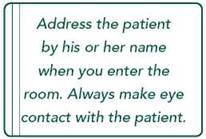
Your entrance into the examination room is a critical part of the encounter. So before you enter the room, be sure to read and commit to memory the patient’s last name, and then knock on the door. Once you have entered the examination room, ask the patient if he or she is the person identified on the door (eg, “Mr. Smith?”). You will receive credit for having done so and will not have to worry about remembering the patient’s name for the remainder of the encounter. If the patient does not respond to your query, consider the possibility that there may be a change in mental status and that the SP might have been instructed not to respond to his or her name.
After your initial entrance, you should shake hands with the patient and introduce yourself in a confident yet friendly manner (eg, “Hi, I am Dr. Morton. Nice to meet you.”). You may also add something like “I would like to ask you some questions and do a physical exam.” Again, make an effort to establish eye contact with the patient during this initial period.
The Patient-Centered Interview
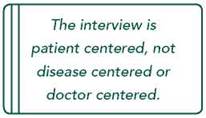
Conducting a patient-centered interview (PCI) is an essential component of successfully completing the encounter in the Step 2 CS. The main goals of the PCI are to establish a trusting doctor-patient relationship and to ensure that the encounter centers on the patient’s concerns and needs, not on the disease or the doctor.
Building a trusting relationship with the patient starts from the moment you enter the examination room. It includes the simple but essential components described previously: calling the patient by his or her name, introducing yourself, and shaking hands. Remember that these steps are not just courtesies; they set a respectful and attentive tone to the entire encounter.
The next step in conducting a PCI involves reflective listening. Building trust with your patient requires that you be a good listener. Therefore, start the encounter by telling the patient what your role is and then asking about his or her concerns (eg, “I was asked to see you for your chest pain; what are your concerns?”). Once you have asked the patient to state his or her concerns, listen without interrupting or interjecting your own thoughts. Encourage the patient to express these issues by using phrases such as “Is there anything else?” or “Tell me more about that.” When the patient has stated all of his or her concerns, summarize them using the patient’s own words as much as possible. Doing so builds trust by showing the patient that you are actively listening. In some instances it is also appropriate to express empathy, particularly if the patient is distraught, by saying something like “This must be a difficult time for you,” or “I can only imagine what you are going through.”
The next step in the PCI involves setting a joint agenda with the patient. Once you have summarized the patient’s concerns, you need to prioritize them and establish a joint agenda with the patient to address them. For example, you might say to the patient, “You are concerned about chest pain, cough, and smoking. I am concerned about all these things as well. Let’s start by addressing whichever of these things concerns you the most.” By doing this, you will make the patient feel that he or she is an active part of the interview and that you are indeed conducting a patient-centered interview and not a doctor-centered interview.
Once this is established, you can begin gathering information and developing a diagnosis (discussed in the history-taking section below).
Throughout the encounter, you should aim to connect with the patient. The patient is likely to express emotions such as anger, fear, sadness, and anxiety. Be alert to these emotions, and be ready to respond with “PEARLS” (Partnership, Empathy, Apology, Respect, Legitimization, and Support). Look for opportunities to use PEARLS in every patient encounter. Of course, you will not need to use all six PEARLS elements in each of your encounters; instead, you will likely use only one or two, depending on the nature of the case. A brief description of each PEARLS component is given below:
■ Partnership means that you and the patient are working together to identify his or her main concerns and to come up with solutions. Phrases that help facilitate partnership include “Let’s deal with this together” and “We can do this.”
■ Empathy is shown by acknowledging and showing understanding of the patient’s feelings. For example, you might respond to a patient who expresses fear or anger with “That sounds hard” or “You look upset.”
■ Apology refers to taking personal responsibility when it is appropriate to do so (eg, “I’m sorry I was late” or “I’m sorry this happened to you”).
■ Respect means valuing the patient’s choices, behaviors, and decisions (eg, “You have obviously worked hard on this.”).
■ Legitimization validates the patient and shows understanding of his or her feelings and choices. An example of a legitimizing statement would be something like “Many of us would be confused or upset by this situation.”
■ Support should be continually offered to the patient. You can offer support by saying something as simple as “I’ll be here when you need me.”
Again, the PCI is patient centered, not disease centered or doctor centered. Following these principles in the CS exam will help you establish a trusting doctor-patient relationship. From there, you can move on to making appropriate medical decisions and developing the differential diagnosis.