
DOORWAY INFORMATION
Opening Scenario
Rick Meyer, a 51-year-old male construction worker, comes to the office complaining of back pain.
Vital Signs
BP: 120/85 mm Hg Temp: 98.2°F (36.8°C)
RR: 20/minute HR: 80/minute, regular
Examinee Tasks
1. Take a focused history.
2. Perform a focused physical exam (do not perform rectal, genitourinary, or female breast exam).
3. Explain your clinical impression and workup plan to the patient.
4. Write the patient note after leaving the room.
Checklist/SP Sheet
Patient Description
Patient is a 51 yo M who lives with his girlfriend.
Notes for the SP
■ Pretend that you have paraspinal lower back tenderness when examined.
■ Show normal reflexes, sensation, and strength in both lower extremities.
■ Lean forward slightly when walking.
Challenging Questions to Ask
“I don’t think I can go to work, doctor. Can you write a letter to my boss so that I can have some time off?”
Sample Examinee Response
“You’re right; heavy construction work can worsen your back pain or cause it to heal more slowly. I will ask your boss to reassign you to light duty for a while.”
Examinee Checklist
Building the Doctor-Patient Relationship Entrance
□ Examinee knocked on the door before entering.
□ Examinee introduced self by name.
□ Examinee identified his/her role or position.
□ Examinee correctly used patient’s name.
□ Examinee made eye contact with the SP.
Reflective Listening
□ Examinee asked an open-ended question and actively listened to the response.
□ Examinee asked the SP to list his/her concerns and listened to the response without interrupting.
□ Examinee summarized the SP’s concerns, often using the SP’s own words.
Information Gathering
□ Examinee elicited data efficiently and accurately.


Connecting with the Patient
□ Examinee recognized the SP’s emotions and responded with PEARLS.
Physical Examination
□ Examinee washed his/her hands.
□ Examinee asked permission to start the exam.
□ Examinee used respectful draping.
□ Examinee did not repeat painful maneuvers.

Closure
□ Examinee discussed initial diagnostic impressions.
□ Examinee discussed initial management plans:
□ Follow-up tests: Examinee mentioned the need for a rectal exam.
□ Examinee asked if the SP had any other questions or concerns.
Sample Closure
Mr. Meyer, I am concerned about your difficulty urinating, so I would like to do a rectal exam and assess your prostate for benign growths or cancer. I would also like to run some blood tests and order an x-ray and possibly an MRI of your back so that I can better determine the cause of your pain. In the meantime, as we discussed, I will write a note to your employer requesting that you be given only light duties while you are at work. Do you have any questions for me?

History
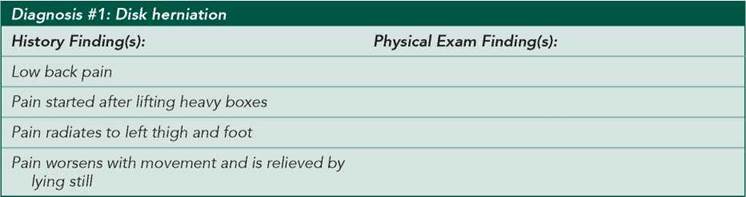
HPI: 51 yo M construction worker c/o low back pain that started after he lifted heavy boxes 1 week ago. The pain is 8/10 and sharp, and it radiates to the left thigh and sometimes to the left foot. Pain worsens with movement, cough, and sitting for a long time. It is relieved by lying still and partially by ibuprofen. He denies urinary/stool incontinence or weakness/loss of sensation in the lower extremities. No fever, night sweats, or weight loss. He does report difficulty urinating and incomplete emptying of the bladder for 6 months as well as a 1-year history of intermittent low back pain. The pain is exacerbated by sitting for long periods but is relieved by sitting after ambulation.
ROS: Negative except as above.
Allergies: Penicillin, causes rash.
Medications: Ibuprofen.
PMH: None.
PSH: None.
SH: 1 PPD for 18 years, 1-2 beers on weekends, CAGE 0/4.
FH: Noncontributory.
Physical Examination
Patient is in mild distress due to back pain.
VS: WNL.
Back: Mild paraspinal muscle tenderness bilaterally, normal range of motion, no warmth or erythema.
Extremities: 2+ popliteal, dorsalis pedis, and posterior tibial pulses bilaterally. Hips normal, nontender range of motion bilaterally.
Neuro: Motor: Strength 5/5 throughout, including left great toe dorsiflexion. DTRs: 2+ symmetric, Babinski bilaterally. Gait: Normal (including toe and heel walking), although he walks with back slightly bent forward. Straight leg raising
 bilaterally. Sensation: Intact.
Differential Diagnosis

CASE DISCUSSION
Patient Note Differential Diagnoses
■ Disk herniation: Low back pain radiating down the buttock and below the knee suggests nerve root irritation due to disk herniation. However, this pattern is nonspecific and can also be caused by sacroiliitis, facet joint degenerative arthritis, spinal stenosis, or other causes of sciatica. Most disk herniations occur at the L4-L5 or L5-S1 vertebral levels. These nerve roots are quickly assessed by checking the knee-jerk reflex (L4), great toe dorsiflexion (L5), and ankle-jerk reflex (S1). Ipsilateral straight leg raising that produces radicular symptoms (with the leg raised < 60 degrees) is highly sensitive but nonspecific in herniations at these levels. This patient may have disk herniation but has no objective evidence of neurologic compromise at this point.
■ Lumbar spinal stenosis: This is most often seen in patients older than 60 years of age. They present with gradual onset of back pain that radiates to the buttocks and legs with or without leg numbness and weakness.
Pain usually occurs with walking or prolonged standing and subsides with sitting or leaning forward (as in this case).
■ Metastatic prostate cancer: The most common cancers leading to vertebral body metastases are prostate, breast, lung, multiple myeloma, and lymphoma. In metastatic disease, patients complain of gradual-onset back pain (or occasionally acute pain in the case of pathologic fracture) with or without neurologic symptoms. Pain may be worse at night and unrelieved by rest. This patient’s urinary symptoms and low back pain may be signs of prostatic disease.
Additional Differential Diagnoses
■ Lumbar muscle strain: This often follows strenuous or unusual exertion, but pain usually does not radiate to the extremities. Paraspinal muscle tenderness is often present.
■ Degenerative arthritis: Degenerative back diseases are common, and classically pain is exacerbated by activity and alleviated by rest. Radicular symptoms may be present.
■ Multiple myeloma: Typically, patients are older than 50 years of age. Back and bone pain may be the only presenting complaint. Anemia, neuropathy, hypercalcemia, and renal failure are also common.
■ Malingering: This is defined as intentional faking of symptoms for secondary gain (eg, getting out of work).
Diagnostic Workup
The history and physical exam are often all that is required, as most patients with acute low back pain will improve within four weeks. Patients who require more extensive or urgent evaluation are those suspected of having pain caused by infection, cancer, abdominal aortic aneurysm, recurrent symptoms, or neurologic emergency (eg, caudaequina syndrome).
■ XR—L-spine: Can show evidence of vertebral osteomyelitis, cancer, or fractures. Degenerative changes are expected in older patients and correlate poorly with clinical symptoms.
■ MRI—L-spine: Provides the best anatomic detail and is the test of choice for suspected herniation, infection, or malignancy. Remember that asymptomatic disk herniation is common, so its presence does not necessarily correlate with clinical disease.
■ Rectal exam (including "saddle area" sensory exam): To evaluate the prostate, rectal sphincter tone, and integrity of sacral nerve roots.
■ PSA: Screening test for prostate cancer.
■ CBC, calcium, BUN/Cr: To detect anemia, hypercalcemia, and renal failure, all of which may be clues to underlying multiple myeloma.
■ Serum and urine protein electrophoresis: To detect a monoclonal paraprotein in myeloma. Both tests must be done because one could be negative.