
DOORWAY INFORMATION
Opening Scenario
Richard Green, a 74-year-old male, comes to the ED complaining of pain in his right arm.
Vital Signs
BP: 135/85 mm Hg Temp: 98.0°F (36.7°C)
RR: 12/minute HR: 76/minute, regular
Examinee Tasks
1. Take a focused history.
2. Perform a focused physical exam (do not perform rectal, genitourinary, or female breast exam).
3. Explain your clinical impression and workup plan to the patient.
4. Write the patient note after leaving the room.
Checklist/SP Sheet
Patient Description
Patient is a 74 yo M.
Notes for the SP
■ Sit up on the bed.
■ Hold your right arm close to your body with your left hand and keep it externally rotated and slightly abducted.
■ Show pain when the examinee tries to move your right shoulder in any direction.
■ Do not allow the examinee to bring your shoulder to its full range of motion in flexion, extension, abduction, or external rotation.
Challenging Questions to Ask
“Doctor, do you think I will be able to move my arm again like before?”
Sample Examinee Response
“I hope so, but first we need to find out exactly what is causing your problem.”
Examinee Checklist
Building the Doctor-Patient Relationship Entrance
□ Examinee knocked on the door before entering.
□ Examinee introduced self by name.
□ Examinee identified his/her role or position.
□ Examinee correctly used patient’s name.
□ Examinee made eye contact with the SP.
Reflective Listening
□ Examinee asked an open-ended question and actively listened to the response.
□ Examinee asked the SP to list his/her concerns and listened to the response without interrupting.
□ Examinee summarized the SP’s concerns, often using the SP’s own words.
Information Gathering
□ Examinee elicited data efficiently and accurately.

Connecting with the Patient
□ Examinee recognized the SP’s emotions and responded with PEARLS.
Physical Examination
□ Examinee washed his/her hands.
□ Examinee asked permission to start the exam.
□ Examinee used respectful draping.
□ Examinee did not repeat painful maneuvers.

Closure
□ Examinee discussed initial diagnostic impressions.
□ Examinee discussed initial management plans:
□ Follow-up tests.
□ Alternative living options such as assisted living.
□ Social work assistance.
□ Examinee offered a statement of support: “Your safety is my primary concern, and I am here for help and support when you need it.”
□ Examinee asked if the SP had any other questions or concerns.
Sample Closure
Mr. Green, you may have a fractured bone, a simple sprain, or a dislocation of the shoulder joint. We will need to obtain an x-ray of your shoulder and arm to make a diagnosis, and more precise imaging studies such as an MRI may be necessary as well. Your safety is my primary concern, and I am here to offer you help and support whenever you need it. Sometimes living with a family can be stressful for the whole household. Have you ever considered moving to an assisted-living community or to an apartment complex for seniors? If you are interested, I can arrange a meeting with our social worker, who can assess your social situation and help you find the resources you need. Do you have any questions for me?
History
HPI: 74 yo M c/o right arm pain for the past 3 days. The pain started after he fell on his outstretched right arm and persisted despite his use of Tylenol and a sling at home. No loss of consciousness before or after the fall. No paralysis or loss of sensation. The pain is in the upper and middle part of the arm, increases with any movement of the arm, and is alleviated by rest. When asked why he delayed seeking medical assistance, the patient looked anxious and stated that his son didn't have time to take him to the hospital.
ROS: Negative except as above.
Allergies: Aspirin (rash).
Medications: Tylenol, albuterol inhaler.
PMH: Asthma, probable BPH s/p prostate surgery.
PSH: As above.
SH: No smoking, no EtOH. Widower for the past 3 years; lives with his son, who recently lost his job. Walks 20 minutes every morning.
Physical Examination
Patient is in no acute distress.
VS: WNL.
HEENT: Normocephalic, atraumatic, no bruises.
Neck: Supple, full range of motion in all directions, no bruises.
Chest: Clear breath sounds bilaterally.
Heart: RRR; normal S1/S2; no murmurs, rubs, or gallops.
Extremities: Right arm held closely against chest wall. Nonlocalized tenderness over middle and upper right arm and right shoulder; pain and restricted range of motion on flexion, extension, abduction, and external rotation of right shoulder. Right elbow and wrist are normal. Pulses normal and symmetric in brachial and radial arteries. Unable to assess muscle strength due to pain. DTRs intact and symmetric. Sensation intact to pinprick and soft touch.
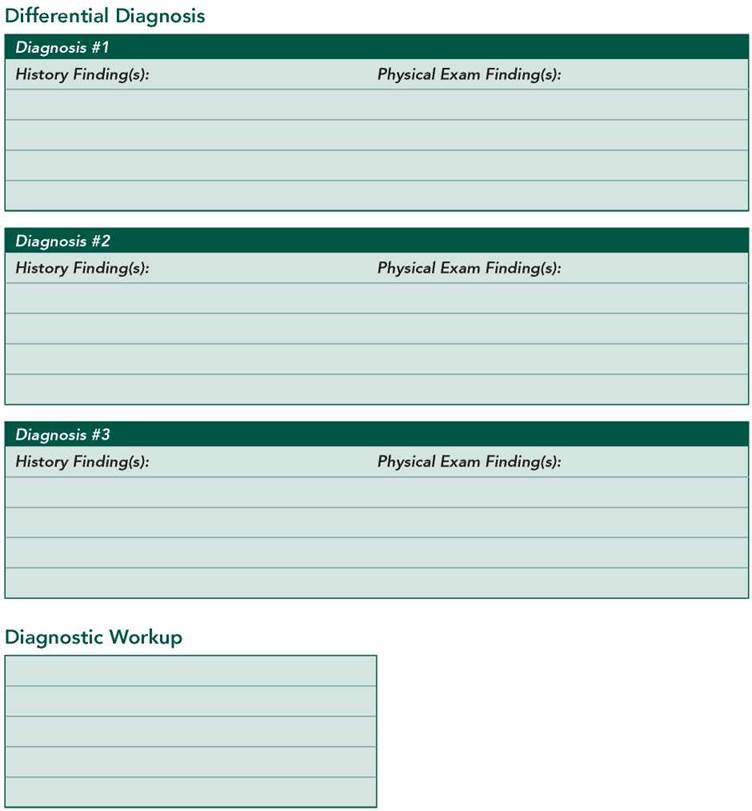
Differential Diagnosis


CASE DISCUSSION
Patient Note Differential Diagnoses
■ Humeral fracture: Most commonly occurs in elderly persons, usually after a fall. The axillary nerve can be injured in a proximal humerus fracture, causing sensory loss along the lateral aspect of the deltoid region. The radial nerve can be injured in a fracture of the midshaft/distal third of the humerus, causing wrist drop.
■ Shoulder dislocation: The glenohumeral joint is the most commonly dislocated joint in the human body. It most often dislocates anteriorly and inferiorly and usually results from a fall on an outstretched arm with forceful abduction, extension, and external rotation of the shoulder. On exam, the patient’s arm is typically externally rotated and slightly abducted. Movement is avoided owing to pain.
■ Osteoporosis: Suspect underlying osteoporosis in elderly patients (especially women) presenting with fractures following minimal trauma. The most common sites of osteoporotic fractures are the thoracic and lumbar vertebral bodies, the neck of the femur, and the distal radius.
Additional Differential Diagnoses
■ Elder abuse: The history contains red flags (bruises, anxious behavior) that may point to elder abuse.
The American Medical Association has defined elder abuse as “an act or omission which results in harm or threatened harm to the health or welfare of an elderly person.” The diagnosis of elder abuse is not readily made because often both the abuser and the victim deny abuse. Thus, diagnosis is often inferential, and supporting evidence must be sought.
■ Rotator cuff tear: Patients usually present with nonspecific pain localized to the shoulder, but pain is often referred down the proximal lateral arm owing to shared innervation. There may be an inability to abduct or flex the shoulder. Patients may also demonstrate significant weakness in internal or external rotation strength.
Diagnostic Workup
■ XR—right shoulder and arm: AP and lateral views that include the joints above and below the injury can show fracture or dislocation. An axillary view is useful to help diagnose proximal humeral fracture or dislocation.
■ MRI—shoulder: Required to diagnose rotator cuff tears, labral disease, and other disorders.
■ Bone density scan (DEXA): To diagnose and quantify osteoporosis.