
DOORWAY INFORMATION
Opening Scenario
The mother of David Whitestone, a 5-day-old male child, calls the office complaining that her child has yellow skin and eyes.
Examinee Tasks
1. Take a focused history.
2. Explain your clinical impression and workup plan to the mother.
3. Write the patient note after leaving the room.
Checklist/SP Sheet
Patient Description
The patient’s mother offers the history.
Notes for the SP
Show concern about your child’s health, but add that you do not want to come to the office unless you have to because you do not have transportation.
Challenging Questions to Ask
“Can this jaundice hurt my baby? Why is he like this?”
Sample Examinee Response
“Newborns often develop a mild case of natural jaundice after birth. This type of physiologic jaundice will resolve and rarely poses a threat to the baby. However, if your newborn has a more severe type of jaundice, his yellow pigment levels, known as bilirubin levels, may rise too high and cause damage to his brain. To determine the severity of your child’s illness, I must examine him in the office and obtain some blood tests. After seeing him, I should be able to give you a more accurate assessment of his condition.”
Examinee Checklist
Building the Doctor-Patient Relationship Entrance
□ Examinee introduced self by name.
□ Examinee identified his/her role or position.
□ Examinee correctly used patient’s name and identified caller and relationship of caller to patient.
Reflective Listening
□ Examinee asked an open-ended question and actively listened to the response.
□ Examinee asked the SP to list his/her concerns and listened to the response without interrupting.
□ Examinee summarized the SP’s concerns, often using the SP’s own words.
Information Gathering
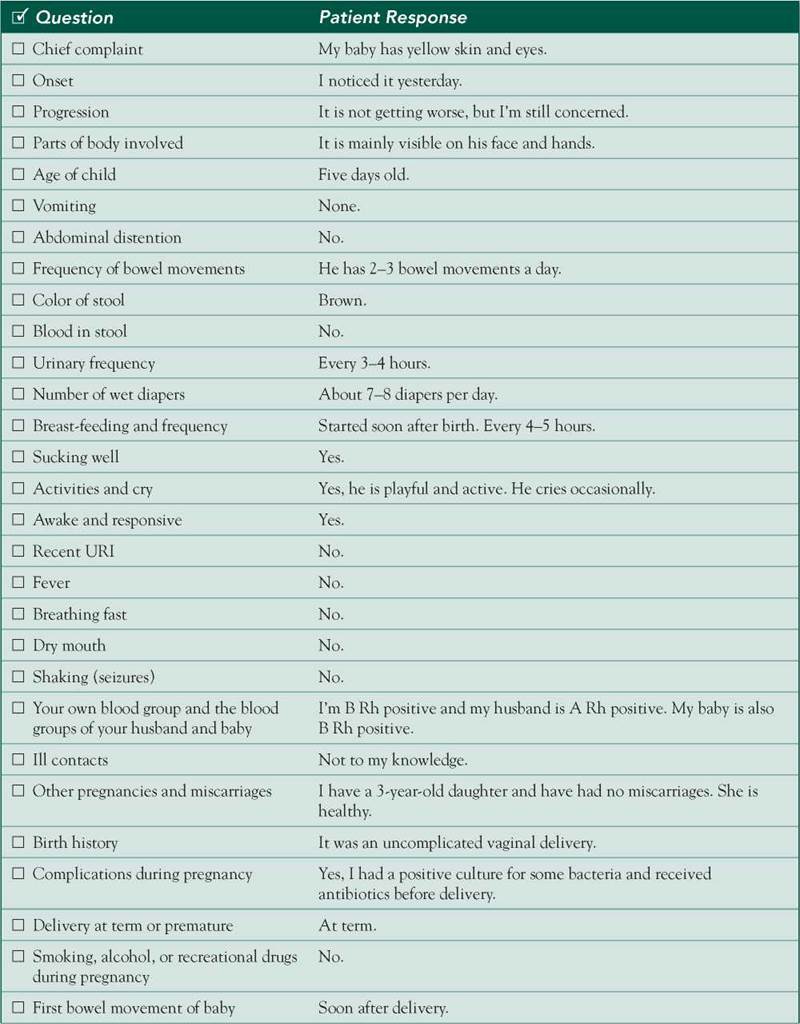
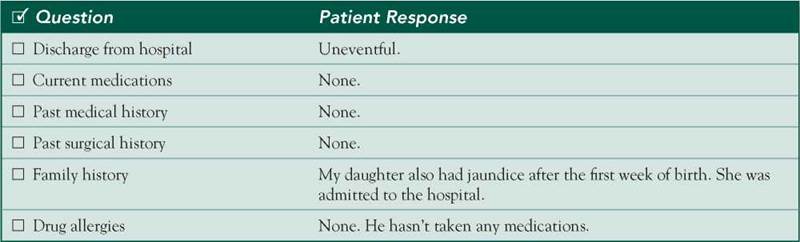
□ Examinee elicited data efficiently and accurately.
Connecting with the Patient
□ Examinee recognized the SP’s emotions and responded with PEARLS.
Physical Examination
None.
Closure
□ Examinee discussed initial diagnostic impressions.
□ Examinee discussed initial management plans:
□ Follow-up tests.
□ Examinee asked if the SP had any other questions or concerns.
Sample Closure
Mrs. Whitestone, given the information you have provided, I’m considering the possibility of physiologic or natural jaundice. This condition usually peaks on day 4 or 5 after birth and then gradually disappears within 1-2 weeks. However, breastfeeding, some other pathologic conditions, and certain birth defects can also cause jaundice in infants, and these need to be ruled out. I suggest that you bring your child to the medical center for further evaluation. I hope you understood what we discussed today. Do you have any concerns or questions?
History
HPI: The source of information is the patient's mother. The mother of a 5-day-old M c/o her child having yellow discoloration of the eyes and skin for 2 days. It has not worsened. The child is awake, responsive, playful, and active. He is breast-fed. His stomach is soft and he has 2-3 daily bowel movements. The color of his stools is brown. She denies any h/o recent fever, vomiting, seizure, URI, or breathlessness. There is no noticeable dryness of the mouth. He is wetting 7-8 diapers per day every 3-4 hours. He was delivered vaginally at full term. The mother did receive antibiotics for a positive culture before delivery. The blood group of both mother and neonate is B positive, while that of the father is A positive.
ROS: Negative.
Allergies: NKDA.
Medications: None.
PMH: None.
PSH: None.
FH: His elder sister was hospitalized after the first week of birth for jaundice.
Physical Examination
None.
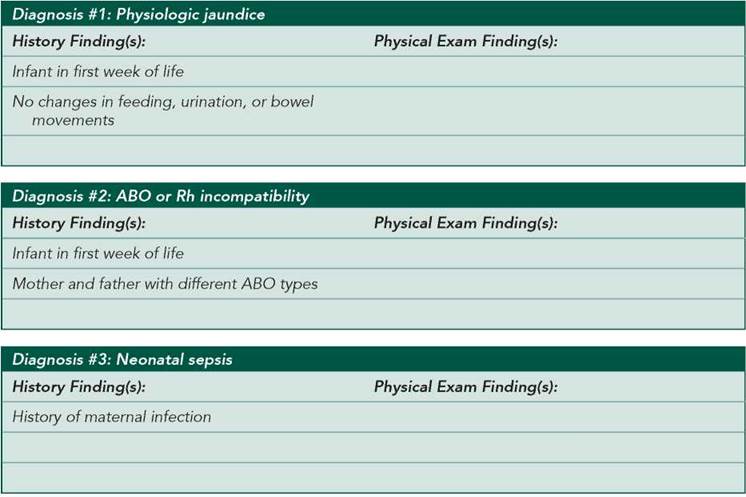
Differential Diagnosis
CASE DISCUSSION
Patient Note Differential Diagnoses
Neonatal jaundice can be divided into causes that predominate in the first week of life (early onset) and those that appear thereafter (late onset). The patient’s age (five days) makes early-onset causes more likely.
■ Physiologic jaundice: A condition that peaks between the third and seventh days of life. Underlying causes include accelerated destruction of erythrocytes, decreased excretory capacity, and decreased activity of the bilirubin-conjugating enzymes in hepatic cells. It is most commonly seen in preterm infants.
■ ABO or Rh incompatibility: Although both the mother and father are Rh positive, the fact that they have different blood types puts the neonate at risk for ABO incompatibility. The hemolysis that results from blood group incompatibility may also cause clinically significant jaundice in neonates within the first week of life.
■ Neonatal sepsis: Jaundice may be a manifestation of early-onset neonatal sepsis. A history of maternal infections, particularly with group B streptococcus, may be a clue to this diagnosis. However, neonatal sepsis typically manifests with other signs of infection, such as lethargy, vomiting, poor feeding, fever, hypothermia, and/or abnormally colored urine. Additionally, intrauterine infections (commonly referred to as TORCH— toxoplasmosis, rubella, CMV, HSV, and others) could present with neonatal jaundice within the first week of life. These infants may exhibit other findings that may help reach the correct diagnosis, such as small size for gestational age, rash, microcephaly, cataracts, microphthalmia, and/or hepatosplenomegaly.
Additional Differential Diagnoses:
Early-onset neonatal jaundice (within the first week of life):
■ Cephalohematoma: As this scalp hemorrhage reabsorbs, it can also serve as a source of increased bilirubin production. There is no mention of cephalohematoma in this presentation.
■ Breast-feeding jaundice: This is a condition that results from poor breast-feeding, which in turn results in slow bowel movements and insufficient removal of bilirubin. This child’s mother reports good feeding as well as frequent bowel movements.
■ Polycythemia: This condition may also lead to abnormally elevated levels of bilirubin resulting from increased total RBC mass.
■ Familial neonatal hyperbilirubinemia: Look for a positive history of a sibling who had neonatal jaundice requiring phototherapy. The patient’s sister had jaundice after birth, making this differential a possibility.
Late-onset neonatal jaundice (after the first week of life):
■ Breast milk jaundice: This condition results from insufficient mechanisms in the neonatal digestive tract to adequately excrete bilirubin. In contrast to breast-feeding jaundice, neonates with this condition typically feed well and therefore increase their bilirubin loads.
■ Biliary atresia: This condition would also present with jaundice but is considerably rarer than the others listed here. Labs show a direct hyperbilirubinemia, and an abdominal ultrasound may be diagnostic.
■ Metabolic disorders: These include hypothyroidism, galactosemia, and hereditary hemolytic disorders such as spherocytosis or G6PD deficiency.
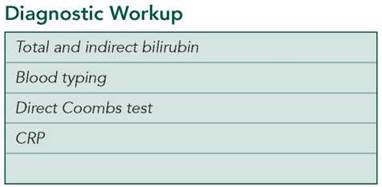
Diagnostic Workup
■ Total and indirect bilirubin: The first step in determining the severity and type of jaundice. Phototherapy is usually indicated and is maintained on the basis of bilirubin measurements (eg, phototherapy should be initiated when total serum bilirubin levels exceed 15 mg/dL in an otherwise well two-day-old term infant).
■ Blood typing and direct Coombs testing: To evaluate for jaundice stemming from blood group incompatibility. All infants who are born to mothers with type O blood should routinely receive direct Coombs testing to check for maternal-fetal incompatibility. Such children should also be closely followed for evidence of jaundice from hemolysis.
■ CRP: To monitor for signs of infection.
■ CBC: To evaluate the status of blood parameters such as hematocrit and hemoglobin due to suspected underlying hemolysis. Differential counts may provide additional clues about infections causing neonatal sepsis, although these can be more subtle in infants than in adults, since the neonatal immune system is immature.
■ Serology for CMV, toxoplasmosis, and rubella; RPR for syphilis; and urine culture for CMV: In suspected intrauterine (TORCH) infections.