Finishing the history and the physical exam does not mean that the patient encounter is over. To the contrary, closure is a critical part of the encounter.
The first thing you should bear in mind is that each patient encounter can be viewed as embodying one or more key questions. Most of these questions are simple and straightforward, but others may be considerably more complex. These questions should be addressed during closure.
As an example, if a patient’s chief complaint is chest pain, the question that the case embodies is, What is causing the chest pain? In this instance, closure should include the formulation of a differential diagnosis consisting of the most likely causes of the patient’s chest pain along with their associated workups. By contrast, if the patient has a history of diabetes mellitus and is presenting for follow-up, the case is posing two questions: First, is the patient’s diabetes well controlled? And second, is the patient experiencing complications such as diabetic retinopathy or nephropathy? Here, both questions should be addressed, and the workup should aim to determine whether the diabetes is well controlled (HbA1c) as well as to look for complications such as nephropathy (urine microalbuminuria).
To cite another example, if the patient is presenting following a rape, the case is posing the following questions: Are there any physical injuries? Psychological injuries? Any signs of STDs? Any signs of pregnancy? Closure should include answers to all of these questions along with a suitable workup for each.
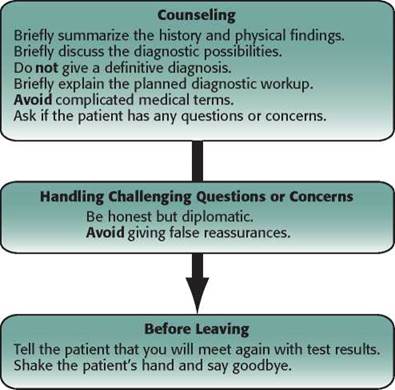
From a broader perspective, you are expected to do several things during closure (see Figure 2-4):
■ Make a transition to mark the end of your encounter.
■ Summarize the chief complaint and the HPI if you have not already done so before the physical exam.
■ Summarize your findings from the physical exam.
■ Give your impression of the patient’s clinical condition and most likely diagnosis.
■ Suggest a diagnostic workup.
■ Answer any questions the patient might have.
■ Address the patient’s concerns.
■ Check to see if the patient has any more questions.
■ Leave the room.
To transition into the closure, you should begin by saying something like “Thank you for letting me examine you, Mrs. Jones. Now I would like to sit down with you and give you my impression.” You should then tell the patient about the possible differential diagnoses (keep to a maximum of three) and explain the meaning of any complicated medical terms you might use. You might also point out the organ or system that you think is involved and explain a simple mechanism underlying the disease. You should not, however, give the patient a definitive diagnosis at this time. Instead, tell him that you still need to run some tests to establish the final diagnosis. In some cases there will actually be no final diagnosis; instead, the case will be constructed in such a way as to be a mixture of signs and symptoms that can be construed to indicate any number of diseases.
During closure, almost every patient will have at least one challenging question to which you must respond (eg, “Do you think I have cancer, doctor?” or “Am I going to get better?”). In answering these questions, be honest yet diplomatic. Essentially, being honest with the patient means not giving false reassurances such as “I am sure you will be cured after a week of antibiotics,” or “Don’t worry, I am sure it is not cancer.” What you might say instead is, “Well, I cannot exclude the possibility of cancer at this point. We need to do additional testing. Regardless of the final diagnosis, however, I want to assure you that I will be available for any support you need.”
FIGURE 2-4. Closure Overview
If you do not know the answer to a patient’s question, you should state as much. See the end of this section for examples of challenging questions patients might pose along with potential responses to each.
During closure, you should also explain to the patient the diagnostic tests you are planning to order. In doing so, you should again use nontechnical terms—for example, “We need to run some blood tests to check the function of your liver and kidneys,” or “You need to have a chest x-ray and a CT scan of the head.” You might further explain the latter by saying, “The CT scan is a form of x-ray imaging that gives us clear images of sections of the body.” You should then add, “After we get the results of those tests, we will meet again to discuss them in detail, along with the final diagnosis and the treatment plan.” Finally, you should conclude by asking the patient if he or she still has any questions.
If you find you are running out of time, do not compromise the closure. If time constraints dictate that you choose between a thorough physical exam and an appropriate closure, give priority to the execution of a proper closure.
Before you leave the room, you can finish your encounter by looking the patient in the eye and saying something like “Okay, Mr. Jones, I’ll contact you when I have your test results. It was nice meeting you.” You may then shake the patient’s hand and leave the room. You are allowed to leave the room as soon as you think you have completed the encounter. Once you have left the encounter room, you will not be allowed to go back inside.