
DOORWAY INFORMATION
Opening Scenario
James Miller, a 54-year-old male, comes to the clinic for hypertension follow-up.
Vital Signs
BP: 135/88 mm Hg Temp: 98.0°F (36.7°C)
RR: 16/minute HR: 70/minute, regular
Examinee Tasks
1. Take a focused history.
2. Perform a focused physical exam (do not perform rectal, genitourinary, or female breast exam).
3. Explain your clinical impression and workup plan to the patient.
4. Write the patient note after leaving the room.
Checklist/SP Sheet
Patient Description
Patient is a 54 yo M who appears anxious.
Notes for the SP
Don’t mention impotence unless the examinee asks whether you are having any side effects from your medications or whether you have any other concerns.
Challenging Questions to Ask
“I think it is my age. Isn’t that right, doctor?”
Sample Examinee Response
“No, I don’t think it’s because of your age. I worry more about your medications. However, testosterone levels can decrease with age, and we will check for that.”
Examinee Checklist
Building the Doctor-Patient Relationship Entrance
□ Examinee knocked on the door before entering.
□ Examinee introduced self by name.
□ Examinee identified his/her role or position.
□ Examinee correctly used patient’s name.
□ Examinee made eye contact with the SP.
Reflective Listening
□ Examinee asked an open-ended question and actively listened to the response.
□ Examinee asked the SP to list his/her concerns and listened to the response without interrupting.
□ Examinee summarized the SP’s concerns, often using the SP’s own words.
Information Gathering
□ Examinee elicited data efficiently and accurately.
Connecting with the Patient
□ Examinee recognized the SP’s emotions and responded with PEARLS.
Physical Examination
□ Examinee washed his/her hands.
□ Examinee asked permission to start the exam.
□ Examinee used respectful draping.
□ Examinee did not repeat painful maneuvers.
Closure
□ Examinee discussed initial diagnostic impressions.
□ Examinee discussed initial management plans:
□ Follow-up tests: Examinee mentioned the need for genital and rectal exams.
□ Lifestyle modification (diet, exercise, alcohol cessation).
□ Changing propranolol to another antihypertensive medication that does not cause erectile dysfunction.
□ Examinee asked if the SP had any other questions or concerns.
Sample Closure
Mr. Miller, your blood pressure level was 135188 when we measured it earlier today, which is close to our target of 130/80. However, it would be even better if we could get it down to around 120/80. Fortunately, that should be feasible with lifestyle changes such as decreasing your salt and fat intake and increasing the amount of exercise you are doing. As for your problems with your erection, this is a very common side effect of one of the blood pressure medications you are taking. For this reason, I would like to give you a medication other than propranolol to control your blood pressure. I am also going to order some blood tests to make sure that your problem is not due to any other medical condition. In addition, I would like to perform a genital exam as well as a rectal exam to assess your prostate. Do you have any questions for me?
History
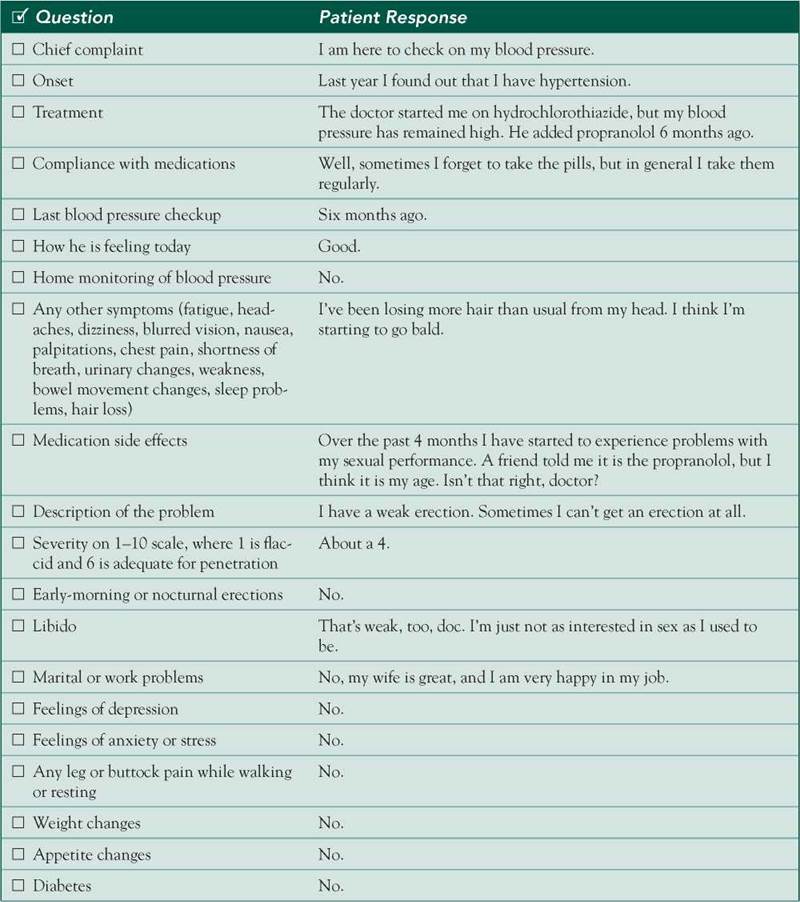
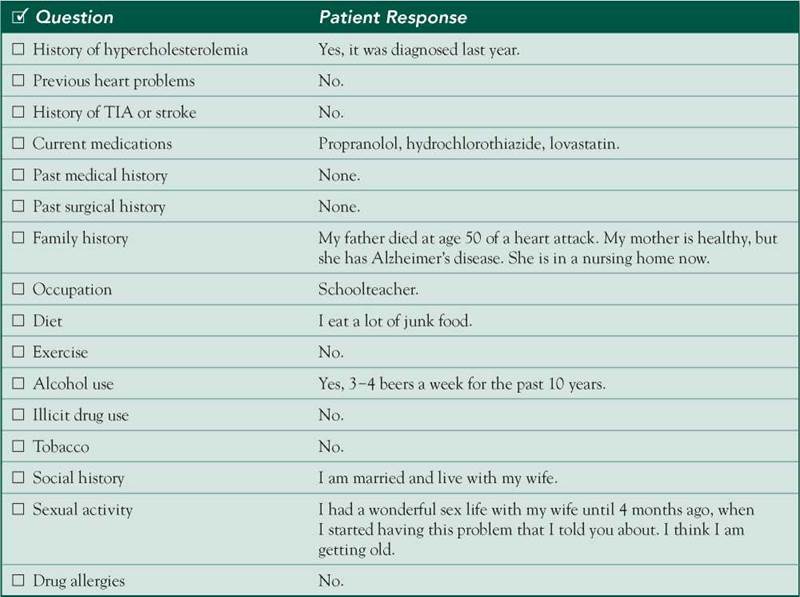
HPI: 54 yo M presents for follow-up of his hypertension that was diagnosed last year. He was initially started on HCTZ; propranolol was added 6 months ago. He is fairly compliant with his medications. He does not monitor his blood pressure at home. His last blood pressure checkup was 6 months ago. He is feeling well except for erectile dysfunction and decreased libido noted 4 months ago. No leg claudication or any previous history of heart problems, stroke, TIA, or diabetes. No marital or work problems. No depression, anxiety, appetite or weight changes, or history of trauma.
ROS: Negative except as above.
Allergies: NKDA.
Medications: HCTZ, propranolol, lovastatin.
PMH: Hypertension, hypercholesterolemia diagnosed 1 year ago.
PSH: None.
SH: No smoking, 3-4 beers/week, no illicit drugs. Works as a schoolteacher; married and lives with his wife. FH: Father died of a heart attack at age 50. Mother is in a nursing home due to Alzheimer's disease.
Physical Examination
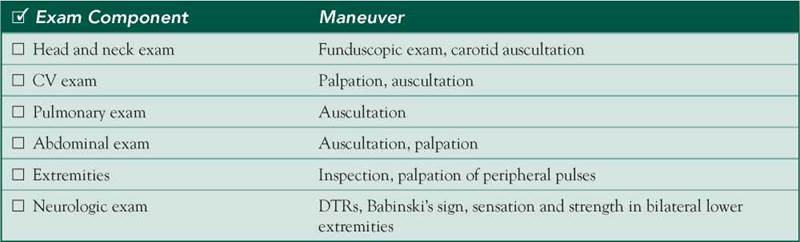
Patient is in no acute distress.
VS: WNL.
HEENT: No funduscopic abnormalities.
Neck: No carotid bruits, no JVD.
Chest: Clear breath sounds bilaterally.
Heart: Apical impulse not displaced; RRR; normal S1/S2; no murmurs, rubs, or gallops.
Abdomen: Soft, nondistended, nontender, BS, no bruits, no organomegaly.
Extremities: No edema, no hair loss or skin changes. Radial, brachial, femoral, dorsalis pedis, and posterior tibialis 2+ and symmetric.
Neuro: Motor: Strength 5/5 in bilateral lower extremities. Sensation: Intact to pinprick and soft touch in lower extremities. DTRs: Symmetric 2+ in lower extremities, Babinski bilaterally.
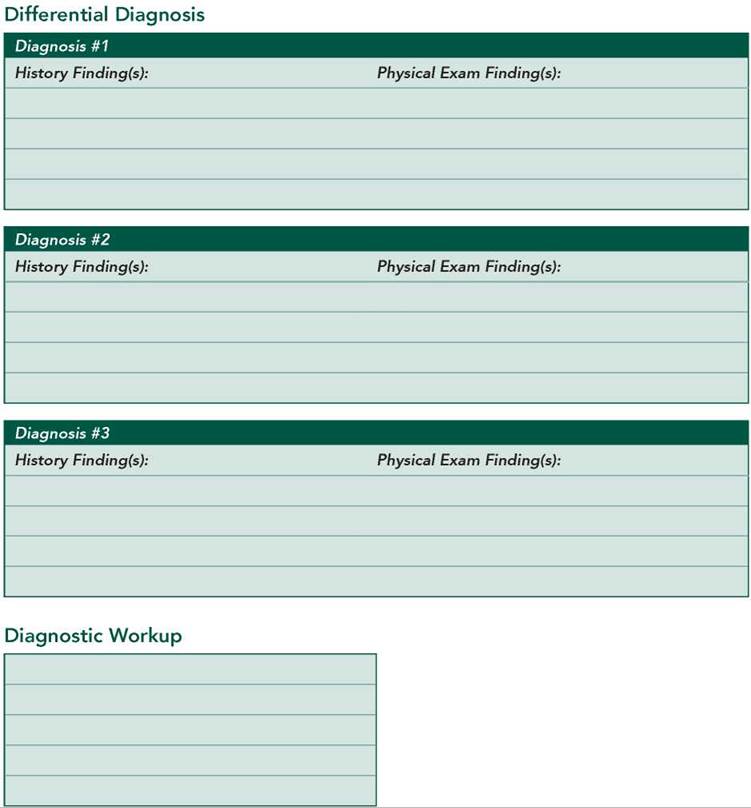
Differential Diagnosis

CASE DISCUSSION
Patient Note Differential Diagnoses
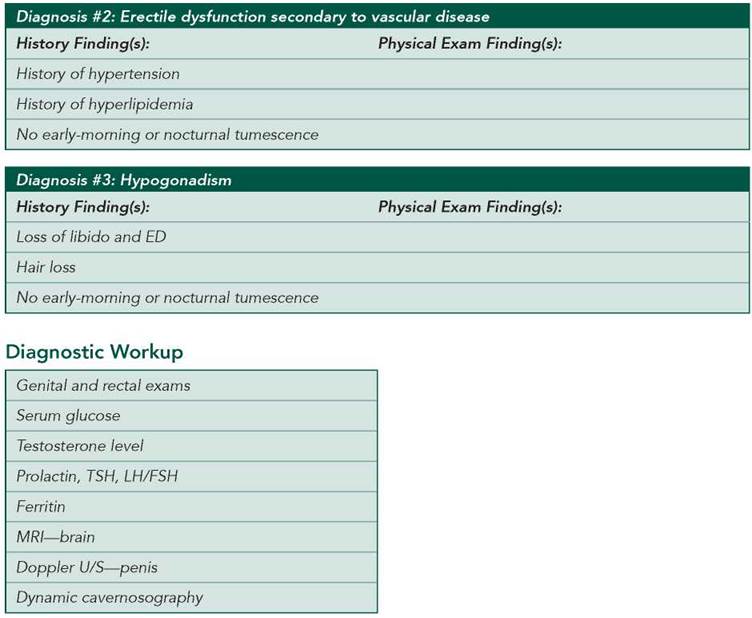
■ Medication-induced erectile dysfunction (ED): Antihypertensives (but rarely diuretics) and alcohol are commonly associated with ED. P-blockers can often cause loss of libido and ED. This patient’s ED began two months after he was started on propranolol. In addition, his lack of early-morning and nocturnal tumescence suggests an organic rather than a psychological etiology.
■ ED secondary to vascular disease: Hypertension and hyperlipidemia are risk factors for atherosclerotic vascular disease, but there are no historical or physical findings to suggest its presence in this case (eg, angina, leg claudication, diminished pulses, hair loss in the legs, or thin, shiny skin).
■ Hypogonadism: Testosterone deficiency has many underlying etiologies but, as with other endocrine problems, is attributable to either central (due to insufficient gonadotropin secretion by the pituitary) or end-organ disease (pathology in the testes themselves). In addition to diminished libido and possible ED, there are often associated symptoms such as hot flashes, fatigue, hair loss, and depression. This patient has hair loss, which is suggestive of testosterone deficiency.
Additional Differential Diagnoses
■ Depression: Psychogenic causes can lead to loss of libido and loss of erections and are suggested when nocturnal or early-morning erections are preserved (not seen in this case). This patient denies other depressive symptoms, but further exploration of his feelings about his nursing-home-bound mother may be more revealing.
■ Peyronie's disease: Fibrous plaque of the tunica albuginea can lead to penile scarring and ED.
Diagnostic Workup
■ Genital exam: To rule out Peyronie’s disease (eg, to look for penile scarring or plaque formation).
■ Rectal exam: To detect masses or prostatic abnormalities.
■ Serum glucose: To screen for diabetes, a possible contributor to ED.
■ Testosterone level: To screen for hypogonadism.
■ Prolactin, TSH: To screen for other abnormalities of pituitary function in patients with hypogonadotropic hypogonadism.
■ LH/FSH: Gonadotropin levels should be checked in patients with low or borderline testosterone levels. Levels are elevated (“hypergonadotropic”) in the setting of testicular pathology and are low (“hypogonadotropic”) in the setting of pituitary or hypothalamic disease.
■ Ferritin: To screen for hemochromatosis, a common condition; ED can be an early manifestation due to iron deposition in the pituitary gland causing hypogonadotropic hypogonadism.
■ MRI—brain: To rule out a pituitary or hypothalamic lesion in patients presenting with hypogonadotropic hypogonadism.
■ Doppler U/S—penis: To assess blood flow in the cavernous arteries.
■ Dynamic cavernosography: To determine the site and extent of venous leak (suspected in patients with normal arterial inflow).
■ BUN/Cr, electrolytes, cholesterol, UA, ECG: Useful in the longitudinal care of hypertension and hyperlipidemia. Can be used to screen for kidney disease, for LVH or prior silent MIs, for response to cholesterollowering medication, and for complications of medical therapy (eg, diuretic-induced hypokalemia).