
PRIMARY SOURCES
Eisenberg, Leon. “Nature, niche, and nurture: the role of social experience in transforming genotype into phenotype.” Academic Psychiatry 22 (December 1998): 213–22.
Ericsson, K. Anders. “Deliberate practice and the modifiability of body and mind: toward a science of the structure and acquisition of expert and elite performance.” International Journal of Sport Psychology 38 (2007): 4–34.
Ericsson, K. A., W. G. Chase, and S. Faloon. “Acquisition of a memory skill.” Science 208 (1980): 1181–82.
Howe, Michael J. A., J. W. Davidson, and J. A. Sloboda. “Innate talents: reality or myth.” Behavioural and Brain Sciences 21 (1998): 399–442.
Lehmann, A. C., and K. A. Ericsson. “The Historical Development of Domains of Expertise: Performance Standards and Innovations in Music.” In Genius and the Mind, edited by A. Steptoe. Oxford University Press, 1998, pp. 67–94.
Levitin, Daniel J. This Is Your Brain on Music: The Science of a Human Obsession. Dutton, 2006.
CHAPTER NOTES
explore the implications of chunking: Chase, Visual Information Processing, pp. 215–81.
Phone numbers, for example, are not stored in our brains as ten separate numbers but in three easy chunks: 513-673-8754.
 This is my mom’s cell phone number. Call her, tell her how much you like the book so far. Believe me, she won’t mind.
While our long-term memory capacity is apparently limitless, new memories are almost pathetically fragile: the average healthy adult can reliably juxtapose only three or four new, unrelated items. Such a limit, noted Ericsson and Chase, “places severe constraints on the human ability to process information and solve problems.”
Seven items are remembered correctly 50 percent of the time. (Ericsson, Chase, and Faloon, “Acquisition of a memory skill,” pp. 1181–82.)
Excerpt from my earlier book The Forgetting, on the importance of a limited memory:
Why? Why would millions of years of evolution produce a machine so otherwise sophisticated but with an apparent built-in fuzziness, a tendency to regularly forget, repress and distort information and experience?
The answer, it turns out, is that fuzziness is not a severe limitation but a highly advanced feature. As a matter of engineering, the brain does not have any physical limitations in the amount of information it can hold. It is designed specifically to forget most of the details it comes across, so that it may allow us to form general impressions, and from there useful judgments. Forgetting is not a failure at all, but an active metabolic process, a flushing out of data in the pursuit of knowledge and meaning.
We know this not just from brain chemistry and inference, but also because psychologists have stumbled upon a few individuals over the years who actually could not forget enough—and were debilitated by it.
In his New Yorker profile, Mark Singer wonders if Martin Scorsese is such a person—burdened by too good a memory. “Was it, I wondered, painful to remember so much? Scorsese’s powers of recall weren’t limited to summoning plot turns or notable scenes or acting performances; his gray matter bulged with camera angles, lighting strategies, scores, sound effects, ambient noises, editing rhythms, production credits, data about lenses and film stocks and exposure speeds and aspect ratios … what about all the sludge? An inability to forget the forgettable—wasn’t that a burden, or was it just part of the price one paid to make great art?”
For some perspective on the inability to forget, consider the case-study that psychologists call S. In the 1920s, S. was a twenty-something newspaper reporter in Moscow who one day got into trouble with his editor for not taking notes at a staff meeting. In the midst of the reprimand, S. shocked his boss by matter-of-factly repeating everything that had been said in the meeting—word for word.
This was apparently no stretch at all for S., who, it emerged upon closer examination, remembered virtually every detail of sight and sound that he had come into contact with in his entire life. What’s more, he took this perfect memory entirely for granted. To him, it seemed perfectly normal that he forgot nothing.
The editor, amazed, sent S. to the distinguished Russian psychologist A. R. Luria for testing. Luria did test him that day, and for many other days over a period of many decades. In all the testing, he could not find any real limit to his capacity to recall details. For example, not only could he perfectly recall tables like this one full of random data after looking at them for just a few minutes—
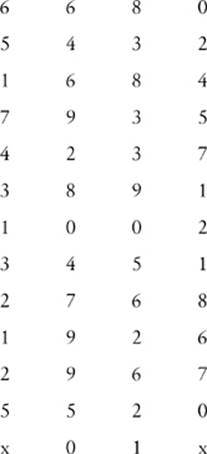
—and not only could he efficiently recite these tables backwards, upside down, diagonal, etc., but after years of memorizing thousands of such tables, he could easily reproduce any particular one of them, without warning, whether it was an hour after he had first seen it, or twenty years. The man, it seemed, quite literally remembered everything.
And yet he understood almost nothing. S. was plagued by an inability to make meaning out of what he saw. Unless one pointed the obvious pattern out to him, for example, the following table appeared just as bereft of order and meaning as any other:

“If I had been given the letters of the alphabet arranged in a similar order,” he remarked after being questioned about the 1–2– 3–4 table, “I wouldn’t have noticed their arrangement.” He was also unable to make sense out of poetry or prose, to understand much about the law, or even to remember people’s faces. “They’re so changeable,” he complained to Luria. “A person’s expression depends on his mood and on the circumstances under which you happen to meet him. People’s faces are constantly changing; it’s the different shades of expression that confuse me and make it so hard to remember faces.”
Luria also noted that S. came across as generally disorganized, dull-witted and without much of a sense of purpose or direction in life. This astounding man, then, was not so much gifted with the ability to remember everything as he was cursed with the inability to forget detail and form more general impressions. He recorded only information, and was bereft of the essential ability to draw meaning out of events. “Many of us are anxious to find ways to improve our memories,” wrote Luria in a lengthy report on his unusual subject. “In S.’s case, however, precisely the reverse was true. The big question for him, and the most troublesome, was how he could learn to forget.”
What makes details hazy also enables us to prioritize information, recognize and retain patterns. The brain eliminates trees in order to make sense of, and remember, the forests. Forgetting is a hidden virtue. Forgetting is what makes us so smart. (Shenk, The Forgetting, p. 59.)
In one-hour sessions, three to five sessions per week, researchers read sequences of random numbers to S.F. at the rate of one digit per second: 2 … 5 … 3 … 5 … 4 … 9 … At intervals, they stopped and asked him to echo their list back. “If the sequence was reported correctly,” the researchers noted, “the next sequence was increased by one digit; otherwise it was decreased by one digit.”
Ericsson, Chase, and Faloon write:
Immediately after half the trials (randomly selected), S.F. provided verbal reports of his thoughts during the trial. At the end of each session, he also recalled as much of the material from the session as he could. On some days, experiments were substituted for the regular sessions. (Ericsson, Chase, and Faloon, “Acquisition of a memory skill,” pp. 1181–82.)
From there, the improvements continued unabated: to thirty digits, forty, fifty, sixty, seventy, and finally to a staggering eighty-plus digits before the team concluded the experiment.
The 1980 paper says seventy-nine digits in more than 230 hours, but in fact the experiment continued. In the book Cognitive Skills and Their Acquisition, they report the higher figures. (Ericsson, Chase, and Faloon, “Acquisition of a memory skill,” pp. 1181–82; Anderson, Cognitive Skills and Their Acquisition.)
Graph of S.F.’s memory-lab sessions.
Fig. 1. Average digit span for S.F. as a function of practice. Digit span is defined as the length of the sequence that is correct 50 percent of the time; under the procedure followed, it is equivalent to average sequence length. Each day represents about 1 hour’s practice and ranges from 55 trials per day in the beginning to 3 trials per day for the longest sequences. The 38 blocks of practice shown here represent about 190 hours of practice; interspersed among these practice sessions are approximately 40 hours of experimental sessions (not shown). (Ericsson, Chase, and Faloon, “Acquisition of a memory skill,” pp. 1181–82;.)
Ericsson and Chase published their results in the prestigious journal Science, and their results were subsequently corroborated many times over.
In one experimental session, S.F. was switched from digits to letters of the alphabet after three months of practice and exhibited no transfer: his memory span dropped back to about six consonants.
More from that article: “After all this practice, can we conclude that S.F. increased his short-term memory capacity? There are several reasons to think not.” (Ericsson, Chase, and Faloon, “Acquisition of a memory skill,” pp. 1181–82;.)
Google Scholar lists this article as being cited 266 times by other researchers.
It was a double lesson: when it comes to memory skills, there is no escaping basic human biology—nor any need to. Remembering extraordinary amounts of new information simply requires the right strategies and the right amount of intensive practice, tools theoretically available to any functioning human being.
We should acknowledge that evidence from other studies demonstrates that people do arrive at studies with different memory capabilities. “The conclusion is clear: the talent for being a memory expert reflects both experiential and individual-difference factors. In this case because of the age association and the extreme robustness of the individual difference finding, the likelihood is high that biology based factors are involved.” (Howe, Davidson, and Sloboda, “Innate talents: reality or myth?” p. 408.)
Relevant studies include:
Anderson, John R. Cognitive Skills and Their Acquisition. Lawrence Erlbaum, 1981.
Baltes, Paul B. “Testing the limits of the ontogenetic sources of talent and excellence.” Behavioral and Brain Sciences 21, no. 3 (June 1998): 407–8.
Kliegl, Smith, and P. B. Baltes. “On the locus and process of magnification of age differences during mnemonic training.” Developmental Psychology 26 (1990): 894–904.
It is imperative to understand that I am not arguing against the existence of biological factors or biological differences among individuals. From the moment of conception, everyone has differences. But what has become clear is none of us really know what those biological differences are, or what each of our biological limits really are. When observing our lives in progress, we are not witnessing our biological differences, per se. What we witness even in the early stages of our lives is our life differences resulting from the dynamic interaction of both our unique biologies and our unique environments. The chess game is already in progress, and even after move number three we cannot say that the position on the board was caused by one player’s moves.
So began Anders Ericsson’s remarkable talent odyssey.
The stunning results from S.F.’s short-term memory (and a follow-up subject who did even better) led him to suggest a previously unknown memory mechanism called “long-term working memory” (LT-WM). “Information in LT-WM is stored in stable form,” he and his coauthor W. Kintsch reported, “but reliable access to it may be maintained only temporarily by means of retrieval cues in [short-term memory].” They went on to explain:
In this article we propose that a general account of working memory has to include another mechanism based on skilled use of storage in long-term memory (LTM) that we refer to as long-term working memory (LT-WM) in addition to the temporary storage of information that we refer to as short-term working memory (ST-WM). Information in LT-WM is stored in stable form, but reliable access to it may be maintained only temporarily by means of retrieval cues in ST-WM. Hence LT-WM is distinguished from ST-WM by the durability of the storage it provides and the need for sufficient retrieval cues in attention for access to information in LTM. (Ericsson and Kintsch, “Long-term working memory,” pp. 211–45.)
Ericsson adds:
Early in the twentieth century it was believed that experts were innately talented with a superior ability to store information in memory. Numerous anecdotes were collected as evidence of an unusual ability to store presented information rapidly. For example, Mozart was supposed to be able to reproduce a presented piece of music after hearing it a single time. However, more recent research has rejected the hypothesis of a generally superior memory in experts and has demonstrated that experts’ superior memory is limited to their domains of expertise and can be viewed as the result of acquired skills and knowledge relevant to each specific domain. (Ericsson, “Superior memory of experts and long-term working memory.”)
Though he couldn’t be sure at the time, Ericsson suspected he had just discovered the hidden key to the veiled domains of talent and genius.
Ericsson writes:
Experts’ superior memory for representative stimuli from their domain of expertise, but not for randomly rearranged versions of those stimuli, has been frequently replicated in chess (see Charness, 1991, for a review) and also demonstrated in bridge (Charness, 1979; Engle & Bukstel, 1978); go (Reitman, 1976); medicine (G. R. Norman, Brooks & Allen, 1989); music (Sloboda, 1976); electronics (Egan & Schwartz, 1979); computer programming (McKeithen, Reitman, Rueter, & Hirtle, 1981); dance, basketball, and field hockey (Allard & Starkes, 1991); and figure skating (Deakin & Allard, 1991). (Ericsson, “Superior memory of experts and long-term working memory.”)
Paganini’s Sauret cadenza: From his first violin concerto.
“Talent” is defined in the Oxford English Dictionary as “mental endowment; natural ability” and is sourced all the way back to the parable of the talents in the book of Matthew.
Actually, the word “talent” goes back much further and was used first for many centuries as a measurement of a weight and then as a name for currency. Its meaning of “ability” began sometime around its use in the book of Matthew (the parable of the talents, Matthew 25:14–30).
The term “genius,” as it is currently defined, goes back to the tail end of the eighteenth century.
Larry Shiner writes:
At the beginning of the eighteenth century it was widely believed that everyone had a genius or talent for something and that their particular genius could only be perfected by the guidance of reason and rule. By the end of the century, not only had the balance between genius and rule been reversed, but in addition, genius itself had become the opposite of talent and instead of everyone having a genius for something, a few people were said to be geniuses. (Shiner, The Invention of Art, pp. 111–12.)
“Poets and musicians are born,” declared the poet Christian Friedrich Schubart in 1785: Lowinsky, “Musical genius,” p. 325.
“Musical genius is that inborn, inexplicable gift of Nature,” insisted the composer Peter Lichtenthal in 1826: Lowinsky, “Musical genius,” p. 324.
“Don’t ask, young artist, ‘what is genius?’” proclaimed Jean-Jacques Rousseau in 1768. “Either you have it—then you feel it yourself, or you don’t—then you will never know it.”
The longer passage:
Don’t ask, young artist, “what is genius?” Either you have it—then you feel it yourself, or you don’t—then you will never know it. The genius of the musician subjects the entire Universe to his art. He paints all pictures through tones; he lends eloquence even to silence. He renders the ideas through sentiments, sentiments through accents, and the passions he expresses he awakens [also] in his listener’s heart. Pleasure, through him, takes on new charms; pain rendered in musical sighs wrests cries [from the listener]. He burns incessantly, but never consumes himself. He expresses with warmth frost and ice. Even when he paints the horrors of Death, he carries in his soul this feeling for Life that never abandons him, and that he communicates to hearts made to feel it. But alas, he does not speak to those who don’t carry his seed within themselves and his miracles escape those who cannot imitate them. Do you wish to know whether a spark of this devouring fire animates you? Hasten then, fly to Naples, listen there to the masterworks of Leo, of Durante, of Jommelli, of Pergolesi. If your eyes fill with tears, if you feel your heart beat, if shivers run down your spine, if breath-taking raptures choke you, then take [a libretto by] Metastasio and go to work: his genius will kindle yours; you will create at his example. That is what makes the genius—and the tears of others will soon repay you for the tears that your masters elicited from you. But should the charms of this great artist leave you cold, should you experience neither delirium nor delight, should you find that which transports only ‘nice,’ do you then dare ask what is genius? Vulgar man, don’t profane this sublime word. What would it matter to you if you knew it? You would not know how to feel it. Go home and write—French music. (Lowinsky, “Musical genius,” pp. 326–27.)
Artists have a vested interest in our believing in the flash of revelation, the so-called inspiration: Lowinsky, “Musical genius,” p. 333.
As a vivid illustration, Nietzsche cited Beethoven’s sketchbooks.
To see an example of one of Beethoven’s working drafts, see Sketches for the ‘Pastoral’ Symphony (no. 6 in F Major, op. 68). (Ludwig van Beethoven, 1808, British Library Add. MS 31766, f.2.)
Beethoven would sometimes run through as many as sixty or seventy different drafts of a phrase before settling on the final one: Wierzbicki, “The Beethoven Sketch-books.” (Wierzbicki cites Douglas Johnson, Alan Tyson, and Robert Winter, The Beethoven Sketchbooks: History, Reconstruction, Inventory, University of California Press, 1985.)
Over the following three decades, Ericsson and colleagues invigorated the largely dormant field of expertise studies in order to test this idea, examining high achievement from every possible angle: memory, cognition, practice, persistence, muscle response, mentorship, innovation, attitude, response to failure, and on and on. They studied golfers, nurses, typists, gymnasts, violinists, chess players, basketball players, and computer programmers.
A small sampling of their published research, from earliest to most recent:
Conley, D. L., et al. “Running economy and distance running performance of highly trained athletes.” Medicine and Science in Sports and Exercise (1980).
Salthouse, T. A. “Effects of age and skill in typing.” Journal of Experimental Psychology: General (1984).
Schulz, R., et al. “Peak performance and age among superathletes: track and field, swimming, baseball, tennis, and golf.” Journal of Gerontology (1988).
Coyle, E. F., et al. “Physiological and biomechanical factors associated with elite endurance cycling performance.” Medicine and Science in Sports and Exercise (1991).
Abernethy, B., et al. “Visual-perceptual and cognitive differences between expert, intermediate, and novice snooker players.” Applied Cognitive Psychology (1994).
Starkes, J. L., et al. “A new technology and field test of advance cue usage in volleyball.” Research Quarterly for Exercise and Sport (1995).
Krampe, R. Th., et al. “Maintaining excellence: deliberate practice and elite performance in young and older pianists.” Journal of Experimental Psychology (1996).
Higbee, K. L. “Novices, apprentices, and mnemonists: acquiring expertise with the phonetic mnemonic.” Applied Cognitive Psychology (1997).
Nevett, M. E., et al. “The development of sport-specific planning, rehearsal, and updating of plans during defensive youth baseball game performance.” Research Quarterly for Exercise and Sport (1997).
Masters, K., et al. “Associative and dissociative cognitive strategies in exercise and running: 20 years later, what do we know?” Sport Psychologist (1998).
Pieper, H.-G. “Humeral torsion in the throwing arm of handball players.” American Journal of Sports Medicine (1998).
Gabrielsson, A. “The Performance of Music.” In The Psychology of Music, edited by D. Deutsch. Academic Press, 1999.
Helson, W. F., et al. “A multidimensional approach to skilled perception and performance in sport.” Applied Cognitive Psychology (1999).
Helgerud, J., et al. “Aerobic endurance training improves soccer performance.” Medicine and Science in Sports and Exercise (2001).
Hopkins, W. G., et al. “Variability of competitive performance of distance runners.” Medicine and Science in Sports and Exercise (2001).
Pelliccia, A., et al. “Remodeling of left ventricular hypertrophy in elite athletes after long-term deconditioning.” Circulation (2002).
Goldspink, G. “Gene expression in muscle in response to exercise.” Journal of Muscle Research and Cell Motility (2003).
Maguire, E. A., et al. “Routes to remembering: the brains behind superior memory.” Nature Neuroscience (2003).
McPherson, S., et al. “Tactics, the neglected attribute of expertise: problem representations and performance skills in tennis.” In Expert Performance in Sports, edited by Janet Starkes and K. Anders Ericcson. Human Kinetics Publishers, 2003.
Pantev, C., et al. “Music and learning-induced cortical plasticity.” Annals of the New York Academy of Sciences (2003).
Duffy, L. J., B. Baluch, and K. A. Ericsson. “Dart performance as a function of facets of practice amongst professional and amateur men and women players.” International Journal of Sports Psychology 35 (2004): 232–45.
Ericsson, K. A. “Deliberate practice and the acquisition and maintenance of expert performance in medicine and related domains.” Academic Medicine (2004).
Prior, B. M., et al. “What makes vessels grow with exercise training?” Journal of Applied Physiology (2004).
Pyne, D. B., et al. “Progression and variability of competitive performance of Olympic swimmers.” Journal of Sports Sciences (2004).
Wittwer, M., et al. “Regulatory gene expression in skeletal muscle of highly endurance trained humans.” Acta Physiologica Scandinavica (2004).
Baker, J., et al. “Cognitive characteristics of expert, middle of the pack, and back of the pack ultra-endurance triathletes.” Psychology of Sport and Exercise (2005).
Bengtsson, S. L., et al. “Extensive piano practicing has regionally specific effects on white matter development.” Nature Neuroscience (2005).
Larsen, H., et al. “Training response of adolescent Kenyan town and village boys to endurance running.” Scandinavian Journal of Medicine and Science in Sports (2005).
Legaz, A., et al. “Changes in performance, skinfold thicknesses, and fat patterning after three years of intense athletic conditioning in high level runners.” British Journal of Sports Medicine (2005).
van der Maas, H. L. J., et al. “A psychometric analysis of chess expertise.” American Journal of Psychology (2005).
Young, L., et al. “Left ventricular size and systolic function in Thoroughbred race horses and their relationship to race performance.” Journal of Applied Physiology (2005).
Coffey, V. G., et al. “Interaction of contractile activity and training history on mRNA abundance in skeletal muscle from trained athletes.” American Journal of Physiology, Endocrinology, and Metabolism (2006).
His father, Leopold Mozart, was an intensely ambitious Austrian musician.
Leopold’s book was published the year his son Wolfgang was born. (Sadie, ed., The Grove Concise Dictionary of Music, 1988.)
[Leopold] advocated the so-called “Geminiani grip”: November, “A French edition of Leopold Mozart’s Violinschule (1756).”
Then came Wolfgang. Four and a half years younger than his sister, the tiny boy got everything Nannerl got—only much earlier and even more intensively.
There is a wonderful parallel with another family three centuries later—the three Polgar sisters in Hungary, all raised to be exceptional chess players. As each girl was exposed to chess earlier than her elder sister, she subsequently became the better player. The youngest, Judit, became the youngest grandmaster in history at age fifteen (at that time). (Shenk, The Immortal Game, p. 132.)
Literally from his infancy, he was the classic younger sibling soaking up his big sister’s singular passion. As soon as he was able, he sat beside her at the harpsichord and mimicked chords that she played.
Nannerl later wrote: “He often spent much time at the clavier [keyboard], picking out thirds … and his pleasure showed it sounded good [to him].” (Zaslaw and Cowdery, The Compleat Mozart, p. 276.)
His sister also echoed her father’s words that Wolfgang was the beneficiary of a God-given talent, and that his abilities were apparent from very early on. This may seem to be in contradiction with my argument here. But neither the intense religiosity of the Mozart family nor the obvious precociousness of young Wolfgang refutes the notion of his genius being a matter of development.
Not only did Leopold openly give preferred attention to Wolfgang over his daughter; he also made a career-altering decision to more or less shrug off his official duties in order to build an even more promising career for his son.
“Everything connected with his son’s career was of such importance that his official duties fell into the background.” pp. 401–4. (Geiringer, “Leopold Mozart,”.)
Also, Alfred Einstein writes:
Up to 1762, [Leopold’s] ambition to rise in Salzburg to the highest position had been thwarted by his superior, the Kapellmeister Johann Ernst Eberlin, who towered far above him as a creative musician, and whom he himself recognized as a pattern “of a thorough and finished master,” as an example of wonderful fertility and ease of production. But some months before Eberlin died (1762), Leopold had departed with his children on his second tour which, as a moral obligation and as a pecuniary speculation, he put far above his official duties at Salzburg. (Alfred Einstein, preface to A Treatise on the Fundamental Principles of Violin Playing. See also Stowell, “Leopold Mozart Revised,”, pp. 126–57, and November, “A French Edition of Leopold Mozart’s Violinschule [1756].”)
From the age of three, then, Wolfgang had an entire family driving him to excel with a powerful blend of instruction, encouragement, and constant practice.
Have we identified every explanation for the marvelous success of Leopold Mozart’s children? Of course not. This book does not pretend that there is a simple recipe for talent or presume to fully understand the dynamic that makes the children of some ambitious parents into amazingly skilled performers and others mediocre or disinterested players. The point here is that it is a dynamic process—not that we can track every single factor and interaction as it plays out.
today many young children exposed to Suzuki and other rigorous musical programs play as well as young Mozart did—and some play even better: Lehmann and Ericsson, “The Historical Development of Domains of Expertise,” pp. 67–94.
Deconstructing the myth of Mozart’s early achievements, and understanding why they were so rare, does not make those achievements any less spectacular. It is a blessing for anyone, at any age, to be able to bring grace and beauty into other people’s lives. For a child to attain such poise and proficiency while his or her peers lark about on swings and fumble with toy instruments is truly something to behold.
That having been said, no one today would pay any attention to Mozart’s earliest years if he hadn’t gone on to develop into such a remarkable adult composer.
“When we say that someone is talented”: Levitin, This Is Your Brain on Music,.
Practice changes your body. Researchers have recorded a constellation of physical changes (occurring in direct response to practice) in the muscles, nerves, hearts, lungs, and brains of those showing profound increases in skill level in any domain.
Ericsson writes:
[There is] emerging evidence that extended focused practice has profound effects on, and can influence virtually every aspect of, the human body, such as muscles, nerve systems, heart and circulatory system, and the brain. (Ericsson et al., eds., The Cambridge Handbook of Expertise and Expert Performance, p. 59.)
The brain drives the brawn. Even among athletes, changes in the brain are arguably the most profound, with a vast increase in precise task knowledge, a shift from conscious analysis to intuitive thinking (saving time and energy), and elaborate self-monitoring mechanisms that allow for constant adjustments in real time.
Supporting Ericsson’s thesis is his observation, from many pieces of research, that “expert performance is primarily mediated by acquired mental representations that allow the experts to anticipate courses of action, to control those aspects that are relevant to generating their superior performance, and to evaluate alternative courses of action during performance or after the completion of the competition.” (Italics mine.) (Ericsson, “Deliberate practice and the modifiability of body and mind,” pp. 4–34.)
In other words, most of the advantages held by superior achievers, even among athletes, occur in particular regions of the brain. Better musicians, typists, hockey goalies, etc., are all able to draw on more elaborate mental representations of what they want to do—and to execute them more efficiently.
This first came to researchers’ attention in studies of typists, when the researchers realized that the better and faster typists were able to look further ahead and prepare themselves better for future keystrokes. Later, they observed the same thing with hockey goalies, tennis players, and baseball batters—showing that they had more elaborate mental preparation for the events about to unfold and that they could more efficiently draw on better “anticipatory cues” to make better decisions and execute more efficient motor function in real time.
“Experts certainly know more, but they also know differently,” says Ericsson. “Expertise is … not a simple matter of fact or skill acquisition, but rather a complex construct of adaptations of mind and body, which include substantial self-monitoring and control mechanisms.”
He continues: “There is an element of unencumbered elegance in expert performance, the underpinnings of which are based on the efficient management and control of the adaptive processes. A source for this might be in abstracted layers of control and planning.” (Ericsson et al., eds., The Cambridge Handbook of Expertise and Expert Performance, p. 57.)
“Deliberate practice is a very special form of activity”: Ericsson et al., “Giftedness and evidence for reproducibly superior performance,” pp. 3–56.
Recall Eleanor Maguire’s 1999 brain scans of London cabbies, which revealed greatly enlarged representation in the brain region that controls spatial awareness. The same holds for any specific task being honed; the relevant brain regions adapt accordingly.
See earlier note, beginning, “Further, her conclusion was perfectly consistent with what others have discovered in recent studies …”
Whereas the amateur singers experienced the lesson as self-actualization and an enjoyable release of tension, the professional singers increased their concentration and focused on improving their performance during the lesson: Ericsson, K. Anders, Roy W. Roring, and Kiruthiga Nandagopal. “Giftedness and evidence for reproducibly superior performance: an account based on the expert performance framework.” High Ability Studies18, no. 1 (June 2007): 3–56.
The same phenomenon is discussed in the following works:
Charness, Neil, R. Th. Krampe, and U. Mayr. “The Role of Practice and Coaching in Entrepreneurial Skill Domains: An International Comparison of Life-Span Chess Skill Acquisition.” In The Road to Excellence: The Acquisition of Expert Performance in the Arts and Sciences, Sports, and Games, edited by K. A. Ericsson. Lawrence Erlbaum, 1996, pp.51–80.
Charness, Neil, M. Tuffiash, R. Krampe, E. Reingold, and E. Vasyukova. “The role of deliberate practice in chess expertise.” Applied Cognitive Psychology 19 (2005): 151–65.
Duffy, L. J., B. Baluch, and K. A. Ericsson. “Dart performance as a function of facets of practice amongst professional and amateur men and women players.” International Journal of Sports Psychology 35 (2004): 232–45.
Ward, P., N. J. Hodges, A. M. Williams, and J. L. Starkes. “Deliberate Practice and Expert Performance: Defining the Path to Excellence.” In Skill Acquisition in Sport: Research, Theory and Practice, edited by A. M. Williams and N. J. Hodges. Routledge, 2004.
Genes are involved, of course. They’re a dynamic part of the process as they become activated.
Ericsson writes:
The adult body has evolved to cope with short-term fluctuations in physiological demands … Whenever individuals engage in physical sport activities, the metabolism of their muscle fibers increases, and the supply of oxygen and energy within the muscle cells is rapidly reduced and supplies are extracted from the nearest blood vessels. To preserve homeostasis, the body activates various counter measures (negative feedback loops). For example, increased breathing rates increase oxygen concentrations and decrease carbon dioxide concentrations in the blood. In turn, the conversion of stored energy replenishes expendable energy available in the blood, and the increased rate of blood circulation distributes these commodities to the systems of the body with the greatest needs. However, when individuals deliberately push themselves beyond the zone of relative comfort (Ericsson, 2001, 2002) and engage in sustained strenuous physical activity, they will challenge the available protection of homeostasis sufficiently to induce an abnormal state for cells in some physiological systems. These states will sometimes be associated with abnormally low levels of certain vital elements and compounds, such as oxygen, and energy-related compounds (e.g., glucose, adenosine-diphosphate; ADP and adenosine-triphosphate; ATP), which lead metabolic processes to change and produce alternative biochemical products. These biochemical states will trigger the activation of some genes in massive storage of dormant genes within the cells’ DNA. The activated genes in turn will stimulate and “turn on” biochemical systems designed to cause bodily reorganization and adaptive change. Recent research shows that the biochemical response of cells to various types of strain induced by vigorous activity, such as physical exercise, is very complex. Even more directly relevant to physical exercise, over one hundred different genes are activated and expressed in mammalian muscle in response to intense physical exercise. (Ericsson, “Giftedness and evidence for reproducibly superior performance,”. pp. 3–56.)
“When individuals deliberately push themselves”: Ericsson, “Giftedness and evidence for reproducibly superior performance,” pp. 3–56.
This does not mean, of course, that every person has the same resources and opportunity, or that anyone can be great at anything; biological and circumstantial differences and advantages/disadvantages abound. But in revealing talent to be a process, the simple idea of genetic giftedness is forever debunked. It is no longer reasonable to attribute talent or success to a specific gene or any other mysterious gift.
Ericsson writes:
A careful review of the published evidence on the heritability of acquisition of elite sports achievement failed to reveal reproducible evidence for any genetic constraints for attaining elite levels by healthy individuals (excluding, of course, the evidence on body size). (Ericsson, “Deliberate practice and the modifiability of body and mind,” pp. 4–34.)
R. Subotnik adds:
In order to be gifted, that is, to be exceptional, as one matures, one needs to be increasingly active in one’s own development. You have to develop your hunger, you have to be open to career advice, and you have to hone your social skills or your intriguing persona. (Subotnik, “A developmental view of giftedness,” pp. 14–15.)
From sublime pianists to unusually profound physicists, researchers have been very hard-pressed to find any examples of truly extraordinary performers in any field who reached the top of their game before that ten-thousand-hour mark.
Daniel Levitin writes:
In study after study, of composers, basketball players, fiction writers, ice-skaters, concert pianists, chess players, master criminals … this number comes up again and again. Ten thousand hours is equivalent to roughly three hours a day, or 20 hours a week, of practice over 10 years … No one has yet found a case in which true world-class expertise was accomplished in less time. It seems that it takes the brain this long to assimilate all that it needs to know to achieve true mastery. (Levitin, This Is Your Brain on Music, p. 193.)
Recent chess studies conform with Levitin’s and Ericsson’s observations in a number of ways—practice hours, starting age, etc. (Campitelli and Gobet, “The role of practice in chess”; Gobet and Campitelli, “The role of domain-specific practice, handedness and starting age in chess,” pp. 159–72.)
“People make a great mistake who think that my art has come easily to me,” Mozart himself once wrote to his father, as if to make this precise point. “Nobody has devoted so much time and thought to compositions as I.”
He continues: “There is not a famous master whose music I have not studied over and over.” (Pott, “The Triumph of Genius.”)
His first seven piano concertos, written from ages eleven to sixteen, “contain almost nothing original,” reports Temple University’s Robert Weisberg, and “perhaps should not even be labeled as being by Mozart.”
And they may not even have been that impressive—they exist today only in his father’s handwriting.
Robert W. Weisberg writes:
Mozart seems to have begun learning his skill through study and small-scale modification of the works of others. Mozart arranged it for piano and other instruments … Even when Mozart began to write music of his own, those pieces seem to have been based relatively closely on works by other composers, as can be seen in his production of symphonies. (Weisberg, “Case Studies of Innovation,”. p. 214)
Jon Pott adds: “Many of his early compositions were dazzling and accomplished for his age, but not for more.” Pott also writes that critics consider his Symphony no. 29, written ten years after his first symphony, to be his first work of real stature. (Pott, “The Triumph of Genius.” See also Weisberg, “Expertise in Creative Thinking,” pp. 761–87.)