
PRIMARY SOURCES
Entine, Jon. Taboo: Why Black Athletes Dominate Sports and Why We Are Afraid to Talk About It. Public Affairs, 2000.
Noakes, Timothy David. “Improving Athletic Performance or Promoting Health Through Physical Activity.” World Congress on Medicine and Health, July 21–August 31, 2000.
CHAPTER NOTES
At the 2008 Summer Olympics in Beijing.
Olympic track and field results for Jamaican medalists:
Men’s 100-meter final: Usain Bolt (gold) 9.69 seconds
Men’s 200-meter final: Usain Bolt (gold) 19.30 seconds
Women’s 100-meter final: Shelly-Ann Fraser (gold) 10.78 seconds, Kerron Stewart (silver) 10.98 seconds, Sherone Simpson (silver) 10.98 seconds
Women’s 200-meter final: Veronica Campbell-Brown (gold) 21.74seconds, Kerron Stewart (bronze) 22.00 seconds
Women’s 400-meter final: Shericka Williams (silver) 49.69 seconds
Women’s 400-meter hurdles final: Melaine Walker (gold) 52.64 seconds
Men’s 4 × 100-meter relay: Nesta Carter, Michael Frater, Usain Bolt, Asafa Powell (gold) 37.10 seconds
Women’s 4 × 400-meter relay: Shericka Williams, Shereefa Lloyd, Rosemarie Whyte, Novelene Williams (bronze) 3 minutes 20.40 seconds
Total Jamaican medals: six gold, three silver, two bronze
JamaicaOlympicGlory.com Web site.
“They brought their A game”: Phillips, “Jamaica Gold Rush Rolls On, US Woe in Sprint Relays.”
Within hours, geneticists and science journalists rushed in with reports of a “secret weapon”: Fest, “‘Actinen A,’ Jamaica’s secret weapon”; see also Olympics Diary, “Jamaicans built to beat the rest.”
“no clear relationship between the frequency of this variant in a population and its capacity to produce sprinting superstars”: MacArthur, “The Gene for Jamaican Sprinting Success? No, Not Really.”
This is the same question people asked about champion long-distance runners from Finland in the 1920s and about great Jewish basketball players from the ghettos of Philadelphia and New York in the 1930s. Today, we wonder how tiny South Korea turns out as many great female golfers as the United States—and how the Dominican Republic has become a factory for male baseball players: Bale, Sports Geography, pp. 60, 72.
 To be clear, “great Jewish basketball players” is not a joke. Jon Entine notes the success of Jewish players in the 1930s:
“The reason, I suspect, that basketball appeals to the Hebrew with his Oriental background,” wrote Paul Gallico, sports editor of the New York Daily News and one of the premier sportswriters of the 1930s, “is that the game places a premium on an alert, scheming mind, flashy trickiness, artful dodging and general smart aleckness.” Writers opined that Jews had an advantage in basketball because short men have better balance and more foot speed. They were also thought to have sharper eyes, which of course cut against the stereotype that Jewish men were myopic and had to wear glasses. (Entine, “Jewish hoop dreams.”)
“sports geography” has developed over the years to help understand it.
Some prominent sports geographers: John Bale, Joseph Maguire, Harold McConnell, Carl F. Ojala, Michael T. Gadwood, John F. Rooney, G. A. Wiggins, and P. T. Soule.
In his book Taboo: Why Black Athletes Dominate Sports and Why We’re Afraid to Talk About It, journalist Jon Entine insists that today’s phenomenal black athletes—Jamaican sprinters, Kenyan marathoners, African-American basketball players, etc.—are propelled by “high performance genes” inherited from their West and East African ancestors.
Blacks descended from West Africans, Entine explains, are endowed with shorter trunks and smaller lungs, longer arms and legs, narrower hips, heavier bones, more muscle all around, less subcutaneous fat, a higher center of gravity, a higher bone density, and a much higher proportion of “fast-twitch” muscle fibers—all key ingredients for strength-based, short-burst aerobic sports.
Meanwhile, three thousand miles across the continent, Entine explains, the same evolutionary forces have bestowed East Africans with a very different set of “high performance genes.” This lucky breed has smaller physiques, narrow shoulders, lean legs, much less muscle mass, and a higher proportion of “slow-twitch” muscles, rendering them ideal endurance athletes: marathon runners, cyclists, swimmers, etc.:
Relative advantages in these physiological and biomechanical characteristics are a gold mine for athletes who compete in such anaerobic activities as football, basketball, and sprinting, sports in which West African blacks clearly excel … East Africa produces the world’s best aerobic athletes because of a variety of bio-physiological attributes. (Entine, Taboo, p. 269.)
“White athletes appear to have a physique between central West Africans and East Africans,” Entine writes. “They have more endurance but less explosive running and jumping ability than West Africans; they tend to be quicker than East Africans but have less endurance.”
Physiologically, Entine tells us, they’re stuck somewhere in the middle, leaving them without particular advantages in either short-burst or endurance sports. (Entine, Taboo, p. 269.)
In his own book, Entine quotes geneticist Claude Bouchard: “The key point is that these biological characteristics are not unique to either West or East African blacks. These characteristics are seen in all populations, including whites.”
Bouchard continues: “However, based on the limited number of studies available, there seem to be more African Blacks with such characteristics than there are in other populations.” (Entine, Taboo, p. 261.)
Entine also quotes others making the same point: “An average advantage, yes, but that says nothing about any individual competitor,” says Lindsay Carter. “You’ve got to be very careful generalizing,” warns Michigan State’s Robert Malina. (Entine, Taboo.)
Entine also acknowledges that we haven’t in fact found the actual genes he’s alluding to. “These genes will likely be identified early in the [twenty-first century],” he predicts.
Still, he contends, these as-yet-unfound genes are critical. “All the hard work in the world will go for naught if the roulette wheel of genetics doesn’t land on your number.” (Entine, Taboo, p. 270.)
“It’s pointless for me to run on the pro circuit,” complained American 10,000-meter champion Mike Mykytok: Bloom, “Kenyan Runners in the U.S. Find Bitter Taste of Success.”
“The better a young man was at raiding [cattle]”: Manners, “Kenya’s running tribe.”
He wasn’t the most precocious or “natural” athlete: Bale, comment on The Sports Factor radio show, February 28, 1997.
“I used to run from the farm to school and back,” he recalled: Entine, Taboo,.
In the decades that followed, the long-standing but profitless Kalenjin running tradition became a well-oiled economic-athletic engine.
Alexander Wolff writes on the Kenyan running “miracle”:
Salazar ticks off the ironic circumstances that seem to cast the U.S. as a Third World country in distance running: “As big as we are, we have fewer people to draw on. In Kenya there are probably a million schoolboys 10 to 17 years old who run 10 to 12 miles a day … The average Kenyan 18-year-old has run 15,000 to 18,000 more miles in his life than the average American—and a lot of that’s at altitude. They’re motivated because running is a way out. Plus they don’t have a lot of other sports for kids to be drawn into. Numbers are what this is all about. In Kenya there are maybe 100 runners who have hit 2:11 in the marathon—and in the U.S. maybe five …
With those figures, coaches in Kenya can train their athletes to the outer limits of endurance—up to 150 miles a week—without worrying that their pool of talent will be meaningfully depleted. Even if four out of every five runners break down, the fifth will convert that training into performance … (Wolff, “No Finish Line.”)
Commenting on this Wolff article on his Web site, Malcolm Gladwell writes:
We’ve always known that running is culturally important in Kenya, in a way it isn’t anywhere else in the world. But these are staggering numbers. A million 10 to 17 year olds running 10 to 12 miles a day? I’m guessing the United States doesn’t have more than 5,000 or so boys in that age bracket logging that kind of mileage. [Seventy] miles a week is an enormous amount of running—even for an adult. I ran middle distance at a nationally competitive level as a teenager, and never got close to 70 miles a week.
I know this isn’t going to put the genetic argument about Kenyan running dominance to rest. But maybe it should. It’s a far more parsimonious explanation. No one ever claims that Canadians are genetically superior to everyone else when it comes to hockey, or that Dominicans have a genetic advantage when it comes to baseball. We all accept the fact that those two countries succeed at those sports because they draw their elite talent from a developmental pool that is simply larger—in relative and in some cases absolute terms—[than] other nations. [It’s] a numbers game. If Kenya really has a million kids, doing that kind of mileage, then we scarcely need any other explanation for their success.
Here’s the appropriate thought experiment. Imagine that every year 50 percent of all American 10 year old boys were shipped to Boulder, Colorado, where they ran 50 to 70 miles a week at altitude for the next seven years. Would the United States regain control of international middle and long distance running? (Gladwell, “Kenyan Runners.”)
High-altitude training and mild year-round climate are critical:
Sir Roger Bannister’s statement, that it would take a lifetime for an athlete born at sea level to adapt for maximum exercise at medium altitude, was proved correct. (Noakes, “Improving Athletic Performance or Promoting Health through Physical Activity.”)
In testing, psychologists discovered a particularly strong cultural “achievement orientation”: Hamilton, “East African running dominance,” pp. 391–94.
Much research has been conducted on individuals “high in achievement motivation” (HAMs). In 1938, H. A. Murray defined HAMs as those who seek challenge, desire to attain competence, and strive to outdo others.
Psychologists John M. Tauer and Judith M. Harackiewicz write:
Our results provide strong evidence that the effects of competition on intrinsic motivation are moderated by achievement orientation, even when feedback is not provided. Our findings converge with those of Study 1 to suggest that HAMs and LAMs [individuals low in achievement motivation] respond to competition very differently …
Clearly, positive feedback is not the reason HAMs enjoy activities in competition. In Study 1, HAMs enjoyed Boggle more in competition than LAMs, even when they received negative feedback. In Study 2, we observed similar reactions in the absence of any outcome feedback. Taken together, these results clearly demonstrate that the differential effects of competition are due to the competitive context established at the beginning of competition …
The results of this study are therefore consistent with Joe Paterno’s claim that competition can be enjoyable regardless of whether one wins or loses. (Tauer and Harackiewicz, “Winning isn’t everything,” pp. 209–38.)
How can the rest of the world defuse Kenyan running superiority? Answer: Buy them school buses: Wolff, “No Finish Line.”
“coaches in Kenya can train their athletes to the outer limits of endurance”: Wolff, “No Finish Line.”
And what of genetics? Are Kenyans the possessors of rare endurance genes, as some insist? No one can yet know for sure, but the new understanding of GxE and some emergent truths in genetic testing strongly suggest otherwise.
Some pertinent comments on this from T. D. Brutsaert and E. J. Parra:
First, the cumulative evidence, going back more than one century, is all but overwhelming in support of the general idea that genes are responsible for some of the variation in human athletic performance.
The second point is that despite the obvious role of genetics in human physical performance, there is little unequivocal evidence in support of a specific genetic variant with a major gene effect on a relevant performance phenotype.
Much like the complex genetic and environmental etiology of chronic disease, athletes likely emerge on a predisposing and favorable genetic background where individual alleles are both common and have only modest effects.
The challenge for exercise science is to incorporate an even broader concept of the environment to include environmental influences that act, not just over the short term, but during critical periods of development including prenatal life, early childhood, and adolescence. (Brutsaert and Parra, “What makes a champion?” p. 110.)
Skin color is a great deceiver; actual genetic differences between ethnic and geographic groups are very, very limited.
According to researchers at the National Human Genome Research Institute:
A prominent exception to the common distribution of physical characteristics within and among groups is skin color. Approximately 10% of the variance in skin color occurs within groups, and ∼90% occurs between groups (Relethford 2002). This distribution of skin color and its geographic patterning—with people whose ancestors lived predominantly near the equator having darker skin than those with ancestors who lived predominantly in higher latitudes—indicate that this attribute has been under strong selective pressure. (Berg et al., “The use of racial, ethnic, and ancestral categories in human genetics research,” pp. 519–32.)
All human beings are descended from the same African ancestors.
Kate Berg writes:
The existing fossil evidence suggests that anatomically modern humans evolved in Africa, within the last ∼200,000 years, from a pre-existing population of humans (Klein 1999). Although it is not easy to define “anatomically modern” in a way that encompasses all living humans and excludes all archaic humans (Lieberman et al. 2002), the generally agreed-upon physical characteristics of anatomical modernity include a high rounded skull, facial retraction, and a light and gracile, as opposed to heavy and robust, skeleton (Lahr 1996). Early fossils with these characteristics have been found in eastern Africa and have been dated to ∼160,000–200,000 years ago (White et al. 2003; McDougall et al. 2005). At that time, the population of anatomically modern humans appears to have been small and localized (Harpending et al. 1998). Much larger populations of archaic humans lived elsewhere in the Old World, including the Neanderthals in Europe and an earlier species of humans, Homo erectus, in Asia (Swisher et al. 1994).
Fossils of the earliest anatomically modern humans found outside Africa are from two sites in the Middle East and date to a period of relative global warmth, ∼100,000 years ago, though this region was reinhabited by Neanderthals in later millennia as the climate in the northern hemisphere again cooled (Lahr and Foley 1998). Groups of anatomically modern humans appear to have moved outside Africa permanently sometime >60,000 years ago. One of the earliest modern skeletons found outside Africa is from Australia and has been dated to ∼42,000 years ago (Bowler et al. 2003), although studies of environmental changes in Australia argue for the presence of modern humans in Australia >55,000 years ago (Miller et al. 1999). To date, the earliest anatomically modern skeleton discovered from Europe comes from the Carpathian Mountains of Romania and is dated to 34,000–36,000 years ago (Trinkaus et al. 2003). (Berg et al., “The use of racial, ethnic, and ancestral categories in human genetics research,” pp. 519–32.)
there is roughly ten times more genetic variation within large populations than there is between populations.
Moreover, genetic variation is even higher inside Africa than it is elsewhere. The following data are according to researchers at the National Human Genome Research Institute:
In general, however, 5–15% of genetic variation occurs between large groups living on different continents, with the remaining majority of the variation occurring within such groups (Lewontin 1972; Jorde et al. 2000a; Hinds et al. 2005) …
For example, ∼90% of the variation in human head shapes occurs within every human group, and ∼10% separates groups, with a greater variability of head shape among individuals with recent African ancestors (Relethford 2002).
In addition to having higher levels of genetic diversity, populations in Africa tend to have lower amounts of linkage disequilibrium than do populations outside Africa. (Berg et al., “The use of racial, ethnic, and ancestral categories in human genetics research,” pp. 519–32.)
It has also been determined that human beings are far less different from one another than other animals are within their own species:
The data gathered to date suggest that human variation exhibits several distinctive characteristics. First, compared with many other mammalian species, humans are genetically less diverse [than other species]. (Berg et al., “The use of racial, ethnic, and ancestral categories in human genetics research,” pp. 519–32.)
“While ancestry is a useful way to classify species”: Wilkins, “Races, Geography, and Genetic Clusters.”
By no stretch of the imagination, then, does any ethnicity or region have an exclusive lock on a particular body type or secret high-performance gene. Body shapes, muscle fiber types, etc., are actually quite varied and scattered, and true athletic potential is widespread and plentiful.
Even Jon Entine acknowledges this. Bob Young writes:
Entine is careful to stress that he’s talking about trends among groups of very elite athletes. He’s not saying white guys should give up playing pickup ball because they can’t jump. He is saying that among the small population of elite athletes, there are differences that could give a fraction-of-a-second advantage to people of African ancestry, which makes the difference, at the elite level, between a medal and fourth place …
In the end, Entine says, the individual’s work ethic, competitive spirit and training remain the key to success. “That’s why plenty of guys with Scottie Pippen’s talent are [stuck] in the CBA [Continental Basketball Association],” he says. (Young, “The Taboo of Blacks in Sports.”)
In the words of King’s College’s developmental psychopathologist Michael Rutter, genes are “probabilistic rather than deterministic”: Rutter, Moffitt, and Caspi, “Gene-environment interplay and psychopathology,” pp. 226–61.
For my critique of the term “probabilistic,” see the note “Many scientists have understood this much more complicated truth for years but have had trouble explaining it to the general public. It is, after all, a lot harder to explain and understand than simple genetic determinism” on page 151.
A seven- or fourteen- or twenty-eight-year-old outfitted with a certain height, shape, muscle-fiber proportion, and so on is not that way merely because of genetic instruction.
Some of the truly fascinating insights into talent and greatness emerge from the realm of human musculature—how our skeletal muscles are initially formed, the attributes of different muscle fibers, and the different ways muscles can be transformed by activity and training. Reviewing the nature and nurture of muscles is also perhaps the best window into the dynamics of genetic expression. Here’s an overview:
The human body contains three basic muscle types:
· Smooth (involuntary muscles serving the digestive system, blood vessels, airways, etc.)
· Cardiac (also involuntary; cardiac muscle is self-excitable and designed to function on its own)
· Skeletal (all voluntary muscles, from eyes to fingers to toes).
This overview concentrates on skeletal muscles—the muscles we exert direct control over. Each skeletal muscle is a bundle of thousands of specialized elongated cells called muscle fibers.
The fibers are fed by tiny blood-filled capillaries, held together with various kinds of connective tissue, and fired (“innervated”) by motor neurons—one neuron firing six hundred or so muscle fibers.
Each individual muscle fiber also contains a string of DNA-filled nuclei positioned just underneath and along the entire length of its membrane. The genetic material constantly instructs each fiber how to react and adapt to various circumstances.
There are two basic types of muscle fibers:
· “Slow-twitch” (type I) fibers are designed to contract for long periods of time; packed with mitochondria, they are extremely efficient at converting oxygen to fuel. These fibers enable us to jog, swim, bicycle, and engage in other lengthy activities.
· “Fast-twitch” (type II) fibers contract rapidly and forcefully for a period of seconds, very quickly using huge amounts of (anaerobic) energy, becoming spent and needing to rest and replenish. These fibers enable us to sprint, jump, lift weights, and engage in other short-burst activities.
In musculature, we are not all created equal. Although on average, human beings have about a fifty-fifty mix of slow- and fast-twitch muscle fibers, some are born with differing proportions.
“The ‘average’ healthy adult has roughly equal numbers of slow and fast fibers in, say, the quadriceps muscle in the thigh. But as a species, humans show great variation in this regard; we have encountered people with a slow fiber percentage as low as 19 percent and as high as 95 percent in the quadriceps muscle.” (Anderson et al., “Muscle, Genes and Athletic Performance.”)
As anyone might logically expect from the above description of the fiber types, a higher proportion of one or another can offer certain potential advantages to highly trained athletes. Elite marathon runners and cyclists benefit from a higher proportion of slow-twitch fibers, for example, while sprinters benefit from a higher proportion of fast-twitch fibers. (Anderson et al., “Muscle, Genes and Athletic Performance.”)
These genetic differences, however, must be put into careful context.
First, muscle fiber proportion is only one of many performance factors. On its own, it is not a good predictor of individual performance. (Quinn, “Fast and Slow Twitch Muscle Fibers.”)
Second, muscles are tremendously adaptive to external stimulus, and are designed to be so. The muscles we are born with are merely default muscles—ready and waiting to be re-created in one or another particular direction by active use.
To understand how adaptation is literally built into our muscle DNA, let’s look at all the things that happen as a result of training.
At any given time, each muscle is adapted to a status quo of activity and exertion—i.e., each muscle is exactly as big, strong, and efficient as it needs to be. When pushed just beyond the ordinary level of exertion, a number of physiological changes begin to unfold:
1. Neural response. The first measurable effect is an increase in the neural drive stimulating muscle contraction. Within just a few days, an untrained individual can achieve measurable strength gains resulting from “learning” to use the muscle.
3. Genetic response makes muscle fibers more efficient. In response to extended (aerobic) exercise—e.g. jogging—there is a genetic response in the nucleus of each cell fiber that makes it more efficient and enduring, increasing the number of mitochondria and provoking an increase in surrounding capillaries and the accumulation of fats and carbohydrates.
4. Genetic response makes muscle fibers become stronger and grow in size. In response to overload/resistance exercise—e.g. weight lifting—the DNA responds with instructions that will lead to the strengthening and enlarging [hypertrophy] of each fiber.
As the muscle continues to receive increased demands … upregulation appears to begin with the ubiquitous second messenger system (including phospholipases, protein kinase C, tyrosine kinase, and others). These, in turn, activate the family of immediate-early genes, including c-fos, c-jun and myc. These genes appear to dictate the contractile protein gene response.
Finally, the message filters down to alter the pattern of protein expression. It can take as long as two months for actual hypertrophy to begin. The additional contractile proteins appear to be incorporated into existing myofibrils (the chains of sarcomeres within a muscle cell) … These events appear to occur within each muscle fiber. That is, hypertrophy results primarily from the growth of each muscle cell, rather than an increase in the number of cells. (National Skeletal Muscle Research Center, “Hypertrophy.”)
4. When training is particularly intense and prolonged, slow-twitch muscle fibers can become transformed into fast-twitch fibers, and vice versa.
Adult skeletal muscle shows plasticity and can undergo conversion between different fiber types in response to exercise training or modulation of motoneuron activity. (Wang et al., “Regulation of muscle fiber type and running endurance by PPAR.”)
A detailed diagram of gene expression at work in muscle fibers:
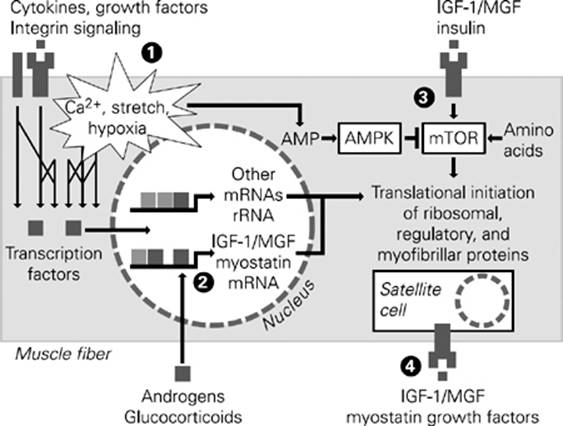
Exercise, stretches and other muscle activity (LEFT) interacts with DNA in the nucleus (CENTER), which in turns interacts with protein translators to effect changes on the cell and surrounding tissue (RIGHT).
(Source of graphic and detailed explanation of genetic transcription: Rennie et al., “Control on the size of the human muscle mass,” p. 802.)
In sum, while evolution has given humans some variability in muscle types, perhaps its powerful product is its adaptivity. Muscles are designed to be rebuilt. “The ability of striated muscle tissue to adapt to changes in activity or in working conditions is extremely high. In some ways it is comparable to the ability of the brain to learn.” (Bottinelli and Reggiani, eds., Skeletal Muscle Plasticity in Health and Disease.)
Citations
Among humans, great variation in muscle-fiber ratios
Anderson, Jesper L., Peter Schjerling, and Bengt Saltin. “Muscle, Genes and Athletic Performance.” Scientific American, September 2000.
DIFFERENT FIBER RATIOS PROVIDE ADVANTAGES AND DISADVANTAGES FOR CERTAIN SPORTS
Anderson, Jesper L., Peter Schjerling, and Bengt Saltin. “Muscle, Genes and Athletic Performance.” Scientific American, September 2000.
MUSCLE-FIBER TYPE IS A POOR PREDICTOR OF PERFORMANCE
Quinn, Elizabeth. “Fast and Slow Twitch Muscle Fibers: Does Muscle Type Determine Sports Ability?” Published on the About.com Sports Medicine Web site, October 30, 2007.
Articles cited by Quinn for further reference
Anderson, Jesper L., Peter Schjerling, and Bengt Saltin. “Muscle, Genes and Athletic Performance.” Scientific American, September 2000.
McArdle, W. D., F. I. Katch, and V. L. Katch. Exercise Physiology: Energy, Nutrition and Human Performance. Williams & Wilkins, 1996.
Lieber, R. L. Skeletal Muscle Structure and Function: Implications for Rehabilitation and Sports Medicine. Williams & Wilkins, 1992.
Thayer, R., J. Collins, E. G. Noble, and A. W. Taylor. “A decade of aerobic endurance training: histological evidence for fibre type transformation.” Journal of Sports Medicine and Physical Fitness 40, no. 4 (2000): 284– 89.
NEURAL RESPONSE AND GENETIC RESPONSE
National Skeletal Muscle Research Center. “Hypertrophy.” Published on the UCSD Muscle Physiology Laboratory Web site.
Genetic response makes muscle fibers more efficient
Russell, B., D. Motlagh, and W. W. Ashley. “Form follows function: how muscle shape is regulated by work.” Journal of Applied Physiology 88, no. 3 (2000): 1127–32.
Conversion between different fiber types
Wang, Yong-Xu, et al. “Regulation of muscle fiber type and running endurance by PPAR.” Published on the Public Library of Science Web site, August 24, 2004.
Kohn, Tertius A., Birgitta Essén-Gustavsson, and Kathryn H. Myburgh. “Do skeletal muscle phenotypic characteristics of Xhosa and Caucasian endurance runners differ when matched for training and racing distances?” Journal of Applied Physiology 103 (2007): 932–40.
Coetzer, P., T. D. Noakes, B. Sanders, M. I. Lambert, A. N. Bosch, T. Wiggins, and S. C. Dennis. “Superior fatigue resistance of elite black South African distance runners.” Journal of Applied Physiology 75 (1993): 1822–27.
Andersen, J. L., H. Klitgaard, and B. Saltin. “Myosin heavy chain isoforms in single fibres from m. vastus lateralis of sprinters: influence of training.” Acta Physiologica Scandinavica 151 (1994): 135–42.
Pette, D., and G. Vrbova. “Adaptation of mammalian skeletal muscle fibers to chronic electrical stimulation.” Reviews of Physiology, Biochemistry and Pharmacology 120 (1992): 115–202.
Trappe, S., M. Harber, A. Creer, P. Gallagher, D. Slivka, K. Minchev, and D. Whitsett. “Single muscle fiber adaptations with marathon training.” Journal of Applied Physiology 101 (2006): 721–27.
This nongenetic aspect of inheritance is often overlooked by genetic determinists: culture, knowledge, attitudes, and environments are also passed on in many different ways: See chapter 7.
“The large variance in both the global and individual admixture estimates”: Benn-Torres et al., “Admixture and population stratification in African Caribbean populations,”.
The annual high school Boys’ and Girls’ Athletic Championships: Rastogi, “Jamaican Me Speedy.”
“dozens of small children showed up for a Saturday morning youth track practice”: Layden and Epstein, “Why the Jamaicans Are Running Away with Sprint Golds in Beijing.”
Dennis Johnson did come back to Jamaica to create a college athletic program: Clark, “How Tiny Jamaica Develops So Many Champion Sprinters”; Rastogi, “Jamaican Me Speedy.”
“We genuinely believe that we’ll conquer,” says Jamaican coach Fitz Coleman: Clark, “How Tiny Jamaica Develops So Many Champion Sprinters.”
a person’s mind-set has the power to dramatically affect both short-term capabilities and the long-term dynamic of achievement: Dweck, Mindset; Elliot and Dweck, eds., Handbook of Competence and Motivation.
Bannister himself later remarked that while biology sets ultimate limits to performance, it is the mind that plainly determines how close individuals come to those absolute limits.
“Though physiology may indicate respiratory and cardiovascular limits to muscular effort,” commented Bannister, “psychological and other factors beyond the ken of physiology set the razor’s edge of defeat or victory and determine how closely the athlete approaches the absolute limits of performance.” (Bannister, “Muscular effort,” pp. 222–25.)
There’s also a national pride that works both to give Kenyan runners a psychological boost and to intimidate non-Kenyans. The emergent aura of invincibility around the Kenyan runners “cannot be overestimated,” says sports psychologist Bruce Hamilton. (Hamilton, “East African running dominance,”. p. 393)
“The past century has witnessed a progressive, indeed remorseless improvement in human athletic performance”: Noakes, “Improving Athletic Performance or Promoting Health Through Physical Activity.”
Actual record times for the mile: 4:36.5 (1865), 3:43.13 (1999). Infoplease.com.
The one-hour cycling distance record increased from 26 kilometers in 1876 to 49 kilometers in 2005.
March 25, 1876, F. L. Dodds, 26.5 kilometers (Burke, High-tech Cycling.)
July 19, 2005, Ondrej Sosenka, 49.7 kilometers (Willoughby, “Czech Ondrej Sosenka Sets New World One-hour Cycling Record of 49.7 km.”)
The 200-meter freestyle swimming record decreased from 2:31 in 1908 to 1:43 in 2007.
Actual times: 2:31.6, 1:43.86. (Agenda Diana swimming records Web site.)
Technology and aerodynamics are a part of the story, but the rest of it has to do with training intensity, training methods, and sheer competitiveness and desire.
University of Cape Town sports biologist Timothy David Noakes lists his “15 Laws of Training”:
1. Train frequently all year round.
2. Start gradually and train gently.
3. Train first for distance, only later for speed.
4. Don’t set yourself a daily schedule.
5. Alternate hard and easy training.
6. At first, try to achieve as much as possible on a minimum of training.
7. Don’t race in training, and run time-trials and races longer than 16 km only infrequently.
8. Specialize.
9. Incorporate base training and peaking (sharpening).
10. Don’t overtrain.
11. Train under a coach.
12. Train the mind.
13. Rest before a big race.
14. Keep a detailed logbook.
15. Understand the holism of training.
Noakes, “Improving Athletic Performance or Promoting Health Through Physical Activity.”
They are participants in a culture of the extreme, willing to devote more, to ache more, and to risk more in order to do better.
In the late twentieth and early twenty-first centuries, the extreme athletic culture has yielded both short-term dangers (such as “overtraining syndrome”) and long-term dangers such as premature skeletal aging and psychological damage. (Budgett, “ABC of sports medicine,” 465–68.)