
Are you frustrated by all those female ancestors with missing maiden names, or not sure which Edith is your great-great-grandmother? Look no further than the answers provided by mitochondrial DNA (mtDNA). One of the most powerful tools available to genetic genealogists, mtDNA offers a glimpse into the maternal lines of even your most challenging ancestors. mtDNA is so powerful that it is used by the military to identify the remains of recovered soldiers, by scientists to identify the remains of kings and tsars, and by genealogists to solve innumerable genealogical mysteries. So how can mtDNA help you?
Mitochondrial DNA
Mitochondria are tiny energy “factories” located inside almost every cell in the body. These factories spend every hour of every day producing energy that the body uses to power things like muscles. You have hundreds or thousands of mitochondria in each cell, and each one contains hundreds of copies of mtDNA. There is a lot of mtDNA in every cell!
Mitochondrial DNA (image A) is a small circular piece of DNA made up of a chain of approximately 16,569 pairs of special molecules called nucleotides. The DNA codes for thirty-seven genes, many of which are directly involved in helping the mitochondria produce energy for the cell. Although mtDNA is an unbroken loop of DNA, scientists and testing companies have given portions of the loop different names based on the DNA found within those portions. The first and second portions, called hypervariable control region 1 (HVR1) and hypervariable control region 2 (HVR2), are regions of the mtDNA that accumulate changes relatively quickly, and thus tend to be hyper-variable (i.e., more likely to change) from one person to the next unless those people are closely related. The third portion, the coding region (CR), accumulates far fewer changes and contains the nucleotide base-pair sequence for mitochondrial genes.
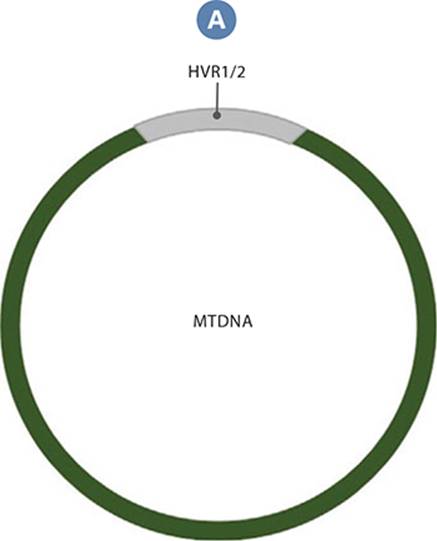
mtDNA is circular in shape, and mtDNA testing examines either sections of the DNA that are especially prone to mutation (HVR1 and HVR2, in gray) or the whole sequence of DNA (in green).
The exact start and stop positions for these portions can vary from one testing company to the next, but the most commonly used start and stop positions for each region are:
· HVR1: base pairs 16,001–16,569
· HVR2: base pairs 001–574
· CR: base pairs 575–16,000
As shown in image B, the HVR regions are found on either side of the first numbered base pair (00001) of the mtDNA sequence. There is nothing special about this base pair; it is always counted as the first base pair because it was so identified in the very first mtDNA sequence obtained, and the designation has stuck.

HVR1 and HVR2 are groups of base pairs in mtDNA that are more likely to mutate than the rest of the molecule.
Traditionally, mtDNA testing only sequenced the HVR1 and HVR2 regions. But as the price of sequencing has dropped, most current mtDNA tests sequence all 16,569 base pairs of mtDNA. Full mtDNA sequencing offers several benefits over HVR1/HVR2 sequencing, including better ancient origin information as well as more accurate cousin matching. Reading and comparing the entire mtDNA sequence provides as much information as can be gleaned from this type of DNA. To put it another way, testing the HVR1/HVR2 regions is like reading the abbreviated study guide for Moby-Dick, while testing HVR1/HVR2 and the coding region is like reading the entire novel.
The Unique Inheritance of mtDNA
mtDNA has a unique inheritance pattern that makes it particularly valuable for genetic genealogy testing. Unlike other types of DNA, which can be jumbled in a process called recombination (more on that later), mtDNA is always passed down from a mother to her children—both male and female—without jumbling. The mother makes exact copies of her mtDNA and passes them down in her egg.
Although mothers pass down mtDNA to both sons and daughters, only daughters will pass it on to the next generation. While every man has mtDNA he inherited from his mother and can be tested, that mtDNA ends with him. He does not pass it on to the next generation.
Image C shows the path of mtDNA inheritance within a short family tree. Joan decides to test her mtDNA and would like to determine from whom in her family tree she inherited that particular piece of DNA. She inherited the mtDNA from her mother, Karen, who in turn inherited it from her mother, Lisa, who in turn inherited it from her mother, Marie. At every generation, only one ancestor carried the mtDNA. And due to this inheritance pattern, Joan will know exactly which ancestor passed down her mtDNA even though she may not know that ancestor’s name. For example, Joan has 1,024 ancestors at ten generations (512 men and 512 women), but only one of those 512 women passed down her mtDNA to Joan.

mtDNA is passed down the maternal line (in purple).
Knowing the inheritance pattern of mtDNA also gives genealogists the ability to trace this piece of DNA forward through a family tree. Joan is a great-grandmother and would like to know which of her descendants carry her mtDNA. Image D is Joan’s family tree, in which all the purple-labeled individuals carry Joan’s mtDNA. Of course, all four of Joan’s children—one son and three daughters—carry her mtDNA. At the grandchild level, four of Joan’s five grandchildren carry her mtDNA; her son did not pass it on to the next generation. At the great-grandchild level, only two of Joan’s five grandchildren carry her mtDNA, great-grandchildren 3 and 4.
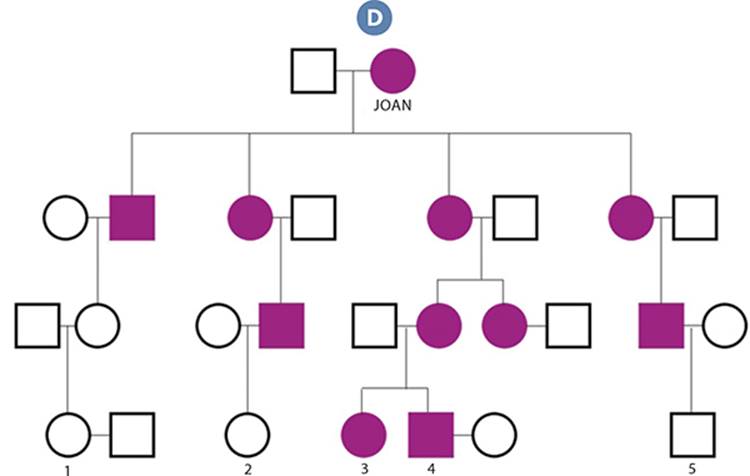
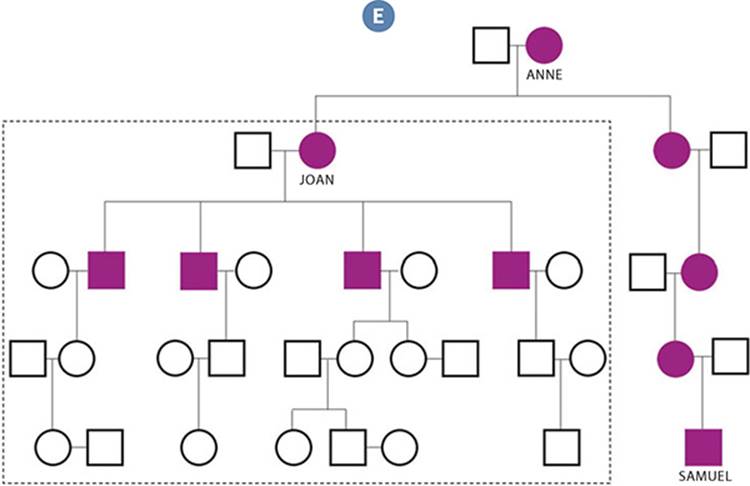
If you’re having trouble finding a living descendant who has your ancestor’s mtDNA and is willing to take an mtDNA test, work back another generation to find a more distant cousin who can help. Here, Samuel has the same mtDNA as Joan even though he’s not one of her direct descendants.
Although Joan’s four male descendants in the chart who carry her mtDNA (the four purple square boxes) can take an mtDNA test, none of these males passed on this piece of DNA to the next generation. For mtDNA, a male is a dead end in the line, although they should never be overlooked as a possible testing source. Indeed, a male may be the last living person available to take an mtDNA test for a specific ancestor.
Finding an mtDNA Descendant: Working Backward to Go Forward
To find a living descendant of an ancestor who can take an mtDNA test, a genealogist must trace the mtDNA line through the generations that separate the ancestor and the living descendants. Sometimes, however, an ancestor may have no descendants who carry her mtDNA, even if they have numerous descendants. For example, as shown in image E, Joan had four sons (all deceased), and thus there are no living descendants with Joan’s mtDNA and no one who the genealogist can ask to take that test. However, the genealogist may still find a relative who possesses Joan’s mtDNA by going back a generation and working forward to determine whether there are any living mtDNA descendants. In this example, Samuel possesses the same mtDNA as his great-great-grandmother Anne and his great-grandaunt Joan. As a result, he can take the mtDNA test to be matched to those two ancestors.
Joan’s descendants who have her mtDNA are in purple; notice great-grandchildren 3 and 4 have Joan’s mtDNA, but 1, 2, and 5 don’t.
If Samuel is unwilling or unable to take a DNA test, the genealogist will be forced to find another of Anne’s descendants or go back yet another generation to Anne’s mother’s descendants. Sometimes, you may have to go back generations before identifying a suitable mtDNA descendant. There is no limit to how many generations back a genealogist can go to find an mtDNA relative, although the difficulty of researching the maternal line can be a barrier, as the surname usually changes with every generation.
How the Test Works
There are two types of mtDNA tests (image F). The first is mtDNA sequencing, which is performed by sequencing all or a portion of the mtDNA genome. A sequenced section of DNA is a long series of just four different letters (A, C, G, and T) that stand for the four different nucleotides (adenine, cytosine, guanine, and thymine) that make up all DNA. All mtDNA, for example, is a sequence of 16,569 total base pairs represented by the four nucleotides—A, C, G, and T—that make up the base pairs. Low-resolution mtDNA tests sequence just the 1,143 or so base pairs of the HVR1 and HVR2 regions, while high-resolution mtDNA tests sequence every one of the 16,569 base pairs.

Genealogists have two types of mtDNA to choose from: mtDNA sequencing that looks at the whole mtDNA genome and SNP testing that examines specific portions.
The second type of mtDNA test, called SNP testing, examines single nucleotide polymorphisms (SNPs) at hundreds or thousands of locations along the circular mtDNA. An SNP is a single nucleotide of DNA that can vary from one person to the next. For example, the nucleotide at position 15,833 of the mtDNA may be a cytosine (C) in one person or a thymine (T) in another person. People who are very closely related should have the same SNP at every location. The more distant the genealogical relationship between two people on the maternal line, the more differences there will be in the tested SNP locations.
Once the mtDNA is tested by one of these two methods, it is compared to a reference mtDNA sequence, and any differences between the test-taker’s mtDNA and the reference mtDNA sequence are identified and listed. Researchers can use three different reference sequences to compare the test-taker’s mtDNA:
· The Cambridge Reference Sequence (CRS) represents the first mtDNA sequence ever published. This first mtDNA sequence was derived from the placenta of a European female and was published in 1981. It was the only reference mtDNA sequence for several decades.
· The revised Cambridge Reference Sequence (rCRS) is an update to the CRS. In the nearly twenty years following the creation of the CRS, researchers discovered several errors, such as missing nucleotides, that were corrected in the rCRS.
· The Reconstructed Sapiens Reference Sequence (RSRS) is a recent effort to represent a single ancestral genome of all living humans. The RSRS was introduced in 2012, and scholars are still debating whether to stay with the rCRS or adopt the RSRS. Both sequences have merit and are used in some tests. At Family Tree DNA <www.familytreedna.com>, for example, the test-taker’s mtDNA is compared to both the rCRS and the RSRS.
Any difference between the test-taker’s mtDNA and the selected reference sequence is identified and listed as a mutation. Although the word can sometimes have a negative connotation, “mutations” to geneticists are simply changes. The change can involve one nucleotide switching to another, an extra nucleotide appearing, or a nucleotide disappearing, among others. Almost all of these changes are completely benign and harmless, although occasionally a mutation can affect the individual’s health, ability to function, or appearance.
The differences between the test-taker’s mtDNA and a reference sequence, which are used to determine how closely related two people are on their maternal lines, can be reported in several different ways. For example, differences between the tested mtDNA and the rCRS are acknowledged in the following ways:
· When the mtDNA contains a different nucleotide than the reference sequence, the nucleotide difference is indicated with the site of the location and the abbreviated nucleotide, such as 538C for a cytosine that has replaced the reference nucleotide at position 538. Sometimes the result will provide the reference nucleotide that was replaced, such as A538C for a cytosine that replaced the adenine of the reference sequence at position 538.
· When the mtDNA lacks a nucleotide that is present in the reference sequence, the nucleotide difference is indicated by the position number and a - sign, such as 522- for a missing nucleotide at position 522 of the reference sequence.
· When the mtDNA has an extra nucleotide compared to reference sequence, the mutation is indicated by the position and a .1. For example, 315.1C indicates an extra cytosine located after the nucleotide at position 315 of the reference sequence.

View text version of this table
Once the testing company obtains the list of differences, it can use the information to learn about the test-taker’s ancient ancestry and find maternal relatives, which we’ll look at in the next section.
Family Tree DNA is the primary mtDNA testing company, having tested the mtDNA of several hundred thousand customers. Family Tree DNA only sequences mtDNA, and although the company used to offer HVR1/HVR2 sequencing, the primary test available today is the full mtDNA sequence. After obtaining the sequencing results, Family Tree DNA compares the sequence to one of the reference sequences and provides the list of differences, or mutations, to the test-taker. In image G, for example, the sequencing results have been compared to the rCRS, and a list of differences has been provided.
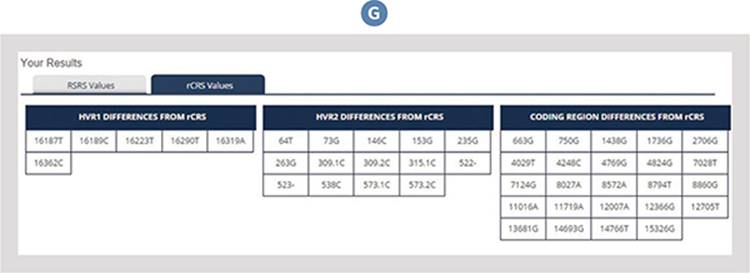
Family Tree DNA provides a list of specific differences between the test-taker’s mtDNA and the rCRS.
Family Tree DNA also uses the RSRS as a reference sequence. Image H lists the differences between the RSRS and the same test-taker from the rCRS example. This shows the importance of knowing which reference sequence a test-taker’s mtDNA is being compared to.

The rCRS and the RSRS are not the same, so it’s important to note which template your DNA is being compared to.
23andMe <www.23andme.com> also tests mtDNA, although it uses SNP sequencing instead of HVR1/HVR2 or full mitochondrial genome sequencing. The current version of 23andMe examines approximately three thousand SNPs located all along mtDNA. 23andMe does not provide the list of differences between the test-taker’s mtDNA and the reference sequence, although test-takers can review or download their mtDNA information in order to compare it to a reference sequence themselves.
Applying mtDNA Test Results in Genealogical Research
How can an mtDNA test help your research? An mtDNA test has several important uses for genealogists. For example, the results can be used to determine the ancient origins of the mtDNA and to determine whether or not two people are related on their maternal line. The results of the mtDNA test can also be used to estimate the length of time, since the two tested individuals shared a most recent common ancestor (or MRCA). In this section, we’ll discuss each of these uses in depth.
Determining an mtDNA Haplogroup
Regardless of the type of mtDNA test, results will reveal information about the location of your maternal line thousands of years ago. For example, knowing the origin of your mtDNA, such as whether your maternal line is European, Asian, or Native American, will often provide important clues about the maternal brick wall you’ve undoubtedly hit in your research.
The results of an mtDNA test are used to determine which haplogroup that mtDNA belongs to. An mtDNA haplogroup is a group of maternally related individuals who have a recent common ancestor on a particular branch of the mtDNA family tree, which is defined by a particular SNP mutation. (Genealogists can also have a Y-DNA haplogroup, which we’ll discuss in chapter 5.) All members of an mtDNA haplogroup can trace their maternal line back to a single ancestor who lived in a specific location several thousand years ago. In most cases, scientists have a good idea of the general location where mtDNA haplogroup ancestors lived.
HETEROPLASMY
Some mitochondrial test results indicate that the test-taker’s mtDNA is heteroplasmic, and this can create problems for researchers looking to mtDNA for proof of a relationship with someone else.
Heteroplasmy is the presence of more than one mtDNA sequence in a cell or organism. Because human cells have hundreds or thousands of mitochondria, some of the mtDNA in that cell can possess a mutation that the other mtDNA in that cell don’t possess. People or individual cells with two or more different mtDNA sequences are heteroplasmic, while people or individual cells with a single mtDNA sequence are homoplasmic.
When a heteroplasmic cell divides, the mtDNA will segregate randomly into the two progeny cells. Over time, a heteroplasmic cell can eventually give rise to a homoplasmic cell, though it can take many, many generations for this to happen.
Heteroplasmy can be detected by a commercial genetic genealogy test in the buccal (cheek) cells of the test-taker, where the mtDNA is obtained for the test. However, a test-taker’s heteroplasmy may or may not be found in her offspring due to the random segregation of the mitochondria. Additionally, a heteroplasmy that is present in the mother’s cheek cells may not be present in the egg that gave rise to the child, and vice versa. Accordingly, the child of a heteroplasmic parent may have mtDNA with one of three different outcomes:
· Heteroplasmic: Each egg cell (which develops into a child) has some mitochondria with the heteroplasmic mutation and some mitochondria without the mutation. When the child takes an mtDNA test, both versions of the mtDNA may be detected.
· Homoplasmic with the mutation: In this outcome, all the mitochondria in the egg that became the child had the mutation, or (if the child is in fact heteroplasmic) the buccal cells of the child only have a version of the mitochondria with the mutation.
· Homoplasmic without the mutation: Even though the parent’s buccal cells are heteroplasmic, the child inherited only mitochondria without the mutation. Alternatively, if the child is in fact heteroplasmic, the buccal cells of the child only have mitochondria without the mutation.
View text version of this table
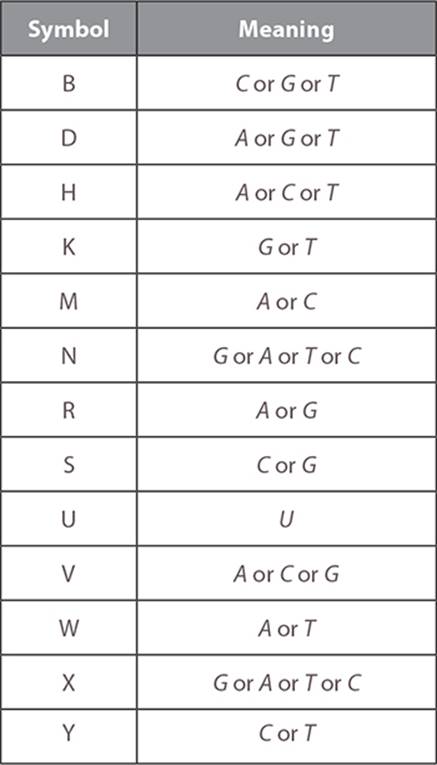
A heteroplasmy is written with the original value in the reference sequence, the location of heteroplasmy, and a symbol that indicates what nucleotides are found at that location. For example, a heteroplasmy of C or G at position 263 would be written as A263S. The table below contains the symbols used to represent various combinations of nucleotides for heteroplasmic results.
Heteroplasmy can affect mtDNA matching through Family Tree DNA. For example, if two individuals have identical mitochondrial genomes with the exception of a heteroplasmic mutation in one of them, they may show up as having a genetic distance of one. Thus, if Bill has mutation 16230A and John has mutation 16230W (indicating an A or T at this location), they are not shown as exact matches.
The most famous example of heteroplasmy is Tsar Nicholas II of Russia (1868–1918). Testing his skeletal remains revealed a heteroplasmy of C and T at position 16169. (If the results had been reported at Family Tree DNA, this heteroplasmy would be 16169Y.) The heteroplasmy originally confused researchers trying to prove the skeletal remains belonged to the Tsar, since the heteroplasmy was not found in the Tsar’s maternal relatives against which the sequence was compared. However, the same heteroplasmy was later identified in the remains of Grand Duke George Alexandrovich (1871–1899), brother of Tsar Nicholas II. The ratio of the heteroplasmic mutation differed in the two brothers, with the Tsar having mostly C/t and his brother George having mostly T/c. (The capitalized letter represents the predominant result for the tested base pair at position 16169, and the lowercase letter represents the minority result at that position.)
MITOCHONDRIAL EVE
If every human on earth could trace back his or her maternal line as far as possible, they all would merge on a single person, a woman called “Mitochondrial Eve” who is the mtDNA ancestor of all living humans. She is the most recent common ancestor of all humans on their maternal line. Indeed, all living humans likely have a much more recent atDNA common ancestor, probably on the order of just a few thousand years ago.
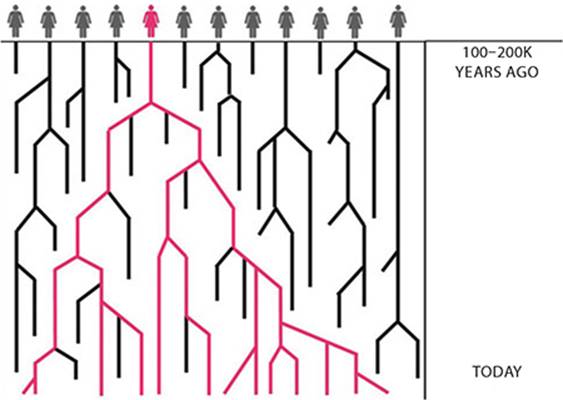
Although we will never know Mitochondrial Eve’s real name, we know a few things about her:
1. She probably lived about one to two hundred thousand years ago. The date is based on the variation—the mutations—found in the mtDNA of all of her descendants. Using current information about the mutation rate of mtDNA (approximately one mutation every thirty-five hundred years per nucleotide), it has taken approximately one hundred thousand or two hundred thousand years for all that variation to arise. This can considerably move Mitochondrial Eve’s estimated lifetime.
2. She likely lived in East Africa, as the oldest branches of the mtDNA family tree are all found (and appear to have originated) in East Africa.
3. She had at least two daughters, who each gave rise to different lines of the mtDNA family tree. This created a branch point in the mtDNA family tree, as hypothetical Mitochondrial Eve provided one daughter with one type of mtDNA, and a second daughter with a second type of mtDNA.
Although Mitochondrial Eve is named after the biblical Eve, she was not the only woman alive at that time and is not the only one of her contemporaries to have living descendants. It is likely that thousands of other women alive at that time have living descendants, but a final mtDNA descendant in each of these other lines failed to produce daughters at some point between then and today.
New mtDNA lines may be discovered that could further push back the date of Mitochondrial Eve. For example, if a new mtDNA were discovered that pre-dated Mitochondrial Eve based on the number of mutations in the sequence, the date of Mitochondrial Eve would have to be pushed back in time so she could also be the ancestor of the newly discovered line.
Haplogroups are named with letters and numbers, and individuals in the same haplogroup will have the same (or a very similar) list of mutations. For example, mtDNA haplogroup A2w is a subgroup within haplogroup A. The mtDNA haplogroup A2w is one of the five mtDNA haplogroups found in North and South American indigenous peoples (the others being B, C, D, and X). If someone were to reach a maternal brick wall and learn from an mtDNA test that they belonged in mtDNA haplogroup A2w, for example, that test-taker would know to look for a Native American ancestor somewhere along the maternal line, ranging from very recently to long ago.
If all mtDNA sequences on earth were plotted onto a giant family tree, they would all trace back to Mitochondrial Eve (image I; see the Mitochondrial Eve sidebar). From Mitochondrial Eve forward, major branches of the family tree indicate new haplogroups and minor branches indicate subgroups, or subclades, of that new haplogroup. Each branch, whether major or minor, is defined by a particular SNP mutation. Although some SNP mutations are found in multiple branches, usually a branch contains a number of mutations such that an mtDNA sequence can be properly assigned to the correct haplogroup.

Major groups of mtDNA haplogroups (called subclades) can be mapped in accordance with how they evolved from Mitochondrial Eve.
Each haplogroup is associated with an approximate time and place in which the founder of that haplogroup arose. This information is based on mutation rates and modern-day distributions of the haplogroup, not on ancient samples of mtDNA, although ancient DNA is being used to further study and refine information about various haplogroups.
Mitochondrial haplogroup J, for example, is estimated to have arisen approximately forty-five thousand years ago in the Near East or Caucasus region of the world. In contrast, mitochondrial haplogroup Tis a newer haplogroup that likely originated approximately seventeen thousand years ago in or around Mesopotamia.
Once test-takers receive their haplogroup assignment, they can seek out more information about that haplogroup and ancient origins. For example, the mtDNA Haplogroups page at WorldFamilies <www.worldfamilies.net/mtdnahaplogroups> is a great resource with information about each of the major branches of the mtDNA family tree.
Finding mtDNA Cousins
Another popular use of mtDNA testing is to hunt for mtDNA cousins. At Family Tree DNA, for example, a test-taker’s mtDNA is compared to all other mtDNA in the database, and the test-taker will receive a list of anyone in the database who has identical or nearly identical mtDNA. These individuals are mtDNA cousins and are related to the test-taker through the maternal line. Some may have identical mtDNA, while others might differ by one or two mutations. Generally, the fewer the differences between the two sequences, the more closely those two individuals are related.
For example, in image J, six test-takers in the Family Tree DNA database have mtDNA similar to the test-taker’s mtDNA. However, all of these individuals have a genetic distance of 1 or more, meaning the two mtDNA sequences are not identical; instead, they differ by one or more mutations. In this interface, it is not possible to directly compare your mtDNA with the matches’ mtDNA. However, for a genetic distance of 1, for example, either the test-taker’s mtDNA has a mutation that the other individual’s mtDNA does not have, or it’s missing a mutation that the other does have. For example, your mtDNA may be identical to the genetic match’s mtDNA, except you have a T16362C mutation that the match does not have. Or perhaps the match has a G16319A mutation that you don’t have. Similarly, with a genetic distance of 2, there are a variety of possible explanations: You might have two mutations that the match does not have, the match may have two mutations that you don’t have, or you both may have one mutation that the other does not have.
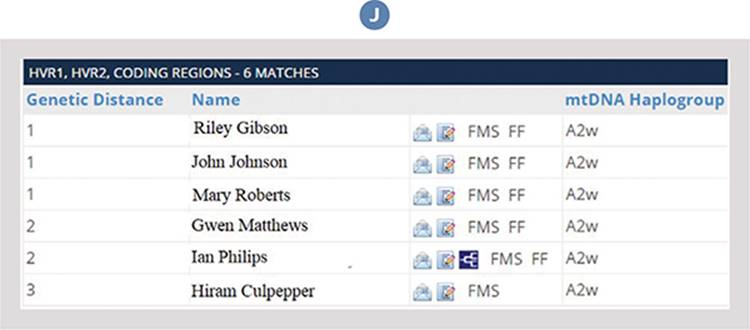
Any mtDNA matches whose DNA has few differences from yours will have a low genetic distance from you, meaning they’re likely more closely related to you than are matches with more differences/a higher genetic distance from you.
However, it’s difficult to pinpoint how closely related two individuals with mtDNA matches are. Because mtDNA changes relatively slowly, individuals with identical mtDNA can be related either very recently or as much as several thousand years ago. For example, an exact HVR1 and HVR2 match is most likely maternally related somewhere between zero and fifteen hundred years ago. This is one reason why it is better to sequence the entire mtDNA genome rather than just the HVR1/HVR2 regions; an exact full sequence match will likely be maternally related through a common ancestor who lived within the past five hundred years or so.

View text version of this table
To find the maternal ancestor shared with an mtDNA match, the test-taker can review the match’s online family tree or contact the match and ask if he is interested in sharing information. If the match is willing to cooperate, the test-taker can determine whether the two individuals share any names or locations on their maternal lines. Sometimes mtDNA matches will list a match’s most distant maternal ancestor, which the test-taker might be able to use to reverse engineer his maternal line if he’s not interested in sharing information with others.
In addition to the list of mtDNA matches provided by the company, a test-taker can also search MitoSearch <www.mitosearch.org> for others who share their mtDNA. MitoSearch is a free publicly available database with thousands of records from several different testing companies. Test-takers can upload their mtDNA to MitoSearch to look for matches that are already in the database, as well as compare their results to new matches that are uploaded to MitoSearch.
Analyzing Genealogical Questions
In addition to learning about the ancient origins of the maternal line and finding mtDNA relatives, you can use the results of an mtDNA test to help with specific genealogical tasks, such as confirming known lines, analyzing family mysteries, and potentially breaking through brick walls. Traditional documentary research used with the results of mtDNA testing can be a powerful combination for genealogists.
Since mtDNA is inherited maternally, it is very good at determining whether two people are related through their maternal lines. Many genealogical applications of mtDNA, therefore, use mtDNA test results from two or more people to examine whether those test-taker’s mtDNA ancestors could have been maternally related.
For example, it is possible to use mtDNA testing to determine whether you might be maternally related to an autosomal-DNA (atDNA) match. As we’ll learn later in the book, an atDNA match can be found on any of your ancestral lines, and it is difficult to identify the common ancestor shared with an atDNA match. If an atDNA match also shares your mtDNA, it can significantly narrow down which lines to search for a common ancestor.
As another example, adoptees sometimes use mtDNA testing to assist in their search for their biological family. Finding an exact mtDNA match can potentially point the adoptee toward the biological mother’s family, provided the match is closely related to the adoptee and has a well-researched family tree.
Remember both the benefits and limitations of mtDNA testing when applying the results to a genealogical question. For example, mtDNA testing can only determine whether two people are maternally related on their direct matrilineal line. Accordingly, an mtDNA test will likely not be the first choice when the genealogical question is whether two men born in the 1800s were brothers. Further, an mtDNA test can only reveal that two people are maternally related somehow, but it can’t determine the exact nature of the relationship. As a result, people with matching mtDNA might be sisters, mother/daughter, aunt/niece, first cousins, and so on, for many generations.
These limitations must be contrasted with some of the powerful benefits of mtDNA testing. Unlike atDNA, for example, mtDNA passes down to the next generation unchanged and therefore does not get diluted like atDNA. A test-taker has 100 percent of the mtDNA of her mother’s mother’s mother’s mother (her great-great-grandmother), but just approximately 6.25 percent of her atDNA. Accordingly, even with its limitations, mtDNA can be a powerful tool for genealogists.
CORE CONCEPTS: MITOCHONDRIAL-DNA (MTDNA) TESTING
mtDNA is a circular piece of DNA located within the mitochondria of the cell.
Although both men and women inherit mtDNA from their mothers, only women pass down mtDNA to the next generation. As a result of this unique inheritance pattern, mtDNA is only used to examine a test-taker’s maternal line.
mtDNA testing is done by either sequencing portions of (or the whole) mtDNA or through SNP analysis of the mtDNA. Full sequencing of the mtDNA is the best test and provides the most information.
The results of any mtDNA test can be used to determine the haplogroup, or ancient origins, of the maternal line back thousands of years.
The results of an mtDNA sequencing test can be used to fish for genetic cousins. However, since mtDNA mutates so slowly, it is not as useful for finding random genetic cousins in a testing company’s database. An exact mtDNA match may be very closely related, or may be maternally related hundreds of years ago.
Results from an mtDNA test can be useful for examining specific genealogical questions, such as whether or not two people are maternally related.
DNA in Action
Are They Sisters?
Say a genealogist has identified three historical women (Mary, Jane, and Prudence) who are potential sisters based on paper-trail evidence. To determine whether the women might have in fact been sisters, the genealogist has traced descendants of Mary, Jane, and Prudence and asked them to take an mtDNA test. All three descendants agreed, and the genealogist is now reviewing the results. Note that any or all of the three descendants could be either men or women, but the line from the three women to their living descendant has to be an unbroken maternal line of mother to daughter.
The (simplified) results in the table show that Mary and Prudence’s mtDNA descendants have identical mtDNA but Jane’s mtDNA descendant has a genetic distance of 3—that is, there are three differences between the mtDNA of Jane’s descendant and the other mtDNA results. As the results show, Jane’s descendant is missing two mutations found in the other test-takers, and has one additional mutation not found in the other two test-takers. Since so few generations have passed between the three women and each respective mtDNA descendant, it is unlikely that there was enough time for a genetic distance of 3 to arise.

View text version of this table
Do the mtDNA test results alone prove that Mary and Prudence were sisters? Unfortunately, the results only establish that they could have been sisters. They also could have been mother/daughter, aunt/niece, maternal cousins, or a variety of other maternal relationships. Indeed, they could even be very distant maternal cousins. The DNA evidence will have to be combined with the traditional documentary evidence in order to create a strong argument that Mary and Prudence were sisters.
Similarly, the results do not definitively prove that Jane could not have been a sister of Mary and Prudence, either. It is possible, although unlikely, that there could have been a misattributed parentage event in the line between Jane and her descendant. For example, there might have been an undocumented adoption in that line. Additionally, it is possible that the mtDNA line between Jane and her descendant could have accumulated the three observed changes. In other words, that line could have both randomly acquired the 16129G and 16223C mutations and added the 16311T mutation, though this is statistically improbable. Additionally, the genealogist may have erred and mistakenly identified an individual for testing who is not an actual descendant of Jane.
DNA in Action
Is This the King? Part I
In 2012, researchers supported by the Richard III Society <www.richardiii.net> found a skeleton under a parking lot in Leicester, England. Based on the time frame in which the skeleton was buried, the age of the skeleton upon the person’s death (mid-thirties), and physical characteristics including battle wounds and severe scoliosis, the researchers believed that this skeleton could be the remains of King Richard III of England.
Richard III was the final ruler of the Plantagenet dynasty. On August 22, 1485, the thirty-two-year-old Richard was killed at the Battle of Bosworth Field. Richard was buried within the Greyfriars Friary Church in Leicester. However, the location of Richard’s grave was ultimately lost through the passage of time.
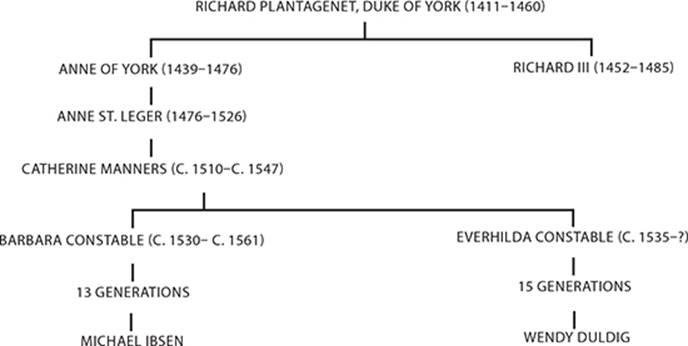
To determine whether the skeleton was in fact Richard III’s remains, researchers wanted to compare mtDNA obtained from the skeleton to mtDNA obtained from Richard’s maternal relatives. Genealogists traced descendants of Richard’s sister, Anne of York, through seventeen and nineteen generations to identify two living descendants, Michael Ibsen and Wendy Duldig, who took mtDNA tests. The results of Ibsen’s and Duldig’s full-sequence mtDNA test showed that they have almost identical mtDNA, differing by only a single mutation even though their mtDNA lines diverged nearly five hundred years ago. Their haplogroup is the relatively rare J1c2c.
When the results of the skeleton’s full mtDNA sequencing were compared to the Ibsen/Duldig results, they were identical with the exception of the single mutation found in Duldig’s mtDNA. Together with the other evidence, the researchers definitively concluded that the remains were those of King Richard III. The site of the exhumation is now the King Richard III Visitor Centre where visitors can see the gravesite under glass.
For more about King Richard’s DNA testing, see Turi E. King et al., “Identification of the Remains of King Richard III”, originally published in Nature Communications<www.nature.com/ncomms/2014/141202/ncomms6631/full/ncomms6631.html>.