EQUIPMENT
 Penlight
Familiar objects (coins, keys, paper clip)
Sterile needles
Cotton wisp
Tongue blades (one intact and one broken with pointed and rounded edges)
Cup of water
Tuning forks, 200 to 400 Hz and 500 to 1000 Hz
Reflex hammer
5.07 monofilament or Waardenberg wheel
Test tubes of hot and cold water
Vials of aromatic substances (coffee, orange, peppermint, banana)
Vials of solutions (glucose, salt, lemon or vinegar, quinine) with applicators
List of tastes
EXAMINATION
Assess the neurologic system as the rest of the body is examined. When history and examination findings have not revealed a potential neurologic problem, perform a neurologic screening examination as shown in the box on p. 244, rather than a full neurologic examination. See Chapter 17, Musculoskeletal System, for evaluation of muscle tone and strength, because these findings are important for interpreting neurologic system examination findings. The mental status portion of the neurologic system examination is found in Chapter 2.
Neurologic Screening Examination
This shorter screening examination is commonly used for health visits when no known neurologic problem is apparent.
Cranial Nerves
Cranial nerves II through XII are routinely tested; however, taste and smell are not tested unless some aberration is found.
Proprioception and Cerebellar Function
One test is administered for each of the following: rapid rhythmic alternating movements, accuracy of movements, balance (Romberg test), gait, and heel-toe walking.
Sensory Function
Superficial pain and touch at a distal point in each extremity are tested; vibration and position senses are assessed by testing the great toe.
Deep Tendon Reflexes
All deep tendon reflexes and the plantar reflex are tested, excluding the test for clonus.
CRANIAL NERVES I-XII
The table below summarizes the cranial nerve (CN) examination. When a sensory or motor loss is suspected, be compulsive about determining the extent of the loss.
Procedures for Cranial Nerve Examination
|
Cranial Nerve (CN) |
Procedure |
|
CN I (olfactory) |
Test ability to identify familiar aromatic odors, one naris at a time with eyes closed. |
|
CN II (optic) |
Test vision with Snellen chart and Rosenbaum near-vision chart. Perform ophthalmoscopic examination of fundi. Test visual fields by confrontation and extinction of vision. |
|
CN III, CN IV, CN VI (oculomotor, trochlear, abducens) |
Test extraocular movement. Inspect eyelids for drooping Inspect pupil size for equality and direct and consensual response to light and accommodation. |
|
CN V (trigeminal) |
Inspect face for muscle atrophy and tremors. Palpate jaw muscles for tone and strength when patient clenches teeth. Test superficial pain and touch sensation in each branch. (Test temperature sensation if there are unexpected findings to pain or touch.) Test corneal reflex. |
|
CN VII (facial) |
Inspect symmetry of facial features with various expressions (e.g., smile, frown, puffed cheeks, wrinkled forehead). Test ability to identify sweet and salty tastes on each side of tongue. |
|
CN VIII (acoustic) |
Test sense of hearing with whisper screening tests or by audiometry. Compare bone and air conduction of sound. Test for lateralization of sound. |
|
CN IX (glossopharyngeal) |
Test ability to identify sour and bitter tastes. Test gag reflex and ability to swallow. |
|
CN X (vagus) |
Inspect palate and uvula for symmetry with speech sounds and gag reflex. Observe for swallowing difficulty. Evaluate quality of guttural speech sounds (presence of nasal or hoarse quality to voice). |
|
CN XI (spinal accessory) |
Test trapezius muscle strength (shrug shoulders against resistance). Test sternocleidomastoid muscle strength (turn head to each side against resistance). |
|
CN XII (hypoglossal) |
Inspect tongue in mouth and while protruded for symmetry, tremors, atrophy. Inspect tongue movement toward nose and chin. Test tongue strength with index finger when tongue is pressed against cheek. Evaluate quality of lingual speech sounds (l, t, d, n). |
|
TECHNIQUE |
FINDINGS |
|
Assess olfactory nerve (CN I) |
|
|
Ask patient to close eyes. Occlude one naris, hold vial (using least irritating aromatic substances first [e.g., orange or peppermint extract]) under nose, and ask patient to breathe deeply and identify odor. Allow patient to breathe comfortably, then occlude other naris and repeat with different odor. Continue, alternating two or three odors. |
EXPECTED:Able to perceive and usually identify odor on each side. |
|
UNEXPECTED:Anosmia, loss of smell or inability to discriminate odors. |
|
|
Assess optic nerve (CN II) |
|
|
See tests for visual acuity and visual fields in Chapter 7, Eyes. |
|
|
Assess oculomotor, trochlear, abducens nerves (CN III, CN IV, CN VI) |
|
|
See tests for six cardinal points of gaze, pupil size, shape, response to light and accommodation, and opening of upper eyelids in Chapter 7, Eyes. |
EXPECTED:Equal pupil size, equal and consensual response to light and accommodation, symmetric eye movements in all six cardinal points of gaze. |
|
UNEXPECTED:Absence of lateral gaze. Absence of any expected finding, ptosis. |
|
|
Assess trigeminal nerve (CN V) |
|
|
Ask patient to clench teeth tightly as you palpate muscles over jaw. |
EXPECTED:Symmetric tone. |
|
UNEXPECTED:Muscle atrophy, deviation of jaw to one side, or fasciculations. |
|
|
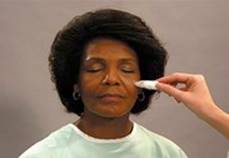
Ask patient to close eyes and report if sensation to touch is sharp or dull as you touch each side of face at scalp, cheek, and chin areas, alternately using sharp and rounded edges of tongue blade or paper clip in an unpredictable pattern. Ask patient to report when the stimulus is felt as you stroke same six areas with cotton wisp or brush. Finally, test sensation over buccal mucosa with wooden applicator. |
EXPECTED:Symmetric discrimination of sensations in each location to all stimuli. |
|
UNEXPECTED:Impaired sensation. If impaired, use test tubes of hot and cold water to evaluate temperature sensation. |
|
|
Testing sensation over distribution of cranial nerve V.
|
|
|
See test for corneal sensitivity in Chapter 7, Eyes. |
EXPECTED:Symmetric blink reflex. May be diminished or absent if patient wears contact lenses. |
|
Assess facial nerve (CN VII) |
|
|
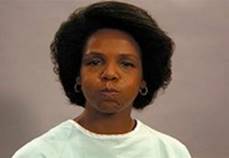
Assess motor function by asking patient to make the following facial expressions: Raise eyebrows and wrinkle forehead Smile Frown Puff out cheeks Purse lips and blow out Show teeth Squeeze eyes shut against resistance |
EXPECTED:Facial symmetry. |
|
UNEXPECTED:Tics, unusual facial movements, or asymmetry of expression (flattened nasolabial fold, lower eyelid sagging, side of mouth drooping). |
|
|
Assessing motor function of cranial nerve VII.
|
|
|
Listen to articulation and clarity of speech |
UNEXPECTED:Difficulties with enunciating b, m, and p (labial sounds). |
|
Hold card listing tastes in patient’s view. Ask patient to extend tongue. Apply one of four solutions to lateral side of tongue in appropriate tastebud region. Ask patient to point to taste perceived. Offer patient a sip of water, and repeat with different solution and applicator, testing each side of tongue with each solution. |
EXPECTED:Able to identify sweet, salty, sour, bitter taste bilaterally when placed in appropriate tastebud region. |
|
Sites for taste assessment.
|
|
|
Assess acoustic nerve (CN VIII) |
|
|
See screening tests in Chapter 8, Ears, Nose, and Throat, or use an audiometer to test hearing. |
EXPECTED:Adequate hearing bilaterally. |
|
See Romberg test, p. 251. |
|
|
Assess glossopharyngeal nerve (CN IX) |
|
|
See CN VII. |
|
|
See CN X. |
|
|
Assess vagus nerve (CN X) |
|
|
Ask patient to say “ah” while observing movement of palate and uvula. |
EXPECTED:Soft palate rises with uvula in midline. |
|
UNEXPECTED:Failure of soft palate to rise or uvula deviates from midline. |
|
|
Tell patient you will be testing gag reflex. Touch posterior wall of pharynx with applicator while observing palate, pharyngeal muscles, and uvula. |
EXPECTED:Upward movement of palate and contraction of pharyngeal muscles, with uvula in midline. |
|
UNEXPECTED:Drooping or absence of arch on either side of soft palate; uvula deviates from midline. |
|
|
Ask patient to swallow water. |
EXPECTED:Water easily swallowed. |
|
UNEXPECTED:Retrograde passage of water through nose. |
|
|
|
UNEXPECTED:Hoarseness, nasal quality, or difficulty with guttural sounds. |
|
Assess spinal accessory nerve (CN XI) |
|
|
See Chapter 6, Head and Neck, and Chapter 17, Musculoskeletal System, for evaluations of size, shape, strength of trapezius and sternocleidomastoid muscles. |
EXPECTED:Symmetric size, shape, and strength. |
|
Assess hypoglossal nerve (CN XII) |
|
|
Inspect while at rest on floor of mouth and while protruded. |
EXPECTED:Tongue midline, symmetric size. |
|
UNEXPECTED:Fasciculations, asymmetry, atrophy, or deviation from midline. |
|
|
Assessing motor function of cranial nerve XII.
|
|
|
Ask patient to move tongue in and out, side to side, curled up toward nose, curled down toward chin. |
EXPECTED:Able to perform most tongue movements. |
|
Ask patient to push tongue against cheek while you apply resistance with index finger. |
EXPECTED:Steady, firm pressure. |
|
|
UNEXPECTED:Problems with l, t, d, or n (lingual sounds). |
|
PROPRIOCEPTION AND CEREBELLAR FUNCTION |
|
|
Evaluate coordination and fine motor skills |
|
|
Have patient sit. |
|
|
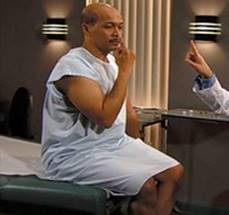
Ask patient to pat knees with both hands, alternately patting with palmar and dorsal surfaces of the hands. Alternatively, ask the patient to touch the thumb to each finger of the same hand sequentially from index finger to little finger and back, one hand at a time. |
EXPECTED:Smooth execution, maintaining rhythm with increasing speed. |
|
UNEXPECTED:Stiff, slowed, nonrhythmic, or jerky clonic movements. |
|
|
Position your index finger 40 to 50 cm from patient. Ask patient to alternately touch his or her nose and your index finger with the index finger of one hand, as shown below. Change location of your index finger several times. Repeat with patient’s other hand. |
EXPECTED:Movements rapid, smooth, accurate. |
|
UNEXPECTED:Consistent past pointing (missing examiner’s index finger). |
|
|
Assessing accuracy of movement with finger-to-finger test.
|
|
|
Ask patient to close both eyes and touch his or her nose with index finger of each hand while alternating hands and gradually increasing speed. |
EXPECTED:Movements rapid, smooth, accurate, even with increasing speed. |
|
Ask patient to run heel of one foot along shin of opposite leg from knee to ankle. Repeat with other heel. |
EXPECTED:Able to move heel up and down shin in straight line. |
|
UNEXPECTED:Irregular deviations to side. |
|
|
Evaluate balance |
|
|
Ask patient to stand with feet together and arms at sides, with eyes first open, then closed. Stand close by in case patient starts to fall. |
EXPECTED:Slight swaying movement, no danger of falling. |
|
UNEXPECTED:Staggering, losing balance, or swaying to the extent of falling. |
|
|
After explaining test to patient, ask patient to spread feet slightly, then push shoulders to throw patient off balance. Be prepared to catch patient. |
EXPECTED:Quick recovery of balance. |
|
UNEXPECTED:Must catch patient to prevent a fall. |
|
|
Have patient stand in place on one foot, then the other, with eyes open. Then have patient hop on each foot. |
EXPECTED:Able to stand and hop 5 seconds on each foot without losing balance. |
|
UNEXPECTED:Instability, need to continually touch floor with opposite foot, or tendency to fall. |
|
|
Ask patient to walk without shoes around examining room or down hallway, with eyes first open, then closed. |
EXPECTED:Smooth, regular gait rhythm and symmetric stride length; upright trunk posture swaying with gait phase; and arm swing smooth and symmetric. |
|
UNEXPECTED:Shuffling, widely placed feet, toe walking, foot flop, leg lag, scissoring, loss of arm swing, staggering, lurching, or waddling motion. |
|
|
Ask patient to walk a straightline, first forward and then backward, with eyes open and arms at side. Ask patient to touch toe of one foot with heel of other. |
EXPECTED:Consistent contact between toe and heel with slight swaying. |
|
UNEXPECTED:Extension of arms for balance, instability, tendency to fall, or lateral staggering and reeling. |
|
|
SENSORY FUNCTION |
|
|
Test primary sensory functions |
|
|
Ask patient to close eyes for all tests. Use minimal stimulation initially, then increase gradually until patient becomes aware. Test contralateral areas, asking patient to compare perceived sensations side to side. |
EXPECTED:For all tests, minimal differences side to side, correct interpretation of sensations, able to distinguish side of body tested and location of sensation (e.g., proximal or distal to previous stimulus). |
|
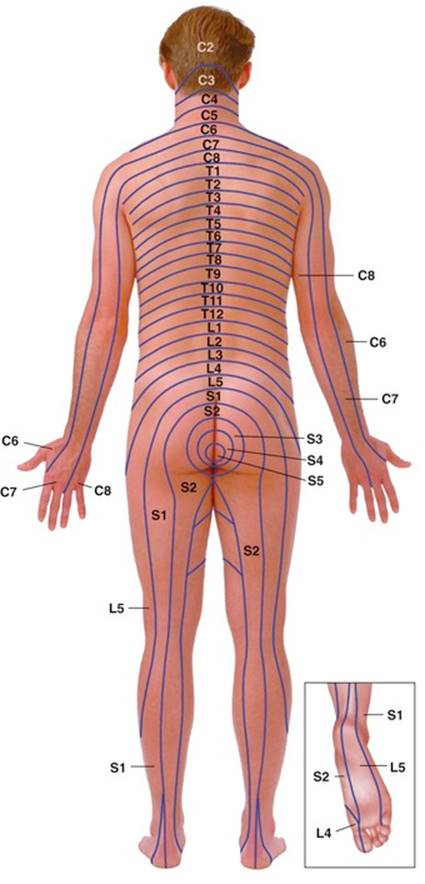
UNEXPECTED:For all tests, map boundaries of any impairment by distribution of major peripheral nerves or dermatomes (see figures on pp. 253-254). |
|
|
Dermatomes of the body, anterior view.
Dermatomes of the body, posterior view.
|
|
|
Lightly touch skin with cotton wisp or your fingertips, as shown at right. Ask patient to point to area touched or acknowledge when sensation is felt. |
|
|
Superficial touch assessment.
|
|
|
Alternating sharp and smooth edges of broken tongue blade or point and hub of sterile needle or paper clip, touch skin in unpredictable pattern. Ask patient to identify sensation (sharp or dull) and where it is felt. |
|
|
Superficial pain assessment.
|
|
|
Perform test only if superficial pain sensation is not intact. |
|
|
Temperature: Alternately roll test tubes of hot and cold water against skin in an unpredictable pattern. Ask patient to indicate hot or cold and where it is felt. |
EXPECTED:Distinguishes between hot and cold and location of sensation. |
|
Deep pressure: Squeeze trapezius, calf, or biceps muscle. |
EXPECTED:Discomfort with deep pressure. |
|
Perform test only if patient has diabetes mellitus or peripheral neuropathy. Apply 5.07 monofilament until filament bends, or lightly roll Waardenberg wheel. Use a random pattern to test several sites on plantar surface of foot and once on dorsal surface. Avoid calloused areas and broken skin. |
EXPECTED:Sensation felt at all sites touched. |
|
UNEXPECTED:Loss of sensation at any site. |
|
|
Monofilament testing of superficial touch.
|
|
|
Place stem of vibrating tuning fork against several bony prominences (e.g., toes, ankle, shin, finger joints, wrist, elbow, shoulder, sternum), beginning distally. Ask patient when and where sensation is felt and what it feels like. Dampen tines occasionally to see whether patient notices the difference. |
EXPECTED:Buzzing or tingling sensation. |
|
UNEXPECTED:Does not distinguish vibration from touch of nonvibrating tuning fork. |
|
|
Assessment of vibration sensation.
|
|
|
Hold joint to be tested (great toe or finger) by lateral aspects in neutral position, then raise or lower digit, as shown, and ask patient which way it was moved. Return to neutral before moving in another direction. Repeat so both feet and both hands are tested. |
EXPECTED:Patient correctly identifies position of joint. |
|
Position sense assessment.
|
|
|
Test cortical sensory functions |
|
|
Ask patient to close eyes for all tests. |
|
|
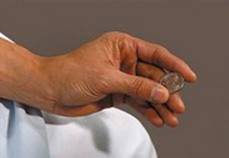
Hand patient familiar objects (e.g., key, coin), and ask patient to identify. |
UNEXPECTED:Inability to recognize objects (tactile agnosia). |
|
Stereognosis.
|
|
|
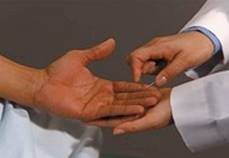
Using two sterile needles or paper-clip ends, alternately touch patient’s skin with one or both points simultaneously at various locations. Find distance at which patient can no longer distinguish two points. |
EXPECTED:See table below. |
|
Two-point discrimination.
|
|
Minimal Distances of Discriminating Two Points
|
Body Part |
Minimal Distance (mm) |
|
Tongue |
1 |
|
Fingertips |
2-8 |
|
Toes |
3-8 |
|
Palms of hands |
8-12 |
|
Chest and forearms |
40 |
|
Back |
40-70 |
|
Upper arms and thighs |
75 |
From Barkauskas et al, 2001.
|
TECHNIQUE |
FINDINGS |
|
Simultaneously touch cheek and hand, or two other areas on each side of body with sterile needles. Ask patient the number of stimuli and locations. |
EXPECTED:Location of both sensations identified. |
|
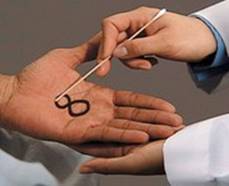
With blunt pen or applicator stick, draw letter, number, or shape on palm of patient’s hand, and ask patient to identify it. Repeat with different figure on other hand. |
EXPECTED:Letter or number readily recognized. |
|
Graphesthesia.
|
|
|
Touch area on patient’s skin and withdraw stimulus. Ask patient to point to area touched. |
EXPECTED:Able to locate stimulus. |
|
REFLEXES |
|
|
Test superficial reflexes |
|
|
Have patient supine. |
|
|
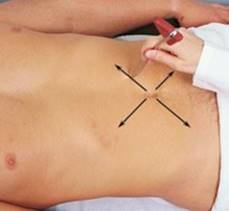
Stroke each quadrant of abdomen with end of reflex hammer or with tongue blade edge. |
EXPECTED:Slight, bilaterally equal movement of umbilicus toward each area of stimulation. May have diminished response in obese patient or when abdominal muscles stretched by pregnancy. |
|
Abdominal reflex assessment.
|
|
|
Stroke inner thigh, proximal to distal. |
EXPECTED:Testicle and scrotum rise on stroked side. |
|
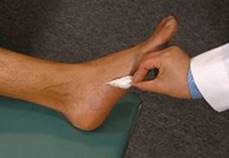
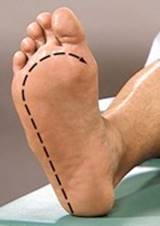
Using pointed object, stroke lateral side of foot from heel to ball, then curve across ball to medial side. |
EXPECTED:Plantar flexion of all toes. Dorsiflexion of great toe and fanning of other toes in children younger than 2 years. |
|
UNEXPECTED:Fanning of toes or dorsiflexion of great toe with or without fanning of other toes (Babinski sign positive) in all patients older than 2 years. |
|
|
Plantar reflex assessment.
|
|
|
Test deep tendon reflexes |
|
|
Patient relaxed and either sitting or lying for most procedures. Test each reflex, comparing responses on corresponding sides. Score deep tendon reflexes on scale shown in table below. |
EXPECTED:Symmetric visible or palpable responses. |
|
UNEXPECTED:Absent or diminished responses (0 or 1+), or hyperactive reflexes (3+ or 4+). |
|
Scoring Deep Tendon Reflexes
|
Grade |
Deep Tendon Reflex Response |
|
0 |
No response |
|
1+ |
Sluggish or diminished |
|
2+ |
Active or expected response |
|
3+ |
More brisk than expected, slightly hyperactive |
|
4+ |
Brisk, hyperactive, with intermittent or transient clonus |
|
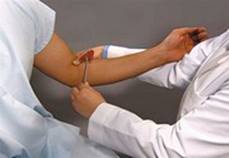
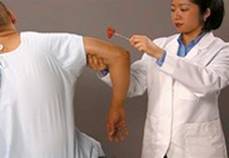
Flex arm 45 degrees at elbow, then palpate biceps tendon in antecubital fossa. Place thumb over tendon and fingers under elbow. Strike your thumb with reflex hammer. |
EXPECTED:Visible or palpable flexion of elbow, contraction of biceps muscle. |
|
Biceps deep tendon reflex.
|
|
|
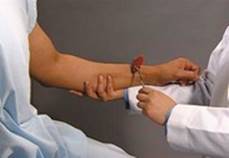
Flex patient’s arm up to 45 degrees while resting patient’s forearm on your arm, with hand slightly pronated. Strike brachioradial tendon. |
EXPECTED:Pronation of forearm and flexion of elbow. |
|
Brachioradialis deep tendon reflex.
|
|
|
Flex patient’s arm at elbow up to 90 degrees and allow patient’s lower arm to hang freely, or rest patient’s forearm on your arm. Palpate triceps tendon and strike directly with reflex hammer, just above elbow. |
EXPECTED:Visible or palpable extension of elbow, contraction of triceps muscle. |
|
Triceps deep tendon reflex.
|
|
|
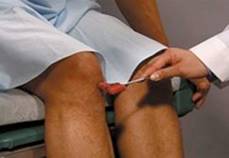
Flex patient’s knee up to 90 degrees, allowing lower leg to hang loosely. Support upper leg so it does not rest against edge of examining table, then strike patellar tendon just below patella. |
EXPECTED:Extension of lower leg, contraction of quadriceps muscle. |
|
Patellar deep tendon reflex.
|
|
|
Ask patient to sit. Then flex patient’s knee and dorsiflex ankle up to 90 degrees, holding heel of foot. Strike Achilles tendon at level of ankle malleoli. |
EXPECTED:Plantar flexion, contraction of gastrocnemius muscle. |
|
Achilles deep tendon reflex.
|
|
|
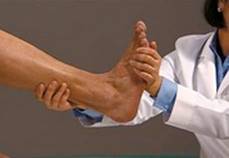
Support patient’s knee in partially flexed position and briskly dorsiflex foot with other hand, maintaining foot in flexion. |
EXPECTED:No rhythmic oscillating movements. |
|
UNEXPECTED:Sustained clonus, rhythmic oscillating movements between dorsiflexion and plantar flexion palpated. |
|
|
Clonus assessment.
|
|
Differential Diagnosis of Upper and Lower Motor Neuron Disorders
|
Assessment Parameters |
Upper Motor Neuron |
Lower Motor Neuron |
|
Muscle tone |
Increased tone, muscle spasticity, risk for contractures |
Decreased tone, muscle flaccidity |
|
Muscle atrophy |
Little or no muscle atrophy, but decreased strength |
Loss of muscle strength; muscle atrophy or wasting |
|
Sensation |
Sensation loss may affect entire limb |
Sensory loss following distribution of dermatomes or peripheral nerves |
|
Reflexes |
Hyperactive deep tendon and abdominal reflexes; positive Babinski sign |
Weak or absent deep tendon, plantar, and abdominal reflexes, negative plantar reflex, no pathologic reflexes |
|
Fasciculation |
No fasciculations |
Fasciculations |
|
Motor effect |
Paralysis of voluntary movements |
Paralysis of muscles |
|
Location of insult |
Damage above level of brainstem will affect contralateral side of body, damage below the brainstem will affect the ipsilateral side of the body |
Damage affects muscle on ipsilateral side of body |
AIDS TO DIFFERENTIAL DIAGNOSIS
|
ABNORMALITY |
DESCRIPTION |
|
Multiple sclerosis |
Subjective Data:Fatigue; vertigo, weakness, numbness; blurred vision, diplopia, vision loss; urinary frequency, urgency, hesitancy; sexual dysfunction; emotional changes. |
|
Objective Data:Muscle weakness, ataxia; hyperactive deep tendon reflexes; paresthesias, sensory loss; intention tremor; optic neuritis; cognitive changes. |
|
|
Generalized seizure disorder |
Subjective Data:Premonition or aura, stiff body followed by rhythmic jerking movements, eyes rolled upward, drooling. Loss of bladder and bowel control. |
|
Objective Data:Tonic phase (brief flexion then extension for 10 to 15 minutes, eyes deviated upward, dilated pupils), clonic phase (alternating muscle contraction and relaxation), postictal (coma followed by confusion and lethargy). |
|
|
Meningitis |
Subjective Data:Fever, chills, headache, stiff neck, lethargy, malaise, vomiting, irritability, seizures. |
|
Objective Data:Altered mental status, confusion, nuchal rigidity, may see positive Brudzinski and Kernig signs. |
|
|
Encephalitis |
Subjective Data:Recovery from mild viral illness with fever, then lethargy, restlessness, mental confusion. |
|
Objective Data:Altered mental status, confusion, stupor, coma, photophobia, stiff neck, muscle weakness, paralysis, ataxia. |
|
|
Intracranial Lesion |
Subjective Data:Headaches; nausea and vomiting; memory loss and confusion; unsteady gait, impaired coordination; behavioural or personality changes. |
|
Objective Data:Signs vary by location of lesion; altered consciousness, confusion, papilledema, cranial nerve impairment, aphasia, vision loss, gait disturbance, ataxia. |
|
|
Stroke (cerebrovascular accident or brain attack) |
Subjective Data:Sudden numbness or weakness, often unilateral; sudden confusion, difficulty speaking or understanding speech; sudden trouble seeing in one or both eyes; sudden trouble walking, loss of balance, or loss of coordination; sudden severe headache with no known cause. |
|
Objective Data:Altered consciousness, elevated blood pressure, difficulty managing secretions, weakness or paralysis of extremities or facial muscles on one or both sides of body, aphasia (receptive or expressive), articulation impairment, impaired horizontal gaze or hemianopia. |
|
|
Parkinson disease |
Subjective Data:Tremors at rest and with fatigue that disappear with intended movement and sleep; slowing of voluntary movement; bilateral pill rolling of fingers; may have numbness, aching, tingling and muscle soreness. |
|
Objective Data:Tremors; muscle rigidity; stooped posture; instability of balance; short steps, shuffling, freezing gait; difficulty swallowing, drooling, voice softening, slowed, slurred, monotonous speech; impaired cognition, dementia. |
|
|
Peripheral neuropathy |
Subjective Data:Gradual onset of numbness, tingling, burning in hands and feet; sensation of walking on cotton or floors feel strange; inability to feel difference between coins; night pain in feet. |
|
Objective Data:Reduced protective sensation in foot and may progress up lower leg; distal pulses diminished, diminished ankle and knee deep tendon reflexes, loss of vibratory sensation below knee, distal muscle weakness, cannot stand on toes or heels |
|
|
Trigeminal neuralgia |
Subjective Data:Sharp pain episodes on one side of face potentially caused by chewing, swallowing, talking, brushing teeth, or cold exposure. |
|
Objective Data:May have slight sensory impairment in regions of pain, may have normal neurologic findings. |
|
|
Bell’s palsy |
Subjective Data:Rapidly progression of muscle weakness on one side of face, feeling of facial numbness. |
|
Objective Data:Facial creases and nasolabial fold disappear on affected side, eyelid does not close and lower lid sags on affected side, facial sensation is intact. |
|
|
Cerebral palsy |
Subjective Data:Delays in gross motor development, activity limitation; may have hearing, speech, or language disorders, feeding difficulties. |
|
Objective Data:Increased or decreased muscle tone, tremors, scissor gait or wide-based gait, toe walking, mental retardation or learning disabilities, persistent primitive reflexes, inconsistent muscle tone. |
Pediatric Variations
EXAMINATION
Neurologic findings in the infant and child change as the child matures. For a complete description of expected developmental findings by age, see Chapter 21.
|
TECHNIQUE |
FINDINGS |
|
Indirectly evaluate cranial nerves in newborns and infants |
|
|
Shine a light at infant’s open eyes. Observe quick closure of eyes and dorsal flexion of head. |
EXPECTED:Gazes intensely at close object or face. Focuses on and tracks an object with both eyes. |
|
UNEXPECTED:No response may indicate poor light perception. |
|
|
Touch one corner of infant’s mouth. |
EXPECTED:Infant should open mouth and turn head in direction of stimulation. If infant has been fed recently, minimal or no response is expected. |
|
Place your finger in infant’s mouth, feeling sucking action. Note pressure, strength, pattern of sucking. |
EXPECTED:Tongue should push up against your finger with good strength. |
|
Observe and note infant’s ability to wrinkle forehead when crying and symmetry of smile. |
EXPECTED:Facial symmetry with all expressions. |
|
Loudly clap your hands about 30 cm from infant’s head; avoid producing an air current. |
EXPECTED:Blink in response to sound. Infant will habituate to to repeated testing. Freezes position with high-pitched sound. |
|
UNEXPECTED:No response after 2 to 3 days. |
|
|
Hold infant under axilla in upright position, head held steady, facing you. Rotate infant first in one direction and then in other. |
EXPECTED:Infant’s eyes should turn in direction of rotation and then opposite direction when rotation stops. |
|
UNEXPECTED:Eyes do not move in expected direction. |
|
|
|
EXPECTED:Coordinated sucking and swallowing ability. |
|
Pinch infant’s nose. |
EXPECTED:Mouth will open, and tip of tongue will rise in midline position. |
|
Evaluate primitive reflexes in infant |
|
|
Making sure infant’s head is in midline, touch palm of infant’s hand from ulnar side (opposite thumb) |
EXPECTED:Strong grasp of your finger. Sucking facilitates grasp. Grasp should be strongest between 1 and 2 months of age and disappear by 3 months. |
|
Touch plantar surface of infant’s feet at the base of toes. |
EXPECTED:Toes should curl downward. Reflex should be strong up to 8 months of age. |
|
With infant supported in semisitting position, allow head and trunk to drop back to a 30-degree angle. |
EXPECTED:Symmetric abduction and extension of arms. Fingers fan out, and thumb and index finger form a “C.” Arms then adduct in an embracing motion followed by relaxed flexion. Reflex diminishes in strength by 3 to 4 months and disappears by 6 months. |
|
Hold infant upright under axilla next to a table or chair. Touch dorsal side of foot to table or chair edge. |
EXPECTED:Flexion of hip and knee, lifting of foot as if stepping up on table. Age of disappearance varies. |
|
Hold infant upright under axilla and allow soles of feet to touch surface of table. |
EXPECTED:Alternate flexion and extension of legs, simulating walking. Disappears before voluntary walking. |
|
With infant lying supine and relaxed or sleeping, turn infant’s head to one side so jaw is over shoulder. Then tuurn infant’s head to other side. |
EXPECTED:Extension of arm and leg on side to which head is turned and flexion of opposite arm and leg. Reversal of extremities’ positions with head turned opposite way. Reflex diminishes by 3 to 4 months of age and disappears by 6 months. |
|
UNEXPECTED:Be concerned if infant never exhibits reflex or seems locked in fencing position. |
|
SAMPLE DOCUMENTATION
Subjective.A 48-year-old man presents for his annual physical examination. No complaints of poor balance, loss of sensation, unsteady gait. History of diabetes mellitus type 1 for 30 years, well controlled.
Objective.Cranial nerves I to XII grossly intact. Gait is coordinated and even. Romberg test negative. Rapid alternating movements coordinated and smooth. Superficial touch, pain, vibratory sensation are intact bilaterally. Deep tendon reflexes 2+ bilaterally in all extremities. Plantar reflex produces expected plantar flexion of toes. No ankle clonus. Monofilament test reveals decreased sensation on plantar surfaces of both feet.
 Facial muscle tone