
Infants, Children, and Adolescents
EXAMINATION GUIDELINES
A pediatric physical examination must, of course, be age appropriate. Not every observation must be made on every child at every examination. What you do depends on the individual circumstance and your clinical judgment, each step dependent on the patient’s age, physical condition, and emotional state. The order of the examination can and should be modified according to need. There is no one right way. The safety of the child on the examining table must be ensured. During most of infancy and into the pre–elementary school years (and even later), an adult’s lap is most often a better site for much and often all of the examination.
Your notes should include a description of child’s behavior and the nature of the relationship during interactions with parent (or surrogate) and with you.
Offer toys or paper and crayons to entertain child (if age appropriate), to develop rapport, and to evaluate development and motor and neurologic status. Attempt to gain child’s cooperation, even if it takes more time; future visits will be more pleasant for both of you.
Only if absolutely necessary, restrain child for funduscopic, otoscopic, oral examinations; restraint is easier on an adult lap with the aid of the adult.
Lessen fear of these examinations by permitting child to handle instruments, blow out light, or use them on a doll, a parent, or you.
Take and record temperature, weight, length or height; also, blood pressure (record extremity or extremities used, size of cuff, and method used).
Note percentiles for all measurements.
If clinical issues require it, include arm span, upper segment measurement (crown to top of symphysis), lower segment measurement (symphysis to soles of feet), upper/lower segment ratio, head and chest circumference.
Use a developmental screening test such as Denver II to evaluate language, motor coordination, social skills.
Evaluate mental status as child interacts with you and parent.
CHILD PLAYING

While child plays on the floor, evaluate musculoskeletal and neurologic system while developing a rapport with child.
Observe child’s spontaneous activities.
Ask child to demonstrate skills such as throwing a ball, building block towers, drawing geometric figures, coloring.
Evaluate gait, jumping, hopping, range of motion.
Muscle strength: Observe child climbing on parent’s lap, stooping, and recovering.
CHILD ON PARENT’S LAP

Perform examination on parent’s lap; the adult and the patient generally enjoy the experience more and you, sitting on a stool, preferably with your eyes at the child’s eye level, will find it easier than the examining table.
Begin with child sitting and undressed except for diaper or underpants.
Upper extremities
Inspect arms for movement, size, shape; observe use of hands; inspect hands for number and configuration of fingers, palmar creases.
Palpate radial pulses.
Elicit biceps and triceps reflexes.
Take blood pressure at this point or later.
Lower extremities
Child may stand for much or part of examination.
Inspect legs for movement, size, shape, alignment, lesions.
Inspect feet for alignment, longitudinal arch, number of toes.
Palpate femoral and dorsalis pedis pulses.
Elicit plantar, Achilles, and patellar reflexes.
Head and neck
Inspect head.
Inspect shape, alignment with neck, hairline, position of auricles.
Palpate anterior fontanel for size (age appropriate); head for sutures, depressions; hair for texture.
Measure head circumference (up to age 36 months).
Inspect neck for webbing, voluntary movement.
Palpate neck: thyroid, muscle tone, lymph nodes, position of trachea.
Chest, heart, lungs
Inspect chest for symmetry, respiratory movement, size, shape, precordial movement, deformity, nipple and breast development.
Palpate anterior chest, locate point of maximal impulse, note tactile fremitus in talking or crying child.
Auscultate anterior, lateral, and posterior chest for breath sounds; count respirations.
Auscultate all cardiac listening areas for S1 and S2, splitting, murmurs; count apical pulse.
CHILD RELATIVELY SUPINE, STILL ON LAP, DIAPER LOOSENED

Inspect abdomen.
Auscultate for bowel sounds.
Palpate: Identify size of liver and any other palpable organs or masses.
Percuss.
Palpate femoral pulses; compare with radial pulses.
Palpate for inguinal lymph nodes.
Inspect external genitalia.
Males: Palpate scrotum for descent of testes and other masses; crossing the legs in the tailor position helps bring testes down.
CHILD STANDING
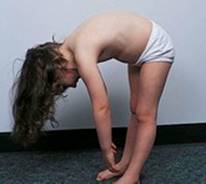
Inspect spinal alignment as child bends slowly forward to touch toes.
Observe posture from anterior, posterior, lateral views.
Observe gait.
CHILD ON PARENT’S LAP

The following steps, often delayed to the end of the examination by many, are more easily performed with a child of appropriate age sitting on a parent’s or surrogate’s lap:
Inspect eyes: Corneal light reflex, red reflex, extraocular movements, funduscopic examination.
Perform otoscopic examination. Note position and description of pinnae.
Inspect nasal mucosa.
Inspect mouth and pharynx. Note number of teeth, deciduous or permanent, and any special characteristics.
Note: By the time child is of school age, it is usually possible to use an examination sequence very similar to that for adults.) See pp. 306-316 for examples of forms used to chart physical growth.
AGE-SPECIFIC ANTICIPATED OBSERVATIONS AND GUIDELINES*
Again this is a suggested outline, always modified by human variation, and that all percentages are subject to Gaussian distribution. History building can be facilitated by referring to baby books, report cards, pictures, and other materials the family may have at home. Of course, you must in a nonemergent situation begin with a full history and physical examination when you first see the patient (at whatever age).
2 WEEKS OF AGE
History (particular attention)
Pertinent perinatal history
Social: Sleeping arrangements, housing
Stool pattern
Umbilicus: Healing, discharge, granulation
Diet: Feeding modality, schedule
Development: By this age:
80% will lift and turn head when in prone position
40% will follow an object to midline visually
35% will vocalize, become quiet in response to a voice
45% will regard a face intently, diminishing activity for the moment
Physical examination (particular attention)
Establish growth curves (weight, height, head circumference).
Examine hips.
Test reflexes: Moro, root, grasp, step.
Anticipatory guidance (particular attention)
Sleep (emphasize supine position and avoidance of soft and fuzzy threats to safe breathing)
Feeding: Use of pacifier (need to suck)
Use of bulb syringe (nasal stuffiness)
Safety: Falling, crib sides, car seats
Skin care
Clothing
Illness: Temperature taking
Crying (holding the baby)
Plans and problems
What risks have revealed themselves as you got to know the family? What are apparent problems? Start a problem list and make appropriate dispositions.
Consider need for hemoglobin or hematocrit value.
Consider immunization needs and, throughout, attempt to follow American Academy of Pediatrics guidelines; on each visit, discuss benefits, risks, side effects of immunizations (always remember risks for the immunocompromised).
2 MONTHS OF AGE
History (particular attention)
Expressions of parental concern
Child’s apparent temperament
Sleep cycle
Feeding patterns, frequency
Stooling pattern, frequency, color, consistency, straining
Be certain there is no probability of immunocompromise in patient or relevant family members or other contacts (before starting immunizations).
Social issues:
Father’s involvement
Living conditions
Smoking, other concerning habits
Any apparent high-risk concerns
Development: By this age
Gross motor:
80% will lift head to 45 degrees in prone position.
45% will lift head to as much as 90 degrees in prone position.
25% will roll over stomach to back.
Fine motor:
99%+ will follow a moving object to midline.
85% will follow a moving object past midline.
Language:
Almost all will diminish activity at the sound of a voice.
35% will spontaneously vocalize.
Many will vocalize responsively.
Psychosocial:
Almost all will diminish activity when regarding a face.
Almost all will respond to a friendly, cooing face with a social smile.
50% may smile spontaneously or even laugh aloud.
Physical examination (particular attention)
Growth curves (weight, height, head circumference)
Hearing
Vision
Hips
Anticipatory guidance
Feeding (delay or at least downplay solids; avoid citrus, wheat, mixed foods, eggs; minimize water)
When and if mother returns to work
Hiccups
Straining at stool
Visual and auditory stimulus (mobiles, mirrors, rattles, singing and talking to baby)
Sibling rivalry (if there are siblings)
Babysitters (checking references, ensuring immunization status, reliability)
Safety (rolling over, playpen, car seat, discourage walker, no smoking)
Sleep (reemphasize location and supine position)
Smoking and contribution to poor health
Plans and problems
Review immunizations and implement as appropriate.
List problems (e.g., allergies, medications, any areas of concern), and make appropriate plans and, if necessary, referrals.
Consider need for hemoglobin or hematocrit value.
4 MONTHS OF AGE
History (particular attention)
Parental concerns
Infant’s sleep cycle and temperament
Feeding patterns, frequency, mother’s feelings if she is breast-feeding
Stooling pattern, frequency, color, consistency, straining
Social issues:
Father’s involvement
Amplification of early impressions of home’s social structure
Smoking, other concerning habits
Any apparent high-risk concerns
Development: By this age
Gross motor:
80%, when prone, will lift chest up with arm support.
80% will roll over from stomach to back.
35% will have no head lag when pulled to sitting position, and many will then hold head steady when kept in that position.
Fine motor:
60% will reach for a dangling object.
Almost all will bring hands together.
Almost all will follow a face or object up to 180 degrees.
Language:
Almost all will laugh aloud.
20% will appear to initiate vocalization.
Psychosocial:
80% will smile spontaneously.
Many will regard their own hand for several seconds.
Physical examination (particular attention)
Update growth curves (weight, height, head circumference).
Reassess hearing.
Reassess vision.
Anticipatory guidance
Introduction of solid food (cereal)
Stool changes with changes in diet
Drooling and teething
Thumb sucking, pacifiers, bottles at bedtime
Safety (aspiration, rolling over, holding baby with hot liquids, reemphasize earlier discussions [e.g., car seat])
Reemphasis on environmental stimulus
Further discussion of babysitters
Use of antipyretics (e.g., acetaminophen)
Plans and problems
Review immunizations and implement as appropriate.
Maintain problem list, making appropriate plans and, if necessary, referrals.
Consider need for hematocrit or hemoglobin value.
6 MONTHS OF AGE
History (interim details)
Parental concerns
Sleep patterns
Diet
Stooling pattern
Further exploration of social issues
If either parent has not attended these care visits regularly, encourage his or her participation, and address relevant issues.
Development: By this age
Gross motor:
90%, pulled to a sitting position, will have no head lag.
60% will sit alone.
75% will bear some weight on legs.
Almost all will roll over.
Fine motor:
More than half will pass a toy from hand to hand.
60%, in a sitting position, will look for a toy.
40%, in a sitting position, will take two cubes.
Language:
60% will turn toward a voice.
30% will initiate speech sounds (e.g., mama, dada) but not specifically.
Psychosocial:
30% may cry and turn away from strangers.
40% may put an object in mouth to explore it, may feed self.
60% may resist an attempt to pull away an object while holding it.
Physical examination (particular attention)
Update growth curves.
Double-check hearing and vision.
Look for any new findings, and recheck the old.
Anticipatory guidance
Bedtime routines (discuss putting child to bed while child is awake; waking up at night)
Fear of strangers
Separation anxiety
Safety (begin discussions about what toddlers can get into, cabinets, hot water, electrical outlets, medications and other poisons; inform about local poison control center, syrup of ipecac)
Shoes, when and if to use them
Teething, oral hygiene
Offering a cup
Checking fluoride intake
Addition of solid foods
Plans and problems
Review immunizations and implement as appropriate.
Consider need for a serum lead level, hemoglobin or hematocrit value.
Maintain problem list, making appropriate plans and, if necessary, referrals.
9 MONTHS OF AGE
History (interim details)
Parental concerns
Continued attention to sleep, diet, stooling patterns
Continuing attention to social issues
Development: By this age
Gross motor:
Almost 100% will sit alone.
80% will stand alone.
45% will cruise.
Some will have begun competent crawling.
Fine motor:
70% will have thumb-finger grasp.
60% will bang two cubes together.
Almost all will finger feed.
Language:
75% will imitate speech sounds.
75% will use mama, dada nonspecifically.
Psychosocial:
Almost 100% will try to get to a toy that is out of reach.
85% will play repetitive games (e.g., peek-a-boo).
45% will be shy with strangers and may cry.
Physical examination (particular attention)
Update growth curves.
Constantly reassess earlier findings, and look for anything new.
Anticipatory guidance
Oral hygiene—for example, water without sugar in bottles (avoid tooth decay)
Sleep and desirability of routine (naps, separation anxiety and how to deal with it)
Reemphasis on babysitters, references and reliability
Safety—for example, stair gates and toddlers, falls, poisoning, burns, aspiration (never enough emphasis on safety, smoking, etc.)
Weaning, breast and/or bottle
Uses of discipline
Plans and problems
Review immunizations and implement as appropriate.
Consider need for a serum lead level, hemoglobin or hematocrit value.
Maintain problem list, making appropriate plans and, if necessary, referrals.
12 MONTHS OF AGE
History (interim details)
Assess parental concerns.
Reassess social and system review.
Development: By this age
Gross motor:
85% will cruise.
70% will stand alone briefly.
50% will walk to some extent, and more will try it with hands held.
Fine motor:
90% will bang two cubes together.
70% will have a good pincer grasp.
Language:
80% will use mama and dada specifically.
30% will use as many as three additional words.
Almost all will indulge in immature jargoning.
Psychosocial:
Almost all will respond to parent’s presence and voice.
Almost all will wave bye-bye.
85% will play pat-a-cake.
50% will drink from a cup.
About half, perhaps a bit more, will play ball with examiner.
Physical examination (particular attention)
Update growth curves.
Continue reassessment.
Evaluate gait if walking has begun.
Anticipatory guidance
Reduced food intake in many (this is expected)
Weaning (especially at night)
Increased use of table food
Dental health, toothbrushing
Toilet training (expectations, attitudes)
Discipline (e.g., limit setting)
Safety (childproofing house, street, lead paint, etc.)
Plans and problems
Review immunizations and implement as appropriate.
Consider need for a serum lead level, hemoglobin or hematocrit value, tuberculosis test.
Maintain problem list, making appropriate plans and, if necessary, referrals.
15 MONTHS OF AGE
History (interim details)
Assess parental concerns.
Reassess social and system review.
Development: By this age
Gross motor:
Almost all will walk well.
Almost all will stoop to recover an object.
35% will walk up steps with help.
Fine motor:
Almost all will drink from a cup.
Almost all will have a neat pincer grasp.
70% will scribble with crayon.
60% will make a tower with two cubes.
Language:
Almost all will use mama and dada specifically.
75% will use as many as three additional words.
30% will put two words together.
Psychosocial:
Many more than 50% will play ball with examiner.
50% will try to use a spoon.
45% will try to remove clothing.
Physical examination (particular attention)
Update growth curves.
Continue reassessment.
Evaluate gait.
Anticipatory guidance
Negativism and independence
Dental health (visit to a dentist)
Toilet training
Weaning
Discipline (e.g., need for consistency)
Safety (all issues, repetitively)
Plans and problems
Review immunizations and implement as appropriate.
Consider need for a serum lead level, hemoglobin or hematocrit value, tuberculosis test.
Maintain problem list, making appropriate plans and, if necessary, referrals.
18 MONTHS OF AGE
History (interim details)
Assess parental concerns.
Reassess social and system review.
Development: By this age
Gross motor:
55% will have begun to walk up stairs without much help.
70% will have started to walk backward.
More than that will have tried running with at least some success.
45% will have tried with some success to kick a ball forward, given the opportunity.
Fine motor:
80% will scribble if given a crayon.
80% will make a tower with two cubes.
About half of those will attempt with some success a tower of as many as four cubes.
Language:
Almost all will have mature jargoning.
85% will have at least three words in addition to mama and dada.
Many of those will put two words together.
More than half will respond to a one-step command (e.g., when asked to point to a body part).
Psychosocial:
Well over half will assist with taking off their clothes.
75% will use a spoon successfully, albeit with some spillage.
Physical examination (particular attention)
Update growth curves.
Continue reassessment; search for new findings.
Continue to evaluate gait.
Anticipatory guidance
Sleep (naps, nightmares)
Diet (mealtime battles)
Dental health (toothbrushing, dentist)
Toilet training
Discipline (methods and, again, consistency)
Safety (never enough discussion [e.g., seat belt, street and car, childproofing home])
Self-comforting (masturbation, thumb sucking, favorite blankets and toys)
Childcare settings if one is necessary
Plans and problems
Review immunizations and implement as appropriate.
Consider need for serum lead level, hemoglobin or hematocrit value, tuberculosis test.
Maintain problem list, making appropriate plans and, if necessary, referrals.
2 YEARS OF AGE
History (interim details)
Assess parental concerns.
Reassess social and system review.
Development: By this age
Gross motor:
All should run well.
All should walk up steps of reasonable height without holding on.
90% will kick a ball forward.
80% will throw a ball overhand.
60% will do a little jump.
40% may balance on one foot for 1 to 2 seconds.
Fine motor:
Almost all should scribble with a pencil.
90% will make a tower of four cubes.
70% will copy a vertical line.
Language:
All should point to and name parts of body.
85% will readily combine two different words.
80% will understand on and under.
75% will name a picture.
Psychosocial:
85% will give a toy to mother or other significant person.
60% will put on some clothing alone and, often, also remove a garment.
50% will play games with others.
Physical examination (particular attention)
Update growth curves.
Continue reassessment; search for new findings.
Examine mouth, and count number of teeth.
Anticipatory guidance
Independence (limit setting, temper tantrums)
Peer interaction
Safety (poisons and potential poisons, water temperature, car safety seat use)
Toilet training
Nightmares
Use of a cup for drinking (as much as possible)
Plans and problems
Review immunizations and implement as appropriate.
Consider need for serum lead level, hemoglobin or hematocrit value, dental referral, tuberculosis test.
Maintain problem list, making appropriate plans and, if necessary, referrals.
3 YEARS OF AGE
History (interim details)
Assess parental concerns.
Reassess social and system review.
Development: By this age
Gross motor:
75% will balance on one foot for at least 1 second.
75% will negotiate a successful broad jump.
40% will balance on one foot for as long as 5 seconds.
Fine motor:
80% will copy a circle in addition to a vertical line.
80% will build a tower of as many as eight cubes.
Language:
Speech is becoming more clearly understood in more than half.
80% will use plurals appropriately.
Almost half will give their first and last names appropriately.
Psychosocial:
90% will put on clothing alone.
75% will play interactive games.
50% will separate from mother or other significant person without too much stress.
Many will have begun to wash and dry hands.
Physical examination (particular attention)
Update growth curves.
Continue reassessment; search for new findings.
Assess whether teeth are coming in appropriately.
Anticipatory guidance
Degrees of independence (limit setting and encouragement, a fine balance), other aspects of discipline
Safety (car seat, guns, strangers)
Personal hygiene (handwashing, toothbrushing, proper use of toilet tissue)
Daycare
Plans and problems
Review immunizations and implement as appropriate.
Consider need for serum lead level, hemoglobin or hematocrit value, tuberculosis test.
Maintain problem list, making appropriate plans and, if necessary, referrals.
4 YEARS OF AGE
History (interim details)
Assess parental concerns.
Reassess social and system review.
Development: By this age
Gross motor:
75% will hop on one foot.
75% will balance on one foot for as long as 5 seconds.
65% will be able to imitate a heel-toe walk.
Many will have begun to throw overhand.
Fine motor:
Almost all will copy a circle and a plus sign.
80% will pick longer line of two.
50% will begin to draw a person in three parts.
Language:
Speech is quite understandable in almost all.
95% will give their first and last names.
85% will understand cold, tired, hungry.
80% will identify three of four colors.
Psychosocial:
Almost all will play games with other children.
70% will dress without supervision.
Physical examination (particular attention)
Update growth curves.
Continue reassessment; search for new findings.
Remind that hearing and vision must be evaluated at each visit.
Remind that taking blood pressure is an integral part of physical examination.
Anticipatory guidance
Importance of reading to child frequently
Need for a toddler car seat
Fears and fantasies
Separation (reliance on other adults as time goes by)
Safety (matches and lighters out of reach, strangers, street, window guards)
Personal hygiene (again, importance of frequent toothbrushing)
Plans and problems
Review immunizations and implement as appropriate.
Consider need for serum lead level, hemoglobin or hematocrit value, urinalysis.
Maintain problem list, making appropriate plans, and if necessary, referrals.
5 YEARS OF AGE
History (interim details)
Assess parental concerns.
Reassess social and system review.
Development: By this age
Gross motor:
Almost all will hop nicely on one foot.
75% will balance on one foot for as long as 10 seconds.
60% will do a heel-toe walk backward reasonably well.
Fine motor:
85% will draw a person in three parts.
65% will draw a person in as many as six parts.
60% will copy a square.
Language:
Almost all will identify four colors.
Almost all will understand on, under, in front of, behind.
Well over half will define adequately five of the following eight words—ball, cake, desk, house, banana, curtain, fence, ceiling.
Psychosocial:
Almost all will dress without supervision.
Almost all will brush teeth without help.
Almost all will play board and card games.
Almost all will be relaxed when left with a babysitter.
More than half will prepare their own cereal.
Physical examination (particular attention)
Update growth curves.
Continue reassessment; search for new findings.
Anticipatory guidance
Reading together
School readiness (plays with others, endures separation from parents)
Chores
Discipline (consistency, praising)
Sex identification, education
Peer interaction
Television
Safety (seat belts, guns, bike helmets, matches, swimming; memorize name, address, phone number)
(It is not usually possible to cover so many topics at one visit, so it is usually necessary to be selective based on your knowledge of the family situation.)
Plans and problems
Review immunizations and implement as appropriate.
Consider need for a tuberculosis test, urinalysis.
Maintain problem list, making appropriate plans and, if necessary, referrals.
ELEMENTARY SCHOOL YEARS (6 TO 12 YEARS OF AGE)
History (interim details)
Parental concerns
Child’s concerns
Reassess social and system review
Attention span
Behavior at home and in school
School accomplishments and experience
Enuresis, encopresis, constipation, nightmares
Development
By this time gross and fine motor problems have most often become apparent (but not always; neurologic examination should not be shortchanged). Language and psychosocial skills can be readily investigated in talks with parents and child and in explorations of school and play experiences. Socialization and developing maturity may have different expressions at home, on the playground, and in school, and when with people of different ages and different degrees of acquaintance. Talks with teachers, report cards, and various drawings and other efforts that the child brings home from school can be very helpful.
Physical examination (particular attention)
Update growth curves.
Continue reassessment; search for new findings.
Begin Tanner stage assessment.
Anticipatory guidance
Parent-child rapport
Need for praise
Responsibility
Safety (seat belts, guns, fire, bike helmets, swimming; memorize name, address, phone number)
Allowance
Television
Sex education
Dental care
Adult supervision
Discipline (limit setting)
(Again, time constraints almost always make it necessary to adjust the menu for anticipatory guidance to your judgment about the family’s needs.)
Plans and problems
Review immunizations and implement as appropriate.
Consider need for a tuberculosis test, urinalysis.
Maintain problem list, making appropriate plans and, if necessary, referrals.
ADOLESCENTS
We have assumed a continuing relationship with the patient from birth on. If you are seeing a patient for the first time, begin with a full history and physical examination.
History (interim details)
Patient’s concerns
Parental concerns
Menstrual history
Use of tobacco, alcohol, street or other drugs
Diet and what guides it
Sexual activity (relationships, masturbation, pregnancy and disease control measures); exact timing for all of this should rely on your assessment of the situation and your judgment; in general, social experience
School experience
Suicidal ideation; always be on the alert, and bring it up when necessary
Update knowledge of home and social structure
Revisit in general social and system review
(An adolescent patient [and some elementary school children] may prefer to be or should be seen alone at times and, as they get older, most often or always. This does not mean, however, that the parents are not involved. Proper balance in this relies on your judgment.)
Development
By this time adolescent’s physical, neurologic, and cognitive abilities should be well understood, but nothing should be taken for granted. Conversation with patient, parent or parents, and school officials; school records; and, of course, a careful physical examination should all be helpful.
Physical examination (particular attention)
Update growth curves.
Continue reassessment; search for new findings.
Do Tanner stage assessment.
Assess spinal curvatures, particularly in early adolescent females.
Anticipatory guidance
Puberty and its issues; body image
Sexuality, sexually transmitted disease, contraception
Diet
Tobacco, alcohol, drugs
Risk-taking behavior
Exercise
Safety (guns, seat belts, bike helmets)
Family and other social relationships
Independence and responsibility
School and the future
(Time constraints almost always make it necessary to adjust the menu for anticipatory guidance to your judgment about the adolescent’s and/or the family’s needs.)
Plans and problems
Review immunizations and implement as appropriate.
Consider need for tuberculosis test, sexually transmitted disease testing, hemoglobin or hematocrit determination, urinalysis, lipid screen.
Maintain problem list, making appropriate plans and, if necessary, referrals.
* Adapted in part from clinic forms prepared by Drs. Janet Serwint and Kevin Johnson at The Johns Hopkins Hospital.