
Dementia
Dementia is an acquired deterioration in cognitive ability that impairs the successful performance of activities of daily living. Memory is the most common cognitive ability lost with dementia; 10% of persons over age 70 and 20–40% of individuals over age 85 have clinically identifiable memory loss. Other mental faculties are also affected in dementia, such as language, visuospatial ability, calculation, judgment, and problem solving. Neuropsychiatric and social deficits develop in many dementia syndromes, resulting in depression, withdrawal, hallucinations, delusions, agitation, insomnia, and disinhibition. Dementia is usually chronic and progressive.
Diagnosis
The mini-mental status examination (MMSE) is a useful screening test for dementia (Table 191-1). A score of <24 points (out of 30) indicates a need for more detailed cognitive and physical assessment. In some pts with early cognitive disorders, the MMSE may be normal and more detailed neuro-psychological testing will be required.
APPROACH TO THE PATIENT Dementia
Differential Diagnosis: Dementia has many causes (Table 194-1). It is essential to exclude treatable etiologies; the most common potentially reversible diagnoses are depression, hydrocephalus, and alcohol dependence. The major degenerative dementias can usually be distinguished by distinctive symptoms, signs, and neuroimaging features (Table 194-2).
TABLE 194-1 DIFFERENTIAL DIAGNOSIS OF DEMENTIA
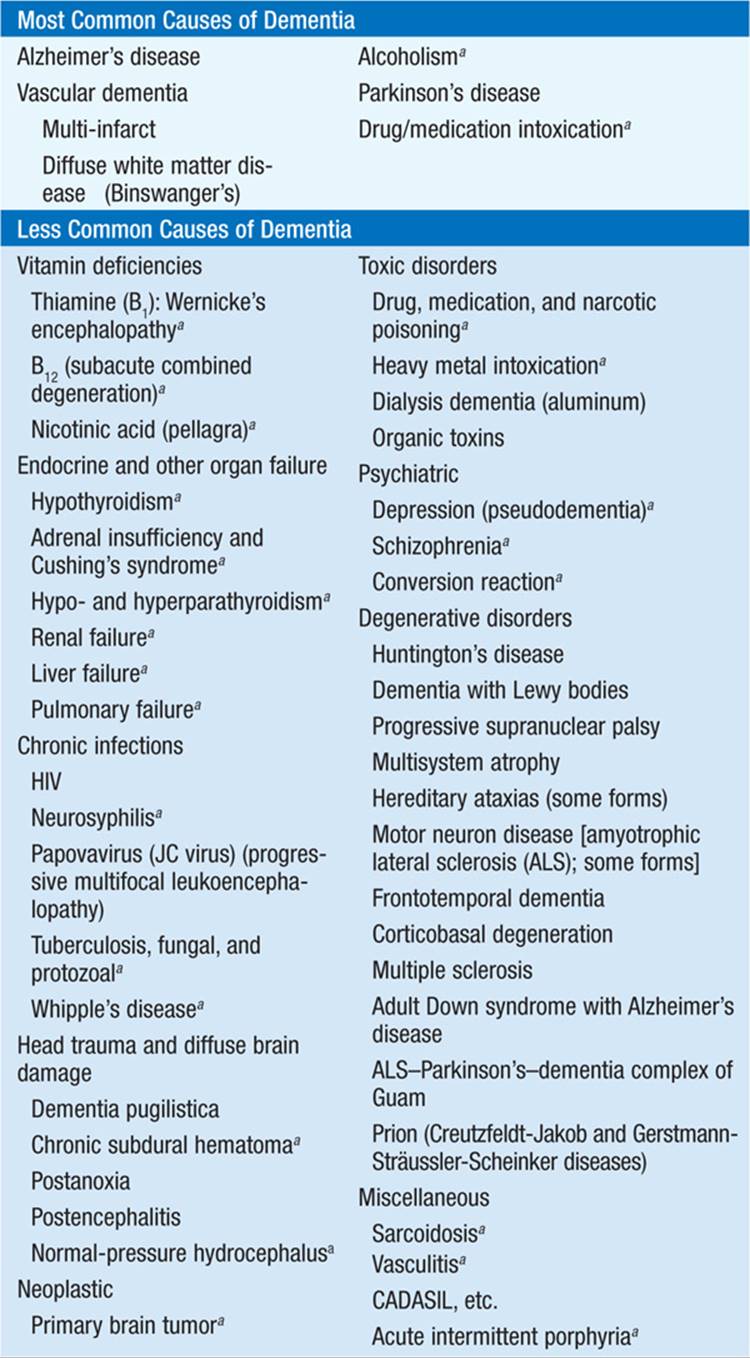

TABLE 194-2 CLINICAL DIFFERENTIATION OF THE MAJOR DEMENTIAS

History: A subacute onset of confusion may represent delirium and should trigger the search for intoxication, infection, or metabolic derangement (Chap. 17). An elderly person with slowly progressive memory loss over several years is likely to have Alzheimer’s disease (AD). A change in personality, disinhibition, gain of weight, or compulsive eating suggests frontotemporal dementia (FTD), not AD; apathy, loss of executive function, progressive abnormalities in speech, or relative sparing of memory or visuospatial abilities also suggests FTD. Dementia with Lewy bodies (DLB) is suggested by the early presence of visual hallucinations, parkinsonism, tendency to delirium, sensitivity to psychoactive medications, or an REM behavior disorder (RBD, the loss of skeletal muscle paralysis during dreaming).
A history of stroke suggests vascular dementia, which may also occur with hypertension, atrial fibrillation, peripheral vascular disease, and diabetes. Rapid progression of dementia with myoclonus suggests a prion disease such as Creutzfeldt-Jakob disease (CJD). Gait disturbance is prominent with vascular dementia, Parkinson’s disease, DLB, or normal-pressure hydrocephalus. Multiple sex partners or IV drug use should trigger search for an infection, especially HIV or syphilis. A history of head trauma could indicate chronic subdural hematoma, dementia pugilistica, or normal-pressure hydrocephalus. Alcoholism may suggest malnutrition and thiamine deficiency. A history of gastric surgery may result in loss of intrinsic factor and vitamin B12 deficiency. A careful review of medications, especially of sedatives and tranquilizers, may raise the issue of drug intoxication. A family history of dementia is found in Huntington’s disease and in familial forms of AD, FTD, DLB, or prion disorders. Insomnia or weight loss is often seen with depression-related cognitive impairments, which can also be caused by the recent death of a loved one.
Examination: It is essential to document the dementia, look for other signs of nervous system involvement, and search for clues of a systemic disease that might be responsible for the cognitive disorder. AD does not affect motor systems until late in the course. In contrast, FTD pts often develop axial rigidity, supranuclear gaze palsy, or features of amyotrophic lateral sclerosis. In DLB, initial symptoms may be the new onset of a parkinsonian syndrome (resting tremor, cogwheel rigidity, bradykinesia, and festinating gait). Unexplained falls, axial rigidity, dysphagia, and gaze deficits suggest progressive supranuclear palsy (PSP).
Focal neurologic deficits may occur in vascular dementia or brain tumor. Dementia with a myelopathy and peripheral neuropathy suggests vitamin B12 deficiency. A peripheral neuropathy could also indicate an underlying vitamin deficiency or heavy metal intoxication. Dry cool skin, hair loss, and bradycardia suggest hypothyroidism. Confusion associated with repetitive stereotyped movements may indicate ongoing seizure activity. Hearing impairment or visual loss may produce confusion and disorientation misinterpreted as dementia. Such sensory deficits are common in the elderly.
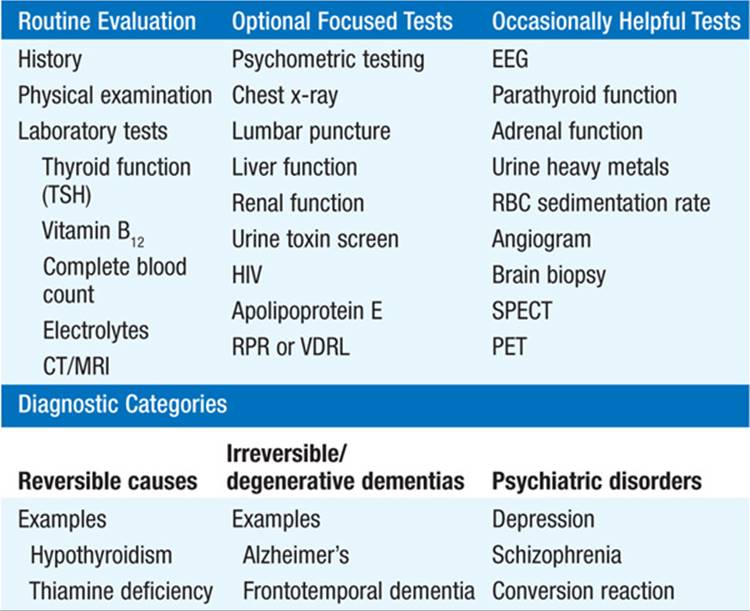
Choice of Diagnostic Studies: A reversible or treatable cause must not be missed, yet no single etiology is common; thus a screen must employ multiple tests, each of which has a low yield. Table 194-3 lists most screening tests for dementia. Guidelines recommend the routine measurement of thyroid function, a vitamin B12 level, and a neuroimaging study (CT or MRI). Lumbar puncture need not be done routinely but is indicated if infection is a consideration; CSF levels of tau protein and amyloid β42 show differing patterns with the various dementias although their sensitivity and specificity are not yet sufficiently high to warrant routine use. An EEG is rarely helpful except to suggest a prion disease or an underlying nonconvulsive seizure disorder. The role of functional-metabolic imaging in the diagnosis of dementia is still under study; amyloid imaging has recently shown promise for the diagnosis of AD. Brain biopsy is not advised except to diagnose vasculitis, potentially treatable neoplasms, unusual infections, or systemic disorders such as sarcoid.
TABLE 194-3 EVALUATION OF THE PATIENT WITH DEMENTIA

ALZHEIMER’S DISEASE
Most common cause of dementia; 10% of all persons over age 70 have significant memory loss, and in more than half the cause is AD. Cost is >$50 billion/year.
Clinical Manifestations
Cognitive changes follow a characteristic pattern beginning with memory impairment and spreading to language and visuospatial deficits. Memory loss is often not recognized initially, in part due to preservation of social graces until later phases; impaired activities of daily living (keeping track of finances, appointments) draw attention of friends/family. Once the memory loss becomes noticeable to the pt and spouse and falls 1.5 standard deviations below normal on standardized memory tests, the term mild cognitive impairment (MCI) is applied; Roughly 12% per year will progress to AD over 4 years. Disorientation, poor judgment, poor concentration, aphasia, and apraxia are increasingly evident as the disease progresses. Pts may be frustrated or unaware of deficit. In end-stage AD, pts become rigid, mute, incontinent, and bedridden. Help may be needed with the simplest tasks, such as eating, dressing, and toilet function. Often, death results from malnutrition, secondary infections, pulmonary emboli, heart disease, or, most commonly, aspiration. Typical duration is 8–10 years, but the course can range from 1 to 25 years.
Pathogenesis
Risk factors for AD are old age, positive family history. Pathology: neuritic plaques composed in part of Aβ amyloid, derived from amyloid precursor protein (APP); neurofibrillary tangles composed of abnormally phosphorylated tau protein. The apolipoprotein E (apo E) ε4 allele accelerates age of onset of AD and is associated with sporadic and late-onset familial cases. Apo E testing is not indicated as a predictive test. Rare genetic causes of AD are Down syndrome and mutations in APP, presenilin I, and presenilin II genes; all appear to increase production of Aβ amyloid. Genetic testing available for presenilin mutations; likely to be revealing only in early-age-of-onset familial AD.
TREATMENT Alzheimer’s Disease
• AD cannot be cured, and no highly effective drug exists. The focus is on judicious use of cholinesterase inhibitor drugs; symptomatic management of behavioral problems; and building rapport with the pt, family members, and other caregivers.
• Donepezil, rivastigmine, galantamine, tacrine (tetrahydroaminoacri-dine), and memantine are approved by the FDA for treatment of AD. Due to hepatotoxicity, tacrine is no longer used. With the exception of memantine, their action is inhibition of cholinesterase, with a resulting increase in cerebral levels of acetylcholine. Memantine appears to act by blocking overexcited N-methyl-D-aspartate (NMDA) channels.
– These compounds are only modestly efficacious and offer little or no benefit in the late stages of AD; they are associated with improved caregiver ratings of pts’ functioning and with an apparent decreased rate of decline in cognitive test scores over periods of up to 3 years.
– Donepezil (Aricept), 5–10 mg/d PO, has the advantages of few side effects and single daily dosage.
– Dosing of memantine begins at 5 mg/d with gradual increases (over 1 month) to 10 mg twice a day.
• There is no role for hormone replacement therapy in prevention of AD in women, and no benefit has been found in the treatment of established AD with estrogen.
• Randomized trials of Ginkgo biloba have found it to be ineffective. Prospective studies are examining the role of NSAIDs and statin medications as well as lowering of serum homocysteine in order to slow the progression to dementia.
• Other experimental approaches target amyloid either through diminishing its production or promoting clearance by passive immunization with monoclonal antibodies.
• Depression, common in early stages of AD, may respond to antidepressants or cholinesterase inhibitors. Selective serotonin reuptake inhibitors (SSRIs) are often used due to their low anticholinergic side effects. Management of behavioral problems in conjunction with family and caregivers is essential. Mild sedation may help insomnia.
• Control of agitation usually involves low doses of atypical antipsychotic medications, but recent trials have questioned the efficacy of this approach; in addition, all of the antipsychotics carry a black box warning in the elderly, increasing the risk of cardiovascular complications and death, and therefore should be used with caution.
• Notebooks and posted daily reminders can function as memory aids in early stages. Kitchens, bathrooms, and bedrooms need evaluation for safety. Pts must eventually stop driving. Caregiver burnout is common; nursing home placement may be necessary. Local and national support groups (Alzheimer’s Disease and Related Disorders Association) are valuable resources.
OTHER CAUSES OF DEMENTIA
Vascular Dementia
Typically follows a pattern of either multiple strokelike episodes (multi-infarct dementia) or diffuse white matter disease (leukoaraiosis, subcortical arteriosclerotic encephalopathy, Binswanger’s disease) (Fig. 194-1). Unlike AD, focal neurologic signs (e.g., hemiparesis) may be apparent at presentation. Treatment focuses on underlying causes of atherosclerosis.

FIGURE 194-1 Diffuse white matter disease (Binswanger’s disease). Axial T2-weighted MR image through the lateral ventricles reveals multiple areas of abnormal high signal intensity involving the periventricular white matter as well as the corona radiata and lentiform nuclei (arrows). While seen in some individuals with normal cognition, this appearance is more pronounced in pts with dementia of a vascular etiology.
Frontotemporal Dementia
Often begins in the fifth to seventh decades; in this age group it is nearly as prevalent as AD. Unlike in AD, behavioral symptoms predominate in the early stages of FTD. Extremely heterogeneous; presents with combinations of disinhibition, dementia, apraxia, parkinsonism, and motor neuron disease. May be sporadic or inherited; some familial cases due to mutations of tau or progranulin genes. Treatment is symptomatic; no therapies known to slow progression or improve cognitive symptoms. Many of the behaviors that accompany FTD such as depression, hyperorality, compulsions, and irritability may be helped with SSRIs.
Dementia with Lewy Bodies
Characterized by visual hallucinations, parkinsonism, fluctuating alertness, and falls. Dementia can precede or follow the appearance of parkinsonism; when it occurs after an established diagnosis of Parkinson’s disease, many use the term Parkinson’s disease dementia (PDD). Lewy bodies are intraneuronal cytoplasmic inclusions. Anticholinesterase compounds often provide significant benefit due to a severe cholinergic deficit in DLB. Exercise programs to maximize motor function, antidepressants to treat depressive syndromes, and possibly antipsychotics in low doses to alleviate psychosis may also be helpful.
Normal-Pressure Hydrocephalus (NPH)
Uncommon; presents as a gait disorder (ataxic or apractic), dementia, and urinary incontinence. Gait improves in some pts following ventricular shunting; dementia and incontinence do not improve. The diagnosis is difficult to make, and the clinical picture may overlap with several other causes of dementia including AD; historically many individuals treated for NPH have suffered from other dementias.
Huntington’s Disease
Chorea, behavioral disturbance, and a frontal/executive disorder (Chap. 59). Typical onset fourth to fifth decade but can present at almost any age. Autosomal dominant inheritance due to expanded trinucleotide repeat in gene encoding the protein huntingtin. Diagnosis confirmed with genetic testing coupled with genetic counseling. Symptomatic treatment of movements and behaviors; SSRIs may help depression.
Creutzfeldt-Jakob Disease (CJD)
Prion disorders such as CJD are rare (~1 per million). CJD is a rapidly progressive disorder with dementia, focal cortical signs, rigidity, and myoclonus; death in <1 year from first symptom. The markedly abnormal periodic discharges on EEG and cortical and basal ganglia abnormalities on diffusion-weighted MR are unique diagnostic features. No proven treatments exist.

For a more detailed discussion, see Seeley WW, Miller BL: Dementia, Chap. 371, p. 3300, in HPIM-18.