
Stability of body weight requires that energy intake and expenditures are balanced over time. The major categories of energy output are resting energy expenditure (REE) and physical activity; minor sources include the energy cost of metabolizing food (thermic effect of food or specific dynamic action) and shivering thermogenesis. The average energy intake is about 2800 kcal/d for men and about 1800 kcal/d for women, though these estimates vary with age, body size, and activity level. Basal energy expenditure (BEE), measured in kcal/d, may be estimated by the Harris and Benedict formula (Fig. 7-1).
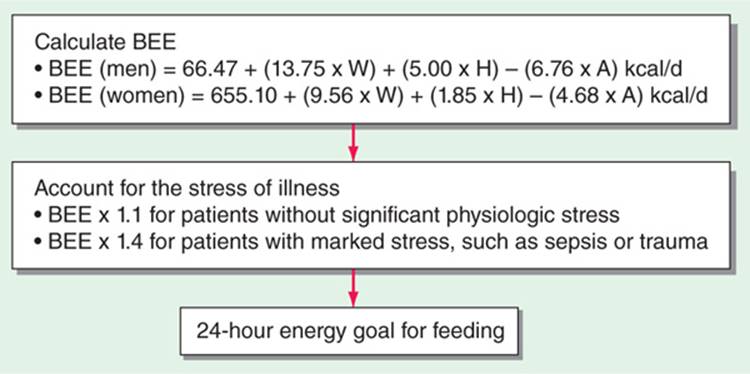
FIGURE 7-1 Basal energy expenditure (BEE) calculation in kcal/d, estimated by the Harris and Benedict formula. A, age in years; H, height in cm; W, Weight in kg.
Dietary reference intakes (DRI) and recommended dietary allowances (RDA) have been defined for many nutrients, including 9 essential amino acids, 4 fat-soluble and 10 water-soluble vitamins, several minerals, fatty acids, choline, and water (Tables 73-1 and 73-2, pp. 590 and 591, in HPIM-18). The usual water requirements are 1.0–1.5 mL/kcal energy expenditure in adults, with adjustments for excessive losses. The RDA for protein is 0.6 g/kg ideal body weight, representing 15% of total caloric intake. Fat should constitute ≤30% of calories, and saturated fat should be <10% of calories. At least 55% of calories should be derived from carbohydrates.
TABLE 7-1 IDEAL WEIGHT FOR HEIGHT


MALNUTRITION
Malnutrition results from inadequate intake or abnormal gastrointestinal assimilation of dietary calories, excessive energy expenditure, or altered metabolism of energy supplies by an intrinsic disease process.
Both outpatients and inpatients are at risk for malnutrition if they meet one or more of the following criteria:
• Unintentional loss of >10% of usual body weight in the preceding 3 months
• Body weight <90% of ideal for height (Table 7-1)
• Body mass index (BMI: weight/height2 in kg/m2) <18.5
Two forms of severe malnutrition can be seen: marasmus, which refers to generalized starvation that occurs in the setting of chronically decreased energy intake, and kwashiorkor, which refers to selective protein malnutrition due to decreased protein intake and catabolism in the setting of acute, life-threatening illnesses or chronic inflammatory disorders. Aggressive nutritional support is indicated in kwashiorkor to prevent infectious complications and poor wound healing.
Etiology
The major etiologies of malnutrition are starvation, stress from surgery or severe illness, and mixed mechanisms. Starvation results from decreased dietary intake (from poverty, chronic alcoholism, anorexia nervosa, fad diets, severe depression, neurodegenerative disorders, dementia, or strict vegetarianism; abdominal pain from intestinal ischemia or pancreatitis; or anorexia associated with AIDS, disseminated cancer, heart failure, or renal failure) or decreased assimilation of the diet (from pancreatic insufficiency; short bowel syndrome; celiac disease; or esophageal, gastric, or intestinal obstruction). Contributors to physical stress include fever, acute trauma, major surgery, burns, acute sepsis, hyperthyroidism, and inflammation as occurs in pancreatitis, collagen vascular diseases, and chronic infectious diseases such as tuberculosis or AIDS opportunistic infections. Mixed mechanisms occur in AIDS, disseminated cancer, chronic obstructive pulmonary disease, chronic liver disease, Crohn’s disease, ulcerative colitis, and renal failure.
Clinical Features
• General—weight loss, temporal and proximal muscle wasting, decreased skin-fold thickness
• Skin, hair, and nails—easily plucked hair (protein); sparse hair (protein, biotin, zinc); coiled hair, easy bruising, petechiae, and perifollicular hemorrhages (vit. C); “flaky paint” rash of lower extremities (zinc); hyper-pigmentation of skin in exposed areas (niacin, tryptophan); spooning of nails (iron)
• Eyes—conjunctival pallor (anemia); night blindness, dryness, and Bitot spots (vit. A); ophthalmoplegia (thiamine)
• Mouth and mucous membranes—glossitis and/or cheilosis (riboflavin, niacin, vit. B12, pyridoxine, folate), diminished taste (zinc), inflamed and bleeding gums (vit. C)
• Neurologic—disorientation (niacin, phosphorus); confabulation, cerebellar gait, or past pointing (thiamine); peripheral neuropathy (thiamine, pyridoxine, vit. E); lost vibratory and position sense (vit. B12)
• Other—edema (protein, thiamine), heart failure (thiamine, phosphorus), hepatomegaly (protein)
Laboratory findings in protein malnutrition include a low serum albumin, low total iron-binding capacity, and anergy to skin testing. Specific vitamin deficiencies also may be present.

For a more detailed discussion, see Dwyer J: Nutritional Requirements and Dietary Assessment, Chap. 73, p. 588; Russell RM and Suter PM: Vitamin and Trace Mineral Deficiency and Excess, Chap. 74, p. 594; and Heimberger DC: Malnutrition and Nutritional Assessment, Chap. 75, p. 605 in HPIM-18.