
MALIGNANT MELANOMA
Most dangerous cutaneous malignancy; high metastatic potential; poor prognosis with metastatic spread.
Incidence
Melanoma has been diagnosed in 76,250 people in the United States in 2011 and caused 9180 deaths.
Predisposing Factors (Table 74-1)
TABLE 74-1 FACTORS ASSOCIATED WITH INCREASED RISK OF MELANOMA
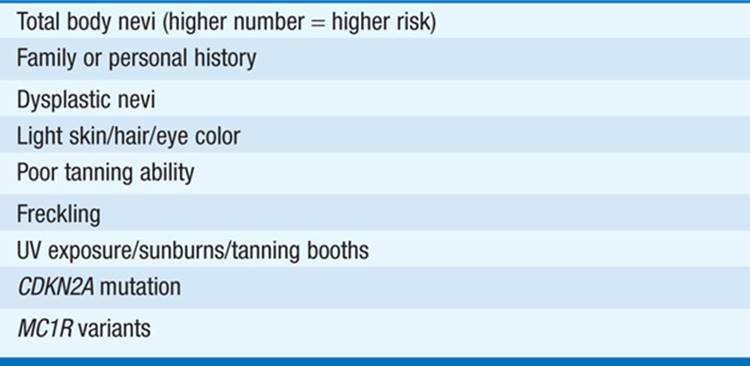
Fair complexion, sun exposure, family history of melanoma, dysplastic nevus syndrome (autosomal dominant disorder with multiple nevi of distinctive appearance and cutaneous melanoma, may be associated with 9p deletion), and presence of a giant congenital nevus. Blacks have a low incidence.
Prevention
Sun avoidance lowers risk. Sunscreens are not proven effective.
Types
1. Superficial spreading melanoma: Most common; begins with initial radial growth phase before invasion.
2. Lentigo maligna melanoma: Very long radial growth phase before invasion, lentigo maligna (Hutchinson’s melanotic freckle) is precursor lesion, most common in elderly and in sun-exposed areas (esp. face).
3. Acral lentiginous: Most common form in darkly pigmented pts; occurs on palms and soles, mucosal surfaces, in nail beds and mucocutaneous junctions; similar to lentigo maligna melanoma but with more aggressive biologic behavior.
4. Nodular: Generally poor prognosis because of invasive growth from onset.
Biology
About half of melanomas carry an activating somatic mutation in the BRAF gene, often a valine to glutamate substitution at amino acid 600 (V600E). N-ras is mutated in about 20% and rare pts have activating mutations in c-kit. These mutations have been targeted by therapeutic agents that appear to have antitumor activity.
Clinical Appearance
Generally pigmented (rarely amelanotic); color of lesions varies, but red, white, and/or blue are common, in addition to brown and/or black. Suspicion should be raised by a pigmented skin lesion that is >6 mm in diameter, asymmetric, has an irregular surface or border, or has variation in color.
Prognosis
Best with thin lesions without evidence of metastatic spread; with increasing thickness or evidence of spread, prognosis worsens. Stage I and II (primary tumor without spread) have 85% 5-year survival. Stage III (palpable regional nodes with tumor) has a 50% 5-year survival when only one node is involved and 15–20% when four or more are involved. Stage IV (disseminated disease) has <5% 5-year survival.
TREATMENT Malignant Melanoma
Early recognition and local excision for localized disease is best; 1- to 2-cm margins are as effective as 4- to 5-cm margins and do not usually require skin grafting. Elective lymph node dissection offers no advantage in overall survival compared with deferral of surgery until clinical recurrence. Pts with stage II disease may have improved disease-free survival with adjuvant interferon-α 3 million units three times weekly for 12–18 months. In one study, pts with stage III disease had improved survival with adjuvant IFN, 20 million units IV daily × 5 for 4 weeks, then 10 million units SC three times weekly for 11 months. This result was not confirmed in a second study. Metastatic disease may be treated with chemotherapy or immunotherapy. Vemurafenib 960 mg PO bid induces responses in about 50% of pts with BRAF mutations. Median survival is about 16 months. The anti-CTLA4 antibody ipilimumab prolongs survival by about 4 months. Dacarbazine (250 mg/m2 IV daily × 5 q3w) plus tamoxifen (20 mg/m2 PO daily) may induce partial responses in one-quarter of pts. IFN and inter-leukin 2 (IL-2) at maximum tolerated doses induce partial responses in 15% of pts. Rare long remissions occur with IL-2. Temozolomide is an oral agent related to dacarbazine that has some activity. It can enter the central nervous system (CNS) and is being evaluated with radiation therapy for CNS metastases. No therapy for metastatic disease is curative. Vaccines and adoptive cellular therapies are being tested.
BASAL CELL CARCINOMA (BCC)
Most common form of skin cancer; most frequently on sun-exposed skin, esp. face.
Predisposing Factors
Fair complexion, chronic UV exposure, exposure to inorganic arsenic (i.e., Fowler’s solution or insecticides such as Paris green), or exposure to ionizing radiation.
Prevention
Avoidance of sun exposure and use of sunscreens lower risk.
Types
Five general types: noduloulcerative (most common), superficial (mimics eczema), pigmented (may be mistaken for melanoma), morpheaform (plaquelike lesion with telangiectasia—with keratotic is most aggressive), keratotic (basosquamous carcinoma).
Clinical Appearance
Classically a pearly, translucent, smooth papule with rolled edges and surface telangiectasia.
TREATMENT Basal Cell Carcinoma
Local removal with electrodesiccation and curettage, excision, cryosurgery, or radiation therapy; metastases are rare but may spread locally. Exceedingly unusual for BCC to cause death. Locally advanced or meta-static disease may respond to vismodegib, an inhibitor of the hedgehog pathway often activated in this disease.
SQUAMOUS CELL CARCINOMA (SCC)
Less common than basal cell but more likely to metastasize.
Predisposing Factors
Fair complexion, chronic UV exposure, previous burn or other scar (i.e., scar carcinoma), exposure to inorganic arsenic or ionizing radiation. Actinic keratosis is a premalignant lesion.
Types
Most commonly occurs as an ulcerated nodule or a superficial erosion on the skin. Variants include:
1. Bowen’s disease: Erythematous patch or plaque, often with scale; noninvasive; involvement limited to epidermis and epidermal appendages (i.e., SCC in situ).
2. Scar carcinoma: Suggested by sudden change in previously stable scar, esp. if ulceration or nodules appear.
3. Verrucous carcinoma: Most commonly on plantar aspect of foot; low-grade malignancy but may be mistaken for a common wart.
Clinical Appearance
Hyperkeratotic papule or nodule or erosion; nodule may be ulcerated.
TREATMENT Squamous Cell Carcinoma
Local excision and Mohs micrographic surgery are most common; radiation therapy in selected cases. Metastatic disease may be treated with radiation therapy or with combination biologic therapy; 13-cis-retinoic acid 1 mg/d PO plus IFN 3 million units/d SC.
Prognosis
Favorable if secondary to UV exposure; less favorable if in sun-protected areas or associated with ionizing radiation.
SKIN CANCER PREVENTION
Most skin cancer is related to sun exposure. Encourage pts to avoid the sun and use sunscreen.

For a more detailed discussion, see Urba WJ et al: Cancer of the Skin, Chap. 87, p. 723, in HPIM-18.