
Graham Hughes1 and Shirish Sangle2
(1)
The London Lupus Centre, London Bridge Hospital, London, UK
(2)
Louise Coote Lupus Unit, St Thomas’ Hospital, London, UK
Abstract
Recurrent pregnancy loss is one of the main complications of the Antiphospholipid Syndrome, with the losses ranging from early miscarriage to late fetal death.
Recurrent pregnancy loss is one of the main complications of the Antiphospholipid Syndrome, with the losses ranging from early miscarriage to late fetal death.
Although there is some debate about the pathological process of the pregnancy loss, the predominant picture is one of extensive placental thrombosis and infarction (Fig. 3.1). Aside from placental ischaemia, other pathological mechanisms include aPL-mediated inhibition of trophoblast invasion, and placental inflammation.
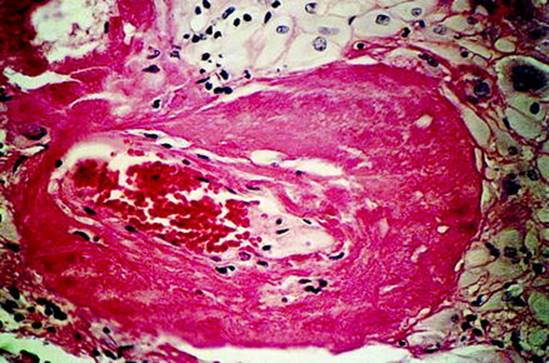
Figure 3.1
A Histopathology image showing placental infarction seen in Hughes Syndrome
3.1 Early Pregnancy Loss
Hughes Syndrome is now recognised as the commonest, treatable cause of recurrent miscarriage. Positive aPL tests are found in no less than 1 in 5 of women with recurrent pregnancy loss. Most of these losses occur before 3 months (at the present time, recurrent fetal loss is defined as three or more consecutive spontaneous abortions).
3.2 Late Pregnancy Loss
Tragically, later pregnancy loss can also occur in Hughes Syndrome. Other causes of pregnancy loss, such as chromosomal abnormalities, are much less common at this stage and, therefore, any woman with late pregnancy loss should be tested for aPL.
In the management of pregnancy in APS, Doppler measurement of fetal blood flow is a vital tool in assessing risk of ischaemia in the pregnancy, caesarean section usually being carried out when the Doppler starts deteriorating (Fig. 3.2a, b).

Figure 3.2
(a) Normal placental Doppler ultrasound. (b) A notched appearance seen (arrow) in placental Doppler ultrasound indicates placental ischaemia in Hughes Syndrome
3.3 Other Pregnancy Complications
These include pre-eclampsia and placental insufficiency. For the mother, the risks of both venous and arterial thrombosis and intra-uterine growth retardation (and of thrombocytopenia) apply, as they also apply in the non-pregnant state.
3.4 Infertility
Some women suffering recurrent very early pregnancy loss have been diagnosed as infertile. This and other evidence, including unexplained implantation failure following IVF, has led to numerous studies of a possible role for aPL in the diagnosis and management of infertility.
The definition of infertility envisions a couple having frequent, unprotected intercourse, failing to conceive a child within a year.
The problem is common, affecting up to 20% of couples. Causes include hormonal, anatomic and possible immunologic factors.
Amongst the antibodies variously reported in infertility studies, aPL has been seen in 15–20%.
Whatever the mechanisms, these observations have led to studies of possible benefits of anticoagulation as a part of the IVF treatment regime. Early reports have been encouraging with those aPL-positive patients receiving aspirin or heparin having more than double the successful pregnancy rates – though other studies have failed to show this.
3.5 Treatment of the aPL-Positive Pregnancy
Anti-thrombosis treatment in aPL-positive pregnancy has proved to be one of the success stories of modern medicine, with pregnancy success rates improving from a previous under 20% to over 90% in most specialist centres.
Warfarin is contraindicated in the first trimester because of the risk of fetal malformation. The choice therefore is between low-dose aspirin and low-molecular-weight heparin.
Although physicians and obstetricians vary in their clinical practice, a general guide is taken from my colleague, Dr. Munther Khamashta, who has extensive experience in the management of pregnancy in lupus and APS.
Aspirin alone for an aPL-positive woman with no previous miscarriages, low-molecular-weight heparin plus or minus aspirin for those with previous thrombosis and one or more previous miscarriages (a disputed area – some would wait for two or more miscarriages before resorting to heparin).