
Evaluation and Diagnosis
When you go to see a Chinese medicine practitioner—whether it’s to treat an illness, resolve acute pain, or begin a program of preventive care—your doctor will follow a system of evaluation and diagnosis that depends on observation and questioning.
In accordance with the philosophy of the Tao, diagnosis is a process of perceiving signs and symptoms and relating them to one another to reveal how they form patterns of harmony or disharmony. Each symptom or sign has meaning only in relationship to other symptoms and signs and to the whole of your mind/body/spirit.
THE FOUR EXAMINATIONS
To begin to develop an accurate picture of your whole being, the Chinese medicine practitioner will examine you. She or he will use traditional Chinese methods called the Four Examinations: Inquiring, Looking, Listening/Smelling, and Touching. (Listening and Smelling are two seemingly different acts that are grouped together. In Chinese, they are the same character.)
This process of examination reveals which of the Eight Fundamental Patterns of disharmony are at work and what type of disharmony of the Essential Substances, Organ Systems, and Channels you may have.
The Four Examinations are often done formally. However, often the practitioner also uses intuition and casual observation to create a vivid profile of a patient. Every gesture, word, and attribute provides clues to your health and well-being.
Let’s look at each step in the diagnostic process in more detail, breaking down the Four Examinations into their components, so you’ll know what to expect for your visit.
Examination One: Inquiring
Although the Four Examinations can be done in any order, and in fact some things are done simultaneously, often the practitioner begins with inquiring. There’s one step within the Inquiring Examination.
STEP ONE: ASKING QUESTIONS
The Chinese medicine doctor will take a great deal of time to ask you about yourself. Your answers allow the practitioner to benefit from the knowledge that you have, because no one can know your body as well as you do. Questioning also allows the practitioner to observe your emotions, voice, and self-presentation.
His or her basic questions will likely focus on the following:
• Your reaction to heat and cold
• Your patterns of perspiration
• If and when you experience headaches or dizziness
• What type of pain you have, if any
• Your bowel and bladder function
• Your thirst, appetite, and tastes
• Your sleep patterns
• Your sexual functioning, sexual activity, and reproductive history
• Your general medical history
• Your general physical activity
• Your emotions
Examination Two: Looking
Generally, the practitioner will focus on the Looking Examination next. There are three steps in this examination: evaluation of the tongue, body language, and facial color.
STEP TWO: EVALUATION OF THE TONGUE
The tongue is the mirror of the body. Harmony and disharmony are reflected in your tongue’s color, moisture, size, coating, and the location of abnormalities.
Healthy Organ Systems and a lack of External Pernicious Influences produce a healthy tongue, which is pinkish red, neither too dry nor too wet, fits perfectly within your mouth, moves freely, and has a thin white coating.
Imbalances in the Organ Systems and/or invasion by External Pernicious Influences produce an unhealthy tongue. External Pernicious Influences primarily produce changes in the tongue coating. Interior problems, such as Organ System or Essential Substance disharmonies, produce changes in the tongue body.
When examining your tongue, the Chinese medicine doctor looks at the color of the tongue body, its size and shape, locations of abnormalities, moistness or dryness, presence or absence of tongue fur, and the color and thickness of the coating or fur. These signs reveal overall state of health, and they also correlate to specific Organ System functions and disharmonies, especially in the digestive system. To evaluate the tongue accurately, we do the examination in natural light whenever possible.
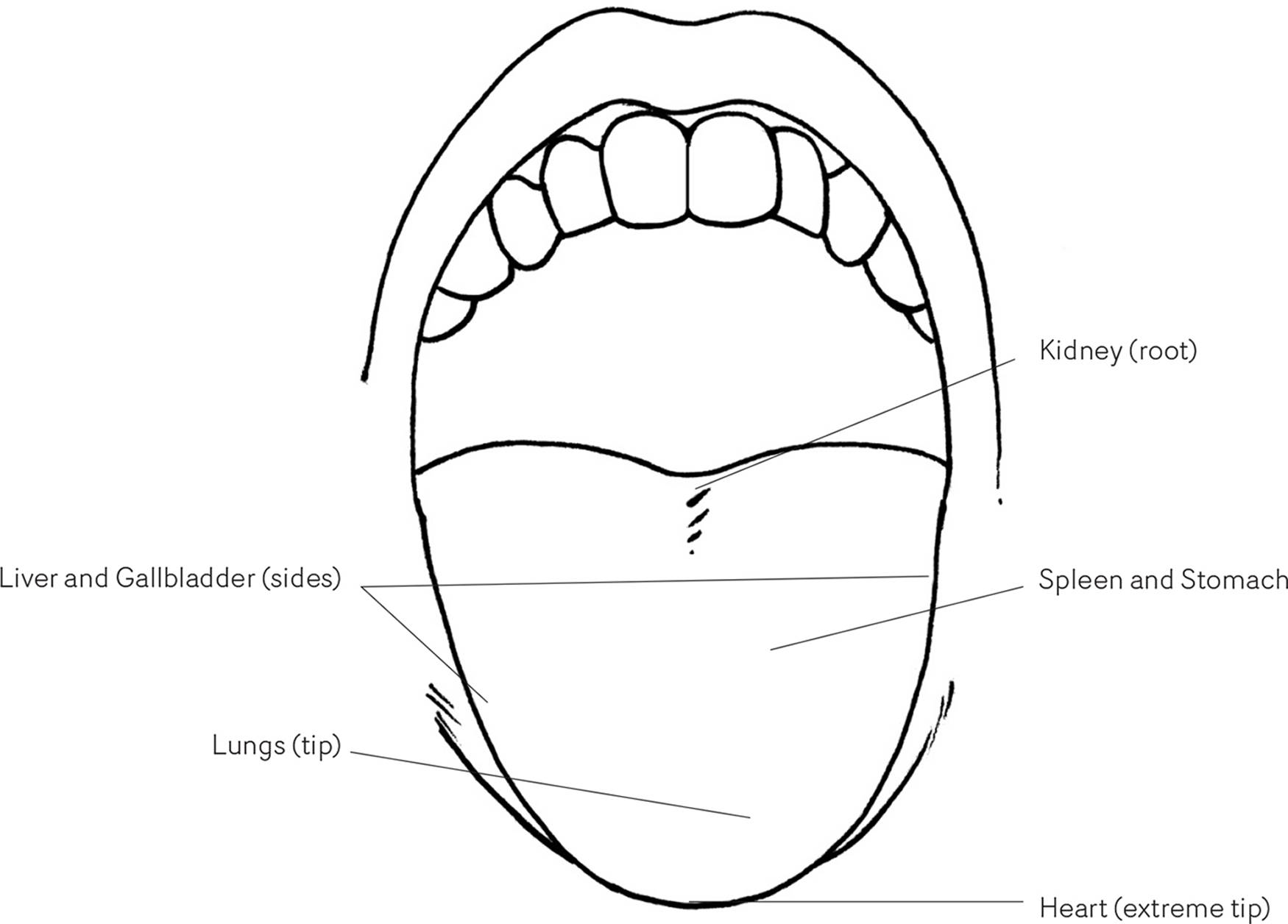
Tongue body: The tongue body is a fleshy mass, and it has color, texture, and shape independent from the apparent qualities of the tongue coating.
• A pale tongue body indicates Deficient Xue, Qi, Yang, or Excess Cold.
• An overly red tongue body indicates Excess Heat.
• A purple tongue indicates that Qi and/or Xue are not moving harmoniously, and they are stagnant.
• A pale purple tongue means the stagnation is related to Cold.
• A reddish purple tongue color is related to stagnation of Heat.
• When the tongue is black or gray, it indicates extreme stagnation.
• If the tongue is black and dry, it indicates extreme Heat Stagnation; if black and wet, it indicates extreme Cold Stagnation.
• A bright red tongue indicates Deficient Yin or Excess Heat.
• Dark red indicates Excess Heat.
• Cracks in a red tongue indicate Deficient Yin or Heat Injuring the Jin-Ye.
• If the tongue is pale and cracked, Deficient Qi or Xue is present.
• Thorny eruptions of the “buds” on the tongue alert the doctor to Heat or Stagnant Xue.
Tongue fur: The tongue’s coating is best described as moss or fur. It arises when the Spleen causes tiny amounts of impure substances to drift upward to the tongue. When the Spleen and Stomach are in balance, there is a uniform density of fur, with a slightly thicker area in the center of the tongue.
• Thick fur indicates Excess.
• Thin fur is related to Deficiency during illness, but it is normal if you are well.
• Fur that is wet indicates Excess Jin-Ye and/or a Deficient Yang.
• Dry fur is a sign of Excess Yang or Deficient Jin-Ye.
• A greasy fur is a sign of Phlegm or Dampness in the body.
• If the fur looks peeled off or missing, it reveals Deficient Spleen, Deficient Yin, or Deficient Jin-Ye.
• White, moist fur indicates Cold.
• Yellow fur means Heat. However, white fur resembling cottage cheese points to Stomach Heat.
• Gray/black fur with a red tongue body is associated with extreme Heat. Gray/black fur with a pale tongue body is a sign of extreme Cold.
Tongue size and shape: A healthy tongue rests comfortably in the mouth, and it is neither too small nor too large.
• If a tongue is enlarged and flabby, it indicates Deficient Qi.
• If in addition to being enlarged and flabby, the tongue has scalloped (or tooth marked) edges, it indicates Dampness due to Deficient Qi or Stagnant Jin-Ye.
• If the tongue is enlarged and hard, it is a sign of Excess.
• If it swells so that it fills the mouth and is deep red, that means Excess Heat in Heart and Spleen.
• A small, thin tongue can indicate Deficient Yin or Xue.
Tongue movement: A healthy tongue sits in the center of the mouth, and is neither too hard nor too soft.
• A trembling, pale tongue indicates Deficient Qi.
• A flaccid tongue that is pale often reveals extreme Deficient Qi or Xue.
• A flaccid tongue that is deep red reveals severe Deficient Yin.
• A trembling, red tongue indicates Interior Wind.
• If the tongue sits off center in the mouth, early or full-blown Wind stroke may be present.
• A rigid tongue accompanies an External Pernicious Influence and fever, and it may indicate the invasion of the Pericardium by Heat and Phlegm Obstructing the Heart Qi.
Location of tongue abnormalities: The location of disturbances on the tongue is a vivid indication of where disharmonies in the mind/body/spirit are located. Certain Organ Systems are associated with the Upper, the Middle, and the Lower Burner, which are in turn associated with the front, middle, and back sections of the tongue.
For example, if there are red spots on the front third of the tongue, which is associated with the Upper Burner, this indicates that there is Heat in the Lung. If the tip of the tongue is red, that indicates Heart Fire. Menstrual cramps, associated with Stagnant Xue, are often accompanied by purple spots on the edges of the tongue in the Liver/Gallbladder area.
Not all tongue irregularities are indications of disharmony, however. Food and drugs may change the coating or color of the body of the tongue. For example, coffee yellows the coating, and Pepto-Bismol turns the tongue black.
Furthermore, some people have minor, unchanging cracks on their tongue, which are considered normal. Other people are born with what is called a geographic tongue, which is covered with severe cracks and covered with hills and valleys. Some practitioners consider this to be normal, while others see it as a sign of congenital disharmony.
The way a tongue appears is not an absolute indicator of the location of the disharmony. But when features of the tongue are taken as part of an overall pattern that includes a complete evaluation, it offers strong clues to the location of disharmony.
STEP THREE: EVALUATION OF BODY LANGUAGE—STYLES OF MOVEMENT, POSTURE, AND SELF-PRESENTATION
Seeking clues to possible External Pernicious Influences, the practitioner looks for signs of Heat or Cold Influences, Excess or Deficiency, and Yin or Yang disharmonies. If a person has a heavy-footed walk and a loud voice and sits in a sloppy, spread-out posture, it may indicate Excess. If a person acts frail and weak, sits with shoulders slumped, and is shy and receding, it may indicate a Deficiency. On the other hand, fast, jerky, impulsive movement and an outgoing personality indicate Heat. If combined with a full red face, high energy, and a loud voice, then both Heat and Excess may be at work. Cold, as you might suspect, is associated with slow but not sloppy movements and a pale face. When coupled with a low voice, shortness of breath, and passivity, Cold and Deficiency may be at work.
STEP NUMBER FOUR: EVALUATION OF FACIAL COLOR
When you are feeling off balance or have a specific disharmony, facial colors offer clues to the nature and the severity of your imbalance.
There are several different methods of facial diagnosis, including Korean, Japanese, Worsley school, and macrobiotic. The following evaluation of facial colors is derived from a combination of Traditional Chinese Medicine (TCM) and the Five Phases1 principles. I have found this system provides accurate analysis.
TIP
To obtain a clear idea of what the various facial colors look like, always use natural light when you examine your face in a mirror.
Understanding the significance of facial colors: When examining facial color, keep the following principles in mind:
• If the facial color is bright and fresh, the disease is called “floating,” and it is on a superficial level.
• If the color is moist, neither wet nor dry, the disease is not severe, and it will be easy to treat.
• If the color is shallow and scattered over a large area, the number of days of the disease will be short.
• If the color is dark and cloudy, the disease is sinking into the inner organs.
• If the color is dark, cloudy, and dry, the disease is severe, and it will be difficult to cure.
• If the color is deep and accumulated in one spot, the disease is a long-term one.
Reading between the lines: Five colors appear on the face: red, green, yellow, white, and black. Depending on a person’s constitution, a healthy face may have one color that is more predominant than others, but several may be visible. To determine which colors are present in your face, always examine it in natural light. Look for the overall color tone, study your skin to see which tones appear from under the surface, and look at any visible veins. For contrast, hold the back of your hand up alongside your face.
• Red is the color associated with the Heart Organ System and Xue. If the face is a fresh red, the Xue is Hot. If the face is dark red, the Xue is Stagnant. If it is light red, the Xue is Deficient.
• Green is the color associated with the Liver System and circulation of the Xue. If veins on the face appear greenish purple, the Xue is Hot. If the veins appear greenish black, the Xue is Stagnant. If the condition is severe, the veins on the face appear black.
• Yellow is the color associated with the Spleen System. If the face appears light yellow, the Spleen system is Damp and Cold. If the face appears deep yellow, Heat has accumulated. If it is dark yellow, Heat is the result of Stagnant Xue. Withered yellow indicates Deficient Heat.
• White is the color associated with the Lung System, which regulates Qi, the breathing in of oxygen, and the exhalation of carbon dioxide. If a person is not able to exhale completely—as in emphysema—her or his face will take on a grayish white color. If the person inhales inadequately, the face will appear pale and lusterless.
• Black is the color associated with the Kidney System. If the face is cold and black, the Kidney System is not properly filtering Xue. If the face color is black but bright and moist, the condition can be treated. If the face is not shining, the condition is not good. If the black is withered, the Kidney System Yin is dry. If the face is cloudy and dark, the Kidney System Yang is dying.
When there are combinations of colors, this further refines the evaluation of your diagnosis. For example, if the color of your face is red and white, both the Heart and the Lung Channels are involved.
BODY SIGNS
Take a couple of minutes to evaluate your facial color and tongue body and fur. For both facial colors and tongue, it helps to do an evaluation with a friend so you can compare the differences in your skin tone and tongue qualities.
On your face, do you see black, white, green, yellow, and/or red? Is the color bright, moist, floating, shallow, cloudy, dark, or dry?
Is your tongue trembling and pale, flaccid or red? Is it enlarged and flabby or scalloped? Or is it enlarged and hard or thin and small?
Examination Three: Listening/Smelling
The third examination, the pair of listening and smelling, is composed of two steps: evaluation of voice and smell.
STEP FIVE: EVALUATION OF VOICE
Listening to the sound of your speech, breathing, and cough can help us identify a disharmony that results from one or more External Pernicious Influences and patterns of disharmony. For example, if your voice is too loud and strident, it indicates Excess, as does the sudden onset of a violent cough. A weak, low voice that doesn’t project and a weak cough indicate Deficiency. Losing your voice or hoarseness can indicate either Deficiency or Excess. Wheezing arises from Dampness.
STEP SIX: EVALUATION OF SMELL
According to Chinese medicine theory, two main odors clue a doctor to the origin of disharmony: A strong stench from secretions or excretions indicates Excess and Heat. A weaker odor indicates Deficiency and Cold.
Five Phases practitioners (see page 42) generally rely on smell more than TCM practitioners do. Each smell is associated with a Phase, and it can indicate disharmony with the associated Organ or among Organs that are related through the Five Phases cycle. The following smells are used in Five Phases diagnosis:
• Goatish, which smells like goat milk, associated with Wood
• Burning or scorched, associated with Fire
• Fragrant or sweet, associated with Earth
• Rank or rotten, associated with Metal
• Putrid, associated with Water
Examination Four: Touching
This last step of the examination is usually made up of two steps: evaluation of pulses and evaluation of sensitivity to touch.
STEP SEVEN: EVALUATION OF PULSES
Twenty-eight pulse qualities are essential to Chinese medicine’s process of evaluation and diagnosis. Learning to read pulses requires years of study and practice and is not something that can be done at home on yourself. However, your Chinese medicine practitioner will talk to you about your pulse diagnosis, and you will want to have a passing familiarity with the terminology that’s used.
The most common pulse descriptions are floating, slippery, choppy, wiry, tight, slow, rapid, thin, big, empty, and full. (For a more detailed explanation of pulse diagnosis, see The Web that Has No Weaver, by Ted Kaptchuk or Chinese texts listed in the appendix on page 332.)
Most of the time, pulses are evaluated at the radial artery on your wrist, although some systems of pulse diagnosis use other locations, such as the carotid pulse on the neck and the tibial pulse on the ankle.
Disharmonies of the pulses indicate the condition of Qi, Xue, and Jin-Ye; Organ System imbalance(s); the location of the imbalance(s); the nature (Hot or Cold) of the disease; and many other qualities.
For example, a wiry pulse may indicate that the Liver System has Stagnant Qi. However, pulses do not have absolute meanings. They contribute to diagnosis only when they are viewed in context with other diagnostic techniques.
STEP EIGHT: EVALUATION OF SENSITIVITY TO TOUCH
When we palpate acupuncture points and Channels, we can trigger, increase, or reduce pain as well as indicate disharmony in the associated Channels and Organ Systems.
• If you have a pain you can’t pinpoint, it indicates Stagnant Qi. Pain that moves around also indicates stagnant Qi.
• If the pain is fixed, it may indicate Stagnant Xue.
• Pain that feels better with pressure is due to Deficiency.
• Pain the feel worse with pressure is due to Excess.
• Pain that feels better with warmth is associated with Cold.
Palpation on the body does not have to be confined to the Twelve Channels, Fifteen Collaterals, or Eight Extraordinary Channels and their associated acupuncture points. Ear acupuncture points are also powerful tools for diagnosis, and they provide refined clues to the sources of disharmony. They are also useful for self-massage (see page 202). Reflexology, while not a traditional Chinese method of diagnosis and treatment, is also a useful tool at this stage of diagnosis (see page 210).
SELECTING A PRACTITIONER
Now that you have an understanding of the basics of Chinese medicine and what to expect at a visit with a practitioner, you may be ready to make an appointment to see a Chinese medicine practitioner. The following guidelines may help you find a qualified practitioner.
When you are selecting an acupuncturist, an herbalist, or a Chinese medicine doctor, the two most important factors to consider are the training of the practitioner and your goals.
Practitioner Training
To gain the full benefit of Chinese medicine therapy, the practitioner who administers the treatment(s) should have reputable training and a keen sense of the philosophical underpinning of Chinese medicine.
The best way to determine if a practitioner meets those standards is to ask questions about her or his training, length of practice, scope of practice, specializations, attitudes about wellness and disharmony, and understanding of Chinese medicine philosophy.
Meeting basic standards: The Taoist belief system is not some fancy window dressing that can be cast aside. Traditionally, it is part and parcel of Chinese medicine. Some practitioners are trained outside this context. However, it is my opinion that no particular Chinese medicine therapy, such as acupuncture or herbal remedies, can deliver its full healing potential if it is separated from the philosophical context of the Tao.
In addition, you want to find a practitioner who is schooled in the Chinese medicine therapies that you want to use. Some practitioners are licensed or certified acupuncturists but do not offer herbal therapy. Other practitioners are Chinese herbalists but provide no acupuncture. Still others are licensed acupuncturists also have training as herbalists. And still other practitioners have attained advanced degrees, such as a Doctor of Acupuncture and Oriental Medicine (D.A.O.M.), Oriental Medicine Doctor (O.M.D.), Doctor of Acupuncture and Chinese Medicine (D.A.C.M.), and Doctor of Oriental Medicine (D.O.M.), who provide advanced evaluations, integrative medicine as well as acupuncture and herbal therapy, and access to the whole breadth of Chinese medicine.
In 2013, the national Accreditation Commission for Acupuncture and Oriental Medicine (ACAOM) approved the first professional doctorate degree as the entry level for becoming a Chinese medicine practitioner. Before then, a master’s degree was the only entry-level degree for becoming a licensed practitioner. Now schools will be able to apply for the doctorate degree as entry-level. Therefore, new doctoral degrees offered by nationally accredited Chinese medicine colleges will meet the new ACAOM criteria for a first professional doctorate and offer new doctorate degrees.2
Choose a practitioner who holds the required licenses, registrations, or certifications. According to the National Certification Commission for Acupuncture and Oriental Medicine (NCCAOM), as of October 2014, forty-four states plus the District of Columbia have acupuncture practice acts. These are laws that govern how people are allowed to practice acupuncture in those states. For example, the act might require licensure, registration, or certification before a person can perform acupuncture. Currently, forty-three states require passage of NCCAOM national examinations or NCCAOM certification for initial licensure. NCCAOM offers acupuncture, herbal, and Oriental medicine certifications on a national level. Currently, California requires passage of its own state examinations for licensure, and it does not accept the NCCAOM. You may contact the NCCAOM for a listing of certified practitioners in your area.3 (See “NCCAOM” in the appendix on page 332.)
If you live in a state without a practice act, and it is legal for an acupuncturist to practice without a license, it is particularly important that your practitioner(s) have NCCAOM certification.
In most states, herbal medicine is not part of acupuncture licensure. Your Chinese herbalist (who may also be your acupuncturist) should have either a certificate of training or a long-standing reputation and years of documented experience. Many professional Chinese medicine schools train people in herbal medicine, but there is generally no independent licensing for Chinese herbalists. Only a few states require acupuncturists to pass an herbal exam to practice Chinese medicine or acupuncture.
Your Goals
When choosing a practitioner, take some time to consider your goals. You want to decide if you are looking for a primary care practitioner, someone to work with your Western or other primary care doctor, or simply someone who can provide short-term treatment for a specific complaint.
If you are looking for a primary care doctor, I recommend you find someone who is knowledgeable about all aspects of Chinese medicine and Western medical procedures. Look for someone who will know when to refer you for Western evaluations and testing and who is willing to work with a Western doctor, if doing so provides you with the best therapy.
To sum up what to look for in a primary care Chinese medicine practitioner, consider the following:
• Someone who does not make promises to cure disorders and diseases for which there is no cure. (This applies to all practitioners, Eastern or Western, no matter what you use them for.)
• A practitioner who understands that there may be many different modalities that work for an individual and does not insist that his or her way is the only right or good way to go.
• Someone who has a bedside manner that pleases you. (What pleases some people most is ability, and they don’t care about personality at all. That’s fine. For others, a more personal relationship is important. You should make that individual decision.)
• Someone who is able to explain what she or he is doing from both a Chinese and a Western viewpoint—or is at least willing to find out about the alternative perspective when necessary.
• A practitioner who is not unconditionally opposed to any drug therapy in conjunction with acupuncture or herbal treatment, and who understands the interactions of drugs and herbs.
• Someone who will work with your medical doctors and other practitioners.
In cases of serious illnesses, you want to select a practitioner who understands Western medical terminology and concepts of the immune system, gynecology, viruses, and cancer, as well as Chinese concepts—if you are going for treatment of these problems.
If you have HIV, hepatitis B, or other chronic viral infections, be sure that the practitioner’s attitude is that you can live with this chronic, manageable viral infection and that acupuncture and herbs may help you, along with Western medicine, to be more successful in that process.
RECEIVING TREATMENT
When you select a practitioner and go for treatment, you shouldn’t surrender control over your health. In the best practice of Chinese medicine, there is recognition that each individual possesses the tools he or she needs to preserve or reclaim good health. The good (or excellent) practitioner simply acts as the guide or catalyst—helping you to coax your body’s own defenses to prevent or mend disharmony.
The practitioner may suggest one or more of the following five basic healing techniques: dietary therapy; acupuncture and moxibustion; acupressure, massage, and body therapy; Chinese herbal medicine; or Qi Gong exercise/meditation. A brief description of each follows here, and each therapy is discussed in detail in the following chapters.
Dietary Therapy
Chinese dietary therapy uses foods to strengthen digestion, increase energy, and balance the body’s Qi. Dietary therapy is often used prior to or in conjunction with other therapies to increase the effectiveness of these treatments.
Acupuncture and Moxibustion
Classic acupuncture is the art of inserting fine, sterile, metal filiform needles into certain points along the Twelve Channels and Fifteen Collaterals (tributaries of the Channels) to control the flow of the Qi. These days, practitioners also use electrostimulation of the needles, lasers, and even ultrasound to stimulate the points.
Acupuncture is well known for its effectiveness for pain relief. But even more powerful is its ability to alter the flow of the Qi so that the body can heal itself when attacked by pathogens that trigger disharmony.
Moxibustion, the burning of the herb moxa (Chinese mugwort) over Twelve Channel points and certain areas of the body, is used to warm, tonify, and stimulate. It also induces the smooth flow of the Essential Substances, prevents diseases, and preserves health. Doing moxa regularly on specific acupuncture points is said to promote strength and longevity. In fact, an old Chinese saying is, “Never take a long journey with a person who does not have a moxa scar on [the acupuncture point called] Stomach 36.” (It’s important to note that moxibustion as it is generally used today does not cause scars. A particular type of moxa, called scarring moxa, was used by the ancient Chinese for longevity and stamina. Scarring moxa is not covered by our malpractice insurance today, but it is still used by some practitioners.)
Acupressure, Massage, and Body Therapy
Acupressure and massage are often used in conjunction with acupuncture. Also, acupressure, massage, and other body therapies are an important part of daily self-care routines, whether self-administered or professionally provided.
Another related body therapy is Gua Sha, is a traditional Chinese medical treatment in which the skin is scraped to produce light bruising.
Chinese Herbal Medicine
Chinese herbal medicine includes more than herbs. Although the overwhelming majority of medicinal substances come from plants, some are derived from minerals (such as oyster shell), and others come from animals (such as snake and deer antler). Whatever their origin, they are used to balance the mind/body/spirit as well as to reverse disease processes. Most Chinese herbs should only be taken under the supervision of a trained herbalist.
Qi Gong Exercise/Meditation
Qi Gong, the Chinese art of exercise/meditation, uses dynamic movements and still postures in combination with mental and spiritual concentration to influence the flow of Qi. It is a powerful preventive therapy, and it can help remedy disharmony in the Organ Systems and the Twelve Channels.