
Joseph LaDou, MS, MD
GLOBAL WORKING CONDITIONS
The world’s workforce sustains more than 250 million injuries every year. Included in this number are 2 million people killed by their work each year. Occupational illnesses attributed to hazardous exposures or workloads may be as numerous as occupational injuries. The lack of adequate surveillance of occupational disease prevents accurate assessment of the problem. The global epidemic of occupational injury and disease is not new. It is inherent in the nature of industrial development that poorer countries adopt hazardous production. The resultant epidemic of injuries and illnesses is compounded by the rapid transfer by developed countries of hazardous industries no longer compatible with host country government regulation. While international standards attempt to obligate employers to pay for occupational injury and disease, inadequate prevention, detection, and compensation make a mockery of these standards.
Occupational injuries and diseases have a profound effect on the health of the world’s population. Occupational injuries and diseases play an even more important role in developing countries where 70% of the working population of the world lives. Occupational injuries and diseases have a serious impact on the economy of all countries. Occupational accidents cause permanent disabilities and economic losses amounting to 4–6% of national incomes. These preventable injuries and diseases also have profound impacts on the work productivity, income, and social well-being of workers and their families. Often ignored is the reality that a single occupational injury or illness can tip an entire family into poverty.
Developing countries seldom have enforceable occupational and environmental regulations. Occupational health should have high priority on the international agenda, but occupational safety and health (OSH) laws cover only about 10% of workers in developing countries. These laws omit many major hazardous industries and occupations. Progress in bringing occupational health to the industrializing countries is painfully slow. In the poorest countries, there has been no progress at all.
Many other health issues compete with occupational and environmental health for scarce funding. Developing countries are concerned with overwhelming problems of unemployment, malnutrition, and infectious diseases. About 450 million people live in extreme poverty and malnutrition, while another 880 million live in what can only be described as absolute poverty. Nearly every fifth worker in the world has to survive on less than $1 a day for each family member. Sixteen million people die each year from easily preventable diseases, and occupational diseases are not included in that definition.
Working conditions in much of Latin America, Africa, Central and Eastern Europe, China, India, and Southeast Asia are unacceptable. The labor force in developing countries totals around 1.8 billion, but it will rise to more than 3.1 billion in 2025—implying a need for 38–40 million new jobs every year. This being the case, demands by workers and governments for improved occupational safety and health are not likely to be heeded.
Developing countries are far behind industrialized countries in the development of workers’ compensation programs. In many countries of Asia, Latin America, and Africa, only a small fraction of the workforce is covered by workers’ compensation programs. In countries as large as Egypt, India, Pakistan, and Bangladesh, fewer than 10% of workers are covered by workers’ compensation. In China, fewer than 15% of workers are covered, and in Venezuela and Colombia, fewer than 20%. In many developing countries, workers’ compensation is little more than a paper program where the government works in concert with industry to minimize the provision and the costs of benefits.
GLOBALIZATION
Globalization, the fast-paced growth of trade and cross-border investment, is a selective phenomenon. Many countries benefit from globalization, and many do not. Indeed, the decline of some economies is linked to the advantages gained by others. In addition to inequities between countries, the benefits of trade are not fairly spread within countries. Globalization benefits countries that are competitive in the knowledge economy, which rewards skills and institutions that promote cutting-edge technological innovation, or the low-wage economy, which uses widely available technology to do routine tasks at the lowest possible cost.
Newly industrialized countries are eager for the financial benefits that foreign companies and foreign investors bring them. However, these benefits bring profound social and ecological problems. In the developed countries, industry provides jobs, pays taxes that support community services, and is subject to environmental and occupational health laws. As industrialized nations enact laws to limit the environmental hazards associated with many industrial operations, production costs rise and undermine competitive advantages. Thus, there is an incentive to avoid or subvert legislative controls.
Middle-income countries have not done nearly as well under globalized markets as either richer or poorer countries. These countries, notably countries in Latin America and Eastern and Central Europe, have been unable to compete in high-value-added markets dominated by wealthy economies because their workforces are not sufficiently skilled and their legal and banking systems are not adequately developed. As a result, they have had little choice but to try to compete with China and other low-income economies in markets for standard products made with widely available and relatively old technologies. But because of their higher wages, the middle-income nations are not able to compete effectively.
 Multinational Corporations
The major multinational corporations account for one-third of all manufacturing exports, three-fourths of commodity trade, and four-fifths of the trade in technology and management services. Yet the human labor required for each unit of their output is diminished dramatically. During the last generation, the world’s 500 largest multinational corporations grew sevenfold in sales. Yet the worldwide employment by these global firms remained virtually unchanged. Global foreign direct investment (FDI) is well in excess of $1 trillion per year. Developing and transition economies together attract more than half of global FDI flows.
All too many multinational corporations accept the reality of developing countries, including internal corruption, poor work practices, lack of regulation and enforcement of labor standards, and the local workers’ inability to claim compensation for injuries and illnesses. Manufacturers may take advantage of the opportunity to move many of their hazardous operations to newly industrialized countries. They are welcomed because the creation of an infrastructure in many developing nations relies on industrial expansion by foreigners. When industry migrates to developing nations, companies not only take advantage of lower wages, but also benefit from the low tax rates in communities that are not spending much on such things as sewage systems, water treatment plants, schools, and public transportation. Developing countries may have a weak capacity to collect taxes, or to control tax avoidance. When companies establish plants in developing countries, their tax burden is a small fraction of what it would be in most developed countries.
Some migrating companies try to introduce their own corporate or home country’s environmental and occupational health and safety standards in the host country. Unfortunately, less conscientious companies simply conform to the standards of the host country. Many companies often state that it is corporate policy not to have international “double standards” in health, safety, and environmental protection in their worldwide operations. In this age of multinational investment and global supply chains, corporate social responsibility for health and safety has to be looked at on a global scale. Workers in all countries are entitled to the basic benefits of federal labor and health and safety laws, including workers’ compensation. At present, only a small minority of workers in Africa, Latin America, and Asia receive protection from such social security schemes.
There have been many efforts to control the behavior of industry. The Organization for Economic Cooperation and Development (OECD) Guidelines for Multinational Enterprises, the UN Code of Conduct on Transnational Corporations, and the ILO (International Labor Organization) Tripartite Declaration of Principles Concerning Multinational Enterprises and Social Policy attempt to provide a framework of ethical behavior. Multinational corporations that sign on to the Ceres Principles agree to operate plants according to more strict home-based regulatory standards and thereby set the best example possible in the developing countries. When these corporations bring their home health and safety practices to the developing world, they are a powerful force for improvement in working conditions in newly industrialized countries. They are also a force for raising the living standards and working conditions of women and child workers. Critics contend that these efforts are watered-down substitutes for a more aggressive regimen that would actually impose human rights obligations on corporations.
Influenced by public policy makers in the United States, such organizations as the World Bank, International Monetary Fund, and World Trade Organization have advocated policies that encourage reduction and privatization of health care and public health services previously provided in the public sector. Corporate strategies have culminated in a marked expansion of corporations’ access to social security and related public sector funds for the support of privatized health services. The Global Agreement on Trade and Services (GATS) includes health services as a commodity subject to trade rules. International financial institutions and multinational corporations have influenced reforms that, while favorable to corporate interests, have worsened access to needed services and have strained the remaining public sector institutions.
SMALL- & MEDIUM-SIZED ENTERPRISES
There are 19 million small- and medium-sized enterprises (SMEs) in the European Union operating in different sectors and employing nearly 75 million people. In the EU, SMEs account for 82% of all occupational injuries and 90% of fatal accidents.
The workforce of developing nations is accustomed to working in small industry settings. Small firms greatly predominate over large firms around the world, both in number and the share of the labor force they employ. Yet the problem is not a simple one. Between and within countries there may be large differences in SMEs. It is often asserted that attention to SMEs will solve problems of unemployment and under-development in the poorer countries. The World Bank and the IMF advise poor countries on how to support SME development, and gain their agreement with donor aid. However, it is hard to find evidence to support what is essentially a dogma. In South Africa, the perceived need to facilitate SME growth threatens to roll back legislative gains made by the labor movement in the transition from apartheid. Some of these key gains are in conditions of employment and health and safety provisions.
Nonetheless, in every region studied, the smaller the industry, the higher the rate of workplace injury and disease. SMEs are characterized by unsafe buildings and other structures, old machinery, poor ventilation, noise, and with workers of limited education, skill, and training. Risk assessment capacity is not provided by government, with no clear emphasis of cleaner production methods and control of hazards at the source. Protective clothing, respirators, gloves, hearing protectors, and safety glasses are seldom available. The companies are often inaccessible to inspections by government health and safety enforcement agencies. In many instances, they operate as an “underground industry” of companies not even registered with the government for tax purposes.
Most SMEs in industrializing countries lack appropriate occupational health regulations and protective or control measures. It is the common world experience that small-scale enterprises do not provide basic occupational health services and other primary medical care. Moreover, many small factories are located in the middle of or near residential areas. Small-scale industrial hazards threaten the health of workers’ families and the adjacent community.
INFORMAL SECTOR
In developing countries, the bulk of new employment is in the informal economy where workers become trapped in survival and subsistence activities. The informal sector is defined as all economic activities by workers and economic units that are—in law or in practice—not covered or insufficiently covered by formal arrangements, and are operating outside the formal reach of the law. The informal sector encompasses a large body of poor workers who are not recognized, recorded, protected, or regulated by the public authorities. The informal sector can no longer be considered a temporary or residual phenomenon. Ghana’s employment is about 60% or more in the informal sector, making it a vital part of public policy. When Ghana introduced a National Health Insurance, its major concern was how to fund it with such a large pool of the workforce falling outside the tax net. The solution proposed was to fund it through a value-added tax (VAT). VAT can be a very regressive tax, doubly unfair to the poor.
Much of the world’s workforce is in the informal sector. The informal nonagricultural employment in Latin America is at about 60%. The informal sector is an integral part of the Mexican economy and includes unofficial self-employed workers whose activities range from hawking goods on the street to independent contracting and small family-run businesses. Approximately 18 million people and their families work in the informal sector in Mexico.
The Indian Ministry of Labor acknowledges that the informal sector comprises the bulk of the workforce. In India and Indonesia, the informal economy accounts for 90% of the women working outside agriculture, while in Benin, Chad, and Mali the proportion is 95%. In India, the informal economy generates about 60% of national income, 50% of gross national savings, and 40% of national exports.
MIGRANT WORKERS
The migrant workforce is increasing worldwide, estimated at about 120 million. Immigrant workers often perform work deemed unattractive, such as seasonal agricultural work in the United States and service sector work in the United Kingdom. Access to public health care for this population depends on national regulations, and their legal status in host countries. Efforts have been made to improve the rights for migrants in Europe with regard to health care, but seasonal migrant workers still remain largely outsiders where these measures are concerned.
Immigrant workers are a rapidly growing segment of the US workforce. Immigrant workers are over-represented in low-paying occupations. High-risk occupations in which a large proportion of immigrant workers are hired include agriculture, sweatshops, day laborers, and construction. In the United States, the number of on-the-job fatalities among Hispanic or Latino workers recently reached its highest level. Pesticide-related illness is an important cause of acute and chronic morbidity among migrant farm workers and their families.
The issues of a migrant workforce in some parts of the developing world take on even greater import. In Southern Africa, for example, migrant mining workers face the extraordinary multiplicative risks of silicosis, tuberculosis, and HIV diseases that are inextricably linked to workplace, housing, social, and economic factors. The migrant labor system drove the disastrous spread of HIV in the region. Migrant workers and asylum seekers are an expanding global population of growing social, demographic, and political importance.
The rise in migration for employment has had serious consequences for many Asian countries. Asian migrant workers tend to be young, male, married, and better educated than the average home population. Most of them come from rural areas and are predominantly employed in construction and labor. The most distinctive feature of these workers is their concentration in a few blue-collar occupations—carpenters, masons, electricians, plumbers, truck drivers, mechanics, and heavy equipment operators. These production and transport workers outnumber the professional and technical workers by anywhere from 3 to 1 in the Philippines to 17 to 1 in Pakistan and Sri Lanka. Despite the efforts of governments to ensure that workers have satisfactory contracts on going abroad, many cases of “contract substitution” occur.
More and more women, especially Asian women, are migrating legally or illegally for overseas employment. These women are among the most vulnerable to exploitation and abuse, mainly because they are outside the legal protection of their home countries and because they work in jobs—as domestic servants, prostitutes, entertainers, contract manual laborers—that are not covered by labor legislation. Their situation is made worse by the fact that they are usually young and poor, living in fear of losing their jobs, do not speak the language of the host country, are unaware that their rights are being infringed, and normally do not know where to go for help. Many also end up in a situation of debt bondage, having borrowed money to pay for the costs of obtaining an overseas job. Upon return, former domestic workers often face social disapproval and marital problems.
CHILD LABOR
Children are the most easily exploited of all workers. Children account for 11% of the workforce in some countries in Asia, 17% in Africa, and a fourth of the workforce in Latin America. Worldwide, at least 250 million children, one in every six aged 5–17, are involved in child labor. Of these, some 180 million children are required to perform the worst forms of child labor, exposing them to work so hazardous that it endangers the child’s physical, mental, or moral well-being. The ILO distinguishes child work from child labor, and proscribes the worst forms of child labor.
Most child labor occurs in developing countries, where poverty, traditions, and cultural differences thwart international efforts to stop it. Poor or nonexistent enforcement of laws that attempt to prevent child labor creates conditions that allow children in some cases to be held in near slavery, often sexually and physically abused. Child labor is an economic and social reality in many developing countries. Children may provide 25% or more of a family’s total income, and many traditional cultures include child labor as an integral part of the child’s socialization and achievement of status in the local community. Governments may regard child labor as a key factor in keeping their economy competitive through the provision of cheap labor. Children who work full-time do not attend school and thereby lose any opportunity for an education.
In developing countries, the poorest and most vulnerable children are most often involved in work in order to earn money for survival. These children are also likely to already lack basic necessities of food and medical care, predisposing them to diarrhea, anemia, and dietary deficiencies. Children are more susceptible to the effects of toxic substances such as lead. Underlying health conditions add to the problem. Children are in occupations with exposures to hazards known to cause illness or injury in adults. Manual labor exposes children to injury, harmful fumes and dust, and poisoning from chemicals such as solvents, pesticides, metals, and caustic agents used on the job.
Occupational illnesses and diseases are seldom if ever reported to governmental agencies when they occur in child workers. When occupational injuries are encountered, they are treated as accidental injuries since, officially, children are not workers. Children are exposed to physical and chemical hazards without proper training or personal protective equipment. There is often a misplaced emphasis on personal protective equipment (PPE). Personal protective equipment is hardly ever designed with a child worker in mind, so even if properly used, it is likely to be ineffective. Moreover, relying on training to prevent injury or illness to child workers presupposes that children are able to translate training into safety practices. The more important health and safety deficiencies are poor or nonexistent safety standards and industrial hygiene, and inappropriate work practices.
Child labor in the agriculture sector accounts for 80% of child laborers in India and 70% of working children globally. A majority of child workers in India report physical and/or verbal abuse by their employers. Nearly a quarter of all Bangladeshi children are in the labor force even though the Bangladeshi laws prohibit child labor.
In 1992, the ILO instituted the International Program for the Elimination of Child Labor (IPEC). IPEC seeks preventive approaches directed toward eliminating the underlying social and economic situations that produce child labor. It is now the ILO’s largest technical cooperation program. Solutions that address the general problems of poverty, while developing alternative sources of education and employment, are most likely to be effective in reducing child labor in countries such as India. The cornerstone of the ILO program is to focus on eradicating the worst forms of child labor while recognizing that phasing out all forms of child labor may aggravate household poverty.
INTERNATIONAL AGENCIES
Most countries defer to the United Nations in the matter of responsibility for international occupational health. The UN’s international agencies have had an important but limited success in bringing occupational health to the industrializing countries. The lack of proper WHO and ILO funding severely impedes the development of international occupational health. The US reliance on international agencies to promote health and safety in the industrializing countries is not nearly adequate.
 World Health Organization
The World Health Organization (WHO) is responsible for the technical aspects of occupational health and safety, the promotion of medical services and hygienic standards. The WHO addresses occupational health through a program in WHO headquarters, six WHO regional offices, and WHO country offices, with the support of a network of collaborating centers.
WHO is implementing a global strategy to
• Provide evidence for policy, legislation, and support to decision makers, including work carried out to estimate the magnitude of the burden of occupational diseases and injuries
• Provide infrastructure support and development through capacity building, information dissemination, and networking
• Support the protection and promotion of workers’ health
To encourage countries to support the protection and promotion of workers’ health, particularly where occupational health services do not reach, WHO has recently introduced the healthy workplaces approach. Healthy workplaces not only reinforce occupational health and safety standards, but also provide physical, organizational (eg, workload, management style, communication), and community environments that protect and promote health and safety of the workers.
The WHO Global Plan of Action on Workers’ Health (GPA) (2008–2017) has the following main objectives:
• Strengthen the governance and leadership function of national health systems to respond to the specific health needs of working populations.
• Establish basic levels of health protection at all workplaces to decrease inequalities in workers’ health between and within countries and strengthen the promotion of health at work. Ensure access of all workers to preventive health services and link occupational health to primary health care.
• Improve the knowledge base for action on protecting and promoting the health of workers and establish linkages between health and work.
• Stimulate incorporation of actions on workers’ health into other policies, such as sustainable development, poverty reduction, trade liberalization, environmental protection, and employment.
Despite these efforts, there is a growing problem of credibility with the WHO, a problem exploited by the private sector to shift authority for key decision making in occupational health and safety away from the WHO to other UN agencies and to the private sector itself.
The global asbestos cancer epidemic is an example of the failure by international organizations to protect the public health. The asbestos cancer epidemic may take as many as 10 million lives before asbestos is banned worldwide and exposures are brought to an end. The asbestos cancer epidemic would have been largely preventable if the WHO and the ILO had responded early and responsibly. The WHO was late in recognizing the epidemic and failed to act decisively after it was well under way. Part of the problem is that the WHO and the ILO allowed organizations such as the International Commission on Occupational Health (ICOH) and other industry advocates to manipulate them and to distort scientific evidence.
A. WHO Collaborating Centers
The WHO global policy on occupational health is primarily advanced by assisting, coordinating, and making use of the activities of existing institutions. All WHO collaborating centers have been designated under that policy, which has enhanced national participation in the WHO’s activities. The WHO collaborating centers adopted a proposal for a WHO global strategy for “occupational health for all.” In adopting the strategy, the centers recognized the urgent need to develop occupational health at a time when rapid changes in work are affecting both the health of workers and the health of the environment in all countries of the world.
The collaborating centers provide networks in developed and developing countries aimed at capacity building. The WHO unfortunately provides no funding for the work of the collaborating centers. Critics contend that very little can be achieved through the exhortations by volunteers to industry stakeholders to improve health and safety practices. The collaborating centers currently implement a large number of projects of dubious value. In the WHO region of the Americas, there are a number of “international health centers” financed and administered by the Pan American Health Organization (PAHO), the regional organization of WHO for the Americas.
International Labor Organization
The International Labor Organization (ILO) is a tripartite organization of government, employer, and worker representatives that develops policy statements, conventions, recommendations, and guidelines. Representatives use a consensus process to develop policy. The adoption and supervision of international labor standards is the primary task of the ILO. The ILO adopts, at an annual International Labor Conference, two kinds of standards: conventions and recommendations. Only conventions can be ratified and thus become legally binding on member states. Recommendations are most frequently used to supplement conventions, either giving more detail on the contents of the standard or setting a higher standard than the convention.
The ILO is the logical starting point for constructing an international basis of OHS standards, starting with key standards and then including additional conventions, recommendations, and guidelines over time. A key aspect of the ILO Fundamental Principles and Rights at Work is that they are binding on all 183 member countries of the ILO, regardless of whether the country has specifically ratified all core conventions or not. The goal in establishing international OHS standards is that all countries will uphold the core conventions, combined with a progressive “upward harmonization” of standards over time, at a pace consistent with the socioeconomic standards of each country, and with financial and technical assistance from countries with more resources and experience.
The ILO conventions guide all countries in the promotion of workplace safety and in managing occupational health and safety programs. The ILO conventions and recommendations on occupational safety and health are international agreements that have legal force if they are ratified by the member country. More than half of the conventions adopted so far by the ILO have links to health and safety issues. Ratification by member countries is entirely voluntary. No sanctions are provided against member countries that do not ratify conventions, and there is usually no time limit set for ratification. Moreover, even if a country has ratified a convention, the ILO cannot enforce compliance. Nonetheless, once ratified, these conventions have relevance in member country legal systems.
These conventions should be key instruments of ILO policy. In reality, none of the ILO Occupational Safety and Health Conventions are included as part of the ILO’s core labor standards. When the ILO adopted its declaration on fundamental principles and rights at work in 1998, eight conventions were rightly confirmed as core labor standards and became the subject of a major campaign. That prompted some of ILO’s constituents, including the US government, to relegate other conventions to second-class status. Core (fundamental) conventions of the ILO cover only freedom of association, child labor, forced labor, and discrimination issues. In practice, it means that occupational safety and health is always given second or third priority when regular budget resources and issues such as international technical cooperation are discussed.
Economic development is a strong predictor of the ratification of ILO conventions. Ratification occurs much more frequently in more highly developed countries, presumably because these countries already have similar labor regulations. Among developing countries, it is the economic costs of ratification which most significantly affects the probability of ratification. Governments and trade unions in developed countries provide political support for ratification. In developing countries, this support is almost never achieved.
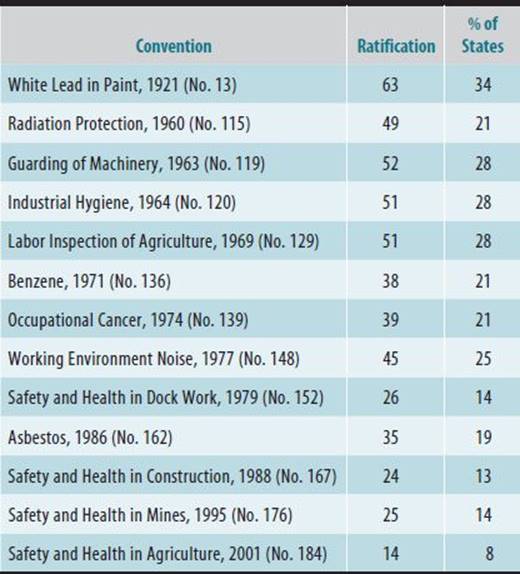
Convention 155 can be considered as the framework for occupational health and safety law at national and at company level. It contains fundamental principles on safety policies, work organization, and prevention of occupational injury and illness. The most important ILO Convention on Occupational Safety and Health has been ratified by only 58 of the 183 ILO member countries. It also has a Protocol (2002), which outlines requirements for the recording and notification of occupational accidents and diseases, thus far ratified by only nine member countries. Convention No. 121, the Employment Injury Benefits Convention, 1964 (amended in 1980), and the List of Occupational Diseases Recommendation 2003 (R194) deal with the recognition and compensation of occupational accidents and diseases, is ratified by 24 member countries.
The ILO conventions cannot promote workplace safety and health in countries where they are not ratified. Conventions directed at managing occupational health and safety programs, such as Convention No. 161 (occupational health services), have only 31 ratifications, and No. 170 (chemical safety) and No. 174 (prevention of major industrial accidents) each have but 17 ratifying countries. The overall disregard for ILO regulation can be seen from the low rates of ratification of various conventions dating back to 1921. Ratifications are made by a disappointingly small percentage of ILO member states.
A. ILO SafeWork
SafeWork, the ILO program on safety, health at work, and the environment, has been leading the ILO’s efforts to promote occupational health. SafeWork attempts to create worldwide awareness of the dimensions and consequences of work-related accidents and diseases; to place occupational safety and health (OSH) on the international and national agendas; and to provide support to the national efforts for the improvement of national OSH systems and programs in line with relevant international labor standards.
Labor inspection departments in ministries of labor are seen in most countries as little more than a nuisance, commanding very little in the way of resources, powers, and respect. Labor inspection is increasingly troubled by obstacles placed by industry, a lack of facilities, and even harassment of inspectors. Recently, inspectors in Brazil and France were killed when carrying out their normal and fully justified duties. A labor inspector in Sao Paulo has been subjected to law suits by asbestos manufacturers and interruptions of her work by her own government because of her attempts to protect the health and safety of Brazilian workers.
The reliance on international agencies to promote health and safety in industrializing countries is not nearly adequate. Developing countries need more direct assistance to help them develop health and safety programs that welcome them into the family of countries that protect their workers. The international agencies have observed that most countries do not have concise legislation on occupational health, and provisions are often scattered in several separate laws and regulations. It is a significant lost opportunity that the developed countries and the international agencies do not fully provide this service.
B. Consultation With Local Governments
The ILO’s Tripartite Consultation (International Labor Standards) Convention (No. 144) requires governments to adopt procedures that ensure effective consultation with employers’ and workers’ representatives on measures entailed in ratified conventions.
The WHO and the ILO are required to provide direct consultation to developing countries when such countries request aid with their health and safety programs. In reality, the WHO and the ILO have limited budgets and staffs and are unable to provide the required consultative services. Moreover, it is not clear that the WHO and the ILO could identify a model occupational health and safety program to recommend. Virtually all models of health and safety programs require trained and experienced personnel to institute them and to provide continuing leadership. The overwhelming reality in the industrializing countries is that they lack trained personnel at every level.
Direct consultations to countries occur through WHO and ILO regional, country, and central offices. The WHO regional office for the Americas, the Pan American Health Association (PAHO), has had success assisting countries to develop national health action plans. The ILO and the WHO work together to assist countries in the ILO/WHO Global Program to Eliminate Silicosis and in the newly developing WHO/ILO Joint Effort on Occupational Health and Safety in Africa.
C. Basic Occupational Health Services
The Basic Occupational Health Services (BOHS) approach was advanced by WHO and ILO in 2005. The institution of a minimum occupational health system to meet the objectives of ILO Convention No. 161(occupational health services) in developing countries is moving very slowly, if at all. No single system can be proposed that satisfies the particular preferences of various governments, industries, and institutions. Moreover, until a local government supports OHS and a legal system ensures regulation and enforcement of OHS laws, little progress can be made.
D. Developed Country OSH Models
A convincing government OSH policy and close cooperation between social partners and the government are critical factors that guarantee sustainable OSH programs in a developing country over a long-term basis. There are a number of regional or national occupational health and safety programs that have served as models for the developing countries. None of these models has been entirely useful, given the complex problems posed by circumstances in developing countries and the great differences found in their levels of industrialization. No model of occupational health and safety transferred to a developing country will work properly if the local conditions are not taken into account.
The Scandinavian system of a powerful health and safety establishment sponsored by government and welcomed by industry and labor has not provided a transferable model for industrializing countries. The Communist model of large, central Institutes of Occupational Health and Safety with regulations seldom enforced and heavy governmental controls imposed on the scientific agencies that regulate industry, although widely accepted by many developing countries, is of limited value to them.
The US and the UK models are often emulated, but with little direct consultative assistance. Malaysia provides an example of a successful OSH program development drawing on many sources. The European Union criteria for diagnosis of occupational diseases have been employed as the basis for criteria documents and notification of occupational diseases, poisoning, and accidents. Being a former colony of Britain, most of the early legislation in Malaysia was based on that of the United Kingdom. However in the later years, legislation from other countries such as the United States and the United Kingdom has been used as a model. The American Conference of Governmental Industrial Hygienists (ACGIH) determines a protective standard, the threshold limit value (TLV). TLVs are not health-based standards, a deficiency shared by virtually all countries’ protective standards. TLVs have largely been developed by industry experts and need more scrutiny than they have received. These standards have wide currency because there is little other guidance. The concept of safe is taken by the public and by workers to imply that government has all the appropriate information needed to conclude that harm will not occur as a result of chemical exposure. Protective standards seldom, if ever, are health-based.
The European Union provides grant support for economic transformation of Central and Eastern European countries, including occupational health and safety projects. The European Commission has expanded its development policy to include cooperation with African, Caribbean, and Pacific countries. The United States sponsors an international effort in occupational health through the Fogarty International Center, and by other governmental agencies and academic institutions. These are primarily focused on research and capacity building, with limited policy reach. There are many other national and regional efforts, but in sum, they are far from adequate to meet the challenge.
Finland provides development collaboration in East African countries and in the Asian-Pacific region, and research and training opportunities in Finland’s government and academic centers of occupational health. The Finnish Institute of Occupational Health (FIOH) works with the WHO and the ILO in producing the African and the Asian Newsletters on Occupational Health and Safety.
AGRICULTURE
Agriculture employs half the world’s workforce. Agricultural workers account for a particularly high proportion of unprotected workers, especially in developing countries. Their work is generally heavy, their working hours can be very long, they are often exposed to difficult climatic conditions, and many are exposed to hazardous chemicals, especially pesticides. Workers and small farmers live where they work so workplace exposures all too easily migrate into the home. Living conditions are often extremely poor, and many have limited access to clean water, electricity, adequate shelter, and nutrition. Literacy is often low in agricultural workers.
These problems are compounded by poverty. Poverty is a multi-dimensional phenomenon, but agriculture plays a major role. More than 75% of the world’s poor live in rural areas where the agricultural sector employs 40% of the workers and contributes to over 20% of their countries’ GDP. Moreover, agriculture has the greatest dominance of female employment in the poorest regions of the world. Therefore, a focus on this sector can also contribute to greater gender equality in the world of work.
In the recent past, researchers and policymakers largely neglected the agricultural sector, while favoring modernization through the development of the manufacturing and service sectors. Declining official investment in agricultural development provides evidence for this trend. This shift away from agriculture went hand in hand with a lower rate of poverty reduction. Poverty, whether relative or absolute, needs to be defined. Average GDP may improve but inequality may become worse. This has implications for what kind of agricultural development is needed.
Pesticide Exposure
In the agricultural sector, the use of pesticides causes at least 7 million cases of acute and long-term nonfatal illness. Pesticides are essential to modern agriculture: more than 2 million tons of pesticides, derived from 900 active ingredients, are used annually worldwide. Pesticides are widely used both in developed and developing countries. They constitute a major risk to farm workers, and in some countries account for as much as 14% of all occupational injuries in the agricultural sector and 10% of all fatal injuries. Unintentional poisonings kill an estimated 355,000 people globally each year. Although developed countries have much more intensive use of pesticides than developing countries, the disease burden is disproportionately carried by developing countries.
Women and children are at considerable risk of pesticide poisoning in the household. Farm workers’ contaminated clothes are washed by their wives or children, and are often mixed in with other laundry. Pesticides stored in the home create the risk of accidental poisoning, especially among children. Moreover, the use of pesticides for domestic vermin control leads to home poisoning. The sale of toxic pesticides typically occurs in the informal sector, resulting in many acute and chronic health consequences.
Monocrotophos was cited in the death of 23 school children in Patna, India in July, 2013, when some of the pesticide was mixed into the school lunches. Monocrotophos is an organophosphate insecticide which works systemically and on contact. It is acutely toxic to birds and humans, and for that reason has been banned in the United States since 1988. The pesticide is still produced by at least 15 manufacturers. It is manufactured and exported by companies in India, China, Brazil, and Argentina. In India, for example, DowElanco makes monocrotophos in a joint venture with the Indian company NOCIL.
In developing countries—where two-thirds of these deaths occur—such poisonings are associated strongly with excessive exposure to, and inappropriate use of, toxic pesticides. Virtually all deaths due to acute pesticide poisoning occur in developing countries.
Many developing country governments report fatalities from pesticides as suicides, thereby shifting responsibility for prevention to the individual, reducing corporate responsibility, and limiting policy options available for control. To be fair, it is often the employer who is responsible for this fiction, to avoid whatever feeble liability does exist in the country concerned. It is true that governments do not critically examine such reports. Whether this is the result of willful collaboration with industry or simply ineptitude or political bias is not clear.
Some widely used pesticides in developing countries are highly toxic. Many of these pesticides are banned or severely restricted in developed countries, yet still legally sold to farmers in developing countries. Pesticides are often applied in combinations or mixtures, a common practice in both developed and developing countries. Studies on pesticide poisoning in developing countries suggest that exposures to mixtures of pesticides are associated with higher rates of case fatality and morbidity. Farmers often mix different pesticides into one mixture for application. Because they do not understand the pesticides they were sold, nor the mechanisms by which the pesticides work, they end up mixing two agents with different trade names but identical active ingredient. This is neither efficient, nor safe, and it is a waste of money. But given the circumstances under which pesticides are sold, there is no stewardship or information to farmers to make rational decisions on whether to use chemicals for pest control, and, if so, what chemicals to use.
It is common for farmers in developing countries to apply hazardous pesticides while working barefoot. Their clothing is soaked with pesticides after spraying with a backpack tank, which further enhances absorption through the skin. Personal protective equipment is often neither available nor affordable in developing countries, nor is it practical to wear in tropical climates because of the heat, humidity, and potential to decrease farm workers’ productivity. Washing facilities are rarely located close to agricultural fields. Dermal absorption continues until the farmer or farm worker can get home to wash. But farm workers spend long hours in agricultural fields and cannot take long breaks to go home. They eat, drink, and smoke with pesticide-soaked hands, ingesting pesticides orally as well as through dermal absorption.
International organizations provide the major sources of information, advice, and technical support on pesticide health and safety to developing countries. There is a lack of rigorous legislation and regulation to control pesticides. Moreover, there are too few training programs for personnel with the responsibility to inspect and monitor the use of pesticides. This is true at the ministry level, but only part of the problem. The farmers and farm workers have little information from any reliable source. What they do learn usually comes from peers in the form of pressure to maximize production, or private entrepreneurs whose business it is to sell pesticides. Consequently, there is an incentive to provide only certain kinds of information, and to limit any health and safety information or advice on how to reduce pesticide usage.
There often is a mutually beneficial relationship established between the pesticide industry (not small salesmen or entrepreneurs running a village shop) and government beholden to these companies. Government in many developing countries allows industry a free hand to shape policy, information, and technical guidance for pesticides. For example, the South American government outsources training of new emergent farmers to the pesticide industry, a training program paid for with public funding.
Climate Change
Global population growth places an ever-increasing demand on sustainable food production. By 2050, the world will have to feed 2–3 billion more people. Climate change adds a further challenge, as changes in temperature and precipitation threaten agricultural productivity and the capacity to feed the world’s population. Weather severely affects farming in developing countries. Two-thirds of Africa is desert or arid. The continent is highly sensitive to climate change and its damaging effect on agriculture. Seventy percent of the population in Africa depends on rain-fed agriculture for their livelihoods.
Global warming also causes both floods and droughts. Moreover, by melting glaciers, global warming reduces nature’s water storage capacity. Two-thirds of the world’s fresh water is stored in glaciers. Their melting leaves poor countries with less of a buffer to protect farmers against changing weather and rainfall patterns. Erosion occurs as a result of floods. Approximately 2.4 billion people live in the drainage basin of Himalayan rivers. India, China, Pakistan, Afghanistan, and Bangladesh are likely to experience floods followed by severe droughts in coming decades.
Few developing countries will be able to afford more efficient technologies to reduce greenhouse gas emissions in the next few decades. Greenhouse gas emissions from developing countries will likely surpass those from developed countries within the first half of this century, highlighting the need for developing country efforts to reduce the risk of climate change.
CONSTRUCTION INDUSTRY
The construction industry accounts for at least 60,000 fatal workplace accidents each year worldwide. About 17% of all fatal workplace accidents occur in this sector. The construction industry accounts for around 10% of the world’s economic activity and employs 180 million people.
The construction industry is one of the most hazardous occupations, and in some countries, the most hazardous. The construction industry accounts for around 7% of the world’s employment but 30–40% of the world’s fatal injuries. Falls from heights due to inadequate scaffolding and lack of basic protections, being buried in excavations, or being crushed by vehicles or building materials are the most common causes of fatal injuries.
Construction is a hazardous industry for almost all key risks—chemicals, dusts, manual handling, physical hazards, and psychosocial hazards. Construction industry exposures are routine and excessive. Moreover, poor access to care and benefits compound the hazards. The vast majority of construction is taking place in developing countries, where health and safety laws are seldom if ever enforced. In most countries, construction is characterized by low status, low paid, short-term, unregistered, informal, and hazardous jobs in a highly fragmented industry. Many workers, in particular rural-urban migrants, are faced with exploitative employment practices, hardship, and hazards.
Worldwide, the cost of occupational injuries and illnesses across all sectors is estimated by the ILO at 4% of the GDP, making workplace prevention a development issue. Yet it is very common to find that even large construction projects have no safety policy or prevention program, no safety officer, no project specific health and safety plan, no information or training on prevention, no collective measures to prevent accidents or illnesses, and not even the most basic personal protective equipment.
The employment relationship in construction is distinctive for the weak ties between contractors and trade workers and the limited supervision provided by the general contractor. These factors are exacerbated by social norms and power relationships characteristic of construction worksites, which create further difficulty in both studying and ameliorating construction site ergonomic risks. The absence of steady employment relationships in construction reinforces a climate in which workers are hesitant to complain about work conditions for fear that they will simply be replaced, and this same dynamic reinforces a culture in which it is assumed that working while injured is just part of the job.
Construction workers are potentially exposed to asbestos, wood dust, various oils, man-made mineral fibers, welding fumes, lead, organic solvents, silica, isocyanates, diesel exhaust, concrete dust, and asphalt vapors. Silicosis from exposure to cement and stone dust kills many thousands of workers. Respiratory diseases, skin problems, deafness, and chronic pain from heavy physical work, punishing workloads, and long hours are almost universal health complaints. The ILO estimates that 100,000 construction workers die annually from diseases caused by past exposure to asbestos. In some countries, deaths from asbestos-related diseases have now outstripped the number of deaths from occupational accidents.
Basic amenities, such as clean drinking water; latrines; facilities for washing, cooking, or eating; or for first aid, are seldom provided on site. Proper accommodation is a basic problem and workers who migrate to the urban centers in search of day labor have no alternative but to live on or near the construction site. Malnutrition and diseases such as malaria, dengue, cholera, and tuberculosis are widespread among construction workers and their families. This vulnerability is most extreme when whole families migrate from rural areas in search of work.
ELECTRONICS WASTE
Electronics manufacture is a major global industry. Its explosive growth has resulted in a world market of more than $1 trillion in electronics products each year, and underlies a large part of the world economy. The demand for electronics products continues to accelerate, while the lifespan of the products shortens, resulting in an alarming increase in electronics waste (e-waste). A billion computers have been manufactured and discarded, and in the next 5 years, another billion will be repeating the cycle. An even larger number of electronic tablets will be produced and discarded in the same period. Many billions of electronics products in addition to computers, including cell phones, television sets, air conditioners, appliances, toys, and a host of other products, have been discarded, a staggering burden on the environment. The rapidly growing e-waste stream presents public health difficulties because a wide range of hazardous metals and chemicals are used in electronics products and in their manufacture.
The printed circuit board is a major component of e-waste. The printed circuit board is the platform upon which electronics components such as semiconductor chips and capacitors are mounted. Printed circuit boards are found in virtually all electronics products. Asia produces three-fourths of the world’s printed circuit boards, with over 1000 manufacturers in China alone.
Lead use is ubiquitous in electronics manufacturing. It is present in solder, batteries, paints, finishes, discrete components, and in heavy concentration in cathode-ray-tube glass used in computer monitors. Approximately 50% of the weight of a computer monitor is composed of CRT glass. CRT glass is considered hazardous waste due to its high lead concentration, yet seldom is treated as such. The elimination of lead solder has been a reasonable environmental objective discussed for decades, yet it remains a remarkably elusive goal.
Processing E-Waste
Discarded computers and other electronics products should be considered hazardous waste in all countries. About one-half of the heavy metals, including lead, mercury, and cadmium, in landfills come from e-waste. Discarded computers and other consumer electronic products are the fastest growing portion of the waste stream—growing almost 3 times faster than the overall municipal waste stream. The regulated pollutants most often found in industrial wastewater are copper, lead, nickel, silver, and total toxic organics. Dopants are chemical materials incorporated into a pure substance to alter its electrical conductivity. Trace elements, such as arsenic, antimony, phosphorous, gallium, and indium, are incorporated into the matrices of silicon-based chips. Many of the agents used as dopants are highly toxic and, in several cases, are now identified as known or probable human carcinogens.
In order to recover valuable materials and to minimize the adverse effects of hazardous materials, waste computers are dismantled, then the retrieved materials are sent to specialized facilities for further recycling or treatment. Recycling can recover 95% of the useful materials from the central processing unit, and 45% of useful materials from the computer monitors.
Export of E-Waste
Less than 20% of discarded electronics products are currently recycled. The United States and many other developed countries have exported e-waste, primarily to Asia, knowing fully well that it carried with it a real harm to the poor communities where it would be discarded. Compounding the problem, many countries export e-waste to developing countries under the guise of recycling and reuse. Most of the e-waste collected for recycling in the United States is not recycled domestically, but is instead exported to developing countries.
E-waste is shipped overseas for dismantling under appalling conditions, contaminating the land, air, and water in China, India, and other Asian nations, Africa, and Latin America. In Africa, as much as 75% of the imports are not economically repairable or marketable. Consequently, the e-waste is inappropriately discarded and routinely burned. Serious adverse impacts on the environment and human health from e-waste recycling continue to occur today due to a lack of regulation and enforcement.
As electronics manufacture increasingly moves to Asia, the problem accelerates. China manufactures almost half of all electronic products used in the world today. Yet China is not taking a leadership position among countries to deal with e-waste. China has become the recipient of 70% of the world’s scrap electronics products. At workshops in China, India, Bangladesh, and many other countries, lead solder and other metals are dissolved in open acid baths. Some e-waste is burned on open fires to recover metals from plastics in which they are encased. The open burning, acid baths, and toxic dumping of e-waste introduce unconscionable levels of contaminants into fragile environments, and expose the world’s poorest people to a large number of toxic materials. Scavenging in e-waste dumps is a serious issue for children who often have the major exposure.
Regulation
Electronics manufacturers resist or delay efforts to eliminate or substitute hazardous materials, and they are slow to design products for eventual ease of disassembly and recycling. In league with the industry, government fails to hold manufacturers responsible for end-of-life management of their products. The electronics industry has largely evaded its responsibility for management of products at the end of their useful life, while public policy has failed to promote producer take back, clean design, and safe recycling.
The United Nations Environment Program (UNEP) sponsors The Basel Convention, a multilateral agreement regulating the international shipment of hazardous wastes. The Convention requires that participating nations reduce the shipment of wastes by minimizing production, and by treating and disposing of wastes as near to the source of production as is possible. Under Organization for Economic Cooperation and Development (OECD) guidelines, nonhazardous wastes exported to recycling facilities do not need to be regulated. The United States and Canada refuse to follow the European nations that define discarded electronics products as hazardous waste. Because the United States remains a nonsignatory of the Basel Convention, this limitation does not apply to one of the world’s largest consumers of electronics products.
Partnership for Action on Computing Equipment (PACE) is a public-private partnership under the umbrella of the Basel Convention. PACE supports the concept of sustainable development and information-sharing on life cycle approaches. PACE develops guidelines for the environmentally sound management (ESM) of computing equipment. EPR policies for the collection and management of e-waste are currently in place in Belgium and Colombia. EPR is an environmental policy approach in which a producer’s responsibility for a product is extended to the post-consumer stage of a product’s life cycle. EPR policy shifts responsibility toward the producer and away from municipalities, and it provides incentives to producers to consider the environmental when designing products. EPR seeks to address the environmental characteristics of products and production processes throughout the product chain.
In 2003, the European Union enacted the Restriction on Hazardous Substances (RoHS) Directive that bans the use of lead, mercury, cadmium, hexavalent chromium, and certain brominated flame retardants in most electronics products sold in the European Union. This Directive, by banning the use of critical materials in electronics products sold in key world markets, may result in a significant change in the way products are designed for global sales. However, the political process has resulted in a number of material exemptions from the RoHS Directive. An EU impact assessment from 2008 states that as much as 41% of the collected electronic products in the EU are treated improperly. Substandard waste treatment is happening both outside and inside of the EU. The export of e-waste for disposal is banned under EU law, yet e-waste makes its way to substandard treatment operations outside of the EU under the guise of reuse and recycling.
The Waste Electrical and Electronic Equipment (WEEE) Directive attempts to establish a new management program that could have far-reaching implications for product design and materials management. The Directive encourages the design and production of electronics equipment to facilitate dismantling and recovery, in particular the reuse and recycling of electronics equipment, components, and materials necessary to protect human health and the environment. The Directive sets a common minimum legislative framework for all EU countries. Loopholes written into the Directive and difficulties in enforcement have limited its effectiveness. The vast majority of e-waste in the EU is still completely unaccounted for, being either landfilled or destined for illegal export to developing countries.
The European Parliament and the European Council have advanced legislation, entitled Regulation, Evaluation, and Authorization of Chemicals (REACH), that requires industry to prove that chemicals being sold and produced in the European Union are safe to use or handle. The REACH proposal gives greater responsibility to industry to manage the risks from chemicals and to provide safety information on the substances. Efforts to restrict the use of carcinogens, mutagens, reproductive toxicants, and persistent and bioaccumulative substances will affect the computer industry and provide a strong incentive to replace these chemicals in products.
The United States has been reluctant to advance legislative solutions to the e-waste problem, and its electronics industry has been unsupportive of efforts by other governments. The electronics industry has never been required to pay anything close to the actual cost of the environmental damage it has produced. Billions of electronics waste products have been discarded in every region of the world. Not until 1997 did the EPA enter into the Design for the Environment project. By that time, the international pollution of the world with e-waste was readily apparent, and no technology to adequately address the problem was forthcoming. The EPA now includes the disposal of e-waste on its list of top priorities, yet it still allows e-waste to be discarded in municipal solid waste landfills.
Most states have passed legislation mandating e-waste recycling and banning e-waste in landfills. There are also certification systems for e-waste recyclers which require companies to eliminate exports of e-waste to developing countries and ban e-waste in municipal landfills or incinerators developed by the Electronics TakeBack Coalition.
Asia has many industrial regulations that are not enforced, and considerable time may elapse before these attempts at regulation are instituted. With more outsourcing and contract manufacturing migrating to South and Southeast Asia, there will be increasing requirements for Asian governments and industries to become more aware of environmental issues, materials reduction, energy efficiency, reduced toxicity, and recycling. Small- and medium-sized enterprises have little awareness and understanding of environmental issues and few governments in these countries have initiated programs covering eco-design, hazardous materials substitution, and recycling.
There is an immediate need for much tighter controls both on the movement of e-waste and on the manner in which it is recycled. Economic and political pressures on governments and international agencies have blunted efforts to address the problem. There is an urgent need for manufacturers of electronics products to take responsibility for their products from production through to the end-of-life. Manufacturers must develop and design clean products with longer life spans that are safe and easy to repair, upgrade, and recycle and will not expose workers and the environment to hazardous chemicals.
RESOURCES
Association of Societies for Occupational Safety and Health South Africa (ASOSH): http://www.Association-of-Societies-for-Occupational-Safety-and-Health-(South-Africa)-(ASOSH).html.
EPA: http://www.epa.gov/oia/.
European Agency for Safety and Health at Work: http://osha.europa.eu/en/front-page.
ILO Encyclopedia of Occupational Health and Safety: http://www.ilocis.org/en/default.html.
ILO SafeWork: http://www.ilo.org/public/english/protection/safe-work/cis/oshworld/events.htm.
International Labor Office (ILO): http://www.ilo.org/global/lang–en/index.htm.
International Occupational Safety and Health Information Center (CIS): http://www.ilo.org/dyn/cisdoc/index_html.
CISDOC contains information about occupational safety and health publications.
NIOSH: http://www.cdc.gov/niosh/programs/global/.
World Health Organization (WHO) Occupational Health: http://www.who.int/occupational_health/en/.
WHO Global Plan of Action on Workers’ Health (2008-2017): http://www.who.int/entity/occupational_health/who_workers_health_web.pdf.
WHO Newsletter: http://www.who.int/occupational_health/publications/newsletter/en/index.html.
WHO/ILO Joint Effort on Occupational Health in Africa: http://www.who.int/occupational_health/regions/en/oehafroharare.pdf.
WHO-ILO-FIOH Newsletters for African and Asian-Pacific regions: http://www.ttl.fi/en/publications/electronic_journals/Pages/default.aspx.
Training Modules for OSH Professionals
ILO Introduction to Occupational Health and Safety: http://www.itcilo.it/english/actrav/telearn/osh/intro/introduc.htm
UNESCO-UNEVO: http://www.unevoc.unesco.org/fileadmin/user_upload/pubs/AB5_HealthSafety.pdf
A list of international meetings is available at: http://www.ilo.org/safework/cis/lang–en/index.htm
REFERENCES (E-WASTE)
Computer Take Back Campaign. http://www.computertakeback.com/
Electronics Industry Code of Conduct (EICC). Global supply chain standards promote socially responsible business practices. http://www.eicc.info/
Environmental Protection Agency. Office of Pollution Prevention and Toxics (OPPT). http://www.epa.gov/oppt/index.html
Europa. European Commission. Registration, Evaluation and Authorization of Chemicals (REACH). http://ec.europa.eu/environment/chemicals/reach/reach_intro.htm
European Commission. Integrated Product Policy; Commission outlines its strategy to stimulate greener products. http://europa.eu.int/comm/environment/ipp/
European Union. Directive 2012/19/EU/108/EC of the European Parliament and of the Council of 4 July 2012 on waste electrical and electronic equipment (WEEE). http://ec.europa.eu/environment/waste/weee/index_en.htm
Lundgren K. The global impact of e-waste: Assessing the challenge, ILO, Geneva, 2012. http://www.ilo.org/wcmsp5/groups/public/—ed_dialogue/—sector/documents/publication/wcms_196105.pdf
 SELF-ASSESSMENT QUESTIONS
Select the one correct answer to each question.
Question 1: Occupational health and safety laws in developing countries
a. are highly developed and adequately funded
b. apply to all workers
c. cover only about 10% of the population
d. ensure access to adequate occupational health services
Question 2: Global working conditions are
a. largely the result of progressive practices of multinational corporations
b. improving because of the controlled growth in the working population
c. complicated by a small informal sector in developing countries
d. affected by a large migrant workforce
Question 3: Child labor
a. is controlled by international law
b. is prevented by the International Labor Organization
c. is an economic and social reality in many developing countries
d. is disappearing at a rapid rate
Question 4: Globalization benefits
a. all countries equally
b. China more than it does Pakistan
c. countries that are competitive in the knowledge economy
d. only corporate interests
Question 5: The World Health Organization
a. is solely responsible for occupational safety and health
b. addresses occupational health through the promotion of medical services and hygienic standards
c. has had no occupational health initiatives in recent years
d. is not responsible for technical aspects of occupational health
Question 6: Occupational diseases
a. account for more than 100 million cases each year worldwide
b. occur primarily in developed countries
c. are diagnosed and compensated in all countries
d. are diagnosed and compensated only in developed countries
Question 7: The International Labor Organization (ILO)
a. plays no role in promoting policies for occupational health and safety
b. is under the WHO with respect to occupational health and safety
c. is a tripartite organization of government, employer, and worker representatives
d. conventions guide only a few occupational health and safety programs
Question 8: Global occupational injuries
a. cause economic losses amounting to 4–6% of national incomes
b. occur in about 1 in 20 workers each year
c. seldom involve preventable fatalities
d. occur most commonly in developed countries
Question 9: ILO conventions and recommendations
a. are international agreements that have legal force if they are not ratified by the national parliament
b. guide all countries in the promotion of workplace safety and in managing occupational health and safety programs
c. leave occupational disease prevention to the WHO
d. are approved by most member states
Question 10: Agriculture is
a. the most prevalent type of employment in the world
b. dominated by male employment in the poorest regions of the world
c. no more dependent on a fair globalization than any other sector
d. The development of the agricultural sector is not important to reducing poverty
Question 11: Global use of pesticides
a. is hardly essential to modern agriculture
b. affects only agricultural workers
c. causes fatalities that are rare and largely accidental
d. includes highly toxic pesticides banned in some countries
Question 12: Global construction industry
a. is the fourth most hazardous industry
b. accounts for about 30–40% of all fatal workplace accidents
c. has only a minor problem with fatalities in the United States and Europe
d. has overcome its problem with carcinogen exposures
Question 13: E-waste
a. is an example of a well-regulated international waste stream
b. is exported to developing countries to provide skilled work opportunities
c. could be prevented entirely by the Basel Convention
d. is addressed directly in REACH and WEEE initiatives