
Approach
• Nature, acuity of onset, duration, associated sxs (cough, fever, drooling, voice change, dysphagia, difficulty breathing)
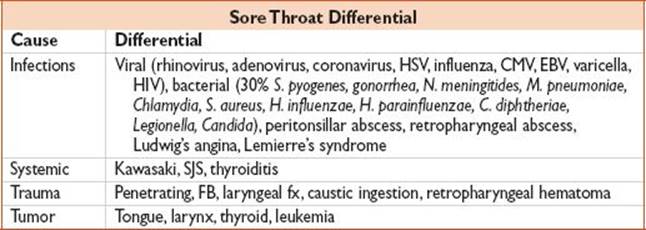
Group A Streptococcus Pharyngitis (“Strep Throat”)
Definition: Infection of the oropharynx caused by GABHS
History: Sore throat, odynophagia, myalgias, fever; no cough
Physical Findings: Erythematous oropharynx, tonsillar exudate, cervical LAD
Evaluation
• Centor criteria: Fever >38°C, tonsillar exudate, tender LAD, absence of cough
• Rapid strep: Sens 60–90%, spec 90% (send culture if negative given low sens)
• GABHS culture: 90% sens
• Consider culture for gonorrhea (if oral sex exposure), or Monospot for EBV
Treatment
• There are multiple conflicting guidelines (NEJM 2011;364:648). One reasonable approach:
• If 0–1 Centor criteria met: No testing, no tx
• If 2–3 Centor criteria met: Rapid strep, treat if positive, confirm w/ culture
• If all Centor criteria met: No testing, yes tx
• Abx
• Benzathine penicillin 25000 U/kg max 1.2 million U IM ×1 OR penicillin VK, OR amoxicillin OR azithromycin. If refractory: Clindamycin, augmentin.
• Dexamethasone 8 mg ×1 may ↓ time to pain relief (J Emerg Med 2008;35(4):363)
Disposition: D/c
Pearl: Treat w/ entire course of abx to prevent rheumatic fever/cx
Croup (Laryngotracheobronchitis)
Definition
• Upper respiratory tract infection in children (6 mo–6 yr) usually by parainfluenza virus causing inflammation/exudate/edema of subglottic mucosa
History: Barky cough, worse at night, mild fever, following 2–3 d of URI sxs
Physical Findings: High-pitched inspiratory stridor, hoarse voice, tachycardia, tachypnea
Evaluation: Neck film if unsure of Dx → narrowing of subglottic trachea (“steeple sign”)
Treatment
• Calm child, monitor pulse oximetry
• Cool mist (no clear benefit)
• Dexamethasone 0.3–0.6 mg/kg (↓ time to improvement) (Cochrane Syst Rev 2004;(1):CD001955)
• Moderate–severe or stridor at rest: Nebulized racemic epinephrine 0.5 mL of 2.25%
Disposition
• Admit if no improvement in ED, hypoxic, persistent stridor at rest, <6 mo old
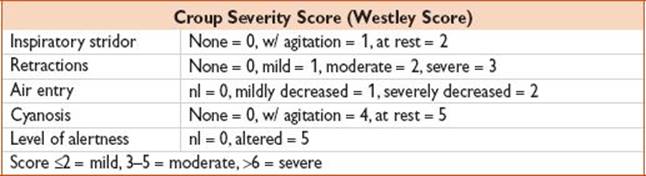
• Croup severity score ≤4 can usually be discharged, score >6 may require ICU
Pearl: If epinephrine given, should observe for >3 h for rebound edema
Epiglottitis
Definition
• Inflammation of the epiglottis caused by H. influenzae >> Staph/Strep
• Can lead to rapidly progressing, life-threatening airway obstruction
History
• Sore throat, muffled “hot potato” voice, odynophagia, respiratory distress, fever
• ↓ Pediatric incidence since vaccination, now more common in adult diabetics
Physical Findings: Dysphonia, stridor, drooling, sitting in tripod position
Evaluation
• Lateral neck XR (90% sens): Epiglottis >7 mm (“thumbprint”), loss of vallecular air space
• Adult: If nl x-ray → indirect or fiberoptic laryngoscopy (have surgical airway ready)
• Pediatric: Avoid agitation (↑ risk of acute airway obstruction), do NOT attempt to visualize in the ED. To OR for DL w/ anesthesia & ENT/surgery.
Treatment: Abx (ceftriaxone, ampicillin–sulbactam); no proven benefit w/ steroids. Disposition: ICU admission.
Pertussis (Whooping Cough)
Definition: Lower respiratory tract infection by B. pertussis (gram-negative rod)
Presentation
• Commonly a prolonged course (AKA “hundred-day cough”)
• Stages: (1) Catarrhal (most infectious): 2 wk mild URI sxs; (2) Paroxysmal: 1–2 wk intense paroxysmal cough ± posttussive emesis, inspiratory “whoop”; (3) Convalescent: Several weeks of chronic cough
• ↑ Risk if unvaccinated, but immunity wanes after ∼12 yr; ↑ morbidity if <6 mo old
Evaluation
• Rapid PCR may be useful esp during epidemics
• May develop PNA; consider CXR if refractory to abx
Treatment
• Droplet precautions × 7 d, abx (only effective in catarrhal stage)
• Azithromycin or clarithromycin, albuterol prn, treat household contacts
• Low threshold for empiric tx in infants, pregnant, healthcare workers
Disposition: Admit <1 y/o or ill appearing
Lemierre’s Syndrome
Definition
• Suppurative thrombosis of internal jugular vein w/ F. necrophorum
• Septic emboli to lung are common (can be confused w/ R-sided endocarditis)
History
• Usually previously healthy young adults’ high fever, sore throat ± cough
• Typical course is pharyngitis that improves & then followed by severe sepsis
Physical Findings: Unilateral neck swelling, tenderness, induration
Evaluation: Contrast CT of neck
Treatment: Abx: Ampicillin–sulbactam or a carbapenem. Anticoagulation is controversial.
Disposition: Admit