Approach
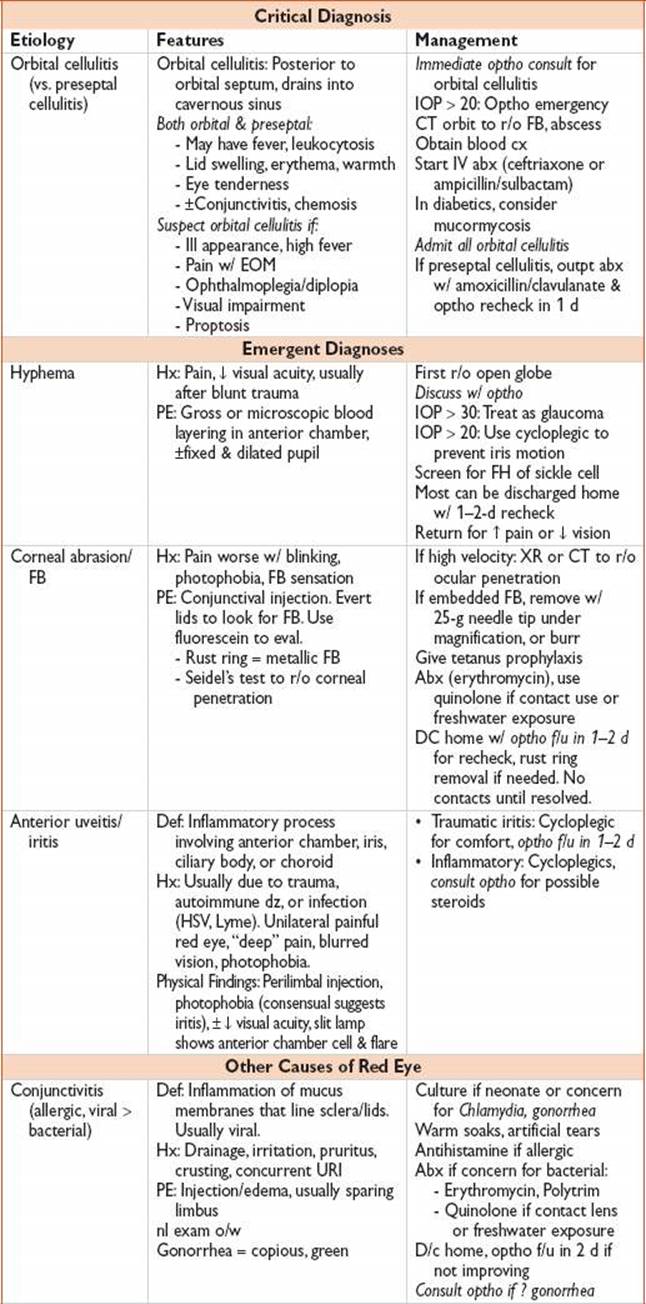
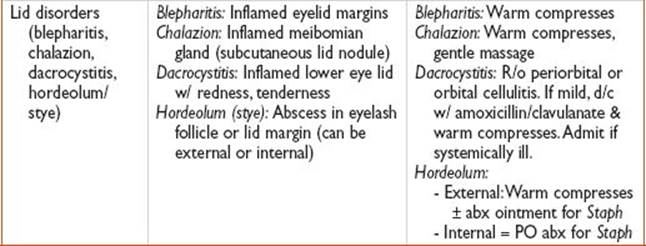
• Ask about FB exposure, chemicals, trauma, contact lens use, freshwater exposure
• Always check visual acuity. Use topical anesthetics (tetracaine, proparacaine) for exam.
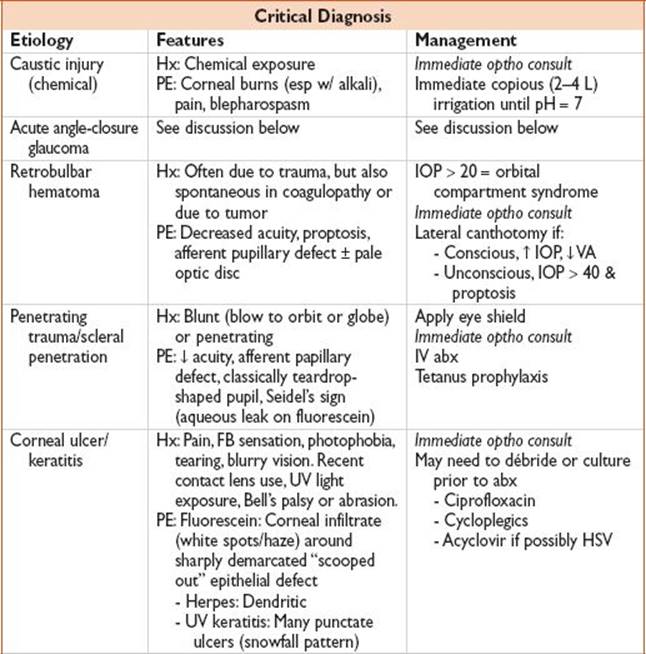
• Complete eye exam: Visual acuity (corrected), visual fields, external inspection, periorbital soft tissue & bones, extraocular movement, pupils (including swinging light test for afferent pupillary defect), pressure (tonometry), slit lamp (lids, conjunctiva, sclera, cornea w/ fluorescein, anterior chamber, iris, lens), funduscopy
Acute Angle-closure Glaucoma
Definition: Increased IOP due to ↓ aqueous outflow. Generally due to reduction in the angle of the anterior chamber in setting of the dilated pupil pushing against trabecular meshwork.
History
• Sudden onset of severe unilateral pain, HA, nausea, vomiting, blurry vision, halos
• May be triggered by dim light, mydriatic drops, stress, sympathomimetics
Physical Findings
• Unilateral perilimbal eye injection, ↓ VA, “steamy” (cloudy) cornea, nonreactive midsize pupil (5–7 mm), shallow anterior chamber, ↑ IOP >21 mmHg, firm globe
Treatment
• Immediate optho consult
• Reduce aqueous production: Timolol 0.5% 1–2 drops q30min (avoid if CI to systemic βB) or acetazolamide 500 mg IV, then 250 q6h
• Facilitate aqueous outflow (miotics): Pilocarpine 2% 1 drop q15min until pupil constricts
• Decrease vitreous volume (osmotics): Mannitol 1–2 mg/kg IV over 30–60 min
Disposition
• Per optho recommendations. Admit for intractable vomiting or need for systemic agents.