
Definition
• Abn, paroxysmal d/c of CNS neurons leading to abn neurologic fxn
Approach
• ABCs, check O2 saturation, temperature
• Immediate bedside glucose fingerstick & tx, consider administering empiric glucose
• If actively seizing, quickly administer suppression medications
• Careful hx: Description of events before & after sz, associated sxs (HA, photophobia, vomiting, visual changes, ocular pain), focal neurologic sxs
• Assess for head or neck trauma, meningismus, petechiae
• Thorough neurologic exam; Todd’s paralysis: Transient paralysis after a sz
• CBC, CMP, tox screen, UA, CXR: Tox screen, anticonvulsant levels, infectious w/u
• Consider CT if persistent AMS, neurologic deficit, or trauma
• Consider LP after head CT if persistently AMS, fever, & therapeutic med levels
• 1st-time sz w/u: Consider head CT, ECG, CBC, CMP, tox screen, LP
• EEG days to weeks after sz unless concern for nonconvulsant status epilepticus
• Status epilepticus is recurrent or continuous sz activity lasting >30 min w/o return to baseline MS
• Can result in cerebral hypoxia, lactic & respiratory acidosis, hypercarbia, hypoglycemia
• Disposition: Admission for abnl neuro exam, others w/ Neurology f/u
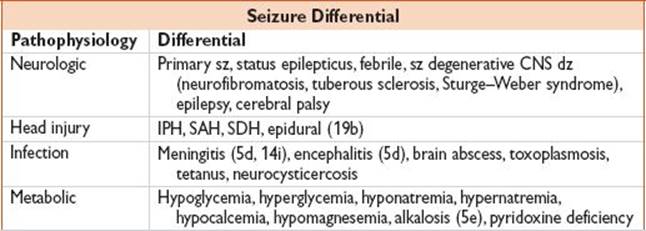
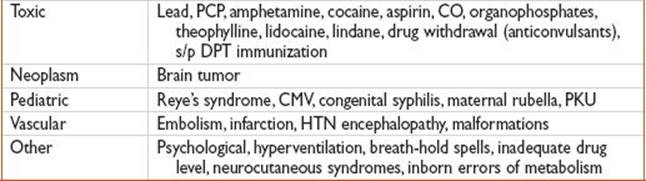
Primary Seizures
History
• Presence/absence of aura, abrupt onset & termination of sz activity, stereotyped purposeless behavior, fecal or urinary incontinence, postictal confusion or lethargy
Findings
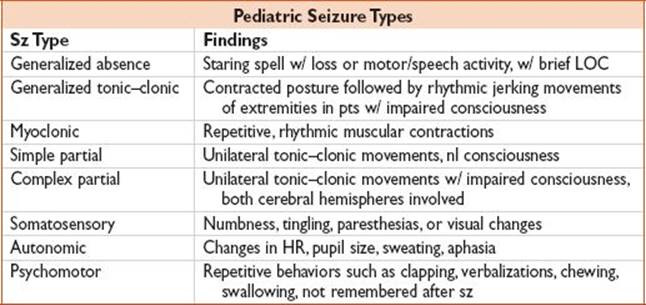
• Depends on type of sz, LOC secondary to simultaneous activation of entire cerebral cortex
Evaluation
• As above
Treatment
• Acute vs. chronic meds, airway mgmt often w/ only nasal trumpet, supplemental O2
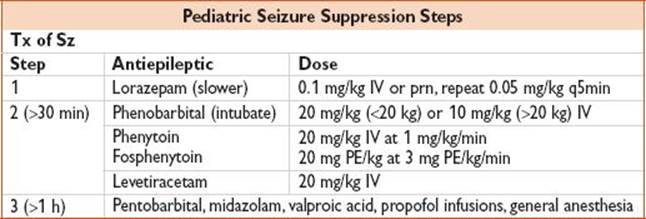
• Abortive tx
• Benzodiazepines are 1st line (lorazepam 0.1 mg/kg up to 4 mg IV)
• BZD: Diazepam (t1/2 15–20 min), lorazepam (t1/2 12–24 h), midazolam (t1/2 <12 h)
• Phenytoin (1 g IV over 1 h) 2nd line in adults, 3rd line in kids
• Phenobarbital (200–600 mg IV up to 20 mg/kg) watch for hypotension & bradypnea
• If refractory szs, give pyridoxine 100 mg IV; consider thiamine 100 mg IV in adolescents
• Long-term Anticonvulsant Medications
• If known SZ disorder & subtherapeutic levels, load w/ chronic med
• Phenytoin load (1 g or 10–20 mg/kg IV), fosphenytoin load (15–20 mg/kg IM or IV)
• Long-term anticonvulsants not routinely indicated in 1st unprovoked sz
Disposition
• Explicit instructions to not drive, operate hazardous machinery or perform tasks where recurrent sz may cause harm; some states have mandatory reporting to DMV
Pearls
• Keep differential broad even if known sz d/o, esp if tx med levels
• If meningitis suspected, give abx preemptively while awaiting confirmation
• Pseudoseizure is Dx of exclusion
• Tx EtOH withdrawal sz w/ BZD, almost never responsive to antiepileptic meds
• Consider Neurology consult if starting new long-term med in 1st-time sz (will need close f/u)
Epilepsy
History
• Typical sz recurrence, may be a/w lip biting, incontinence of bowel or bladder followed by lethargy/combativeness & confusion (postictal period)
Findings
• Depends on type of sz, LOC secondary to simultaneous activation of entire cerebral cortex
Evaluation
• As above
Treatment
• Acute vs. chronic meds, airway mgmt often w/ only nasal trumpet, supplemental O2
Disposition
• Neurology f/u for medication adjustment if indicated
Pearls
• Keep differential broad even if known sz d/o, esp if tx med levels
• Systemic illness such as URI or fever can lower sz threshold
Cerebral Palsy
History
• Nonprogressive lesion sustained during brain development → motor, speech, & learning disabilities, high risk (50%) for szs. Prematurity is the biggest RF.
Findings
• Depends on type of CP:
• I. Quadriplegia: Hypotonic trunk & spastic extremities
• II. Diplegia: Spastic lower extremities, ↑ DTRs, clonus, & “scissoring”
• III. Hemiplegia: Unilateral spasticity, usually UE > LE
• IV. Athetoid: Writhing, involuntary movements of extremities
• V. Ataxic: Unsteady, uncoordinated movements
• VI. Hypotonic: Lacking muscle tone
Evaluation
• Head CT if new onset sz or recent trauma
• Outpt EEG if new onset sz or Δ in sz pattern or frequency
Treatment
• Standard sz tx
Disposition
• Neurology f/u for medication adjustment if indicated
Pearls
• Pts w/ CP often have breakthrough sz & low sz thresholds, look for underlying illness (URI, PNA, UTI, etc.), adjust outpt meds w/ primary neurologist
• CP pts also commonly present to the ED w/ chronic aspiration, PNA, feeding difficulties, G-tube malfunction, UTIs
Febrile Seizures
History
• T ≥38.3°C (101°F) in child b/w 6 mo & 5 yr of age
• No h/o sz; 1 generalized sz lasting <15 min a/w rapidly ↑ temp
Findings
• Generalized sz activity, usually lasts <15 min; high fever, postictal period
• Complex febrile sz: Last >15 min, >1× in 24-h period, or focal component
Evaluation
• Evaluate for underlying (infectious) cause: CXR, UA, labs, bedside glucose, ±LP
Treatment
• Antipyretic, observation until pt back to baseline, parental reassurance
• Anticonvulsants like benzodiazepines & phenobarbital are not indicated
Disposition
• 1st febrile sz, nonfocal exam, negative ED w/u can be discharged w/ neuro f/u
Pearls
• Focal sz do not present as simple febrile sz
• Febrile sz not a/w an epilepsy or brain damage
• Incidence of another febrile sz is 35%
• >2 febrile sz/yr or >3 total febrile sz must be evaluated for other etiologies