
Approach
• Differentiate nervous parents from a child w/ true dz
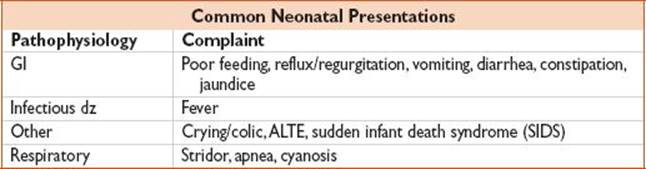
History
• Events during pregnancy, delivery, gestational age & weight @ birth, alertness, diet, frequency of diaper changes, crying patterns, color changes; FH
Findings
• Weight, VS, color; undress baby → full exam
Pearl
• Many signs/sxs are nonspecific: Abnl tone, weak suck, decrease PO intake, jaundice, abnl breathing, peripheral cyanosis, vomiting
POOR FEEDING
Approach
• Check for appropriate weight gain (5–10% wt loss during 1st week, then 1 oz/d for 1st 3 mo), take a careful hx/physical exam to identify any other abnormalities
Treatment
• If weight gain is appropriate & pt has no other issues, attempt feeding trial
Disposition
• Pts w/ appropriate wt gain who tolerate POs in ED may be discharged home w/ parental reassurance & outpt f/u; all other pts require further eval (see w/u for inconsolability below)
CONSTIPATION
Approach
• Differentiate functional (no underlying condition) from pathologic constipation

History
• Sx time course, Δ in stool consistency, baseline stooling patterns, 1st meconium passage after birth (>24–48 h = abnl), recent illness, V/D, fever, ingestion of honey
Findings
• Abdominal (distension), rectal exam (patency, stool @ vault), neuro exam (cranial nerves, muscular tone)
Evaluation
• KUB (if obstruction is suspected); consider Chem 7, TSH, Ca, heavy metal screen
Treatment
• For functional constipation: Glycerin suppository disimpaction, increased water b/w feedings, consider bisacodyl, lactulose, enemas, high fiber diet in older children
Disposition
• Functional constipation → d/c w/ PCP f/u: Pathologic causes warrant further w/u & may require admission
CRYING AND COLIC
Definition
• Colic: Recurrent pattern of inconsolable crying & irritability lasting >3 h/d on >3 d/wk, 3 wk–3 mo of life. Benign GI colic is Dx of exclusion.
Approach
• Excessive crying/colic are nonspecific complaints that can be the presenting signs of benign GI distress or life-threatening dz

History
• Timing of crying, trauma, fever, medication ingestion, feeding hx, complete ROS & PMH
Findings
• Observe behavior, thorough physical exam
Evaluation
• UA; consider further testing (eg, abdominal U/S, x-ray, LP, tox screen) to r/o spec etiologies
Treatment
• Treat the underlying d/o
Disposition
• Home: If etiology is thought to be benign & pt has cry-free period in ED
• Admit: Any pt w/o clear etiology identified & no cry-free period in ED
APPARENT LIFE-THREATENING EVENT (ALTE) (Emerg Med J 2002;19:11)
Definition
• Observed episode frightening to the observer & characterized by ≥1 of the following: Apnea, color change, change in muscle tone, choking, &/or gagging
• Separate clinical entity from SIDS & represents a wide spectrum of etiologies

History
• Obtain 1st-hand account of event when possible, appearance of child (central vs. peripheral cyanosis, pallor, etc.), presence of apnea or gagging, muscle tone, sz-like activity, spontaneous or facilitated recovery
Findings
• Through physical exam
Evaluation
• No standard diagnostic strategy exists. Testing should be guided by hx & physical exam. Consider: CBC, Chem 7, Ca, UA, urine/blood cx, ECG, RSV swab; CT head/LP (based on clinical suspicion); also consider ABG, serum/urine tox, pertussis screen, EEG.
Disposition
• Observe in the ED; pts w/o true ALTE can be discharged w/ f/u in 24 h
• Infant w/ h/o apnea, pallor, cyanosis, limp, unresponsive req stimulation or CPR or have inadequate f/u require admission for observation & further revaluation
Pearl
• Definitive etiology of the ALTE is found in only ∼50% of pts
SIDS
Definition
• Death of child <12 mo of age that is unexplained after careful investigation, autopsy, exam of the death scene, & hx; most common @ 2–4 mo
Approach
• Approach parents of SIDS pts w/ sympathy, as child abuse rare in SIDS (<1–5%)

Prevention
• Remind parents to lay their children in the supine position, avoid smoking, head covering, soft sleeping surfaces, multiple layers, soft sleeping surfaces to reduce risk