
(Emerg Med Clin N Am 2009;27:669)
Approach
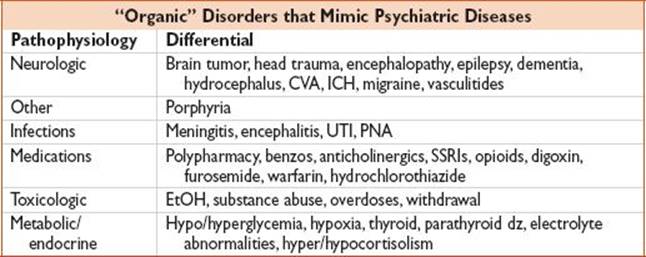
• Always consider medical disorders → esp if no previous psych hx
• Anticipate need for psychiatry consult & restraints (meds, physical) early
Definition
• Medical clearance: An ambiguous term suggesting no “organic” cause for pt’s psych complaint; however, pts can have medical condition that exacerbates their psychiatric presentation (ie, drug abuse, infection)
• Focused medical assessment: The process of excluding medical illnesses that require acute care to determine who is medically stable (Lukens TW, Wolf SJ, Edlow JA, et al. Clinical policy: Critical issues in the diagnosis and management of the adult psychiatric patient in the emergency department. Ann Emerg Med. 2006;47:79)
History
• Ask open-ended? s re: thoughts, feelings, personal relationships; drug use; prior hospitalizations/psych hx; psych medications; physical/sexual abuse
• Suicidal/HI: Access to weapons, plan, prior SI/HI or attempt; command hallucinations
• Depression, mania
• Psychosis: Delusions, hallucinations, bizarre behavior, disorganized speech
Findings
• Abnl VS; appearance, mental status exam
• Head-to-toe exam: E/O trauma, pupils, nystagmus, thyroid, pulm/cardiac/abdomen, skin
• Neuro: CNs, DTRs, motor, sensory, cerebellar, asterixis, gait, catatonia (consider NMS)
Evaluation
• There is no data to support routine use of lab testing in psych pts whose H&P exclude significant medical illness
• βhCG (all women reproductive age), consider ECG & psych med levels (ie, Li)
• Tox: If concern for unreported drug abuse or ingestion (ie, APAP)
• Psychiatry consult: If ? needed for hospitalization, suicide/homicide attempt, uncertain @ risk of danger to self/others
• Other labs: If concern for “organic” d/o or required for psych hospital: CBC, Chem 7, LFTs, UA, TSH, ammonia, CXR
• More thorough w/u is necessary for new onset psych Dx: Consider RPR, CT head, LP, EEG
Treatment
• Treat any underlying medical illness
• Meds:
• Haldol (IM/IV), risperidone (PO/IM), ziprasidone (IM), olanzapine (PO/SL/IM); side effects: ↑ QT, akathisia, dystonia
• Lorazepam/diazepam (PO/IV/IM): preferred for drug-related agitation; avoid in the elderly
• Physical restraints: Soft/leather (1–4 point), posy: Use as temporizing measure in conjunction w/ pharmacologic tx & 1:1 sitter
Pearls
• Signs suggestive of “organic disorder” age >40 w/ no prior psych hx, abnl VS, recent memory loss, clouded consciousness
• Engage family member/friends/partners whenever possible