
Definition
• Ingestions of toxic alcohols
Approach
• History
• Type of alcohol ingested, time of ingestion, coingestants
• PE: Monitor for airway protection, occult trauma (head injury)
• Labs: Bedside glucose test (may be all that’s needed), BAL (declines 20 mg/dL/h), anion gap, serum/urine tox screen (if coingestants suspected), osmolar gap for alcohols other than EtOH
• Osmol calc = 2 × Na + BUN/2.8 + glucose/18 + EtOH/4.6
• Osmol gap = Osmol measured − osmol calc
• Tx: Charcoal doesn’t bind alcohol, ± thiamine/folate
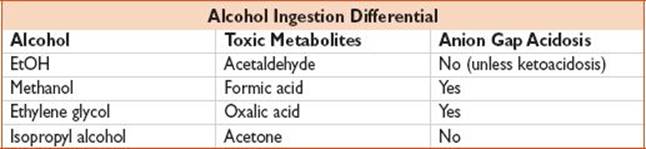
ETHANOL
History
• EtOH ingestion, found down, lethargy, nausea, vomiting, ± associated trauma, ± aspiration, gastritis
Physical Findings
• CNS, respiratory depression, slurred speech, ataxia, nystagmus
Evaluation
• Bedside glucose (hypoglycemia common in alcoholics), ± BAL (if ingestion uncertain), ± CBC/BMP/LFTs/lipase, ± ECG (if pulse if irregular), ± magnesium level
Treatment
• Maintain airway, serial exams, ± IVF/thiamine/folate (given but may not be necessary)
Disposition
• Ambulating w/o ataxia + speaking clearly → d/c
Pearls
• R/o head trauma, CNS infection, Wernicke encephalopathy, alcoholic ketoacidosis, hypoglycemia, alcohol withdrawal/DT, coingestions, SI/HI
• Known EtOH ingestion/intoxication in pt w/ h/o same does not require lab & can be observed until clinically sober
METHANOL
Definition
• Ingestion of methanol (peak levels 30–60 min, 24–30 h ½ life, hepatic metabolism)
History
• Drinking: Paint solvents/antifreeze/windshield-washing fluid/canned fuels/gasoline additives, shellac/copy machine fluid/home heating fuels
Physical Findings
• CNS depression, vomiting, papilledema/hyperemia, visual changes/loss, gastritis
Evaluation
• ↑ Methanol level, ↑ Osmol gap, ↑ anion gap (profound), chemistries, ABG
Treatment
• Based presumptive Dx if levels delayed, maintain airway
• Fomepizole: Loading dose (15 mg/kg in 100 mL D5W over 30 min) → maintenance (10 mg/kg q12h × 4 doses → 15 mg/kg q12 to methanol concentration <20/dL)
• Folate 50 mg IV q4h until resolution of acidemia (cofactor to convert formic acid → CO2 + H2O)
• Dialysis: Absolute indications → visual impairment + detectible methanol level or >50 mL/dL, osmol gap >10, ingestion >1 mg/kg, severe acidosis, renal failure
Disposition
• Admit
ETHYLENE GLYCOL
Definition
• Ingestion of ethylene glycol (peak levels 30–180 min, 3–7 h ½ life, 70% hepatic metabolism)
History
• Drinking: Antifreeze, coolants, paint, polishes, detergents, fire extinguishers
Physical Findings
• 3 phases: <12 h → ↓ CNS (like EtOH), gastritis; 12–24 h → ↑ HR/RR/BP/SOB; >12 h → ATN (oxylate crystal deposition)
Evaluation
• Ethylene glycol level, ↑ osmol gap, ↑ AG, calcium oxylate crystals in urine, beta-hydroxybutyrate (used to distinguish from alcoholic ketoacidosis)
Treatment
• Based presumptive Dx if levels delayed, maintain airway
• Fomepizole: Loading dose (15 mg/kg in 100 mL D5W over 30 min) → maintenance (10 mg/kg q12h × 4 doses → 15 mg/kg q12h to methanol concentration <20/dL)
• Folate/thiamine 100 mg IV q6h/pyridoxine 50 mg IV q6h until resolution of acidemia (cofactors in oxalic acid metabolism)
• HD: Severe acidosis (pH <7.25) + osmol gap >10, renal failure (Cr >1.2 mg/dL), ethylene glycol level >50 mg/dL, deterioration despite supportive care
Disposition
• Admit
Clinical Pearl
• Urine/gastric contents fluorescence w/ Woods lamp due to antifreeze additives (early)
ISOPROPYL ALCOHOL
Definition
• Ingestion of isopropyl alcohol (peak levels 30–180 min, 3–7 h ½ life, 80% hepatic metabolism, lethal dose 2–4 mL/kg)
History
• Drinking: Rubbing alcohol, paint thinner, solvents, skin/hair products, nail polish remover
Physical Findings
• Profound ↓ CNS (2–4 × EtOH), fruity odor on breath, respiratory depression, ↓ BP, gastritis
Evaluation
• Chemistries, UA, FSG, isopropyl level, nl AG, ↑ osmol gap, falsely ↑ Cr (from acetone)
Treatment
• Based presumptive Dx if levels delayed
• Supportive (rarely lethal)
• Dialysis: Refractory hypotension, levels >500 mg/dL
Disposition
• Admit
ALCOHOL WITHDRAWAL
Definition
• Abrupt cessation or significant reduction in alcohol intake (begins 6–24 h/peaks 48–72 h after last drink)
History
• Heavy alcohol use w/ cessation, insomnia, anorexia, nausea, vomiting, restlessness, diaphoresis, sz
Physical Findings
• Tremulousness, szs (25% of pts at 6–48 h), delirium, hallucinations (visual > auditory), autonomic hyperactivity (tachycardia, HTN, irritability, hyperreflexia), delirium tremens (rare/serious, 24 h–5 d after last drink): Tremor/autonomic hyperactivity/confusion/hallucinations/low-grade fever
Evaluation
• Bedside glucose testing, CBC, BMP, LFTs/coags (if liver Dysfxn suspected), BAL
Treatment
• Glucose (if hypoglycemic), thiamine, lorazepam 2 mg IV for sz, IV/IM/PO long-acting BZD (ie, lorazepam 1–4 mg IV q10–30min to sedation, diazepam 5 mg IV q5–10min to sedation, chlordiazepoxide), phenobarbital as 2nd-line
Disposition
• Admit for if requiring IV medication/DTs ± ICU
Clinical Pearls
• Rarely fatal (increased w/ aspiration due to sz) when treated appropriately
• May require very large doses of IV BZD to control/treat