
Pneumonia
History
• Typical (eg, Streptococcus, Klebsiella, Haemophilus influenzae): Acute onset of fever/chills, SOB, CP, productive sputum
• Atypical (eg, mycoplasma): Low-grade fever, mild to moderate SOB, dry cough, GI sx
• Influenza: Fevers/chills, myalgias, malaise, HA, sore throat, nonproductive cough
• Legionella: Causes severe PNA in elderly. A/w hyponatremia, GI sx.
• HCAP
• Definition: PNA w/i 90 d of 2+ day hospitalization, residing in nursing home or long-term care, treated w/ IV abx in prior 30 d, a/w chemotherapy, wound care or after a hospital or HD clinic visit, or contact w/ an MDR pathogen
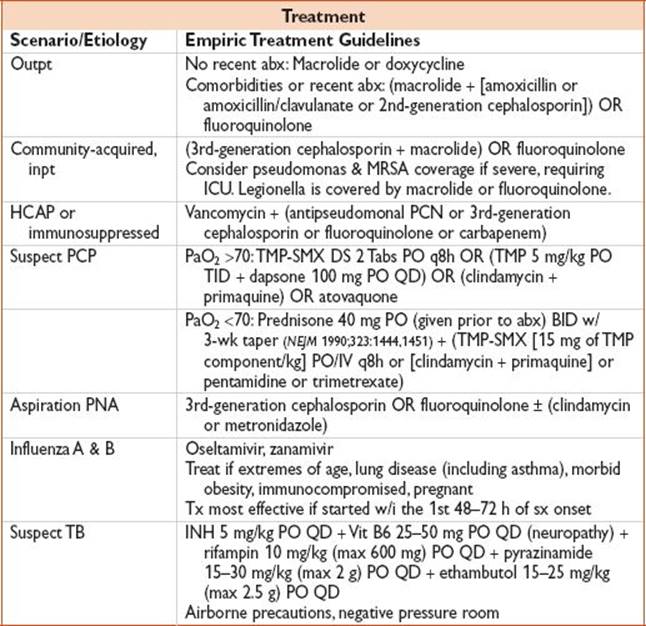
• At risk for drug-resistant Streptococcus, MRSA, pseudomonas
• Always ask about TB/HIV RFs
• TB: Homeless, HIV+, IVDA, incarceration, travel to endemic region; present w/ blood-tinged sputum, night sweats, fevers, weight loss
• PCP: Usually subacute w/ tachypnea in HIV w/ CD4 <200 or total lymphocytes <1000
Physical Exam
• Fever, tachycardia, tachypnea, rales, decreased breath sounds
• PNA unlikely w/ nl VS and clear lungs, except in elderly, infants, immunosuppressed
Evaluation
• Not everyone w/ a cough needs a CXR; reserve for abnl VS, extremes of age, concerning comorbidities, pts requiring hospitalization
• CXR: Focal consolidation (typical); diffuse interstitial pattern (atypical); bat-wing pattern (PCP); hilar adenopathy, calcified or cavitary apical lesions (TB)
• CBC, Chem 7. If suspecting sepsis, check lactate. Blood cultures not routinely indicated, but obtain if may require ICU w/i 24 h. Consider urine legionella antigen in elderly, hyponatremic. Consider influenza during epidemics. If suspect PCP, check LDH, ABG.
Disposition
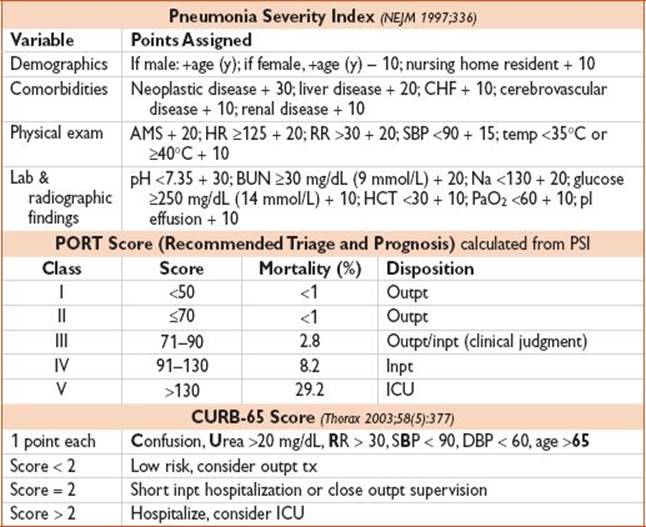
• CAP: See PNA Severity Index Score & CURB-65 (below)
• HCAP: Generally requires admission for IV abx
• PCP: Inpt unless SpO2 >95% w/o desaturation on exertion
• TB: Inpt, reported to Dept of Health
Pearls
• At the time of this writing, JCAHO & CMS mandate that abx must be delivered in w/i 6 h of the Dx of PNA. Blood cultures should be drawn prior to abx if drawn in ED. Order cultures in all pts who may go to ICU w/i 24 h or w/ severe disease, cavitary lesions, or significant comorbidities (Ann Emerg Med 2009;54:704).
• Consider social factors if discharging pt w/ PNA (eg, ability to comply w/ regimen)
Acute Bronchitis
Etiology
• Most commonly viral: Parainfluenza, adenovirus, rhinovirus, influenza
• Atypical bacteria ∼5% of cases; pertussis often occurs in epidemics
History
• Cough (dry or wet), self-resolving fever, often URI sxs, myalgias, wheezing
• Posttussive emesis, whoop, duration >1 wk a/w pertussis (JAMA 2010;304(8):890)
• All-cause median duration of cough is 18 d; pertussis was once called “100-day cough”
Physical Exam
• Fever is uncommon (consider influenza or PNA); may have chest wall tenderness from muscle strain; lungs often clear but up to 40% have bronchospasm/wheeze
Evaluation
• CXR nl or bronchial wall thickening; mild leukocytosis
• CXR not routinely needed: Reserve for abnl VS, extremes of age, comorbidities
Treatment
• Supportive care, antipyretics; abx NOT routinely indicated
• Bronchodilator (albuterol MDI 2 puffs QID) esp if wheezing heard or h/o asthma
• Antitussive (codeine 30 mg q4h, hydrocodone 5 mg q6h; Tessalon Perles 100 mg TID)
• No good evidence for or against OTC expectorants, decongestants, or antihistamines (Cochrane Database Syst Rev 2012;8:CD001831)
• Abx not routinely indicated (Cochrane Database Syst Rev 2012;CD000245)
• Reserved for elderly, significant comorbidities, high suspicion for pertussis
• Azithromycin 250 mg × 5 d or doxycycline 100 mg BID × 7 d, to cover pertussis
• See PNA section for influenza tx guidelines
Disposition
• Discharge home w/ PCP f/u as needed; pts will likely recover in 2–3 wk