

TICK-BORNE DISEASES
Lyme Disease (Borrelia burgdorferi) (Clin Infect Dis 2006;43(9):1089)
History
• 1/3 recall h/o tick bite. Often by I. scapularis (deer tick) in endemic area b/w May & August, or of exposure to wooded areas, incubation period 3–31 d.
• Tick must be attached for >36 h to cause infection
• Rash w/ central clearing, may last 2–3 wk; malaise, fatigue
Findings
• Progression can result in polyarthritis, cardiac conduction dz, neurologic sequelae
• Rash: Erythema migrans (absent in 20–40%)
• Small bump at site of inoculation → erythema w/ bright red outer border & central clearing (“bull’s eye,” “target lesion”)
• Up to 15 cm in diameter, gradually resolves as systemic sxs progress
• Lyme carditis – AV block &/or myopericarditis
• Lyme meningitis; does not present as classic bacterial meningitis
• Early: HA, CN palsy (VII) in 50%, radiculoneuritis, erythema migrans
• Late: Neurocognitive Dysfxn (ie, encephalopathy)
Evaluation
• Testing not recommended for pts w/ only erythema migrans (empiric Dx)
• For pts w/ nonerythema migrans presentations: First antibody screen assay (EIA), if positive, obtain immunoblot. Both results positive required to confirm Dx.
• ECG (AV block), CSF may be considered in pts w/ neurologic involvement
Treatment
• Tick removal: Using forceps or tweezers, grasp the tick as close to skin as possible, pull upward w/ steady pressure. Disinfect site, save tick for identification.
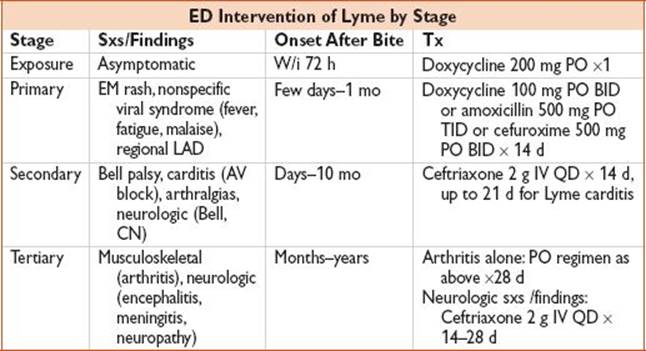
• See table, consider Rheum consult
• Avoid tetracycline in pregnant pts
Dispositions
• D/c w/ abx regimen, PCP f/u unless has symptomatic AV block/syncope
Pearls
• Deer tick tiny (head of pin) vs. dog tick (larger, more, common, don’t transmit Lyme)
• Most common tick-borne dz in US; 90% of cases in MA, CT, RI, NY, NJ, PA, MN, WI, CA
Rocky Mountain Spotted Fever (Rickettsia Rickettsii) (MMWR Recomm Rep 2006;55(RR-4):1)
History
• Fever, myalgias, HA, petechial rash, h/o being in tick area, recent tick bite (60%)
• Fever >102°F w/i 3 d after tick bite, severe HA, myalgias, confusion, abd pain, N/V
Findings
• Multisystem dz; Temp >102°F, may be ↓ BP on presentation
• Rash (85–90%): Petechial rash typically starts at wrist & ankles; may be diffuse at onset
• Rash classically on palms & soles occurs late in course (after 5th day of sxs), spares face
• CNS: Encephalitis, confusion, ataxia, coma, sz, CN palsy, permanent blindness & deafness
• GI: Abd pain, N/V, diarrhea, guaiac + stools, jaundice
Evaluation
• IFA assay most commonly used
• CBC (thrombocytopenia, anemia), Chem (hyponatremia, ↑ BUN), LFTs, coags, blood cx
• CXR if appear toxic or abnl lung findings
• CT or MRI for AMS may show infarction, edema, meningeal enhancement
• CSF may show pleocytosis, nl glucose, elevated protein
Treatment
• Intubation if indicated, resuscitation; dialysis, fluids, PRBC + platelets if indicated
• Abx: Tetracyclines (doxycycline), chloramphenicol
Disposition
• Most require hospitalization, consider ICU (rapid progression)
Pearls
• R. rickettsii infected endothelial cells causing small, medium vessel vasculitis
• Mortality 1.4%, due to delay in Dx & tx
• Seasonal outbreak: 90% from April 1–Sept 30; >50% in NC, OK, SC, AR, TN, GA
Ehrlichiosis
History
• Travel to endemic area in spring/early summer, tick bite; 5–14 d incubation
• Fever, myalgias, malaise, HA, cough, dyspnea, shaking chills, N/V
Findings
• Fever, LAD (<25%), variable rash, meningitis uncommon
Evaluation
• CBC (↓ WBC, ↓ plat), ↑ LFT, LDH, ↑ ESR; blood cultures not helpful
• PCR most sens during acute infection, serologies, peripheral smear
• CT/LP if severe HA to R/O meningitis, may show pleocytosis, mildly elevated protein
Treatment
• Analgesics, resuscitation, abx: Doxycycline 100 mg IV/PO BID × 10 d
Disposition
• Admit for supportive tx
Pearls
• Obligate intracellular gram-negative bacteria
• Vectors: Lone star tick & Ixodes; reservoir hosts: White-tailed deer, white-footed mouse
• Peak in spring & early summer; most cases in MO, AR, OK, TN, MD, CT WI, NY
• Mortality <2%
Babesiosis (Clin Infect Dis 2006;43(9):1089)
History
• Travel to endemic areas b/w May & September, tick bite; 1–4 wk incubation
• Usually asymptomatic in healthy host; affects elderly, immunocompromised, asplenic
• Fever, weakness, fatigue, HA, photophobia, AMS, cough, SOB, N/V, abd pain, arthralgias, chills, myalgias, anorexia, cough
Findings
• Fevers, rigors, diaphoresis, AMS, jaundice, renal failure, hepatosplenomegaly, petechiae
Evaluation
• CBC (hemolytic anemia), ↓ haptoglobin, ↑ LFTs, UA (proteinuria or hematuria)
• Wright or Giemsa peripheral blood smear; PCR, immunofluorescence Ab testing
• Serial blood smear may show parasites
Treatment
• Resuscitation, symptomatic tx, airway management
• Early abx: Atovaquone IV + azithromycin IV OR clindamycin IV + quinine PO
• RBC exchange transfusion if parasite load >10%, severe anemia, end-organ Dysfxn
Disposition
• Admit for ongoing supportive therapy, abx
• Most pts recover spontaneously in 1–2 wk, fatigue may continue for months
Pearls
• Protozoan parasite Babesia transmitted by tick or blood transfusion from infected individual
• Peak in May–October; found in Europe & US (MA, NY, RI, CT, upper Midwest, Northwest)
• Mortality 10% (US), 50% (Europe); if symptomatic
MOSQUITO-BORNE DISEASES
Malaria (WHO Guidelines for the Treatment of Malaria, 2nd ed., 2010)
History
• Travel to Central & South America, Sub-Saharan Africa, India, SE Asia, Middle East, Caribbean, South Central Asia; incubation period 7–30 d, may present months after
• Paroxysmal chills, sweats, & high fevers q48–72h
• Fever, cough, fatigue, myalgias, malaise; less common anorexia, N/V, diarrhea, HA
Findings
• Fever, hypotension, tachycardia, may see jaundice, signs of anemia, splenomegaly, icterus
• Severe malaria: AMS, ≥2 szs, pulm edema, HD unstable, >40˚C, DIC, severe anemia, renal failure, hypoglycemia, hyperparasitemia, acidosis, hyperbilirubinemia
• Cerebral malaria: AMS, meningitis, szs, encephalopathy; 15–20% mortality even w/ tx
Evaluation
• CBC, Chem, haptoglobin, UA, blood cx, thick & thin blood smear, rapid antigen tests
• Triad of thrombocytopenia, ↑ LDH, atypical lymphocytes
• Head CT/LP if AMS or encephalopathy to look for cerebral malaria
• CXR if signs of pulm edema
Treatment
• Airway management, IV access & IV fluid resuscitation, infectious dz consultation
• Prophylaxis regimen often recommended; depends on region of travel
• Use DEET & insect repellent, bed nets w/ permethrin, long-sleeved clothing
• Tx regimen dependent on geography, which species, & severity of dz
• Watch QT interval when giving antimalarials
Disposition
• Admit if suspected or confirmed, if child, pregnant, or immunodeficient
• ICU if end organ sxs noted, signs of cerebral malaria
• Thin & thick blood smears should be performed qwk × 4 after d/c to ensure resolution
Pearls
• Plasmodium (ovale, vivax, malariae, falciparum) cause malaria, transmitted through bite of infected female Anopheles mosquito, causing systemic infection of erythrocytes
• P. falciparum most severe: Can cause cerebral malaria, pulmonary edema, renal failure, anemia; highest occurrence in Sub-Saharan Africa
• P. vivax & P. ovale produce dormant form in liver, usually causes uncomplicated malaria
• 2 million deaths annually, majority in kids <5 y/o, ∼90% in rural Sub-Saharan Africa
• Sickle cell trait, thalassemia, Hemoglobin C disease & G6PD deficiency are protective
• Pregnant women up to 10× more likely to contract & develop severe malaria, ↑ M&M
Yellow Fever (Wkly Epidemiol Rec 2003;78(40):349)
History
• Travel to endemic area (Sub-Saharan Africa [90%] & South America), incubation 3–6 d
• Abrupt onset fever & chills, HA, back pain, myalgias, N/V, transient remission
Findings
• AMS, fever, relative bradycardia, conjunctival injection, jaundice, epigastric tenderness, hepatomegaly, petechiae
• Toxic phase (15%): ↑ fever, HA, N/V, abd pain, somnolence, hematemesis, jaundice
• Late: ↓ BP, shock, confusion, coma, DIC, hemorrhage
• Liver is the most affected organ: Hepatocellular damage (steatosis, necrosis); bleeding
• Kidney is also affected: Renal insufficiency, albuminuria, ATN
• Cardiac: Fatty infiltration of myocardium → myocarditis & arrhythmias
Evaluation
• CBC (leukopenia, thrombocytopenia), ↑ LFTs, abnl coags, ↑ BUN/Cr, fibrinogen (DIC), ↓ ESR, serology, viral isolation
Treatment
• Resuscitation, supportive, symptomatic tx; no antiviral meds approved
• Live attenuated vaccine available for prevention, extremely effective
Disposition
• Admit for supportive care
Pearls
• Flavivirus transmitted by A. aegypti mosquito during tropical wet & early dry season, causes viral hemorrhagic fever
• Mortality 5–10%, if hemorrhagic phase: 20–50% mortality
• Mandated reporting to WHO, local health dept
Dengue Fever (WHO Dengue Guidelines for Diagnosis, Treatment, Prevention and Control; 2009)
History
• Travel to endemic areas: Mostly SE Asia, Central America, Western Pacific, sometimes from Eastern Mediterranean, Africa
• Sxs begin after 4–10 d incubation; N/V, abd pain
• High fever: Abrupt onset × 1–7 d, biphasic, w/ HA, aches, bleeding
• Rash: Characteristically bright red blanching petechiae, usually 1st on lower limbs & chest → morbilliform, maculopapular & sparing palms & soles → desquamation
• Bone pain: Most often in legs, joints, & lumbar spine after onset of fever; ↑ severity
Findings
• Hemorrhagic fever (DHF) or shock syndrome (DSS) occur during 2nd infection by different dengue virus
• Fever, ↓ BP, rash, LAD, hemorrhage (petechiae, purpura, epistaxis, GIB, menorrhagia)
• DHF: High fever, hepatomegaly, hypotension, DIC; begins w/ sudden ↑ in temp & flu sxs
Evaluation
• CBC (↑ Hct, ↓ plat, ↓ WBC), Chem (↑ BUN), ↑ LFTs, guaiac, DIC panel, ELISA, lactate
• CXR, head CT (if AMS), US, viral culture, dengue antigen tests, PCR, viral serologies
Treatment
• Aggressive supportive therapy, IVF, fluid status important 2/2 to plasma leakage
Disposition
• Admit for supportive tx
Pearls
• Caused by dengue virus (Flavivirus) infection, transmitted by A. aegypti mosquitoes
• Called “break-bone fever” due to acute onset severe HA, muscle & joint pains
• Benign acute febrile illness that can cause bleeding or DIC in small # of cases but can lead to lethal DHF
West Nile Disease
History
• Outdoor exposures in area of outbreak during summer months, 2–15 d incubation
• Fever, flu-like illness, N/V, malaise, myalgias, back pain, HA, confusion, rash, diarrhea
• Severe: Muscle weakness, flaccid paralysis, sz, AMS
Findings
• Low-grade fever, hepatomegaly (10%), splenomegaly (20%), generalized LAD
• Rash: Erythematous maculopapular & morbilliform on neck, trunk, arms, legs
• CNS: AMS, confusion, coma, meningismus, papilledema, CN abnormalities, flaccid paralysis, sz, ataxia, tremor, involuntary movements
Evaluation
• CBC (↓ WBC, ↓ lymphocytes, anemia), Chem (↓ Na), ↑ LFTs; ↑ lipase, serologies for IgM Ab
• MRI, CSF: Mild ↑ protein, mild ↑ leukocyte, nl glucose, serologies
Treatment
• Supportive care, airway management, resuscitation
• Limited evidence for interferon & IVIG in case series & reports
Disposition
• Admit for supportive tx, may need rehabilitation from neuro cx
Pearls
• Flavivirus transmitted by several types of mosquito to horses, dogs, birds; crosses the blood–brain barrier to infect nervous system
• Has been reported throughout the world
• Excellent prognosis unless elderly or w/ other comorbid factors
Eastern Equine Encephalitis
History
• Outdoor exposure to area of outbreak in summer or early fall
• Fevers, chills, malaise, weakness, HA, myalgias; rapid progression to confusion, coma, N/V
Findings
• Similar to any other encephalitis; fever, tachycardia, tachypnea
• Neuro: Papilledema, sz, nuchal rigidity, focal neuro abn, CN abnormalities, spastic paralysis
Evaluation
• CBC (↑ WBC), Chem (↓ Na), serologies (IgM), viral isolation from CSF, blood, tissue
• Head CT: Punctuate/intraventricular hemorrhage, focal edema, meningeal enhancement
• MRI, LP: CSF shows ↑ protein, ↑ RBC, ↑ WBC
Treatment
• Supportive care, airway management, resuscitation, corticosteroids, & anticonvulsants
Disposition
• Admit, likely to ICU; will need extensive rehab
Pearls
• Arbovirus transmitted subcutaneously by mosquito, birds serve as primary reservoir; virus causes acute inflammatory process mainly involving meninges
• Primarily found in North America (east of MS river; MI, MA, NY, NJ, NC, SC, FL, LA, GA); wooded areas near freshwater swamps, marshes; less commonly Central/South America
• Poor prognosis: 33–70% mortality in a few days, 90% morbidity, only 10% fully recover