
Definition
• UA (subtotal coronary thrombosis, angina that is new onset, crescendo, OR at rest, usually <30 min, ±ST depression &/or TWI); see above for CCS classification
• Rest angina: Angina occurring at rest & prolonged, usually >20 min
• New-onset angina: New-onset angina of at least CCS class III severity
• Increasing angina: Previously diagnosed angina that has become distinctly more frequent longer in duration, or lower in threshold (ie, increase by 1 or more CCS class)
• NSTEMI (same as UA but w/ +troponin)
• Consider calling cardiology for +Tn, ongoing CP
Routine Medical Therapies “MONAB”
• Morphine: Reasonable to use if there is uncontrolled ischemic CP despite NTG; typical dose 0.05–0.1 mg/kg IV
• O2: Supplemental O2 should be administered to pts w/ UA/NSTEMI w/ an arterial saturation less that 90%, respiratory distress, or other high risk features for hypoxia
• Nitrates: Pts w/ ongoing ischemia should receive NTG SL (0.4 mg) q5min for a total of 3 doses, after which assessment should be made about need for IV NTG if no CIs (CI w/ hypotension, RV infarct, concomitant PD inhibitor use w/i 24–48 h)
• Aspirin: 23% ↓ in death (ISIS-2, Lancet 1988;2:349); typical dose 162–325 mg PO
• Beta-blockers: Oral BB should be administered w/i 24 h of NSTEMI w/o CIs. Routine IV should not be used. It is reasonable to administer IV BBs to UA/NSTEMI pts who do not have 1 or more of the following: (1) signs of HF, (2) e/o low-output state, (3) increased risk of cardiogenic shock, (4) other CIs to BB therapy (RAD, heart block, etc.).
• Other: Often started as inpts include oral BBs, statins, ACE inhibitors/ARBs
Conservative vs. Early Invasive Strategy (JACC 2002;40:166)
• Conservative approach = selective angiography
• Medical tx w/ pre-d/c stress test
• Angio only if recurrent ischemia or strongly +ETT
• Early invasive approach = routine angiography w/i 24–48 h
• 25% ↓ MI, 34% ↓ rehospitalization for ACS & nonsignificant 8% ↓ death c/w cons (JAMA 2005;353:1095), but results dominated by peri-PCI MI; post-d/c benefits of INV c/w prior data
• No benefit to PCI w/i 24 h compared to PCI w/i 72 h (N Engl J Med 2009;360:2165)
• General tx approach
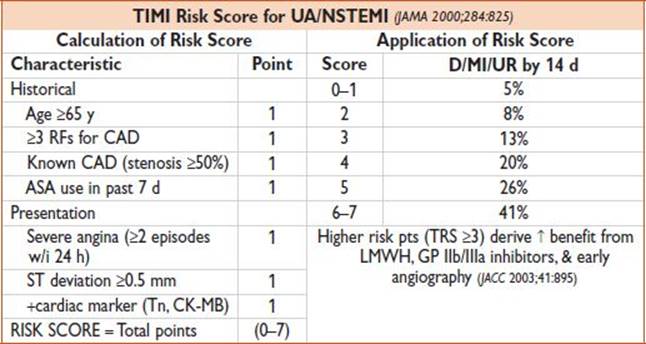
• If low-risk pt (–Tn, no ST ↓, & TRS 0–2)
• If ↓ EF, recent PCI, prior CABG then → INV strategy
• If not, then → CONS strategy (stress test once stabilized, before d/c)
• If high-risk pt (+Tn, ST ↓ >0.5 mm, or TRS ≥3) → INV strategy
• In those where an initial conservative strategy is selected, if recurrent sxs/ischemia, HF, or serious arrhythmias appear, then diagnostic angiography should be performed
Antiplatelet Therapy
• ASA 162–325 mg PO (crushed/chewed) should be given as early as possible in pts w/ UA/NSTEMI (VA Cooperative Study, NEJM 1983;309:396; NEJM 1988;319(17):1105)
If ASA allergy: Clopidogrel (300–600 mg LD followed by daily maintenance dose) should be administered
• Early invasive strategy
• Before PCI:
• Clopidogrel (NEJM 2001;345:494; PCI-CURE, Lancet 2001;358:527); or
• Ticagrelor (PLATO, NEJM 2009;391:1045); or
• An IV GP IIb/IIIa inhibitor, where eptifibatide & tirofiban are preferred
• At the time of PCI:
• Clopidogrel if not started before PCI; or
• Prasugrel (TRITON-TIMI, NEJM 2007;357:2001); or
• Ticagrelor (PLATO, NEJM 2009;391:1045); or
• An IV GP IIb/IIIa inhibitor, where eptifibatide & tirofiban are preferred
• Initial conservative strategy is selected, clopidogrel (300–600 mg LD) or ticagrelor (180 mg LD) should be added to ASA & anticoagulation therapy as soon as possible after admission
A loading dose of a P2Y12 receptor inhibitor is recommended for UA/NSTEMI pts for whom PCI is planned. One of the following regimens is used:
a. Clopidogrel 600 mg PO (J Am Coll Cardiol 2006;48:1339; CURRENT-OASIS 7, Lancet 2010;376:1233)
b. Prasugrel 60 mg PO (TIMI, Lancet 2009;373:732); should not be used in pts w/ a prior h/o stroke or TIA
c. Ticagrelor 180 mg PO (PLATO, Circulation 2010;122:2131)
• In those where an initial conservative strategy is selected, it may be reasonable to add eptifibatide or tirofiban to anticoagulant & oral antiplatelet therapy
• Tirofiban: 0.4 mcg/kg IV bolus over 30 min, then 0.15 mcg/kg/min; ↓ by 50% in CKD (PRISM-PLUS; NEJM 1998;338:1488)
• Eptifibatide: 180 mcg/kg IV bolus, then 2 mcg/kg/min; ↓ by 50% in CKD, avoid in dialysis pts (PURSUIT, NEJM 1998;339(7):436)
Anticoagulant Therapy
• Anticoagulant therapy should be added to antiplatelet therapy in UA/NSTEMI pts as soon as possible after presentation
• For pts undergoing invasive strategy, the following anticoagulant regimens are recommended:
• UFH w/ GP IIb/IIIa inhibitor: 50–70 U/kg bolus to achieve therapeutic ACT
• UFH w/o GP IIb/IIIa inhibitor: 70–100 U/kg bolus to achieve therapeutic ACT
• Bivalrudin: 0.75 mg/kg IV bolus, then 1.75 mg/kg/h infusion w/ or w/o UFH; preferred over UFH w/ GP IIb/IIIa inhibitor in pts at high risk of bleeding
• For pts in whom a conservative strategy is selected, regimens using either enoxaparin, UFH, or fondaparinux are recommended:
• UFH weight-based infusion w/ IV bolus 60 U/kg (max 4000 U) followed by infusion of 12 U/kg/h (max 1000 U) to maintain aPTT ∼50–75 s for 48 h or until revascularization
• Enoxaparin: If <75 y/o, 30 mg IV bolus, then 15 min later, 1 mg/kg SC q12h; If >75 y/o; no bolus, 0.75 mg/kg SC q12h; If CrCl <30 mL/min, 1 mg/kg q24h
• Fondaparinux: Initial 2.5 mg IV, then 2.5 mg SC the following day, CI in CrCl <30
Disposition
• Admission to CCU, step-down unit, or ward bed, depending on risk & whether conservative or early invasive approach is chosen
• Consider admitting to a CP/observation unit if pt deemed low risk, –Tn, & nondiagnostic ECG. Reconsider/admit pts w/ recurrent sxs, ECG changes, +Tn.
Guideline: Anderson JL, Adams CD, Antman EM, et al. ACC/AHA 2007 guidelines for the management of patients with UA/NSTEMI: A report of the American College of Cardiology/American Heart Association Task Force on Practice Guidelines. J Am Coll Cardiol. 2007;50(7):e1–e157.
Guideline: Anderson JL, Adams CD, Antman EM, et al. 2012 ACCF/AHA focused update incorporated into the ACCF/AHA 2007 guidelines for the management of patients with UA/NSTEMI: A report of the American College of Cardiology Foundation/American Heart Association Task Force on Practice Guidelines. J Am Coll Cardiol. 2013;61(23):e179–e347.