
Erythema Multiforme
Definition
• Acute, immune-mediated, mucocutaneous condition commonly caused by HSV & the use of certain medications. Often self-limiting, but may be recurrent or persistent.
• Erythema multiforme major denotes presence of mucosal involvement, where erythema multiforme minor denotes absence of mucosal involvement
• Originally thought to be on a spectrum of disorders including erythema multiforme major → SJS → TEN, but now classified distinctly
• Etiologies include idiopathic, infection (90%, esp HSV, M. pneumoniae, HCV, EBV), medication (esp NSAIDs, sulfa, AEDs, abx), malignancy, autoimmunity, immunization, etc.
History
• Pts w/ EM major may have prodromal malaise & fever days prior to rash
• Pts may experience itching/burning of skin & pain in mouth from oral lesions
• Hx should include signs & sxs of associated infection (HSV, mycoplasma) review of current or new medications/immunizations, & personal or FH of autoimmunity or malignancy
• Lesions typically appear acutely over 3–5 d & self-resolve over 1–2 wk
Physical Findings
• Can be macular/papular/vesicular, maculopapular eruption w/ peripheral clearing (target lesion) most characteristic, greater on extremities/palms/soles, & may be accompanied by oral, genital, or ocular mucosal erosions
• Commonly symmetric on extremities w/ predilection for extensor surfaces; palms & soles may be involved (see chart above)
• Mucosal & genital lesions present w/ edema, erythema, & progress to superficial erosions w/ pseudomembranous formation
Evaluation
• Clinical, but ultimate histopathologic Dx from skin biopsy
Treatment
• Discontinue inciting factors; recall that often self-limiting
• Supportive (pain control, oral antihistamines); oral lesions may benefit from oral anesthetic solutions/gels, oral antiseptic rinses, & oral corticosteroids if severe
• HSV & other infectious processes should be treated if inciting cause
Disposition
• D/c w/ f/u
Pearl
• Distinguishing features from SJS include the lack of significant erythematous/purpuric macules, truncal involvement, painful tender skin, & severe level of mucosal involvement which are all often more characteristic of SJS
Stephens-Johnson Syndrome (SJS)/Toxic Epidermal Necrolysis (TEN) SJS
Definition
• No universally accepted definition of SJS. Often described as a potentially life-threatening dermatologic condition characterized by an acute febrile illness w/ target lesions, involvement of at least 2 mucous membranes, w/ <20% TBSA skin involved.
• Mucous membranes involved in 92–100% of pts. Visceral involvement (sloughing of GI tract mucosa, endotracheal/bronchial erosions, hepatitis) not uncommon.
• Etiologies include infection, immunization, meds (NSAIDs, AEDs, abx, antigout, etc.), systemic dz, physical agents, etc.
History
• Prodromal febrile illness (malaise, HA, cough) w/ prodromal purpuric/erythematous target lesions, followed by rapid progression to skin detachment
• Pts may experience itching/burning/severe pain of skin & pain in mouth from oral lesions
• Hx should include signs & sxs of associated infection (HSV, mycoplasma) review of current or new medications/immunizations, & personal hx or FH of autoimmunity or malignancy
Physical Findings
• VS: Variably febrile, tachycardic, may be hypotensive
• Prodromal macular target lesions (bright pink/erythematous inner, lighter pink outer ring, & dark red/violaceous outermost ring). Often begins on the trunk where it is severe & spreads to extremities; palms & soles may be involved (see chart above).
• Rapid progression to skin detachment & +Nikolsky sign
• Extensive mucosal involvement in 2 or more sites w/ edema, erythema, & progression to superficial erosions w/ pseudomembranous formation
• <20% TBSA involvement characteristic of SJS
Evaluation
• Blood cx CBC, BMP, lactate, +Nikolsky sign (slight pressure w/ thumb → skin wrinkling, slides laterally, separates from dermis)
• Histopathologic Dx is gold standard
Treatment
• No definitive therapy other than supportive care
• Removal of inciting agent
• IVFs (replete as burns: Parkland formula), pressors if needed; phosphate repletion
• Increase room temperature from 30–32°
• Wound care similar to burns (débridement, bacitracin)
• Note: Plasmapheresis, immunomodulatory therapy, systemic corticosteroids, & IVIG have all been used w/ varied success; not usually initiated in ED
• Early Burn specialist consultation; ophthalmology consultation if ocular involvement
Complications
• Mucosal ulcerations may involve the trachea or bronchi, potentially leading to airway compromise
• GI involvement may result in dysphagia, odynophagia, & GIB
• Ocular involvement
• Superinfection secondary to breakdown of protective skin barrier
Disposition
• Burn unit admission
Pearls
• Mortality: 1–5%
• Superinfection common & sepsis w/ MOSF is the most common cause of death, but prophylactic abx not indicated
TEN
Definition
• No universally accepted definition of TEN. Often described as a potentially life-threatening dermatologic condition characterized by an acute febrile illness w/ widespread blistering & morbilliform or confluent erythema a/w skin tenderness, bullae/erosions on >10–20% TBSA or at least 3 or more anatomic areas involved.
• Thought of on a similar spectrum of dz, but more severe than SJS
• TEN generally drug induced (NSAIDs, abx, AEDs, antigout most common offenders), but food additives, fumigants, & contact w/ chemicals also factor
• Mucous membranes involved in 92–100% of pts. Mucositis can occur on conjunctiva, buccal, tracheal, bronchial, pharyngeal, esophageal, nasal, or urogenital regions.
History
• Prodromal febrile illness (malaise, fever, rhinitis, pharyngitis, pruritus) 2–3 d prior to rash
• Acute phase of TEN lasts 8–12 d characterized by persistent fever, mucositis, & generalized epidermal sloughing → epidermolysis over 2–3 d
• Pts may experience itching/burning/severe pain of skin & pain in mouth from oral lesions
• Hx should include signs & sxs of associated infection, URI sxs, & review of current or new medications/immunizations
Physical Findings
• VS: Variably febrile, tachycardic, may be hypotensive
• Painful burning eruption on face & thorax then spreading to rest of body; *target lesions usually absent in TEN compared to SJS
• Rapid progression to skin detachment & +Nikolsky sign
• Extensive mucosal involvement classically in 3 or more sites w/ edema, erythema, & progression to erosions & denudation
• >10–30% TBSA involvement SJS/TEN overlap, >30% TEN
Evaluation
• Blood cx CBC, BMP, lactate, +Nikolsky sign (slight pressure w/ thumb → skin wrinkling, slides laterally, separates from dermis), biopsy may be needed
• Histopathologic Dx is gold standard
Treatment
• Same as SJS (see above)
Prognosis
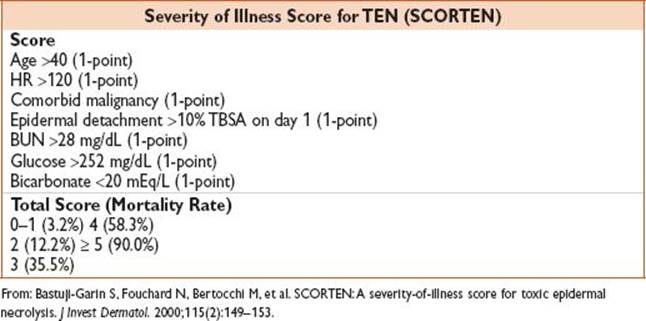
Disposition
• Burn unit admission
Pearls
• Mortality: 10–70%
• Superinfection common & sepsis w/ MOSF is the most common cause of death, but prophylactic abx not indicated
(Refer to Chapter 4, “Soft Tissue Infections” for other dermatologic emergencies: Staphylococcal Scalded Skin Syndrome and Toxic Shock Syndrome)