
Approach
• Treat anaphylaxis; give tetanus prophylaxis
• Consider x-ray for underlying fx or FB
• Assess for joint space violation, copious wound irrigation/wash out w/ NS; if heavily contaminated, do not close
• 24–48 h wound check for high-risk bites, esp in kids or unreliable pts
• National Poison Control Center (PCC): (800)222-1222
HUMAN & ANIMAL BITES
Human
History
• Laceration near MCP joint during altercation should be considered as a human bite (ie, “fight bite”); bacteria spread along tendon sheath deep into hand
Evaluation
• Consider x-ray to assess for fracture, air in joint, tooth fragments; no serology needed
• Extend & explore periarticular MCP joint injuries including in position that injury occurred
Treatment
• Augmentin (ampicillin/clavulanic acid) 875/125 mg BID × 5 d OR clindamycin 300 mg BID + ciprofloxacin 500 mg BID OR clindamycin 300 mg BID + TMP–SMX; if later/infected Unasyn (ampicillin/sulbactam) 1.5 g q6h
• Delayed primary closure if closure needed
Disposition
• Scheduled strict f/u in 24–48 h
Pearl
• Eikenella (most common), Staphylococcus, Streptococcus species found in mouth
Cat
Evaluation
• Consider x-ray to assess for fracture, air in joint, tooth fragments
• Extend & explore joint injuries including in position that injury occurred
Treatment
• Augmentin 875/125 mg BID, cefuroxime 500 mg BID OR doxycycline 100 mg BID
• Delayed primary closure only if cosmetically needed; 80% of cat bites become infected!
Disposition
• Scheduled strict f/u in 24 h
Pearls
• P. multocida most common organism
• Consider cat-scratch dz if pt has tender LAD 1 wk after bite/scratch
• Very high infection rate despite antibiotic use
• Consider antirabies prophylaxis (rabies immunoglobulin + vaccine) if unknown cat (see 4i)
Dog
Evaluation
• Consider x-ray to assess for fracture, air in joint, tooth fragments
Treatment
• Augmentin (ampicillin/clavulanic acid) 875/125 mg BID OR clindamycin 300 QID + ciprofloxacin 500 mg BID
• 1° closure after copious irrigation possible except on hand/foot; only 5% become infected
Disposition
• Scheduled strict f/u in 24 h
Pearls
• Polymicrobial infections
• Consider antirabies prophylaxis if unknown dog as above w/ cats (see 4i)
SNAKE BITES
Pit Vipers (rattlesnakes, copperheads, water moccasins, Mississauga)
History
• Pain & swelling around fang marks, attempt identification of snake if possible
Findings
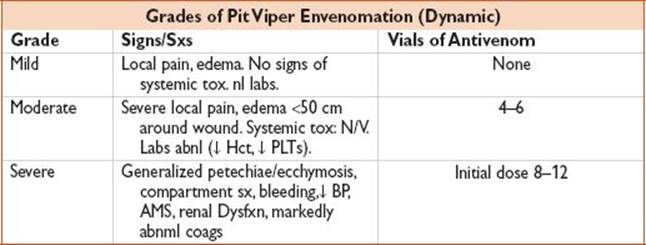
• Local (pain, swelling, ecchymosis), systemic (↓ BP, ↑ HR, paresthesias), coagulopathy (↓ PLTs, ↑ INR, ↓ fibrinogen), pulmonary edema, acidosis, rhabdomyolysis, neuromuscular weakness if bitten by Mojave rattlesnake
Evaluation
• Consult PCC/toxicologist; CBC, Chem 10, coags w/ fibrinogen & split products, CK, T&C, UA, CXR, x-rays to r/o retained fang; watch compartment pressures
Treatment
• Remove rings, constrictive clothing, general wound care, tetanus
• Antivenom (Crotalidae) if systemic effects or coagulopathy; surgical assessment if compartment syndrome; supportive care; no proven benefit w/ abx or steroids
Disposition
• D/c if absence of any findings 8–12 h post bite envenomation in healthy adults, 12–24 h in children/elderly, 12–24 h if concerns for Mojave rattlesnake
• ICU admission if antivenom given
Pearls
• Avoid oral or mechanical suction of wound, tourniquets, incision, & suction
• 25% bites are “dry strikes” (no effect); pit vipers identified by 2 fangs
Elapidae or Coral Snake (Micrurus fulvius)
History
• Bitten by brightly colored snake (black, red, & yellow bands), primarily in tx, FLA
Findings
• Neurotoxic effects from venom: Tremor/sz, ↑ salivation, respiratory paralysis, bulbar palsy (dysarthria, diplopia, dysphagia), usually less local tissue damage than Crotalinae
Evaluation
• Consult PCC/toxicologist; CBC, Chem 10, coags not usually indicated, UA, CXR, consider pulmonary function testing
Treatment
• Consult PCC before giving antivenom as higher risk for allergic rxn; surgical assessment if concern for compartment syndrome; supportive care (esp respiratory support)
Disposition
• 12–24 h observation; ICU admission if antivenin given
Pearl
• True coral snakes have red on yellow banding, nonvenomous snakes have red band on black background: “Red on yellow: Kill a fellow. Red on black: Poison lack.”
SCORPION BITES
Scorpion (Centruroides exilicauda)
History
• Burning & stinging w/o visible injury at bite site
Findings
• Usually no visible local injury; possible systemic effects include roving eye movements (pathognomonic), opisthotonos, ↑ HR, diaphoresis, fasciculations
• Mydriasis, nystagmus, hypersalivation, dysphagia, restlessness
• Severe envenomation may cause pancreatitis, respiratory failure, coagulopathy, anaphylaxis
Evaluation
• “Tap test”: Exquisite tenderness w/ light tapping in exilicauda stings; consult PCC/toxicologist
• CBC, Chem 10, coags, LFTs, CK, UA, CXR, ECG
Treatment
• Most bites self-limited, supportive care
• BZD for muscle spasm/fasciculations, pain control, tetanus, reassurance
• If severe systemic sxs, 1–2 vials scorpion antivenom; avail from AZ PCC
Disposition
• Admission for observation; ICU admission if antivenin given
Pearl
• Only C. exilicauda (bark scorpion) found in Western US produces systemic tox
SPIDER BITES
Brown Recluse (Loxosceles reclusa)
History
• Pt may not remember bite & initially have no pain, pain & pruritus develops over 2–8 h
• Severe rxn: Immediate pain & blister formation, necrosis & eschar over next 3–4 d
• Loxoscelism: Systemic rxn 1–3 d after envenomation; N/V, f/c, muscle/joint aches, sz, rarely renal failure, DIC, hemolytic anemia, rhabdomyolysis
Findings
• Necrotic blister 1–30 cm w/ surrounding erythema, petechiae
Evaluation
• Consult PCC/toxicologist, surgery/plastics consult for lesion >2 cm
• CBC, Chem 7, coagulation profile, UA
Treatment
• No antivenom; wound care, tetanus, supportive care (eg, hydration, abx, transfusion, HD), local débridement
• Consider dapsone 50–100 mg BID to prevent necrosis, hyperbaric O2 (controversial), steroids (controversial)
• Dapsone causes hemolysis, hepatitis; monitor LFTs, check G6PD level
Disposition
• Admission for observation
Pearl
• Located in S. Central & SW (desert) of US; violin-shaped marking on back
Black Widow (Latrodectus mactans)
History
• Immediate pain, then swelling, possible target-shaped lesion, can have unexplained severe abd/back pain, muscle cramps w/i 1 h
• Pain may continue intermittently for 3 d, is often a/w muscle weakness & spasm for weeks to months
Findings
• Severe rxns: HTN, respiratory failure, abd rigidity, fasciculations, shock, coma
Evaluation
• CBC, Chem 10, CK, coagulation profile, UA, abd CT (r/o acute abdomen), ECG
Treatment
• Antivenom if severe rxn: 1–2 vials over 30 min (after cutaneous test dose)
• Wound care, tetanus, supportive care: Benzodiazepines, analgesia
Disposition
• Admission for observation & pain control
Pearls
• Painful abdominal muscle cramps can mimic peritonitis
• Red hourglass-shaped marking on abdomen
HYMENOPTERA (BEE, WASP, STINGING ANT)
History
• Immediate pain & swelling at site of bite
Findings
• Local & systemic signs of allergic rxn can occur
Treatment
• Treat anaphylaxis/allergic rxn; local rxn treated w/ cleansing, ice packs, & elevation
• If present, stinger should be removed immediately by scraping it from the wound (bees)
Disposition
• Close wound care f/u; prescribe EpiPen in case of anaphylaxis
Pearls
• The more rapid onset of sxs, the more severe the rxn; IgE-mediated allergic rxn
• Rapid onset: 50% death in 30 min, 75% in 4 h; usually see fatal rxn following prior mild rxn
• Delayed rxn similar to serum sickness can present 10–14 d after a sting/bite
JELLYFISH STINGS
History
• Swimming in seawater w/ jellyfish
Findings
• Painful papular lesions & urticarial eruptions last minutes to hours
• Systemic rxns rare; vomiting, muscle spasm, paresthesias, weakness, fever, respiratory distress, Irukandji syndrome: Rare, severe chest/abd/back pain, HTN, GI sx
Evaluation
• CBC, Chem 10, CK, coagulation profile, UA, ECG
Treatment
• Analgesia, supportive care
• Tentacles should be removed w/ forceps, nematocysts should be scraped off w/ a knife/blade after dusting w/ talcum powder & covering w/ shaving cream
• Analgesia & after nematocyst removal wash w/ hot (40°C) water (helps w/ pain)
• Antivenom available for serious systemic effects (cardiopulmonary arrest, severe pain) from the Commonwealth Serum Laboratory in Melbourne, Australia
Disposition
• D/c if mild & pain controlled, Admission for observation o/w
Pearls
• Box jellyfish are severely toxic, can induce respiratory & myocardial arrest in minutes
• Use seawater/acid/vinegar (not urine) to wash; freshwater causes nematocysts to fire