
Approach
• Early airway assessment, determine need for intubation (soot in airway, edema, voice Δ, deep facial burns, transfer to burn center, ↓ O2 sat)
• 100% O2 or O2 by NRB mask until CO (10e) & other inhalation toxins assessed
• Evaluate for concomitant trauma (fall, blast injury); maintain c-spine precautions
• Start IVF resuscitation early (almost universally required)
• Keep room warm to ↓ insensate losses
History
• How burn occurred (explosion? closed space?), duration of exposure, type of burn
Findings
• Assess burn
Evaluation
• Mental status on extrication, assess degree of burn,% total body surface area
• Check CO level (10e), CBC, Chem 10, lactate, ABG, LFTs, coags, tox, T&S, UA, CXR
Treatment
• Early & generous analgesia: Morphine 5 mg IV q5–10min titrated to pain
• Airway management: Intubate early
• Toxic inhalation (cough, dyspnea, carbonaceous sputum, soot in oropharynx): Intubate or perform fiberoptic airway exam early; delay could cause ↑ airway edema → airway compromise, difficult/impossible intubation
• If >15% TBSA, aggressive IVF resuscitation, 2 LBIV through unburned skin
• Parkland formula calculates IVF requirement in 1st 24 h after burn:
• 4 mL × weight (kg) × BSA (2nd- & 3rd-degree burns)
• Give ½ over 1st 8 h, other ½ over next 16 h
• Urinary catheter placement: Target urine output: 30–50 mL/h
• Burn mgmt: Irrigate w/ NS, remove debris, clothing, jewelry, & ruptured blisters (prevent future infection)
• Apply Silvadene (silver sulfadiazine, antipseudomonal) ointment to denuded areas
• Bacitracin only on face (Silvadene may cause discoloration)
• Immediate escharotomy for full-thickness circumferential burns that compromise distal neurovascular status or significantly ↓ chest compliance
• Tetanus prophylaxis, no role for steroids or IV abx
Disposition
• Admit 2nd-degree burns 10–20% BSA (or 5–10% if <10 y/o), circumferential or if meet criteria below
Pearls
• Burns often progress in severity, watch for worsening burns
• Remove tar (asphalt burns) w/ mineral oil
• Consider cyanide w/ industrial/closed space fires, check lactate, treat w/ hydroxocobalamin
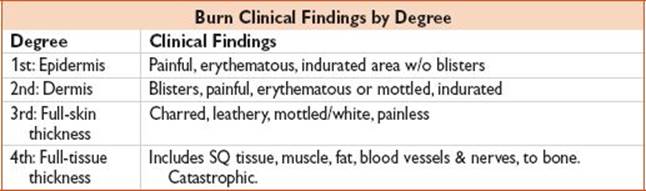
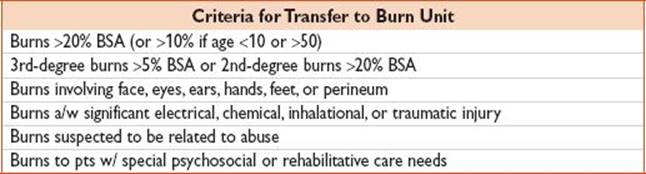
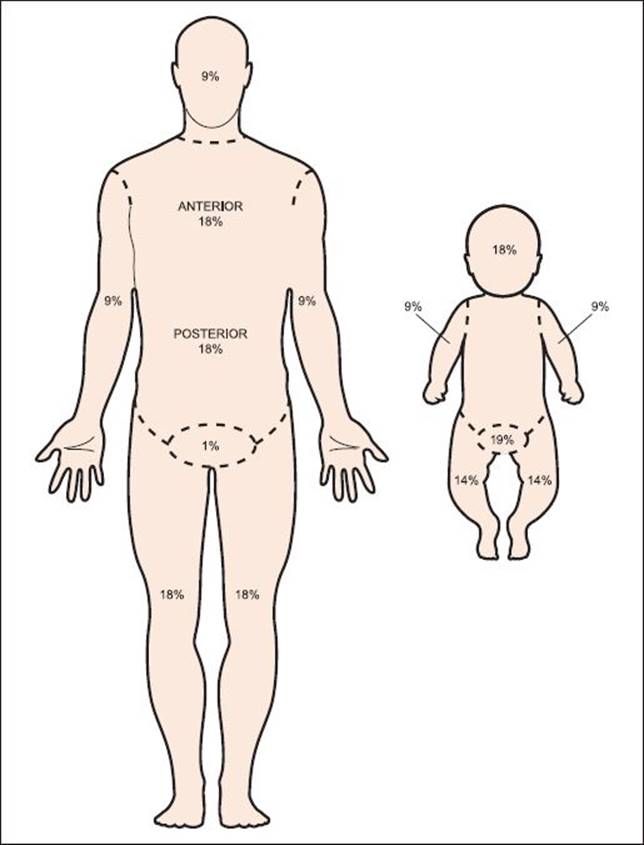
Figure 10.1 Reprinted with permission from: Mick NW, Peters JR, Egan D, et al. Blueprints Emergency Medicine. Philadelphia, PA: Lippincott Williams & Wilkins; 2006.