
Approach
• Evaluate & treat anyone w/ anaphylaxis immediately
• Anticipate the clinical course & consider intubation early

Definition
• Anaphylaxis – acute onset skin, mucosal or GI involvement w/ at least 1 of the following: Respiratory distress, hypotension, end-organ Dysfxn
History
• Exposures: Nuts, shellfish, medication (abx, NSAIDs, iodine contrast), insect, ACEI (angioedema), PMH: Hereditary angioedema
• Sx: SOB, swelling of tongue/throat, hoarseness, hives, N/V, abdominal cramps, syncope
Findings
• Urticaria, conjunctival injection, diffuse erythema, swelling (face, tongue, mouth), hoarseness, drooling, stridor, ↓ BP
Evaluation
• Assess airway, potential need for intubation; IV access & fluid resuscitation for anaphylactic shock
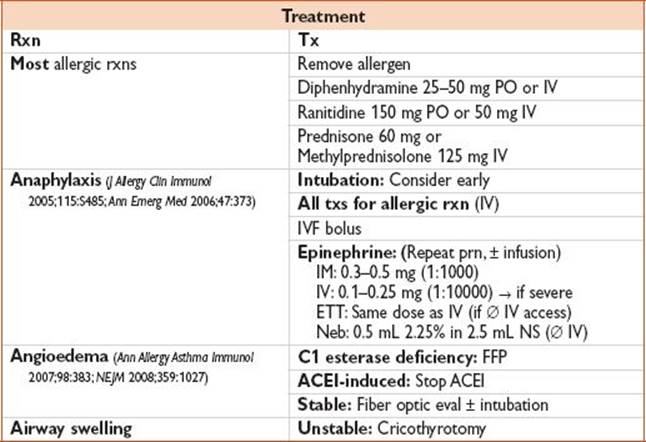
• H1 + H2 > H1 antagonist alone for urticaria (NEJM 2004;351:2203)
• IM vs. SC epinephrine: IM preferred → more rapid absorption (J Allergy Clin Immunol 2001;108:871)
• Epinephrine & cardiac dz: Pt should be on monitor; CAD = relat. CI
• Glucocorticoids may prevent recurrence or extended event, though evidence inconclusive
Disposition
• Home w/ 2 epi-pens (one home, one w/ pt)
• Pts w/ either (1) local rxns w/o airway involvement or (2) generalized rxn + presented to ED hours after exposure
• Admit to Obs unit/floor: Any pt requiring epinephrine
• Admit to ICU: Severe anaphylactic rxn, airway compromise
Pearls
• ACEI can cause angioedema at any time, independent of length of use
• PCN allergy: IgE-mediated allergy confers low (∼1%) risk of cross-reactivity w/ cephalosporins; however, avoid if rxn is severe (NEJM 2006;354:601)
Approach
• Evaluate & treat anyone w/ anaphylaxis immediately
• Anticipate the clinical course & consider intubation early
Definition
• Anaphylaxis – acute onset skin, mucosal or GI involvement w/ at least 1 of the following: Respiratory distress, hypotension, end-organ Dysfxn
History
• Exposures: Nuts, shellfish, medication (abx, NSAIDs, iodine contrast), insect, ACEI (angioedema), PMH: Hereditary angioedema
• Sx: SOB, swelling of tongue/throat, hoarseness, hives, N/V, abdominal cramps, syncope
Findings
• Urticaria, conjunctival injection, diffuse erythema, swelling (face, tongue, mouth), hoarseness, drooling, stridor, ↓ BP
Evaluation
• Assess airway, potential need for intubation; IV access & fluid resuscitation for anaphylactic shock
• H1 + H2 > H1 antagonist alone for urticaria (NEJM 2004;351:2203)
• IM vs. SC epinephrine: IM preferred → more rapid absorption (J Allergy Clin Immunol 2001;108:871)
• Epinephrine & cardiac dz: Pt should be on monitor; CAD = relat. CI
• Glucocorticoids may prevent recurrence or extended event, though evidence inconclusive
Disposition
• Home w/ 2 epi-pens (one home, one w/ pt)
• Pts w/ either (1) local rxns w/o airway involvement or (2) generalized rxn + presented to ED hours after exposure
• Admit to Obs unit/floor: Any pt requiring epinephrine
• Admit to ICU: Severe anaphylactic rxn, airway compromise
Pearls
• ACEI can cause angioedema at any time, independent of length of use
• PCN allergy: IgE-mediated allergy confers low (∼1%) risk of cross-reactivity w/ cephalosporins; however, avoid if rxn is severe (NEJM 2006;354:601)