
NEUROLOGY
WEAKNESS & NEUROMUSCULAR DYSFUNCTION
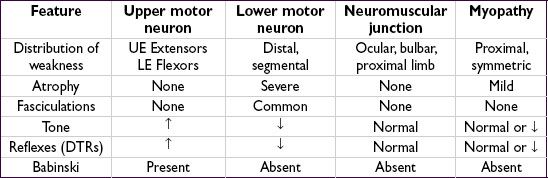
PERIPHERAL NEUROPATHIES
Etiologies
• Mononeuropathy (one nerve): entrapment, compression, trauma, DM, Lyme.
Commonly seen: median n. (carpal tunnel syndrome); ulnar n. (at elbow or wrist); common peroneal n. (at knee with habitual leg crossing); lateral femoral cutaneous n. (at inguinal ligament).
• Mononeuropathy multiplex (axonal loss of multiple, separate, noncontiguous nerves):
vasculitides, sarcoid, DM, Lyme, Sjögren, hereditary neuropathy with pressure palsies
• Small fiber neuropathy: (unmyelinated or thinly myelinated nerves): idiopathic, DM, CTD, alcohol, sarcoid, thyroid dysfxn, B12 defic, paraproteinemia, paraneo, celiac, hered.
• Polyneuropathy (multiple symmetric nerves, generally length dependent)
Demyelinating
acute: acute inflammatory demyelinating polyneuropathy (AIDP) = Guillain-Barré
subacute: meds (paclitaxel), paraneoplastic
chronic: idiopathic, DM, CIDP, hypothyroidism, toxins, paraproteinemia, hereditary
Axonal
acute: acute motor axonal neuropathy (AMAN), porphyria, vasculitis, uremia
subacute: DM, meds (cisplatin, paclitaxel, vincristine, INH, ddI), EtOH, sepsis, paraneo.
chronic: DM, uremia, lead, arsenic, HIV, paraproteinemia, B12 defic
Clinical manifestations
• Weakness, fasciculations, numbness, dysesthesias (burning/tingling), allodynia
• ± Autonomic dysfxn (orthostasis, bowel/bladder retention/incontinence, impotence)
• Depressed or absent DTRs (may be normal in small fiber neuropathy)
Diagnostic studies
• Distal symmetric polyneuropathy: start w/ HbA1C or glc tolerance test, B12, SPEP + SIEP
• EMG & NCS (often no change in first 10–14 d or in small fiber neuropathy)
• Electrolytes, BUN/Cr, CBC, TSH, LFTs, ANA, anti-Ro, anti-La, ESR, HIV, Cu, Lyme titers, genetic testing and heavy metal screening as indicated by clinical history and exam
• Autonomic testing/skin bx (small fiber), nerve bx (mononeuropathy multiplex)
• MRI if possible radiculopathy or plexopathy (after EMG)
Treatment of neuropathic pain
• Pharmacologic: pregabalin, gabapentin, TCAs (nortriptyline, amitriptyline), SSRIs (duloxetine, venlafaxine), tramadol, topical analgesics (lidocaine, capsaicin), opiates
• Nonpharmacologic: transcutaneous electrical nerve stimulation (TENS)
GUILLAIN-BARRÉ SYNDROME (GBS)
Definition & epidemiology
• Acute inflammatory demyelinating polyneuropathy (AIDP)
• Incidence 1–2 per 100,000; most common acute/subacute paralysis
• Precipitants in 60%: viral illness (CMV, EBV, HIV), URI (Mycoplasma), gastroenteritis (Campylobacter), Lyme, immunizations (no proven risk w/ current), surgery
Clinical manifestations
• Distal sensory dysesthesias and numbness often first symptoms, back pain also common
• Ascending symmetric paralysis over hours to days; plateau in 1–3 wk
• Hypoactive then absent reflexes
• Resp failure requiring mech vent occurs in 30%; autonomic instability & arrhythmias in 50%
• Fisher variant: ophthalmoplegia, ataxia, areflexia; associated with anti-GQ1b antibodies
Diagnostic studies (results may be normal in first several days)
• LP: albuminocytologic dissociation = ↑ protein w/o pleocytosis (<10 WBCs) seen in up to 50% of Pts in 1st wk, 75% by 3rd wk of symptoms
• EMG & NCS: ↓ nerve conduction velocity, conduction block, prolonged F wave latency
• FVC & NIF: to assess for risk of respiratory failure (cannot rely on PaO2 or SaO2)
Treatment
• Plasma exchange (Coch Data Syst Rev 2002;2:CD001798) or IVIg of equal efficacy and no additional benefit with both (Neuro 2012;78:1009), steroids not beneficial
• Supportive care with monitoring in ICU setting if rapid progression or resp. failure
• Watch for autonomic dysfunction: labile BP, dysrhythmias (telemetry)
• Most recover near baseline; axonal variant (~5%) with incomplete recovery; 3–5% mortality
MYASTHENIA GRAVIS
Definition & epidemiology
• Autoimmune disorder with Ab directed against acetylcholine receptor (AChR) in NMJ
• Prevalence: 1 in 7500; affects all ages, peak incidence 20s–30s (women), 60s–70s (men)
Clinical manifestations
• Fluctuating weakness w/ fatigability (worse w/ repetitive use, relieved by rest)
• Cranial muscles involved early → ocular (ptosis, diplopia) in 50%; bulbar (difficulty
chewing, dysarthria, dysphagia) in 15%. Often later progresses to generalized weakness.
• Limb weakness proximal > distal; DTRs preserved; minimal/no atrophy
• Exacerbations triggered by stressors such as URI, surgery, pregnancy or postpartum, meds (eg, aminoglycosides, procainamide, phenytoin); prednisone can worsen acutely
• Myasthenic crisis = exacerbation → need for respiratory assistance
• Cholinergic crisis = weakness due to overtreatment with anticholinesterase medications; may have excessive salivation, abdominal cramping and diarrhea; rare at normal doses
Diagnostic studies
• Bedside: ptosis at baseline or after >30 sec of sustained upgaze, improved with ice pack over eyes for 2–5 min, Se 77%, Sp 98%
• Neostigmine test: temporary ↑ strength; false  &
&  occur; premedicate w/ atropine
• EMG: ↓ response with repetitive nerve stimulation (vs. ↑ response in Lambert-Eaton)
• Anti-AChR Ab: Se 80%, 50% if ocular disease only; Sp >90%; muscle specific receptor tyrosine kinase (MuSK) Ab account for most AchR Ab cases
• CT or MRI of thorax to evaluate thymus (65% hyperplasia, 10% thymoma)
Treatment
• Thymectomy if thymoma; may lead to improvement in up to 85% Pts w/o thymoma
• Cholinesterase inhibitors (eg, pyridostigmine) are most rapid acting (benefit in 30–60 min)
• Immunosuppression: prednisone (benefit in wks) ± azathioprine, cyclophosphamide (benefit in 6–12 mo)
• Myasthenic crisis: treat precipitant
consider d/c anticholinesterase if suspect cholinergic crisis
immunosuppression with glucocorticoids (in monitored setting as risk for initial worsening)
IVIg or plasmapheresis of equal efficacy (Ann Neurol 2010;68:797)
ICU if rapid or severe (follow FVC, NIF)
MYOPATHIES
Etiologies
• Hereditary: Duchenne, Becker, limb-girdle, myotonic, metabolic, mitochondrial
• Endocrine: hypothyroidism, hyperparathyroidism, Cushing syndrome
• Toxic: statins, fibrates, glucocorticoids (incl. critical illness myopathy), zidovudine, alcohol, cocaine, antimalarials, colchicine, penicillamine
• Infectious: HIV, HTLV-1, trichinosis, toxoplasmosis
• Inflammatory (see “Rheumatology”): polymyositis, dermatomyositis, inclusion body myositis
Clinical manifestations
• Progressive or episodic weakness (not fatigue)
• Weakness most often symmetric, proximal > distal (stairs, rising from sitting, etc.)
• ± Myalgias (though not prominent or frequent), cramps, myotonia (impaired relaxation)
• May develop either pseudohypertrophy (dystrophies) or mild muscle atrophy
• Assoc. organ dysfxn: cardiac (arrhythmia, CHF), pulmonary (ILD), dysmorphic features
Diagnostic studies
• CK, aldolase, LDH, electrolytes, ALT/AST, PTH, TSH, ESR, HIV
• Autoantibodies (anti-Jo1, antisynthetase, anti-Mi-2, anti-SRP, ANA, RF)
• EMG/NCS: low-amplitude, polyphasic units with early recruitment, ± fibrillation potentials
• Muscle biopsy, molecular genetic testing (where indicated)