
PULMONARYQ
PULMONARY HYPERTENSION (PHT)
PA mean pressure >25 mmHg at rest
Pathobiology (NEJM 2004;35:1655)
• Smooth muscle & endothelial cell proliferation; mutations in bone morphogenic protein receptor 2 (BMPR2) in ~50% familial & ~26% sporadic cases of IPAH (NEJM 2001;345:319)
• Imbalance between vasoconstrictors and vasodilators
↑ vasoconstrictors: thromboxane A2 (TXA2), serotonin (5-HT), endothelin-1 (ET-1)
↓ vasodilators: prostacyclin (PGI2), nitric oxide (NO), vasoactive peptide (VIP)
• In situ thrombosis: ↑ TXA2, 5-HT, PAI-1; ↓ PGI2, NO, VIP, tissue plasminogen activator
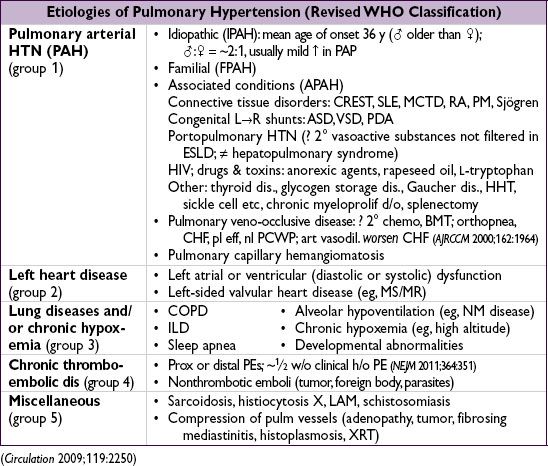
Clinical manifestations
• Dyspnea, exertional syncope (hypoxia, ↓ CO), exertional chest pain (RV ischemia)
• Symptoms of R-sided CHF (eg, peripheral edema, RUQ fullness, abdominal distention)
• WHO class: I=asx w/ ordinary activity; II=sx w/ ord. activ.; III=sx w/ min activ.; IV=sx at rest
Physical exam
• PHT: prominent P2, R-sided S4, RV heave, PA tap & flow murmur, PR (Graham Steell), TR
• ± RV failure: ↑ JVP, hepatomegaly, peripheral edema
Diagnostic studies & workup (Circ 2009;119:2250)
• IPAH yearly incidence 1–2 per million, ∴ r/o 2° causes
• CXR and high-resolution chest CT: dilatation & pruning of pulmonary arteries, enlargement of RA and RV; r/o parenchymal lung disease
• ECG: RAD, RBBB, RAE (“P pulmonale”), RVH (Se 55%, Sp 70%)
• PFTs: ↓ DLco, mild restrictive pattern; r/o obstructive and restrictive lung disease
• ABG & polysomnography: ↓ PaO2 and SaO2 (esp. w/ exertion), ↓ PaCO2, ↑ A-a gradient; r/o hypoventilation and OSA
• TTE: ↑ RVSP (but over or under by ≥10 mmHg in 1/2 of PHT Pts; Chest 2011;139:988), flattened (“D”) septum, TR, PR; r/o LV dysfxn, MV disease and congenital heart disease
• RHC: ↑ RA, RV, & PA pressures, nl PCWP (unless due to L-sided heart disease), ↑ transpulm gradient (PAP-PCWP >12–15, but can be nl if due to LV or valvular dis.), ↑ PVR, ↓ CO; r/o ↑ L-sided pressures shunt
• CTA (large/med vessel), V/Q scan (small vessel to r/o CTEPH), ± pulmonary angiogram: r/o PE and chronic thromboembolic disease
• Vasculitis labs: ANA (~40%  in PAH), RF, anti-Scl-70, anticentromere, ESR
• LFTs & HIV: r/o portopulmonary and HIV-associated PAH
• 6-min walk test (6MWT) or cardiopulmonary exercise testing to establish fxnl capacity
Treatment (NEJM 2004;351:1425; JIM 2005;258:199; Circ 2009;119:2250)
• Principles
1) prevent and reverse vasoactive substance imbalance and vascular remodeling
2) prevent RV failure: ↓ wall stress (↓ PVR, PAP, RV diam); ensure adeq. systemic DBP
• Supportive
Oxygen: maintain SaO2 >90–92% (reduces vasoconstriction)
Diuretics: ↓ RV wall stress and relieve RHF sx; gentle b/c RV is preload dependent
Digoxin: control AF, ? counteract neg. inotropic effects CCB
Dobutamine and inhaled NO for decompensated PHT
Anticoagulation: ↓ VTE risk of RHF; ? prevention of in situ microthrombi; ? mort. benefit even if in NSR (Circ 1984;70:580; Chest 2006;130:545)
• Vasodilators (right heart catheterization prior to initiation) acute vasoreactivity test: use inhaled NO, adenosine or prostacyclin to identify Pts likely to have a long-term response to oral CCB (vasoreactive response defined as ↓ PAP ≥10 mmHg to a level <40 mmHg with ↑ or stable CO); ~10% Pts are acute responders; no response → still candidates for other vasodilators (NEJM2004;351:1425)

• Treat underlying causes of 2° PHT; can use vasodilators, although little evidence
• Refractory PHT:
balloon atrial septostomy: R→L shunt causes ↑ CO, ↓ SaO2, net ↑ tissue O2 delivery
lung transplant (single or bilateral); heart-lung needed if Eisenmenger physiology
Figure 2-5 Treatment of PAH (modified from JACC 2009;54:S78)

Management of ICU patient
• Avoid overly aggressive volume resuscitation
• Caution with vasodilators if any L-sided dysfunction
• May benefit from inotropes/chronotropes
• Consider fibrinolysis if acute, refractory decompensation (eg, TPA 100 mg over 2 h)
Prognosis
• Median survival after dx ~2.8 y; PAH (all etiologies): 2-y 66%, 5-y 48% (Chest 2004;126:78-S)
• Poor prognostic factors: clinical evidence of RV failure, rapidly progressive sx, WHO (modified NYHA) class IV, 6MWT <300 m, peak VO2 <10.4 mL/kg/min, ↑ RA or RV or RV dysfxn, RA >20 or CI <2.0, ↑ BNP (Chest 2006;129:1313)
• Lung transplant: 1-y survival 66–75%; 5-y survival 45–55% (Chest 2004;126:63-S)