
HEMATOLOGY-ONCOLOGY
COLORECTAL CANCER (CRC)
Epidemiology and risk factors (Lancet 2010;375:1030; CA Cancer J Clin 2011;61:212)
• 4th most common cancer in U.S. men & women; 2nd leading cause of all cancer death
• Rare before age 40, w/ 90% of cases occurring after age 50. ~75% are sporadic.
• Family history: up to 25% of Pts have  FHx. Risk depends on # of 1st-degree relatives (w/ CRC or polyp) and their age at dx; ~5% have an identifiable germline mutation
Familial adenomatous polyposis (FAP): mutation in APC gene → 1000s of polyps at young age → ~100% lifetime risk; ↑ risk of thyroid, stomach, small bowel cancers
Hereditary nonpolyposis colorectal cancer (HNPCC): most common hereditary CRC (~3% of all CRC; NEJM 2003;348:919); mutations in DNA mismatch repair genes (eg, MSH2, MLH1) →microsatellite instability (MSI) → ↑ tumor progression → ~80% lifetime risk; predom. right-sided tumors; ↑ risk of endometrial, ovarian, stomach, urothelial, small bowel and pancreatic cancers.
Amsterdam criteria: ≥3 family members w/ HNPCC-related cancer, one of which is dx before age 50, affecting 2 successive generations.
• Inflammatory bowel disease: ↑ risk with ↑ extent and duration of disease
• Other factors a/w ↑ risk of CRC: diet rich in animal fat, ? smoking, ? diabetes/obesity
• COX-2: ↓ risk of adenomas w/ ASA & NSAIDs. ASA assoc. w/ ↓ CRC incidence, mets and mortality (Lancet: 2010;376:1741; 2012;379:1591 & 1602). ↓ COX-2-expressing CRC after prolonged ASA (NEJM 2007;356:2131). ASA effect limited to PIK3CA-mut CRC (NEJM 2012;367:1596). COX-2 inhib. effective but ↑ bleeding & CV events (NEJM 2006;355:873 & 885).
Pathology and genetics (NEJM 2009;361:2449; Nature 2012;487:330)
• Adenoma → carcinoma sequence reflects accumulation of multiple genetic mutations. ↑ risk of malig. w/ large (>2.5 cm), villous, sessile adenomatous polyps. Adenomas typically observed ~10 y prior to onset of cancer (both sporadic & familial).
• Genetic profile in sporadic CRC: APC (~80%), KRAS (~40%), TP53 (50–70%), DCC or SMAD4, or BRAF (~15%); chrom instability (majority) or mismatch repair defic (10–15%)
• Upfront genotyping may guide Rx; eg, benefit of anti-EGFR Ab cetuximab greater in KRAS wild-type than KRAS mutant (NEJM 2008;359:1757). BRAF mutation may guide clinical trials.
Clinical manifestations
• Distal colon: Δ bowel habits, obstruction, colicky abdominal pain, hematochezia
• Proximal colon: iron defic. anemia, dull vague abd pain; obstruction atypical due to larger lumen, liquid stool and polypoid tumors (vs. annular distal tumors)
• Metastases: nodes, liver, lung, peritoneum → RUQ tenderness, ascites, supraclavicular LN
• Associated with Streptococcus bovis bacteremia and Clostridium septicum sepsis
Screening (NEJM 2009;361:1179)
• Average risk: colonoscopy starting at age 50 & repeat q10y strongly preferred method
• ↑ risk: earlier and/or more frequent screening. FHx: age 40 or 10 y before index dx, then q5y. IBD: 8–10 y after dx, then q1–2y. Known or suspected familial syndrome: genetic counseling & very early screening (eg, age 20–25 y), then q1–2y.
• Imaging
Colonoscopy: test of choice as examines entire colon; 90% Se for lesions >1 cm. Flex sig less Se vs. colo and CTC (Gut 2009;58:241). If polyp found, re ✓ in 3–5 y. Removal of adenomatous polyps associated with lower CRC mortality (NEJM 2012;366:687).
Sigmoidoscopy: 21% ↓ incidence in CRC & 26% ↓ mortality in distal CRC (NEJM 2012;366:2345). Benefit may also be seen w/ 1-time flex-sig (Lancet 2010;375:9726).
CT colonography (CTC): c/w colonoscopy, ~90% Se for lesions ≥1 cm but considerably less for smaller lesions (NEJM 2008;359:1207). In high-risk Pts, Se only 85% for advanced neoplasia ≥6 mm (JAMA 2009;301:2453). At population level, ↑ participation w/ CTC, but ↓ yield vs. colonoscopy; ∴ similar screening overall (Lancet 2012;13:55).
• Biochemical fecal testing
Occult blood (FOBT): ↓ mortality (NEJM 1993;328:1365 & 2000;343:1603); 3 card home testing more Se (24% vs. 5%) than DRE/FOBT (Annals 2005;142:81). Repeat q1y.
Immunohisto for Hb: Se ~35% & ~80% for adv neoplasia & CRC (AJG 2012;107:1570)
DNA: ↑ Se,  Sp c/w FOBT, but less Se than colonoscopy (NEJM 2004;351:2704)
Staging (AJCC Cancer Staging Manual, 7th ed, 2010)
• TNM staging: Size/depth of primary (T), locoregional nodes (N), distant metastases (M). Staging is complex and based on pathologic correlation with observed survival data.
• Colonoscopy + biopsy/polypectomy + intraoperative and pathologic staging essential for evaluating extracolonic spread
• CT scans of chest and abdomen/pelvis (inaccurate for depth of invasion & malignant LN)
• Baseline CEA in Pt with known CRC has prognostic significance and is useful to fol- low response to therapy and detect recurrence; not a screening tool
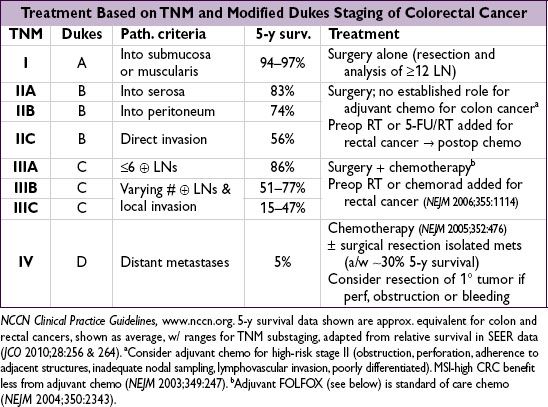
• Chemotherapy
FOLFOX (5-FU + leucovorin + oxaliplatin), FOLFIRI or CapeOx (NEJM 2004;350:2343)
± Bevacizumab (anti-VEGFA mAb, NEJM 2004;350:2335) or cetuximab (anti-EGFR mAb, NEJM 2004:351:337; benefit limited to Pts w/o KRAS mutation; NEJM 2008;359:1757)
Regorafenib (multikinase inhib.) ↑ survival in Pts w/ progressive metastatic CRC (Lancet 2013;381:303).