
INFECTIOUS DISEASES
FUNGAL INFECTIONS
Candida species
• Microbiology: normal GI flora; C. albicans & nonalbicans spp. (consider azole resistance if h/o Rx or nonalbicans; C. parapsilosis ↑ echinocandin resistant). Sensi testing available.
• Risk factors: neutropenia, immunosupp., broad-spectrum abx, intravascular catheters (esp. if TPN), IVDU, abd surgery, DM, renal failure, age >65
• Clinical manifestations
Mucocutaneous: cutaneous (eg, red, macerated lesions in intertriginous zones); oral thrush (exudative, erythematous or atrophic; if unexplained, r/o HIV); esophageal (odynophagia; ± oral thrush); vulvovaginal, balanitis
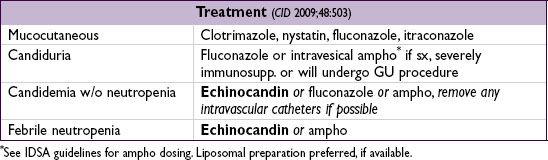
Candiduria: typically colonization due to broad-spectrum abx and/or indwelling catheter
Candidemia (#4 cause of health care assoc. bloodstream infxn): r/o retinal involvement (req ↑ Rx); endocarditis rare but serious (esp. w/ nonalbicans & prosthetic valve)
Hepatosplenic: intestinal seeding of portal & venous circulation; esp. in acute leukemia
Hematogenous dissemination: lung, brain, meninges, etc.
Cryptococcus (CID 2010;50:291)
• Epidemiology: immunosupp. (esp. AIDS) most susceptible; can occur in healthy host, esp. elderly, EtOH, DM. If from Pacific NW, consider C. gatti (↑ mortality in healthy host).
• Clinical manifestations
CNS (meningitis): HA, fever, meningismus, ↑ ICP, CN abnl, ± stupor, often subacute. Dx: CSF CrAg, India ink stain, fungal cx. Cell counts vary; serum CrAg >1:8 Se/Sp in AIDS.
Other sites: pulm, GU, cutaneous, CNS cryptococcoma. With any crypto dx, LP all Pts.
• Treatment
CNS: If ↑ ICP, repeat large-volume LPs or temp. lumbar drain; few require VP shunt
In HIV  or immunosupp. Pts, CNS Rx has induction (ampho ± flucytosine), consolidation and maintenance (fluconazole) phases (NEJM 2013;368:1291). If r/o CNS disease, then fluconazole. Dosing and duration vary by host.
Non-CNS disease in healthy Pts: fluconazole vs. observation, based on clinical setting
Histoplasmosis (CID 2007;45;807)
• Endemic: central & SE U.S. (esp. in areas w/ bird & bat droppings), river banks elsewhere
• Clinical manifestations
Acute: often subclinical, but may see mild to severe PNA ± cavitary & hilar LAN
Chronic pulm: ↑ productive cough, wt loss, night sweats, apical infiltrates, cavitation
Disseminated (typically in immunosupp.): fever, wt loss, HSM, LAN, oral ulcers, skin lesion, fibrosing mediastinitis, reactive arthritis, pericarditis
• Treatment: itraconazole (monitor levels); ampho ± steroids if severe or immunosupp.
Coccidioidomycosis (CID 2005;41:1217)
• Endemic: SW U.S. (San Joaquin or “Valley” fever)
• Clinical manifestations
Acute: 50–67% subclinical; PNA w/ cough, chest pain, fever, arthralgias, fatigue
Chronic pulm: nodule(s), cavity or progressive fibrocavitary PNA (can be asx or sx)
Disseminated (typically in immunosupp.): fever, malaise, diffuse pulmonary process, bone, skin, & meningeal involvement
• Treatment: monitor mild disease closely q3–6mo; for severe disease: fluconazole, itraconazole or amphotericin
Blastomycosis (CID 2008;46:1801)
• Endemic: south central, SE and midwest U.S.
• Clinical manifestations
Acute: 50% subclinical; cough, multilobar PNA; can progress to ARDS
Chronic pulm: cough, wt loss, malaise, CT w/ masses & fibronodular infiltrates
Disseminated: (25–40% of all but >> in immunosupp.): verrucous & ulcerated skin lesions, bone, & GU involvement; CNS rare unless immunosupp.
• Treatment: itraconazole (monitor levels); ampho B if severe, disseminated or immunosupp.
Aspergillosis (CID 2008;46:327; NEJM 2009;360:1870)
• ABPA; hypersensitivity pneumonitis: see “Interstitial Lung Disease”
• Aspergilloma: usually in pre-existing cavity (from TB, etc.); most asx, but can lead to hemoptysis; sputum cx in <50%; CT → mobile intracavitary mass with air crescent
Rx: antifungals w/o benefit; embolization or surgery for persistent hemoptysis
• Necrotizing tracheitis: white necrotic pseudomembranes in Pts w/ AIDS or lung Tx
• Chronic necrotizing: seen in COPD, mild immunosupp.; subacute sputum, fever, wt loss; CT: infiltrate ± nodule ± thick pleura; lung bx → invasion
• Invasive/disseminated: seen if immunosupp. (neutropenia, s/p transplant, steroid Rx, AIDS esp. w/ steroids or neutropenia); s/s PNA w/ chest pain & hemoptysis; CT: nodules, halo sign, air crescent sign; BAL + galactomannan; lung bx if dx inconclusive
• Rx (necrotizing/invasive): voriconazole PO preferred to ampho; monitor serum levels
Zygomycetes (eg, Mucor, Rhizopus)
• Epidemiology: diabetes mellitus (70%), heme malignancy, s/p transplant, chronic steroids, deferoxamine or iron overload, trauma, h/o voriconazole Rx or Ppx
• Clinical manifestations: rhinocerebral = periorbital/forehead pain (more extensive than orbital cellulitis), ± fever (may appear nontoxic at first), exophthalmos, ↓ EOM, CNs (V > VII); nasal turbinates ± black eschar but exam can be quite nl. Also, pulmonary (PNA w/ infarct & necrosis); cutaneous (indurated painful cellulitis ± eschar); GI (necrotic ulcers).
• Treatment: Serial debridement + ampho (? + posaconazole). High mortality despite Rx.
Fungal diagnostics
• Culture: Candida grows in blood/urine Cx, but ↓ Se of BCx if deep tissue infection; others (eg, Crypto, Histo) ↓↓ Se of BCx; if suspect Coccidio alert lab (biohazard)
• Antibody detection: Histo, Blasto, Coccidio, Aspergillus. Se variable (best for Coccidio).
• Antigen detection
Histo urine/serum Ag: Se of urine Ag 90% (serum 80%) if dissem; Sp limited by X-react
Crypto Ag (serum, CSF): serum Ag >90% Se & Sp in invasive infxn, less for pulm only
1,3-b-D-glucan: Se for many fungal infxns (Candida, Aspergillus, Histo, Coccidio, Fusarium, Pneumocystis, Sporothrix; but not Crypto, Blasto, Mucor, Rhizopus); not Sp
Galactomannan: more specific for Aspergillus, but Se <50%. ↑ Se on BAL.
• Biopsy (ie, histopathology): nb, no grinding of tissue if Zygomycetes suspected