
David J. Roberts1 & Chris V. Prowse2
1University of Oxford, NHS Blood and Transplant and Department of Haematology, John Radcliffe Hospital, Oxford, UK
2Edinburgh University, Edinburgh, Scotland, UK
Collecting and fractionating human blood for medical use is an expensive and time-consuming process. Large donor panels must be recruited and tested to maintain a constant supply of safe, phenotyped cellular and protein fractions of whole blood. Collection and processing of blood are complex procedures. Moreover blood transfusion carries risks and has significant, and in some cases unavoidable, side effects [1]. There are obvious attractions to the potential replacement of transfusion of cellular components with alternative products that do not have the same dependence on a readily available blood donor population, can be treated to reduce infectious and noninfectious risks, do not require crossmatching and that have a less-restrictive shelf life than the current red cell and platelet components provided by transfusion services [2]. Such products would be of particular interest in battlefield and emergency situations and the armed services have been a major funder of research in this field [3] (Table 36.1).
Table 36.1 Potential ‘real’ blood substitutes.
|
Red blood cells |
Crosslinked haemoglobin tetramers |
|
Recombinant haemoglobin tetramers |
|
|
Polymerized haemoglobin |
|
|
Conjugated haemoglobins |
|
|
Encapsulated haemoglobin |
|
|
Perfluorocarbons |
|
|
In vitro expansion of red blood cells |
|
|
Platelets |
Freeze-dried platelets |
|
Infusible platelet membranes |
|
|
Fibrinogen-coated microspheres |
|
|
Peptide-coated red cells |
|
|
Glycoprotein receptor carrying liposomes |
|
|
Megakaryocytes |
|
|
In vitro expansion of megakaryocytes |
|
|
White blood cells |
In vitro generation of antiviral and antitumour cytotoxic lymphocytes |
|
In vitro generation of dendritic cells |
|
|
Stem cells |
In vitro expansion of stem cells |
Despite this and research programmes that stretch back to the earlier half of the last century there are, as yet, no licensed products in this field, other than one haemoglobin solution in South Africa. Hopes of making artificial blood substitutes have also been dampened by a persuasive systematic review of red cell haemoglobin substitutes that has revealed that aggregated data from many small trials show a high morbidity and mortality from thrombotic events including myocardial infarction [4]. At the same time our understanding of stem cell biology and haematopoietic development has made the growth of red blood cells, platelets and neutrophils in vitro a real possibility. An alternative approach of ‘virtual blood substitutes’ to achieve the desired effect without transfusion is described below.
In broad terms there are three categories of blood substitute under development:
· products that are still based on the use of donor-derived blood cells (human or animal);
· synthetic products that achieve the same endpoint by mirroring the function of the natural product or by novel mechanisms;
· ‘virtual’ blood substitutes (see Table 36.2), using growth factors to stimulate endogenous haemopoiesis or drugs to secure haemostasis.
Table 36.2 Virtual blood substitutes.
|
Red blood cells |
Erythropoietin |
|
Leucocytes |
Antibiotics, antiviral and antifungal agents |
|
Active immunization |
|
|
G-CSF and GM-CSF |
|
|
Platelets |
TPO |
|
PEGylated recombinant human megakaryocyte growth and development factor (MGDF) |
|
|
Interleukin 11 |
|
|
TPO mimetics – microbial peptides |
|
|
Haemostatic & |
Aprotinin |
|
Pharmacological |
DDAVP |
|
Agents |
episilon-aminocaproic acid and tranexamic acid |
|
Recombinant coagulation factor VIIa |
|
|
Fibrin sealants |
The outstanding ‘virtual’ blood substitutes are the haemopoietic growth factors that can stimulate production of red cells and platelets and mobilize white cells and stem cells. Increasing the effectiveness of circulating platelets with 1-deamino-8-D-arginine vasopressin (DDAVP) or the use of recombinant factor VIIa, inhibiting fibrinolysis by tranexamic acid or ɛ-aminocaproic acid, or securing haemostasis by the use of fibrin sealant are well-established methods of reducing bleeding and through avoiding red cell and/or platelet transfusion are classic ‘virtual’ blood substitutes [5–7]. The pivotal CRASH-2 trial showed that tranexamic acid reduced mortality in major trauma when given up to three hours after injury [8]. This landmark study has stimulated renewed interest in this therapy and recent studies have suggested tranexamic acid may be effective in reducing blood loss in orthopaedic surgery and reducing mortality in battlefield trauma. Further major trials of tranexamic acid are planned in obstetric and upper gastrointestinal haemorrhage.
This chapter discusses the ‘real’ red cell and platelet substitutes in development. The virtual blood substitutes are covered in Chapters 25, 35 and 37. Understanding the potential role of blood substitutes and the practical and theoretical obstacles to their introduction into clinical practice provides illuminating lessons about the physiology of blood and modern biotechnology.
Red cell substitutes
Modified haemoglobin-based blood substitutes
Red blood cells have a number of functions beyond oxygen and carbon dioxide transport, including:
· modulation of oxygen delivery under conditions of low pH and/or high pCO2 (the Bohr effect);
· encapsulation of haemoglobin to prolong circulating half-life;
· modulation of vascular tone via effects on nitric oxide (NO) concentrations;
· reduction of methaemoglobin.
These functions depend on a complex and elegant interplay between the haemoglobin molecule, the red cell enzymes, the internal milieu and the red cell membrane [8]. Perhaps, not surprisingly, the higher order functions of the red cell have proved difficult to mimic in artificial components.
Early attempts to transfuse purified unmodified haemoglobin did show that the oxygen-carrying capacity could be restored. However, transfusion of unmodified haemoglobin causes a number of problems [9]. The main side effects can be summarized as follows:
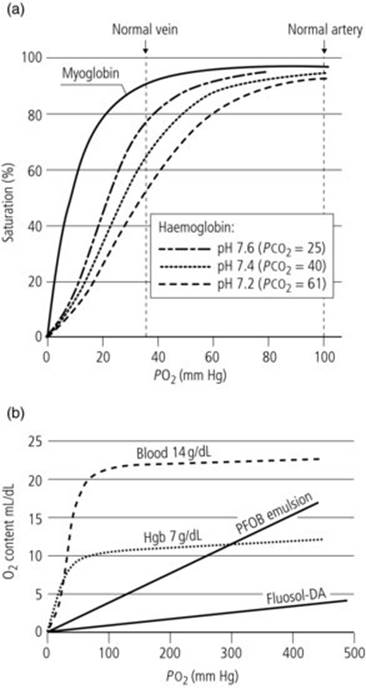
· Isolated tetramers are unstable and dissociate to globin dimers and monomers. As the tetramers dissociate, the allosteric cooperativity and the modulation of oxygen affinity by bound 2,3-diphosphogylcerate (2,3-DPG) are lost, giving a reduced oxygen carrying capacity. The P50 (the partial pressure of O2 at which haemoglobin is half-saturated with oxygen) is reduced from 26 to less than 10 mmHg (Figure 36.1a).
· Globin chains, and to some extent tetramers, are filtered by the kidneys and precipitate in the renal tubules, causing renal dysfunction.
· Isolated tetramers transit the vascular endothelium and scavenge NO, so reducing NO availability in the extravascular compartment causes vasoconstriction and oesophageal spasm.
Fig 36.1 (a) Oxygen affinity of haemoglobin tetramers and monomers. Oxygen-dissociation curve of myoglobin or dissociated haemoglobin monomers compared with that of haemoglobin at two pH values. PO2, partial pressure of oxygen. (b) Oxygen affinity of PFCs. Comparison of oxygen-carrying capacity of whole blood and fluorocarbons. Whole blood with a haemoglobin content of 14 g/dL possesses an arterial O2 content of 20 mL/dL at a PO2 of 100 mmHg. By contrast, fluorocarbon emulsions carry less O2 at a given partial pressure of oxygen. A 90% PFOB emulsion can carry 10 mL of O2 at a PO2 of 300 mmHg. Perfluorodecalin (Fluosol-DA 20), which used early emulsification technology to achieve a 20% fluorocarbon emulsion, can only carry 2–3 mL of O2/dL at PO2 of 300 mmHg.
Reduction of NO has dramatic effects on the vascular physiology and can result in not only vasoconstriction but also inflammation and platelet activation. Several modifications have been made to free haemoglobin tetramers to overcome these problems. Currently, Several second-generation red cell substitutes, including intramolecularly crosslinked haemoglobin, conjugated haemoglobin and polymerized haemoglobin, have been the subject of clinical trials and the third generation of substitutes of artificial red blood cells is under development and at the stage of animal trials (for summary see Table 36.3). It is also now clear that haemoglobin-based blood substitutes do not reduce transfusion requirements but merely defer it as they are cleared quickly. The strategy for the possible use of these therapies is now focused on improving oxygen delivery in specific situations. In the USA, the FDA have stated that they will only consider licensing red cell substitutes for three indications:
· regional perfusion, e.g. percutaneous transcoronary angioplasty, enhancing radiation therapy of tumours;
· acute haemorraghic shock;
· for use in the perioperative period.
Table 36.3 Red cell substitutes under trial or development.
|
Product/company |
Current status |
|
|
Intramolecularly crosslinked haemoglobin |
||
|
Diaspirin crosslinked haemoglobin |
Hemassist, Baxter Healthcare (USA) |
Failed phase III trials |
|
Recombinant haemoglobin |
Optro/rHb2.0, Somatogen Inc. with Baxter (USA) |
Shelved |
|
Polynitroxylated haemoglobin tetramers |
Hemozyme, SynZyme(USA) |
Shelved |
|
Sebacoyl-linked haemoglobin tetramers |
OxyVita IPBL Pharmaceuticals |
Shelved |
|
Polymerized haemoglobin |
||
|
Glutaraldehyde crosslinked haemoglobin |
Polyheme, Northfield (USA) |
Shelved |
|
Glutaraldehyde crosslinked bovine haemoglobin* |
Hemopure, Biopure (USA) |
Shelved |
|
O-raffinose crosslinked haemoglobin |
Hemolink, Hemosol (Canada) |
Failed phase III trials |
|
Conjugated haemoglobin |
||
|
Polyoxyethylene: haemoglobin |
PHP, Apex Bioscience (USA) |
In phase III trials |
|
Polyethylene glycol: bovine haemoglobin |
Enzon (USA) |
In phase Ib/II trials |
|
Polyethylene glycol: human haemoglobin |
Hemospan, Sangart (USA) |
Shelved |
|
Bovine Hb polymer containing SOD and catalase |
PolyHb-SOD-CAT, McGill University |
Pre-clinical |
|
Covalent complex bovine haemoglobin with GSSG, adenosine and ATP |
Hemotech, HemoBiotech Inc. |
Pre-clinical |
|
Encapsulated haemoglobin Perfluorocarbons |
||
|
Liposome-encapsulated haemoglobin |
Terumo (Japan), US Navy |
Pre-clinical |
|
Perfluorocarbons |
||
|
Synthetic fluorocarbron/emulsifer |
Perftoran |
Licensed in Russia and Mexico |
|
Oxycyte |
Side effects concern in phase I trials |
|
|
*Licensed in South Africa for anaemia therapy. |
||
Intramolecularly crosslinked haemoglobin
Diaspirin crosslinked haemoglobin
The crosslinking of haemoglobin tetramers with bis-(3,5-dibromosalicyl) fumarate yields diaspirin crosslinked haemoglobins with a high P50 for good oxygen delivery, e.g. Hemassist. However, haemoglobin tetramers still cause significant smooth muscle spasm, leading to oesophageal spasm and increases in blood pressure. The product has now been withdrawn due to an excess death rate in a clinical trial in trauma patients.
Recombinant haemoglobin
Large-scale production of recombinant haemoglobin in Escherichia coli and yeast has been established by Somatogen, who were purchased by Baxter in 1998. Using recombinant DNA technology the alpha globin chains were fused to yield an undissociable ‘tetramer’. It was also possible to engineer haemoglobin molecules to reduce NO affinity. Baxter has announced withdrawal from this development.
Polymerized haemoglobin
Haemoglobin may be crosslinked by bifunctional chemicals to form polymers or haemoglobin molecules can be directly linked to a high molecular weight nonprotein carrier. In either form renal filtration and smooth muscle dysfunction may be reduced. The oxygen-carrying capacity, reduced by the loss of 2,3-DPG binding, may be restored by other modifications. Three forms of crosslinked polymerized haemoglobin were produced for clinical trials.
Glutaraldehyde crosslinked haemoglobin
Human haemoglobin has been crosslinked with glutaraldehyde and pyridoxal phosphate added to the 2,3-DPG pocket to increase P50 (Polyheme, Northfield, Inc.). The second polymerized product is a glutaraldehyde crosslinked bovine haemoglobin (Hemopure, Biopure). This product is licensed in South Africa and a similar product is already licensed for canine use.
O-raffinose crosslinked haemoglobin
The third form of polymerized haemoglobin is one with oxidized O-raffinose crosslinking, which produces a haemoglobin polymer with a high P50. However, the product contains biologically significant amounts of crosslinked haemoglobin tetramers, which can and do cause smooth muscle spasm in the gastrointestinal tract.
Conjugated haemoglobin
Polymeric haemoglobin may also be made by crosslinking haemoglobin, not to itself but to high molecular weight polyoxyethylene (PHP, Apex Bioscience) or to polyethylene glycol (PEG-Hb, Enzon Inc.; Hemospan, Sangart Inc.) These methods increase the half-life of the preparations and reduce NO-mediated vasoactivity. The Apex Bioscience and Enzon products have been at trial in sepsis and to improve solid tumour radiation therapy. Hemospan is unusual in having a deliberately low P50 to prevent the release of oxygen until the haemoglobin reaches the capillaries, and phase I trials have shown it lacks the vasoactivity of most other preparations and can result in smooth muscle spasm.
The use of these haemoglobin-based blood substitutes was reviewed by Nathanson and colleagues following an FDA-sponsored workshop to consider the reasons behind the slow development of these products [4, 9]. The group reviewed the clinical effectiveness of Hemassist, Hemopure, Hemolink, PolyHeme and Hemospan. It proved very difficult to assemble the data from many small trials, which in some cases had never been made public, but they were able to use data presented to the FDA and from press releases. The meta-analysis reached many startling conclusions. First, these haemoglobin-based blood substitutes were associated with an increased mortality (relative risk 1.3) and myocardial infarction (relative risk 2.7). Second, and perhaps more disturbingly, the trials that could have reached this conclusion were completed in 2000 but no mechanism existed to ensure such clinically significant data on morbidity and mortality from a medicinal product reached the public domain. It was evident that several subsequent trials had been granted ethical permission without the full data on the dangers of the products available to the review boards. Development of these products has now ceased [10].
Second-generation haemoglobin-based blood substitutes
Development has continued on other modifications to haemoglobin that may make it useful and safe as a blood substitute. Flexible cross-linkers may generates well-defined octamers or bis-tetramers that show cooperative oxygen binding and remain within the circulation [11]. Within the red cell, haemoglobin may also enhance the production of NO by reduction of nitrite. It appear that bis-tetramers and haemoglobin linked to polyethylene glycol (PEGylated-Hb) retain nitrite reductase activity and so enhance NO bioavailability and vasodilation [12]. These results are promising but the clinical effectiveness and safety of these products remains to be established.
Artificial red blood cells – encapsulated haemoglobins
The third generation of haemoglobin-based red cell substitutes include artificial red blood cells. The modern formulations have used phospholipid vesicles (0.2 μm in diameter) with sialic acid analogues added to the membranes to reduce the clearance by the reticuloendothelial system. Further improvements to microencapsulated haemoglobin under investigation are:
· inclusion of catalase and superoxide dismutase to reduce oxygen radical and methaemoglobin formation and
· use of biodegradable polylactides and polyglycolides in artificial membranes or nanoparticles to increase haemoglobin concentration to 15 g/dL in small nanometre diameter vesicles.
These second- and third-generation haemoglobin substitutes are at the early stage of animal trials. It seems feasible that further development may produce artificial erythrocytes or haemoglobin polymers that may mimic some of the complex, higher order functions of ‘real’ red cells.
Clinical use of haemoglobin-based red cell substitutes
The problems that have been revealed regarding not only the lack of effectiveness but also the increased morbidity and mortality of haemoglobin-based blood substitutes has diminished but not extinguished enthusiasm for their development and clinical use. It seems certain that any product entering clinical trials will be subject to much greater scrutiny and evaluation of known side effects in well-designed animal trials before entering human Phase I trials [13]. It looks very difficult to achieve sustained increased delivery in total oxygen in clinical use or reduction in use of allogeneic blood cells. It is of interest to remember that a recent systematic review has demonstrated that reducing trigger levels can by itself reduce allogeneic transfusion by up to 40% [14]. Nevertheless, there is much interest in using these blood substitutes to improve local oxygen delivery in critically ischaemic areas by manipulating the molecular size and oxygen affinity of haemoglobin-based therapies [15].
Red blood cells grown in vitro
All red cells are ultimately derived from self-renewing stem cells that reside in the periosteal niche in the bone marrow. These stem cells can also circulate and both bone marrow and peripheral blood-derived stem cells can be isolated and used for haematopoietic stem cell transplants. Isolated stem cells can be induced to differentiate into early and late erythroblasts and finally enucleated reticulocytes using defined ambient oxygen concentrations, cytokine mixtures with or without stromal or supporting cells [16,17]. These models have been used to understand the normal and pathological development of red cells. However, the expansion of erythroid cells has been sufficiently refined to grow enough red cells in vitro for transfusion into humans [17]. The derived red cells appear to have a normal structure and function although the type of haemoglobin chains that are present depends on the source of the stem cells and the degree of switching from the fetal to adult pattern of haemoglobin gene expression. Red cells derived in vitro would all be young red cells or reticulocytes while red cells from a donor are comprised of red blood cells with an age distribution from reticulocytes to cells that are near the end of their lifespan. Therefore, red cells grown in vitro may have a long lifespan and so enhanced survival in the recipient compared to red cells collected from a donor.
There are now other possible sources of stem cells. Embryonic stem cells can be isolated and maintained in culture. They can be induced to develop into all cell linages including red blood cells. The number of embryonic stem cells lines is limited but now it is possible to form induced pluripotent stem cells (iPSCs) from fibroblasts or other apparently terminally differentiated cells by ‘reprogramming’ these mature cells by the expression of just a few transcription factors [18]. The ultimate potential of iPS cells to make mature erythroid cells with normal phenotypes is not yet clear but these methods would have the enormous advantage of generating self-renewing stem cells from donors with defined red cell, white or platelet antigen phenotypes for specific applications in diagnostic or therapeutic uses, e.g. as rare blood groups or as exact matches for recipients with multiple alloantibodies. While the red cell work is the furthest advanced, it is also possible to develop platelets and neutrophils in vitro from stem cells from cord or adult blood or from embryonic or induced pluripotent stem cells.
There are many technical problems to be overcome if red cells, neutrophil or platelets derived in vitro are to become a reality. Maintaining the cultures will require industrial scale methods and artificial supports to allow the large volume of cells to develop in culture. Nevertheless, these applications, which could not have been seriously contemplated only a few years ago, are now at advanced stages of development in many laboratories and over the next few years we can expect to see human trials of these products.
Perfluorocarbons
Principle
Liquid perfluorocarbons (PFC) are synthetic hydrocarbons in which most of the hydrogen atoms have been substituted by fluorine atoms. The low intermolecular attractions result in a high capacity to dissolve gases such that the oxygen content of a PFC is up to 20 times that of water [19].
These chemicals have inherent limitations including a short intravascular half-life (∼12 h), insolublity in water requiring emulsification with surfactants and limited oxygen-carrying capacity–the amount of oxygen carried is directly proportional to the inspired oxygen concentration (see Figure 36.1b). This requires patients to breathe oxygen-rich air, limiting their use to operating rooms and intensive care settings.
First-generation fluorocarbons
Fluosol-DA 20, an emulsion of 20% perfluorodecalin, is the only oxygen-carrying volume expander licensed in the USA. It was initially hoped it would gain widespread use but trials showed no efficacy in patients who refused blood transfusions. The only indication for which it has been approved is percutaneous transluminal coronary angioplasty, although some trials showed no benefit in combination with tissue plasminogen activator (tPA) over tPA alone. The inherent limitations of this perfluorocarbon are compounded by the side effects, which include:
· marked uptake by the reticuloendothelial system;
· disruption of pulmonary surfactant leading to ventilation/perfusion defects in the lungs; and
· complement activation resulting in anaphylaxis.
Fluosol has been approved to date by the US Food and Drug Administration and licensed for use in nine countries, not for the use of reducing the amount of allogeneic blood units transfused but for use during cardiac angioplasty. However, the storage and rewarming of this emulsion proved problematic and production has ceased.
Perftoran is an improved first-generation perfluorocarbon. The emulsified product consists of particles of approximately 1 μm diameter, apparently allowing them to evade clearance by macrophages and so have a longer half-life and fewer side effects. It is, however, only produced in Russia and has been licensed for use there and in Mexico.
Oxygent
This second-generation perfluorocarbon, based on perfluoro-octylbromide (PFOB), has been trialled by Alliance Pharmaceutical Company and contains egg yolk phospholipids as emulsifier. This composition confers several advantages over previous products including:
· greater oxygen-carrying capacity (see Figure 36.1b);
· reduced or absent complement activation;
· reduced interference with pulmonary surfactants; and
· improved stability and shelf life.
The small size of PFCs has suggested that they may improve oxygenation in ischaemic or infarcted tissues or increase oxygenation in tumours and so increase sensitization to radiotherapy or chemotherapy. Trials have been performed in a number of perioperative settings, most notably in cardiac surgery, in conjunction with acute normovolaemic haemodilution (ANH). Such trials have shown a delay in the time to reach the trigger levels for allogeneic transfusion, but a large pivotal trial was recently suspended due to concerns about the excess rate of stroke. This has now been ascribed to overenthusiastic ANH rather than the use of the PFC. Side effects of flushing and flu-like symptoms and delayed fever, headaches and nausea, as a result of macrophage activation, and a transient thrombocytopenia occur in some patients and may limit clinical applications.
It is currently approved for Phase II trials in the USA and Phase II trials in Europe. Some results are promising but a recent trial in cardiac surgery showed an excess of stoke compared to controls, suggesting that systemic side effects have not been eliminated. Further trials will be watched carefully.
Third-generation perfluorocarbons
Third-generation PFCs are under development. Oxycyte is based on F-tert-butylcyclohexane and is being studied as an ‘oxygen therapeutic’. The aim of these products is not to replace allogeneic blood components but to supplement their use or effectiveness in specific situations. A Phase I safety study in traumatic brain injury has been completed and Phase II studies are underway in Switzerland and Israel.
Platelet substitutes
Platelet concentrates are widely used in the management of thrombocytopenia and abnormal platelet function. These products have allowed the development of chemotherapy regimens that cause prolonged absence of platelet production and have made extracorporeal bypass a safe, routine procedure. However, both the supply and use of fresh platelets pose particular problems due to storage being limited to 5 days due to gradual loss efficacy and the risk of bacterial contamination. Supply also requires the maintenance of large, well-characterized donor panels and specialized centres for apheresis procurement. Repeated platelet transfusions are frequently accompanied by the development of antiplatelet antibodies, usually directed against major histocompatibility complex (MHC) class I antigens or against other platelet surface antigens.
Artificial platelet substitutes hold the promise of avoiding these logistic, technical and medical problems and so achieving cheaper, safer and more readily available therapy for thrombocytopenia. However, as for red cells, replacement of the natural product has not been straightforward. Attempts to replace platelets can again be divided into ‘real’ and ‘virtual’ platelet substitutes. Virtual platelet substitutes range from improved clinical guidelines and their implementation (Chapters 23 and 34), through drugs that may reduce blood loss (Chapter 37) to compounds that stimulate platelet production. Although not strictly speaking a platelet substitute, the development of pathogen reduction technologies for platelets may eliminate bacteria, viruses and leucocytes from this product, so reducing transfusion-transmitted infection, febrile nonhaemolytic transfusion reactions and transfusion-associated graft-versus-host disease.
Substitutes for platelets have not yet been licensed but several products are under development (Table 36.1). The most promising are summarized below.
Platelet membrane preparations
In the search for an alternative to fresh platelet concentrates, freeze-dried platelets were initially shown to be superior to frozen and thawed platelets in tests of haemostasis in vitro. Freeze-dried platelets were subsequently shown to be as effective as stored platelets in vitro and to provide haemostasis in thrombocytopenic animals. Clinical evaluation is planned. Compared to platelet concentrates, freeze-dried platelets have the apparent advantages of reduced viral and bacterial load as a result of paraformaldehyde treatment. However, they have some disadvantages:
· must be made from fresh platelets and
· may still stimulate an alloimmune response.
Infusible platelet membranes are derived from stored platelets as membrane fragments that seem to promote haemostasis without causing thrombosis in animals [20]. They are the only platelet substitute to have undergone clinical trial, where they were shown in a small number of patients to be effective in individuals refractory to standard platelet transfusion studies. The advantages of infusible plasma membranes over platelet concentrates include:
· reduced viral and bacterial load;
· reduced expression of HLA class I antigens; and
· may be made from outdated platelets.
However, these membrane preparations are clearly recognized by the innate immune system and rapidly cleared by splenic macrophages. The short circulating half-life of these agents poses a substantial obstacle to their clinical use.
Synthetic platelets
Beyond the manipulation of platelet membranes the search for a useful substitute for platelet concentrates has led to a totally synthetic approach (Figure 36.2). Microspheres of human albumin coated with human fibrinogen (Synthocytes, Thrombospheres) reduce bleeding time and acute blood loss in thrombocytopenic animals. They have no immediate toxicity in rodents or primates. Fibrinogen-coated microspheres would have the advantages of:
· sterility;
· production independent of platelet concentrates; and
· absence of HLA class I and platelet surface alloantigens.
Fig 36.2 Artificial platelet substitutes–SynthocytesTM. Electron micrograph showing the interaction of SynthocytesTM and normal platelets on a collagen surface.
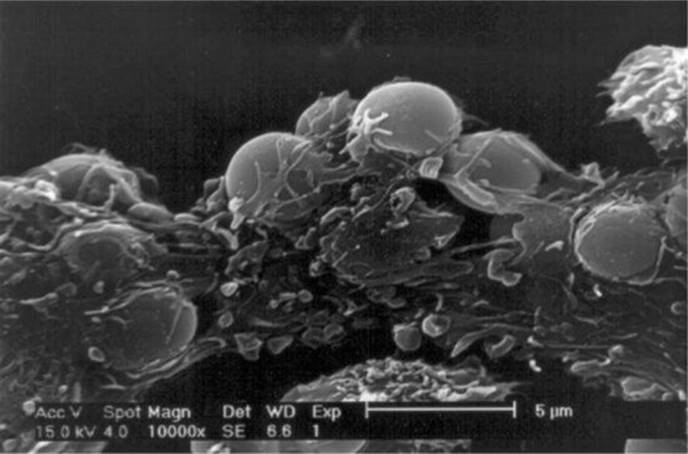
Interestingly, these microspheres appear to promote the formation of a platelet plug by interacting with residual normal platelets. It seems likely that both lyophilized platelet and infusible plasma membranes may also function in a similar manner. Liposomes with inserted platelet receptors are also under investigation as a platelet alternative.
The efficacy of lyophilized platelets, infusible platelet membranes and fibrinogen-coated microspheres in the prophylaxis of bleeding in severely thrombocytopenic patients will require careful evaluation and there has been little progress in this field over the last decade. More immediate applications for these platelet substitutes may be in improving haemostasis where the platelet count is moderately reduced and as alternative or adjuvant therapy where patients have become refractory to platelet transfusions through alloimmunization.
Summary
Real red blood and platelet substitutes have yet to reach the clinic. Simple substitutes lack the more complex and important function of whole cells. The development of first and second generation of haemoglobin-based blood substitutes has been halted after a pivotal systematic review showed that they were associated with excess mortality and an increased risk of myocardial infraction compared with controls. There are a number of other haemoglobin substitutes in development that are being designed to have no vasoactive effects and that may increase NO delivery locally. Incorporation of haemoglobin in polymers or nanoparticles may also yield a safe and effective product. The perfluorocarbons have also been beset by serious side effects, but second- and third-generation products are in early clinical trials.
Progress with platelet substitutes has also been slow. Synthetic microspheres that provide platelet-like activity may be free of viral contamination and polymorphic molecules, but would seem unlikely to be as effective as fresh platelets with the possible exception of treating haemorrhage, e.g. in patients with immune platelet refractoriness with no compatible donors.
Therefore, while nontoxic substitutes with reasonable biological activity are likely to be available, it is far from clear whether they will replace cells derived from donors for the majority of clinical uses. The new understanding of stem cell biology and differentiation has revealed the possibility of growing red blood cells and platelets in vitro. The conclusion drawn five years ago still seems valid, namely, at the risk of making speculative assessments, it seems more likely that real blood substitutes will find small niche applications and the virtual blood substitutes and improved prescribing will reduce the use of donor-derived products.
Key points
1. A series of modified haemoglobin-based blood substitutes have been developed to try to avoid dependence on donors, any infectious risk and unwanted immune responses.
2. Red blood cells have a number of functions beyond oxygen and carbon dioxide transport including NO generation and control of vascular responses that have proved difficult to mimic with blood substitutes. Existing haemoglobin-based blood substitutes have proven to be unsafe, causing myocardial infarction and increasing mortality.
3. Newer crosslinked and polymerized haemoglobin-based blood substitutes may have a better vascular response profile but are in an early phase of clinical development.
4. Platelet substitutes have been developed but have not been shown to be clinically effective.
5. It may be possible to grow red blood cells, platelets and neutrophils in vitro from stem cells for therapeutic use.
6. It is likely that blood substitutes in development will only have niche applications for the foreseeable future.
References
1. Shander A, Javidroozi M, Ozawa S & Hare GM. What is really dangerous: anaemia or transfusion? Br J Anaesth 2011; 107 (Suppl. 1): i41–59.
2. Jacobs T and Fischer J. When a long shot is worth a shot. Nature Biotechnol 2005; 23: 805.
3. Auker CR & McCarron RM. US Navy experience with research on, and development of, hemoglobin-based oxygen carriers. J Trauma 2011; 70 (5 Suppl.): S40–S41.
4. Natanson C, Kern SJ, Lurie P, Banks SM & Wolfe SM. Cell-free hemoglobin-based blood substitutes and risk of myocardial infarction and death: a meta-analysis. J Am Med Assoc 2008; 299: 2304–2312.
5. Dhillon S. Fibrin sealant (evicel® [quixil®/crosseal™]): a review of its use as supportive treatment for haemostasis in surgery. Drugs 2011; 71: 1893–1915.
6. Morrison JJ, Dubose JJ, Rasmussen TE & Midwinter MJ. Military Application of Tranexamic Acid in Trauma Emergency Resuscitation (MATTERs) Study. Arch Surg 2012; 147: 113–119.
7. Safo MK, Ahmed MH, Ghatge MS & Boyiri T. Hemoglobin–ligand binding: understanding Hb function and allostery on atomic level. Biochim Biophys Acta 2011; 1814: 797–809.
8. CRASH-2 trial collaborators; Shakur H, Roberts I, Bautista R, Caballero J, Coats T, Dewan Y, El-Sayed H, Gogichaishvili T, Gupta S, Herrera J, Hunt B, Iribhogbe P, Izurieta M, Khamis H, Komolafe E, Marrero MA, Mejía-Mantilla J, Miranda J, Morales C, Olaomi O, Olldashi F, Perel P, Peto R, Ramana PV, Ravi RR & Yutthakasemsunt S. Effects of tranexamic acid on death, vascular occlusive events, and blood transfusion in trauma patients with significant haemorrhage (CRASH-2): a randomised, placebo-controlled trial. Lancet 2010;376: 23–32.
9. Estep T, Bucci E, Farmer M, Greenburg G, Harrington J, Kim HW, Klein H, Mitchell P, Nemo G, Olsen K, Palmer A, Valeri CR & Winslow R. Basic science focus on blood substitutes: a summary of the NHLBI Division of Blood Diseases and Resources Working Group Workshop 2006. Transfusion 2008; 48: 776–782.
10. Jaspen B. FDA shoots down Northfield Labs blood substitute. Chicago Tribune 2009, April; 36.
11. Harris DR & Palmer AF. Modern cross-linking strategies for synthesizing acellular hemoglobin-based oxygen carriers. Biotechnol Prog 2008; 24: 1215–1225.
12. Lui FE & Kluger R. Enhancing nitrite reductase activity of modified hemoglobin: bis-tetramers and their PEGylated derivatives. Biochemistry 2009; 48: 11912– 11919.
13. Fergusson DA & McIntyre L. The future of clinical trials evaluating blood substitutes. J Am Med Assoc 2008; 299: 2324–2326.
14. Carson JL, Carless PA & Hebert PC. Transfusion thresholds and other strategies for guiding allogeneic red blood cell transfusion. Cochrane Database Syst Rev 2012; 4: CD002042.
15. Kluger R. Red cell substitutes from hemoglobin – do we start all over again? Curr Opin Chem Biol 2010; 14: 538–543.
16. Migliaccio AR, Whitsett C & Migliaccio G. Erythroid cells in vitro: from developmental biology to blood transfusion products. Curr Opin Hematol 2009; 16: 259–268.
17. Giarratana MC, Rouard H, Dumont A, Kiger L, Safeukui I, Le Pennec PY, François S, Trugnan G, Peyrard T, Marie T, Jolly S, Hebert N, Mazurier C, Mario N, Harmand L, Lapillonne H, Devaux JY & Douay L. Proof of principle for transfusion of in vitro-generated red blood cells. Blood 2011; 118: 5071–5079.
18. Okita K & Yamanaka S. Induced pluripotent stem cells: opportunities and challenges. Phil Trans R Soc Lond B Biol Sci 2011; 366: 2198–2207.
19. Lane TA. Perflurochemical-based artifical oxygen carrying red cell substitutes. Transfus Sci 1995; 16: 19–31.
20. Chao FC, Kim BK, Houranieh AM et al. Infusible platelet membrane (IPM) is a potential substitute for platelets in transfusion: correction of prolonged bleeding time in thrombocytopenic rabbits. Thromb Haemost 1993; 69: 750.
Further reading
Baudin-Creuza V, Chauvierre C, Domingues E, Kiger L, Leclerc L, Vasseur C, Celier C & Marden MC. Octamers and nanoparticles as hemoglobin based blood substitutes. Biochim Biophys Acta Prot Proteom 2008; 1784: 1448–1453.
Blajchman MA. Substitutes and alternatives to platelet transfusions in thrombocytopenic patients. J Thromb Haemost 2003; 1: 1637–1641.
Blood substitute. Wikipedia. http://en.wikipedia.org/wiki/ Blood_substitute. Accessed 10 June 2012.
Estep T, Bucci E, Farmer M, Greenburg G, Harrington J, Kim HW, Klein H, Mitchell P, Nemo G, Olsen K et al. Basic science focus on blood substitutes: a summary of the NHLBI Division of Blood Diseases and Resources Working Group Workshop, March 1, 2006. Transfusion 2008; 48: 776–782.
Gladwin MT, Grubina R & Doyle MP. The new chemical biology of nitrite reactions with hemoglobin: R-state catalysis, oxidative denitrosylation, and nitrite reductase/anhydrase. Acc Chem Res 2009; 42: 157–167.
Ker K, Kiriya J, Perel P, Edwards P, Shakur H & Roberts I. Avoidable mortality from giving tranexamic acid to bleeding trauma patients: an estimation based on WHO mortality data, a systematic literature review and data from the CRASH-2 trial. BMC Emerg Med 2012; 12: 3.