
Dana V. Devine1, Walter H. Dzik2 & Zbigniew M. Szczepiorkowski3
1Canadian Blood Services, Ottawa, Ontario and Centre for Blood Research, University of British Columbia, Vancouver, British Columbia, Canada
2Blood Transfusion Service, Massachusetts General Hospital and Harvard Medical School, Boston, Massachusetts, USA
3Transfusion Medicine Service, Cellular Therapy Center, Dartmouth-Hitchcock Medical Center and Geisel School of Medicine at Dartmouth, Hanover, New Hampshire, USA
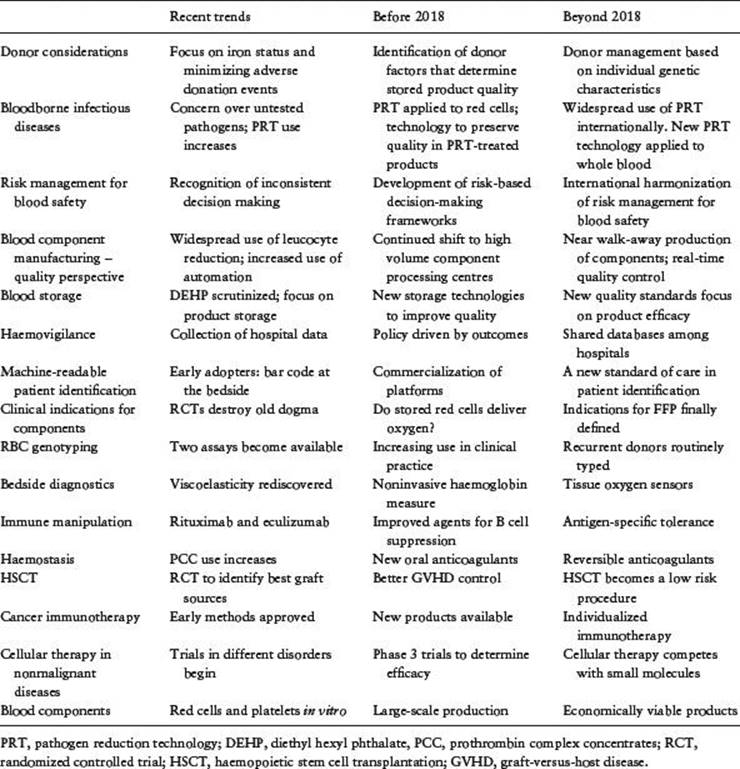
Transfusion medicine is a technology-based discipline. The early years of the 21st century have witnessed exciting innovation and discovery throughout the biological sciences including transfusion medicine. New technology is being introduced that is changing the way blood is collected, processed and used for therapeutic benefit. Beginning from the vantage point of recent changes to our profession, this chapter attempts to summarize developments anticipated to occur before the year 2018 as well as innovations that may lie further in the future. Considerations of blood collection and component preparation, hospital-based transfusion practice and cellular therapies are considered in turn (see Table 48.1). The authors recognize that the actual pace of change is often slower than the pace of innovation and acknowledge that some predictions may be influenced by optimism. Indeed, significant advances in healthcare and transfusion are expensive and the appetite of modern society to create new technology will need to be tempered by the wisdom of its application.
Table 48.1 Transfusion medicine horizon scanning.
Blood collection and component production
Over the past two decades, blood organizations have become increasingly focused on the use of good manufacturing practices (GMPs) adapted from pharmaceutical manufacturing to bring increased standardization to the production of blood components. At the same time, technological advances have brought an increasing level of automation with new approaches on the horizon. These developments have taken place against a backdrop of blood management practices that have actually slowed or reduced the demand for red cells in many developed countries, while platelet concentrate demand continues to increase. These trends keep donor recruitment professionals hard at work and cause us to maintain our heightened emphasis on blood component safety.
Donors
Recent: are we doing donors harm?
Despite considerable effort to create artificial blood components over the last decades, the maintenance of a blood supply remains completely dependent on the goodwill of our fellow citizens. Having created donation practices that optimize an individual's opportunity to donate whole blood or apheresis products, we have now begun to ask whether these practices are actually causing inadvertent harm to some groups of donors. Our attention has been drawn to this area by recent work on quantification, analysis and amelioration of adverse donor events, particularly in our youngest donors [1]. The development of more sophisticated deferral criteria based on estimated blood volume should make donation safer [2]. Recent studies addressing donor iron metabolism have highlighted the differences in managing donor iron stores across various jurisdictions and the vulnerability of some donors to chronic disruption of iron stores [3]. The challenge, as always, will be to ensure that blood system operators attend to the responsibility of their advocacy and stewardship, not only of the blood supply but of those who create it.
Looking ahead: optimizing the donor's impact on product quality
Donors represent the ‘raw material’ for the manufacture of blood components. In almost all other manufacturing processes, the raw materials are qualified to increase the probability of making a high quality product. In blood transfusion we have been, and remain, appropriately focused on qualifying our donors with respect to their behaviours that may influence product safety from the standpoint of transmissible diseases. In addition, to avoid causing bodily harm to donors, we also focus on their suitability to undergo the process of donation. In the next decade, our focus will be not only on increasing the donor base to offset any increase in demand due to shifting demographics or increased accessibility of health care but will be on improving our understanding of donor characteristics as they relate to product quality. As the tools of proteomics, genomics and metabolomics are beginning to be applied to understanding the characteristics of stored blood components, the role of the variability of donor characteristics becomes increasingly apparent [4]. Armed with this information, we will manage donors with tailored strategies for donation and produce those products that are most likely to have the highest product quality. This will lead to much more sophisticated donor information utilization, clinic design and donor relationship management.
Blood component manufacturing – safety
Recent: safer but unaffordable?
We remain frozen in the headlights of blood safety risk. Good work has been accomplished in lowering the risk of known transfusion transmissible diseases through the development of sophisticated tests. However, these come with significant cost and it is clear that we are reaching the breaking point with respect to how much additional safety even wealthy nations can afford. For the developing world, there are even greater challenges. Yet despite massive financial investment, we know that fatal complications from bloodborne pathogens still occur due to lack of testing (e.g. Babesia), highlighting the pitfall of our current risk reduction strategy: we cannot afford to test for everything. The development of the first generation of pathogen reduction treatments for platelets and plasma has brought an opportunity to rethink the blood safety paradigm. We must find a more cost-effective way to deal with known and emerging threats to blood safety than our current reactive approach of incremental test addition (also see Chapter 16). An important part of this discussion is the generation of a more uniform process for risk-based decision making in the area of blood safety that can be used by blood operators and regulatory authorities alike [5].
Future: make it simple, make it safe
Pathogen reduction technology (PRT) will become more widely used and applied to a broader range of blood components. Newer developments in PRT will include strategies to protect therapeutic elements in components from the damage caused by pathogen inactivation. Blood systems in the developed world will continue to mature after learning the lessons of HIV and hepatitis, moving from reactionary fear of any risk to blood safety to the recognition that risk must be balanced against other factors, including the security of the blood supply, cost and social justice.
Blood component manufacturing – quality
Recent: get the white out
In addition to the widespread application of GMP and quality management, two specific developments have led to a significant improvement in product quality in the last decade. The first is the wider use of pre-storage leucocyte reduction of blood components, resulting in the minimization of leucocyte-derived biological response modifiers in cellular blood components as well as the direct detrimental effects of passenger leucocytes themselves. The second is the increasing drive towards automation and standardization in blood component production. Whether this occurs through the use of apheresis equipment or the use of instrumentation to assist in the production of components from whole blood donations, it has fundamentally altered the way that blood services operate. Investment in such equipment and the quality systems required to operate GMP production facilities have in turn led to manufacturing consolidation with the creation of high throughput component production laboratories and mergers among smaller blood centres. Other recent developments in component manufacture will drive change in the future, including the spreading renewed concern over the use of diethyl hexyl phthalate (DEHP) as a plasticizer in storage sets [6] and renewed appreciation of the impact of component outdating on the cost of transfusion products, particularly platelets.
Future: the next major steps in the quality journey
The world of the blood operator will continue to be one of significant change. We will see newer generations of automated component equipment to process whole blood donations that do not have the high cost and large footprint of the current generation machinery; these will feed the increasing demand in developing countries for alternative strategies to improve technology and increase quality and consistency.
Storage as we know it will change dramatically. Products may be frozen or freeze-dried, allowing prolonged storage. Liquid cellular products are likely to be found in containers that have much improved preservation characteristics, readily addressing the concerns about the age of stored red cells or the short shelf life of platelets. Containers will have ‘smarts’, including the ability to self-interrogate and report their status to the blood bank throughout the storage period without breaking sterility of the system. This will permit the removal of products from the inventory that have an unacceptable loss of quality prior to their expected outdate.
However, before these new storage systems become available, concerns over possible harm caused by older red cell concentrates may force the development of new inventory management strategies focused on demand for red cells with a shorter shelf life. Unfortunately, this demand is likely to exist even if current randomized controlled trials fail to demonstrate any significant advantage to shorter shelf life red cells.
New quality parameters focused on product efficacy will be developed. For example, platelet count can only partially predict product efficacy and an improved understanding of the physiology of stored platelets will lead to the development of quality standards that more accurately reflect product efficacy. Similarly, the factors that affect the efficacy of red cells during storage will be identified. These will make strong candidates for better markers to monitor the quality of blood components produced by all methods.
Hospital blood transfusion practice
Improving hospital transfusion care
Hospital biovigilance lights the path to improved care
Recent trends: haemovigilance extends to the hospitals
Led by programmes in the UK, Quebec and France, haemovigilance has spread worldwide and has become an expected standard of blood transfusion systems in economically advantaged nations (see Chapter 18). Recent efforts have focused on the root causes of patient harm. In 2010, the USA launched the haemovigilance module of the National Healthcare Safety Network, a programme run under the overall direction of the Centers for Disease Control. This programme is expected to gather information systematically on the frequency of reported adverse events among transfusion recipients. Nevertheless, even better data would be useful. We still do not understand well the reason why physicians request blood components, the clinical benefits of transfusion, nor the true frequency of adverse events. Data need not be collected from all hospitals in order to draw meaningful conclusions. A system that prospectively collects detailed data from a group of sentinel hospitals – whose size and complexity is representative of all hospitals – would serve to provide much needed data on blood transfusion therapies.
Looking ahead: policy driven by data
Changes in transfusion medicine policy and regulation can be connected to haemovigilance data resulting in evidence-based prioritization and metrics for assessment. For example, recognition of rates of platelet bacterial contamination led to diversion of the initial portion of donor blood and screening for bacterial overgrowth. Haemovigilance data on the frequency of transfusion-associated acute lung injury led to policies that reduced high plasma volume products donated by female donors with HLA antibodies. As haemovigilance draws closer to the bedside to determine toxicities of blood transfusion accurately, policies and technologies can be rationally applied based on the reality of harm rather than the perception of threat.
Beyond 2018, shared databases will improve patient outcomes. The Quebec haemovigilance programme documented a statistically significant reduction in the frequency of haemolytic transfusion reactions as a result of sharing patient data among hospital transfusion services. For example, patients whose current antibody screen is negative but who previously had a red cell alloantibody identified at another hospital can avoid delayed haemolytic reactions. More importantly, ABO results on a first-time patient sample tested at one hospital can be instantly compared to prior ABO results obtained at other hospitals (see Chapter 23). Given the truly prodigious capacity of shared information systems in an Internet world, and given the technology for secure digital transactions upon which the world economy and legal systems already operate, there is no reason not to share data related to vital aspects of transfusion safety.
Machine-readable technology for patient identification
Early adopters show the way
The use of bar codes to improve patient identification at the bedside was begun by a few early adopters in the first decade of the 21st century. The transfusion medicine programmes at the John Radcliffe Hospital in Oxford (UK) and the University of Iowa hospitals (USA) (among others) demonstrated that barcode-based systems could be used for the bedside clerical check. Despite these early steps, most hospitals continue to use eye-readable technology for the bedside identification check with poor performance. Surveys by the American College of Pathology document that all aspects of the pretransfusion bedside patient identification were performed in only 25% of transfusions [7].
Looking ahead to a new standard of care
We anticipate that commercially available systems will be increasingly deployed in the next few years. Advances in point-of-care diagnostics (e.g. glucometry) that use barcode inputs for patient information and the increasing use of the electronic medical record will make machine-readable bedside technology for blood transfusion naturally integrated with other bedside nursing activities. In addition to bar codes, inexpensive radiofrequency chips embedded in wristbands and in bag labels will carry more information and are expected to make machine-readable technology even more user-friendly [8].
Beyond 2018, it is difficult to imagine that machine-readable patient identification will not become the standard of care. In all other areas of society, transactions are increasingly done using digital (not handwritten) technology. We look forward to the day when the current process – whereby healthcare workers in distracted environments attempt to check eye-readable information found on printed labels and on printed wristbands – will be a thing of the past.
Clinical indications for standard blood components
Recent trends: randomized controlled trials destroy old dogma
Recent years have witnessed multiple examples of transfusion dogma overturned by higher quality evidence obtained from randomized clinical trials. Examples include the PLADO study, which found no benefit to the use of >3 platelet units when transfused as prophylaxis against bleeding among patients with haematologic malignancy [9]. The FOCUS trial demonstrated that elderly patients undergoing orthopedic surgery do not fair better if maintained at a haemoglobin >10 g/dL [10]. The TRACS trial underscored the wisdom of a conservative policy for red cell transfusion for patients undergoing cardiac surgery [11]. Studies such as these breathe fresh air into the profession and become the bedrock for future advances.
Looking ahead: do stored red cells deliver oxygen?
A central question in the profession is whether or not stored red cells adequately deliver oxygen to tissues. Four large prospective trials are currently underway to examine clinical outcomes among recipients randomized to short storage-versus-prolonged storage red cells. In the next five years the results of these trials are likely to have long-term implications for the management of worldwide RBC inventories [12].
Beyond 2018, we can anticipate that indications for FFP will finally be clarified. Despite the current excitement over the use of increasing amounts of FFP in the resuscitation of trauma patients, we should require randomized trials that will measure the benefit and the toxicity of large volumes of FFP. Of even greater value would be randomized trials among intensive care patients that identify the threshold INR values at which benefit from FFP occurs, when used for prophylaxis or for treatment of bleeding. As the number of critical care patients continues to grow, transfusion medicine will need high quality data to identify an appropriate trigger for FFP transfusion.
Diagnostics
Genotyping applied to transfusion care
Recent: commercial assays become available
While many laboratories have developed in-house methods for analysis of DNA polymorphisms corresponding to red cell antigens, the field has been advanced by the development of commercially available assays for use in clinical transfusion medicine. BLOODchip™ (Progenika, Cambridge, MA) is a DNA-based system that uses a prepared solid support coated with probes for red cell antigen single nucleotide polymorphisms. Sample DNA is amplified with fluorescent nucleotides, hybridized with the probes, unbound DNA is washed away and the solid support examined for fluorescence. In the BeadChip™ (Bioarray Solutions, Warren, NJ) assay, coloured polystyrene beads are each coated with a different probe. The beads are hybridized with the test DNA and, after washing, the hybridized DNA is elongated with fluorescent nucleotides. A photograph determines which coloured beads acquired fluorescence. The Luminex™ platform is also being used for analysis of RBC DNA polymorphisms [13].
Looking ahead: increasing use of DNA methods for transfusion care
Developments in DNA-based diagnostics should find increasing application in several areas of clinical transfusion care. For multitransfused patients or patients with strongly reactive autoantibodies, DNA-based methods provide a fast and reliable method of determining the probable phenotype. The method will prove valuable for antigens for which reliable antisera are in short supply. DNA assays are also well suited to determining fetal blood types and for resolution of variant D antigens [14].
Beyond 2018, with increasing throughput of DNA technology, DNA-based typing may be applied to recurrent group O blood donors. Genotyping, done once, could be reported on the bag label for each subsequent donation, creating an enormous pool of donors with extensive characterization of their red cell expected phenotype. This resource could be used not only for patients with alloantibodies but also in programmes of deliberate antigen matching to prevent sensitization [15].
Bedside diagnostics influence decision to transfuse
Recent: rediscovery of viscoelasticity
Invented in 1948, measurement of clot viscoelasticity was largely a curiosity confined to liver transplant surgery complicated by fibrinolysis. In recent years two commercial systems have resurfaced: TEG® (thromboelastograph, Haemonetics, USA) and ROTEM® (rotation thromboelastometry, TEM International, Germany) (also see Chapter 25). Both systems employ a sensor placed in blood during rotational movement. The change in torque is detected electronically in TEG® and optically in ROTEM®. Both systems assess time to initial clot formation, speed and strength of clot, and time to clot lysis. There is widespread interest in whether or not either of these systems can improve upon traditional coagulation testing as methods not only to diagnose defects in haemostasis but also to guide transfusion therapy. Good parallel studies with clinical outcomes will be needed and welcome [16].
Looking ahead: noninvasive monitoring may guide transfusion
A recently developed clip-on finger oximeter offers a continuous readout of the patient's haemoglobin concentration. This technology, if validated in clinical practice, may change transfusion decisions for critically ill patients, especially during surgery. The technology, coupled with bedside cardiac echo imaging, could provide the three measures needed to calculate systemic oxygen delivery: haemoglobin concentration, percent saturation and cardiac output. Transfusions based on better physiologic measurements should be the shared clinical goal.
In the future, noninvasive measurement of tissue oxygen utilization will be the ultimate guide to red cell transfusion. Two devices represent early steps in this direction [17]. The Fore-Sight® (CAS Medical Systems, USA) system shines near infrared laser light on the scalp and measures reflected light from the surface and from the deeper (2.5–3 cm) underlying brain tissue. After subtracting the surface light component, the amount and wavelength of reflected deeper penetration light is used to estimate cerebral O2 saturation. The In-spectra® device (Hutchinson Technology Inc., USA) measures real-time changes in tissue oxygen saturation of the thenar muscle, calculating the ratio of oxygenated-to-total haemoglobin at 0–14 mm beneath the skin. Whether or not devices such as these may one day serve to guide transfusion awaits research to be done.
Therapeutics
Advances in immune manipulation
Recent: rituximab and eculizumab
Antibody-directed and complement-mediated cell destruction is central to the pathophysiology of haemolysis, humoral allograft rejection, platelet refractoriness, autoimmune neurologic disorders, certain varieties of vasculitis and other immune disorders. In recent years, anti-CD20 (rituximab) has been increasingly used for treatment of autoimmune blood disorders [18]. Eculizumab, a recombinant humanized murine monoclonal that inhibits cleavage of complement protein C5, effectively reduces complement-mediated membrane lysis in paroxysmal nocturnal haemoglobinuria and may be of benefit in the treatment of autoimmune haemolytic anaemia and atypical haemolytic uremic syndrome [19]. Eculizumab may have potential benefit in humoral allograft rejection, haemolytic transfusion reactions, hyperhaemolysis syndrome and certain varieties of vasculitis, including cryoglobulinemia. More research is needed to evaluate this agent either used singly or in combination with other immune inhibitors.
Looking ahead: increasing options for B-cell suppression and parallel further decline of plasma exchange
New drugs directed at B-cell activity are emerging. These include B-cell depleting agents such as rituximab, alemtuzumab, ofatumumab and anti-CD19; B-cell activation inhibitors including epratuzumab (anti-CD22), belimumab and atacicept; and drugs directed at plasma cells, including the proteosome inhibitor bortezomib. In addition, recombinant factor H and factor I in the complement system would represent attractive infusion molecules for patients with immune-mediated tissue damage. The introduction of these and other drugs over the next decade should gradually replace plasma exchange as a treatment for immune-mediated disorders [20].
Beyond 2018, improved pharmacologic agents that act directly upon plasma cells or that induce antigen-specific immune suppression would be welcome. For example, in a patient who has made anticellano antibodies, one can imagine specific targeting of B-cell surface immunoglobulin resulting in clonal deletion of those cells generating anticellano. The human polyclonal immune response to blood group antigens represents an excellent model for the investigation of antigen-specific immune suppression. Application to HLA antibodies would have an immediate benefit for solid organ transplant patients.
New strategies for haemostasis
Recent: rise of prothrombin complex concentrates (PCCs)
PCCs are pooled plasma-derived factor concentrates initially developed and licensed for the treatment of haemophilia B. Three-factor PCCs have qualified levels of factor IX, variable levels of factors II and X, and low levels of factor VII. Four-factor PCCs, in contrast, have therapeutic levels of factors II, VII, IX, X, C and S. Although four-factor PCCs are widely available in Canada, the UK and Europe, three-factor PCCs are the only currently licensed products available in the USA and Australia. Because four-factor PCCs offer ease of administration and small volume, they have recently been combined with vitamin K for emergency reversal of coumadin. Despite lack of evidence, enthusiasm for four-factor PCCs has led some to use them as an alternative to FFP in other clinical settings, such as liver disease, surgical bleeding and trauma [21]. The manufacturer of one four-factor PCC (Beriplex®) has applied to the US Food and Drug Administration for approval to market their product in the USA. If approved, the availability of this product will increase the options in the USA for emergency reversal of coumadin.
Looking ahead: alternatives to coumadin become widespread
Two classes of oral medications serving as alternatives to coumadin were introduced in 2011: the direct thrombin inhibitor dabigatran and direct inhibitors of the factor Xa complex (rivaroxaban, apixaban and endoxaban). These drugs offer the convenience of fixed dosing without the need for blood test monitoring and a level of efficacy that is not inferior to coumadin. However, their anticoagulant effect is prolonged by renal insufficiency and the drugs all suffer the disadvantage of not having an agent proven to reverse their anticoagulant effect. Transfusion medicine specialists will certainly contribute to the challenging management of bleeding in the setting of these nonreversible anticoagulants [22].
As experience with the difficulties of managing bleeding among patients taking nonreversible anticoagulants grows, there will be pressure to develop reversible anticoagulants. In some ways, this advance will be a return to features originally offered by unfractionated heparin and coumadin, but with newer drugs that shed the disadvantages of blood monitoring, heparin-induced thrombocytopenia or vitamin K and drug interactions. Already, agents to reverse factor Xa inhibitors are under development and include recombinant Xa molecules where the active procoagulant site is blocked and where glutamic acid domains are depleted, resulting in a decoy substrate for direct Xa inhibitor medications.
Cellular therapy
Chronic, incurable or devastating conditions are often portrayed as the best targets for miraculous treatments with novel cellular therapies, including, among others, mesenchymal stem cells (MSCs), embryonic stem cells (ESCs) or induced pluripotent stem cells (iPSCs). It seems as if any human tissue contains cells that can be coaxed into pluri- or multipotent stem cells, which in turn can be used to alleviate, if not cure, any human condition. This is, of course, if one relies exclusively on headlines intended for the general public. Scientists including transfusion medicine specialists will need to manage societal expectations, otherwise cellular therapy may come to resemble the bloodletting of the 17th century or hydrotherapy of the 19th century. Cellular therapy, gene therapy and regenerative medicine have great promise, but only if clinical trials are well designed and research endeavours and achievements are honestly presented. In this section we will focus on a few examples of cell-based therapies and their potential impact on the future of healthcare.
Haematopoietic stem cell transplantation
Recent developments
Progress in haemopoietic stem cell transplantation (HSCT), the cell-based therapy recently celebrating its 50th anniversary, has been extremely encouraging. Since its inception, HSCT had to deal with several challenges, including optimal matching of the donor with recipient, the choice of the graft source assuring prompt engraftment with minimal complications and long-term complications including acute and chronic graft-versus-host disease (GVHD), delayed immune reconstitution and posttransplant lymphoproliferative disorders (PTLDs). Graft selection has been enhanced by the availability of cord blood units and new strategies for cellular expansion. The first randomized controlled study comparing apheresis versus marrow sources of haemopoietic stem cells (HSCs) was very recently reported. The study confirmed more rapid engraftment with apheresis HSC, but found a significantly increased incidence of chronic GVHD with apheresis HSC compared with HSC obtained from marrow (53% versus 40%) [23]. A new cellular therapy modality utilizing small molecules interacting with modified components of the human intrinsic apoptotic pathway (e.g. caspase 9) has been shown to be a powerful tool in the induction of cell death in patients receiving cell therapy [24]. This approach seems to be much more efficient than previous attempts to insert thymidine kinase-dependent suicide genes, which were activated in the presence of ganciclovir. Furthermore, manipulation of lymphocytes to generate cytotoxic T cells against adenovirus, cytomegalovirus and Epstein–Barr virus (EBV) has shown promise in the treatment of infections with these viruses and with EBV-associated PTLD. These virus-specific T-cell lines also showed efficacy against infections with all three viruses in partially HLA-matched third party recipients. Thus, they may become an ‘off the shelf’ treatment for many more patients [25].
Looking ahead
We should see an increased demand for marrow-derived HPC as the source for HSCT with a corresponding decrease in demand for apheresis collections. The impact is most likely to be moderate and transient as apheresis-derived HPC will still remain the first choice for the growing number of older patients and for those with aggressive malignant conditions. Advances in personalized medicine may further increase options in ameliorating GVHD without compromising graft versus tumour/leukaemia effect or increasing posttransplant infections. The survival rate of HSCT recipients with better selected donors and personalized graft processing should continue to improve. We should also see increased utilization of HSCT in nonmalignant conditions, such as HIV-infected patients with cells from CCR5 negative donors, once transplant related mortality and morbidity decrease further.
Immunotherapy in cancer treatment
Recent developments
The last two decades have seen numerous trials evaluating manipulation of the immune system in patients with cancer. One of the major issues facing the field is identification of appropriate endpoints, which range from the generation of antitumour lymphocytes to measurements of tumour burden, up to patient survival. The Cancer Immunotherapy Consortium established three novel endpoint recommendations: harmonization of assays of the immune response, definition of new immune-related response criteria and use of hazard ratios as a function of time to address delayed separation of survival curves [26]. Additional efforts to standardize the design and evaluation of so many heterogeneous immunotherapy trials should help to identify true biologic effects. Studies with only a few patients who respond well to immunotherapy, often hailed as final solutions, should be correctly interpreted as a proof-of-principle endeavour. Thus far, the biggest recognition in cancer immunotherapy was given to Sipuleucel-T (Provenge®; Dendreon), which was licensed in the USA in April 2010 for patients with metastatic prostate cancer. The logistics of this autologous therapy are very complex and the median increased survival of approximately four months is limited. Nevertheless, the demand for this therapy appears to be growing.
Looking ahead
Cancer immunotherapy is likely to continue to grow, despite the expense of treatments based on exclusively autologous therapies. New approaches to creating an immune response in the cancer patients will be tried and some of the new products will reach the market within the next 5 to 10 years. However, these therapies will continue to be challenged by small molecules and other directed therapies, which are generally easier to generate, test and bring to the market.
Cellular therapy in nonmalignant diseases
Recent developments
Cell-based therapies are being extensively studied in the cardiovascular area, especially in the treatment of acute and chronic heart failure and peripheral vascular disease. There are multiple approaches to identify the appropriate cell source (e.g. bone marrow, cord blood, peripheral blood, cardiomyocytes, pluripotent stem cells), cell manipulation (e.g. buffy coat enrichment, immunomagnetic selection) and form of administration (e.g. location, catheter, cell dose). All these variables make it difficult to assess which type of cells will be most successful in providing a long-lasting effect. Other medical specialties are also involved in a growing number of clinical trials. Examples include allogeneic mesenchymal stem cells in inflammatory bowel disease, pluripotent stem cells in spinal cord injury or growth of islet cells for patients with diabetes.
Looking ahead
This is the area of cellular therapy where the most will happen over the next few years. There will be increased interest in identifying the best cellular therapy products for these chronic conditions with a very large market and potentially long-lasting impact on the health of many affected individuals. We should see first-generation products available for patients prior to 2018 and most likely in the area of cardiology, gastroenterology and metabolic disorders.
Ex vivo generation of blood components
Recent developments
Transfusion medicine specialists have both hoped and feared that one day all blood components would be generated ex vivo. Although initial efforts focused only on the expansion of HSCs in vitro, a growing knowledge of haemopoiesis allowed both expansion and maturation in culture. The first reports of ex vivo generation of fully mature human erythrocytes have been published in the last decade [27–29]. Different sources of stem cells were used, including CD34 positive HSCs from peripheral blood, bone marrow or cord blood, embryonic stem cells and human iPSCs. The process is time consuming and labour intensive but the final product is not different from adult red cells, at least in the initial studies. Recent studies showed that as few as 15 iPSC clones would be sufficient to cover all the needs of the French National Registry of People with a rare blood phenotype/genotype for individuals of Caucasian ancestry [29]. The reports of ex vivo generation of platelets have been also published.
Looking ahead
There is a dose of healthy scepticism regarding ex vivo production of blood components. The challenges of GMP and scale-up make these products prohibitively expensive for the immediate future. However, there are some products (e.g. red cells lacking high frequency antigens) that may be first to see a positive return on investment. While the developments remain exciting, it may be several decades before ex vivo generated blood components replace healthy volunteers for routine transfusions.
Economics of cellular therapy
Recent developments
The financial support for the vast majority of phase I and phase II cellular therapy trials comes from not-for-profit foundations and/or governmental grants. Small for-profit companies, with only a few exceptions, have been able to bring their products to pivotal trials where they required additional capital to complete phase III trials. Only recently have large pharmaceutical companies showed interest in cell-based therapies in their earlier phases. Funding is also complicated by a very lengthy and primarily uncharted regulatory pathway for approval. The licensure of Provenge® by Dendreon in 2010 was the first example of successful navigation of a cellular therapy product from phase I through approval. Although the cost of a full treatment stands at $93 000 per patient, the company was able to navigate the complex private and public insurance market to have its product approved for reimbursement. Even with such success it is said that the investment costs may never be recouped. Other publicly traded companies involved in cellular therapy products have also experienced financial volatility. Recently, the widely publicized exit of Geron Corporation from the stem cell market illustrates the complexity of the economic environment of cellular therapy.
Looking ahead
Funding for cellular therapies will be an important component of the success or demise of the cell-based therapies. Continuous growth of public expectations of miraculous treatments could be met by many years of only incremental success. It is quite possible that current leading companies will not survive due to lack of financial support. Although we anticipate that some of the promised therapies will reach patients, the cost of development may disillusion many. Combination therapies, nanotechnology and small engineered molecules may prove to be a more dynamic therapeutic strategy leading to a shift in resources away from classical cellular therapy.
Conclusion: resetting priorities of health and healthcare
World economic recession
December 2007 marked the beginning of a prolonged economic recession in the USA, resulting from failings in the financial and mortgage markets and lack of oversight of banking and lending practices. Japan had already been in prolonged recession following the burst of an overinflated domestic real estate market in the 1990s. By 2011, sovereign debt among southern European nations resulted in a crisis of confidence in the euro. Worldwide unemployment reached record levels in wealthy nations, reduced tax revenues and placed greater strains on the delivery of national healthcare. There is no reason to believe that the recession now straining North America and Europe will resolve any faster than that which struck Japan a decade earlier. Thus, any expectations for advances in transfusion care and healthcare over the next decade should be set in the context of global worldwide economic constraints.
Cost of new technology collides with world demographics
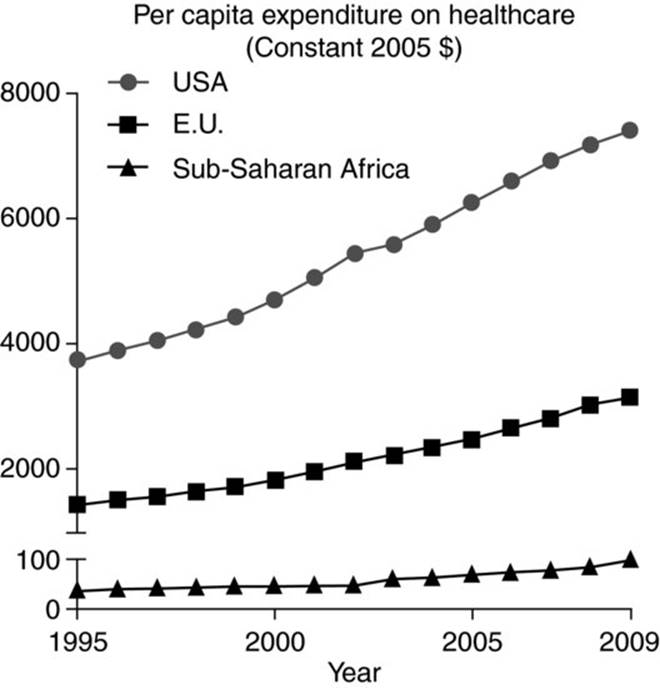
In 2011, the world's population for the first time reached 7 billion and is expected to exceed 10 billion before mid-century. Most population growth has occurred in low income nations with impoverished healthcare. Meanwhile, in wealthy nations, population has increased but average per capita expenditure on healthcare has increased even more, fuelling substantial profits for suppliers to the healthcare industry. For example, in the USA the proportion of the gross domestic product spent on healthcare has risen steadily and in 2011 approached 18%. The effect of these two forces – the rising cost of healthcare technology and the rising world's population in low income nations – has increased the disparity in the per capita wealth devoted to human health (see Figure 48.1). For example, in 2007, the United States spent over $6000 per person on healthcare, while each of the nations of sub-Saharan Africa spent approximately one-hundredth as much ($60 per person per year) [30].
Fig 48.1 Per capita expenditure on healthcare in the USA, Europe and sub-Saharan Africa. Note the split scale of the y axis. Source: World Bank, 2011.
Changing how we use technology
While better products and technology account for some of the spiralling costs of healthcare, much healthcare expenditure is wasteful, redundant and unnecessary. Wasteful transfusion decisions, for example, may be fuelled by a combination of lack of knowledge on the part of the requesting clinician, fear of being ‘wrong’, pharmaceutical marketing and a professional ethos that fosters clinical extravagance over parsimony. If we are to use healthcare services in general and transfusion services in particular, more wisely and with greater value, then healthcare professionals will need to improve decision making under circumstances of risk. Patient management based on conservative use of healthcare resources is far more difficult than that based on unbridled use, involves the assumption of risk and requires a commitment to address the likely outcomes rather than all possible outcomes. Healthcare expenditures in wealthy nations are also fuelled by an unwarranted sense of entitlement by both doctor and patient. The expectations of both will need to become more realistic in a world where healthcare is no longer an enterprise characterized by extravagance.
Deciding who we are: healthcare priorities in a global context
How we choose to advance human health in the 21st century will ultimately reflect who we are. Some choices will reflect both our appetite for and our celebration of a level of technological achievement considered unreachable to earlier generations. Those advances will, however, not be affordable by or available to all who need them and will highlight the concentration of wealth and privilege among an ever smaller subset of the world's population. Other choices will serve to distribute basic healthcare more broadly to the billions of humans who share the planet. Those advances will, however, require a redirection of energy and resources away from the spectacular achievements of organ transplantation, designer drugs and ultrahigh technology critical care. While many who enjoy the benefits of wealthy nations would argue that both paths are possible, the evidence – most clearly reflected by the growing worldwide disparity of per capita wealth devoted to healthcare – argues otherwise. It is entirely possible that we cannot have it both ways – that a choice is to be made between advancing healthcare technology or advancing world health. That choice is beyond the confines of the medical profession alone and will involve politicians, economists, religious groups, governments – each of us. Ultimately, how we chose to care for one another will define who we are.
Key points
1. Blood component processing continues to become more automated with strong quality systems in place driving consolidation of production activity.
2. Emphasis on blood component safety from transfusion-transmitted infections must be done from a perspective of cost effectiveness and informed risk-based decision making.
3. Management of blood donors is evolving to be better aligned with the needs of the hospital blood bank and to optimize the individual characteristics of each donor that impacts the quality of stored blood components.
4. Haemovigilance programmes focused on the hospital transfusion service can provide a data-driven method to improve patient outcomes.
5. Noninvasive measures of haemoglobin concentration and tissue oxygenation may improve clinical decision making for transfusion of red cells.
6. Reversible oral and intravenous anticoagulants and antigen-specific immune suppression would represent substantial therapeutic advances.
7. Haemopoietic stem cell transplantation will continue to evolve into a safer modality with more sophisticated approaches to minimize graft-versus-host disease and other complications.
8. Cell-based cancer immunotherapy will provide for better and more efficient individualized therapies, though at a significant cost.
9. Cell-based solutions affect many specialties (e.g. neurology, cardiology) and may also lead to an ex vivo generation of blood components for clinical use in the future.
References
1. Eder AF, Hillyer CD, Dy BA, Notari EP & Benjamin RJ. Adverse reactions to allogeneic whole blood donation by 16- and 17-year-olds. J Am Med Assoc 2008, 21 May; 299(19): 2279–2286.
2. Wiltbank TB, Giordano GF, Kamel H, Tomasulo P & Custer B Faint and prefaint reactions in whole-blood donors: an analysis of predonation measurements and their predictive value. Transfusion 2008, September; 48(9): 1799–1808.
3. Cable RG, Glynn SA, Kiss JE, Mast AE, Steele WR, Murphy EL et al. Iron deficiency in blood donors: the REDS-II Donor Iron Status Evaluation (RISE) study. Transfusion 2011; 51: 511–522.
4. Devine DV & Schubert P. Proteomic applications in blood transfusion: working the jigsaw puzzle. Vox Sanguinis 2011, January; 100(1): 84–91.
5. Stein J, Besley J, Brook C, Hamill M, Klein E, Krewski D et al. Risk-based decision-making for blood safety: preliminary report of a consensus conference. Vox Sanguinis 2011, November; 101(4): 277–281.
6. Shaz BH, Grima K & Hillyer CD. 2-(Diethylhexyl) phthalate in blood bags: is this a public health issue? Transfusion 2011, November; 51(11): 2510–2517.
7. Novis DA, Miller KA, Howanitz PJ, Renner SW & Walsh MK. Audit of transfusion procedures in 660 hospitals. A College of American Pathologists Q-Probes study of patient identification and vital sign monitoring frequencies in 16494 transfusions. Arch Pathol Lab Med 2003, May; 127(5): 541–548.
8. Murphy MF, Stanworth SJ & Yazer M. Transfusion practice and safety: current status and possibilities for improvement. Vox Sanguinis 2011, January; 100(1): 46–59.
9. Slichter SJ, Kaufman RM, Assmann SF, McCullough J, Triulzi DJ, Strauss RG et al. Dose of prophylactic platelet transfusions and prevention of hemorrhage. N Engl J Med 2010, 18 February; 362(7): 600–613.
10. Carson JL, Terrin ML, Noveck H, Sanders DW, Chaitman BR, Rhoads GG et al. Liberal or restrictive transfusion in high-risk patients after hip surgery. N Engl J Med 2011, 14 December; 365: 2453–2462.
11. Hajjar LA, Vincent JL, Galas FR, Nakamura RE, Silva CM, Santos MH et al. Transfusion requirements after cardiac surgery: the TRACS randomized controlled trial. J Am Med Assoc 2010, 13 October; 304(14): 1559–1567.
12. Triulzi DJ & Yazer MH. Clinical studies of the effect of blood storage on patient outcomes. Transfus Apher Sci 2010, August; 43(1): 95–106.
13. Moulds JM, Sloan SR & Ness PM (eds). BeadChip Molecular Immunohematology: Toward Routine Donor and Patient Antigen Profiling by DNA Analysis. New York: Springer; 2011, pp. 1–152.
14. Anstee DJ. Red cell genotyping and the future of pretransfusion testing. Blood 2009, 9 July; 114(2): 248–256.
15. Denomme GA, Johnson ST & Pietz BC. Mass-scale red cell genotyping of blood donors. Transfus Apher Sci 2011, February; 44(1): 93–99.
16. Bolliger D, Seeberger MD, Tanaka KA et al. Principles and practice of thromboelastography in clinical coagulation management and transfusion practice Transfus Med Rev 2012; 26: 1–13.
17. Sakr Y. Techniques to assess tissue oxygenation in the clinical setting. Transfus Apher Sci 2010, August; 43(1): 79–94.
18. Stasi R. Rituximab in autoimmune hematologic diseases: not just a matter of B cells. Semin Hematol 2010, April; 47(2): 170–179.
19. Kavanagh D & Goodship TH. Atypical hemolytic uremic syndrome, genetic basis, and clinical manifestations. Hematol Am Soc Hematol Educ Program 2011; 2011: 15–20.
20. Clatworthy MR. Targeting B cells and antibody in transplantation. Am J Transplant 2011, July; 11(7): 1359–1367.
21. Patanwala AE, Acquisto NM & Erstad BL. Prothrombin complex concentrate for critical bleeding. Ann Pharmacother 2011, July; 45(7–8): 990–999.
22. Bauer KA. Recent progress in anticoagulant therapy: oral direct inhibitors of thrombin and factor Xa. J Thromb Haemost 2011, July; 9 (Suppl. 1): 12–19.
23. Anasetti C, Logan BR, Lee SJ, Waller EK, Weisdorf DJ, Wingard JR et. al. Peripheral-blood stem cells versus bone marrow from unrelated donors. N Engl J Med 2012, 18 October; 367(16): 1487--1496.
24. Di Stasi A, Tey SK, Dotti G, Fujita Y, Kennedy-Nasser A, Martinez C et al. Inducible apoptosis as a safety switch for adoptive cell therapy. N Engl J Med [Clinical Trial Research Support, NIH, Extramural] 2011, 3 November; 365(18): 1673–1683.
25. Sili U, Leen AM, Vera JF, Gee AP, Huls H, Heslop HE et al. Production of good manufacturing practice-grade cytotoxic T lymphocytes specific for Epstein–Barr virus, cytomegalovirus and adenovirus to prevent or treat viral infections post-allogeneic hematopoietic stem cell transplant. Cytotherapy 2012, January; 14(1): 7–11.
26. Hoos A, Eggermont AM, Janetzki S, Hodi FS, Ibrahim R, Anderson A et al. Improved endpoints for cancer immunotherapy trials. J Natl Cancer Inst [Research Support, Non-US Government Review] 2010, 22 September; 102(18): 1388–1397.
27. Anstee DJ. Production of erythroid cells from human embryonic stem cells (hESC) and human induced pluripotent stem cells (hiPSC). Transfusion clinique et biologique. J Societé Francaise de Transfusion Sanguine [Research Support, Non-US Government Review] 2010, September; 17(3): 104–109.
28. Mountford JC & Turner M. In vitro production of red blood cells. Transfus Apher Sci 2011, August; 45(1): 85–89.
29. Peyrard T, Bardiaux L, Krause C, Kobari L, Lapillonne H, Andreu G et al. Banking of pluripotent adult stem cells as an unlimited source for red blood cell production: potential applications for alloimmunized patients and rare blood challenges. Transfus Med Rev [Research Support, Non-US Government Review] 2011, July; 25(3): 206–216.
30. Human Development Report, 2007, United Nations. Available at: web: hdr.undp.org.
Further reading
Blajchman MA. The clinical benefits of the leukoreduction of blood products. J Trauma 2006, June; 60(6 Suppl.): S83–90.
Daley GQ & Scadden DT. Prospects for stem cell-based therapy. Cell 2008; 132: 544–548.
Gelderman MP & Vostal JG. Current and future cellular transfusion products. Clin Lab Med 2010, June; 30(2): 443–452.
Klein HG, Glynn SA, Ness PM & Blajchman MA; NHLBI Working Group on Research Opportunities for the Pathogen Reduction/Inactivation of Blood Components. Research opportunities for pathogen reduction/inactivation of blood components: summary of an NHLBI workshop. Transfusion 2009, June; 49(6): 1262–1268.
Mohsin S, Siddiqi S, Collins B & Sussman MA. Empowering adult stem cells for myocardial regeneration. Circ Res 2011, 9 December; 109(12): 1415–1428.
Riviere I, Dunbar CE & Sadelain M. Hematopoietic stem cell engineering at a crossroads. Blood 2011. Epub 2011/11/19.