
Sandra P. Welch, PhD and Robert Malcolm, MD
CHAPTER OUTLINE
■ SUBSTANCES INCLUDED
■ FORMULATIONS AND METHODS OF USE AND ABUSE OF NATURAL CANNABINOIDS
■ SYNTHETIC CANNABINOIDS: “SPICE”
■ CLINICAL USES
■ NONMEDICAL USE, ABUSE, AND DEPENDENCE
■ HISTORICAL FEATURES
■ EPIDEMIOLOGY
■ NEUROBIOLOGY
■ MECHANISM OF ACTION
■ RELATIVE ADDICTION LIABILITY
■ PHARMACOKINETICS
■ TOLERANCE AND RECEPTOR PHARMACODYNAMICS
■ TOXICITY/ADVERSE EFFECTS
■ INTOXICATION AND OVERDOSE
■ DRUG–DRUG INTERACTIONS
■ CONCLUSIONS AND FUTURE RESEARCH
Cannabis sativa, historically is one of the oldest and most widely used plants in the world as a source of various products including the drug, Δ9-tetrahydrocan-nabinol (THC) (1). The discovery of cannabinoid receptors and of the endocannabinoid system (ECS) altered in an explosive way the direction of research on cannabinoids, moving the study of the exogenous administration of natural plant products to that of the multiple homeostatic mechanisms maintained by the generation of endogenous cannabinoids in the human and, subsequently, the clinical implications of modulation of this phylogenetically ancient and widely abundant receptor system, as discussed in this chapter (2).
SUBSTANCES INCLUDED
THC, the major psychoactive ingredient in marijuana, first was isolated and purified in 1965 (3). This important discovery was the first step in elucidating the site and mechanism of action of the cannabinoids—a general term for all compounds from the cannabis plant, many lacking the true cannabinoid structure. More than 400 chemicals are synthesized by the hemp plant, approximately 60 of which are cannabinoids and include several nonpsychoactive products that have effects that are clinically useful, such as those of cannabinol and cannabidiol to be discussed in detail later in this chapter. Four decades of the investigation of the complex pharmacologic properties of THC culminated in the discovery of neuronal cannabinoid receptors, which in turn stimulated the search for endogenous ligands for cannabinoid receptors (4). Endogenous ligands that bind to cannabinoid receptors include arachidonoylethanolamide (anandamide), 2-arachidonoylglycerol (2-AG), noladin ether, virodhamin, and N-arachidonoyldopamine. These lipid-signaling molecules are referred to as endocannabinoids. There are two known cannabinoid receptor subtypes, CB1 and CB2. However, emerging evidence for additional cannabinoid receptors is presented later in this review. The discovery of the receptors led to the development of numerous receptor agonists and antagonists, some of which have medicinal benefit. These include the CB1 cannabinoid antagonist/inverse agonist, SR141716A (rimonabant), and the cannabinoid CB2 receptor antagonist, SR144528 (4). Sativex® (a 1:1 mixture of THC and cannabidiol) has been approved to treat spasticity from multiple sclerosis (MS) by Health Canada, the United Kingdom, and other countries around the world. A mixed ratio of THC and cannabidiol in capsular formulation produced by Cannador (Cannador, European Institute for Oncology and Immunological Research, Germany) is also available. In addition, synthetic Δ9-THC (dronabinol, Marinol) is available, as is nabilone (Cesamet), a synthetic cannabinoid with therapeutic use as an antiemetic, appetite stimulant, and adjunct analgesic for neuropathic pain. Nabilone is a structural analog of THC but produces minimal euphoria. Both dronabinol and nabilone are marketed as Schedule III preparations (5).
FORMULATIONS AND METHODS OF USE AND ABUSE OF NATURAL CANNABINOIDS
The concentration of THC varies among the three most common forms of cannabis: marijuana, hashish, and hash oil. Marijuana is prepared from the dried flowering tops and leaves of the harvested plant. Potency decreases through the upper leaves, lower leaves, stems, and seeds. THC concentrations in marijuana containing mostly leaves and stems range from 0.5% to 5%. On the other hand, the “sinsemilla,” the flowering tops from unfertilized female plants, may have THC concentrations of 7% to 14%. Hashish, dried cannabis resin and compressed flowers, has 2% to 8% THC content. Hash oil obtained by extracting THC from hashish (or marijuana) with an organic solvent is a highly potent substance with THC concentration between 15% and 50%. The “fiber-type” cannabis has low THC content (typically <0.4%) coupled with high cannabidiol content. Marijuana is usually smoked by various methods. It is frequently rolled into cigarette paper and smoked as a “joint.” Another ancient and contemporary method of smoking marijuana is in a water pipe, a “bong.” Cigars are sometimes hollowed out and filled with marijuana. These are often called “blunts.” Occasionally, tobacco cigarettes will have hashish resin oil dripped on them and then smoked. Marijuana may be placed in cookies, brownies, or cakes and ingested orally and absorbed via the gastrointestinal tract. Synthetic marijuana is generally smoked by one of the methods just noted, although it can also be packed into metal or glass cylinders and smoked (5).
SYNTHETIC CANNABINOIDS: “SPICE”
Synthetic cannabinoid-like compounds represent a diverse group of pharmacologic agents that are agonists or partial agonist at endogenous CB1 receptors. These agents were originally developed over the last four decades as pharmacologic tools to study the ECS in preclinical models and/or as therapeutic agents for pain management and other clinical uses (6–8). Beginning possibly as early as the mid-2000s in Europe and later in this decade in North America, entrepreneurs began manufacturing substantial quantities of synthetic cannabinoids. Synthetics are sprayed on herbal plants for sale on the Internet, head shops, convenience stores, and gas stations. They are disingenuously marketed as “natural, legal, and herbal” marijuana. They are sold under names such as Spice, K2, Kush, Potpourri, Skunk, Aroma, Moon Rocks, Fake Marijuana, and Genie and many rapidly changing names. A number of these compounds have not been characterized or scheduled as control substances by the Drug Enforcement Administration. They are not detected in standard urine drug screens, and distribution methods occur outside of traditional illicit drug sales networks. These factors have made the understanding of the epidemiology and clinical consequences difficult.
Herbal plant ingredients of synthetic marijuana products are diverse, and some of these botanicals have psychoactive effects. Indian warrior (Pedicularis densiflora), rose hip (Rosa canina), dwarf skullcap (Scutellaria nana), and beach bean (Canavalia maritima) are a few of the dozen or more herbs identified in synthetic marijuana products. Labels may or may not identify them; the synthetic marijuana ingredients are usually not listed. The European Union has classified synthetic marijuanas into four groups (7). The groups include: the cyclohexylphenols, the two structural synthetic drug families produced by J. W. Huffman and the fatty acid derivatives. Pfizer in the 1970s created several cyclohexylphenols that have cannabinoid activity. In the 1990s, J.W. Huffman and colleagues at Clemson University made a large group of synthetic compounds with cannabinoid effects. These include JWH-018, JWH-398, and JWH-250. The latter agent has been identified as a common ingredient of “Spice” in Germany. The fourth family of compounds is fatty acids, similar to oleamide, which has a structure similar to anandamide. These also have been found in synthetic marijuanas.
There is limited clinical information on synthetic marijuanas. Case reports of patients admitted to emergency departments (ED) after acute use may not necessarily represent typical use effects. ED case series (9) reported patients presenting with aggression, paranoia, anxiety, agitation, visual hallucinations, and somnolence. Medical problems included sinus tachycardia, systolic hypertension, and elevated blood glucose. Two patients were treated with restraints and intravenous lorazepam. Symptoms resolved in 3 to 6 hours. In a series of 41 individuals with marijuana dependence applying for a treatment study (10), 50% had used synthetic marijuana. Adverse events of regular synthetic marijuana users included trouble thinking in 30%, headaches in 24%, and palpitations in 14%. Diaphoresis, panic attacks, cough, and fatigue were also listed. A more ominous adverse effect of synthetic marijuana use recently reported to the U.S. Center for Disease Control and Prevention is acute renal damage (11). Six states reported renal impairment after synthetic marijuana smoking. Serum creatinine levels ranged from 6 to 21 mg/dL (normal 0.6 to 1.2 mg/dL). All patients required hospitalization; five patients required hemodialysis. The mechanism of renal damage was not reported.
CLINICAL USES
Therapeutic potential for cannabinoids is currently under investigation, including nonpsychoactive cannabinoids such as cannabidiol and numerous endocannabinoids and the modulators of their synthesis and degradation. The number of potential uses for the drugs is diverse, including both the central and peripheral sites of action from “brain to bone,” and is summarized extensively by Pertwee (4). The problems associated with such uses have also been reviewed (4) and generally lie in the plethora of effects of drugs binding to the CB1 receptor, with psychoactivity and mood alterations being those effects most studied. However, the development of modulators of the ECSs provides an increasingly large number of potential therapeutic uses (4), in large measure due to the identification of novel sites of action as possible therapeutic targets. The use of mixed CB1/CB2 agonists that fail to cross the blood–brain barrier is particularly useful in alleviation of peripheral neuropathic pain in animal models, but has yet to be tested in humans. The treatment of localized pain with transdermally administered cannabinoid “patches” largely avoids the psychoactive effects produced by centrally CB1-accessible cannabinoids in animal models. Development is also ongoing to develop a selective CB2receptor agonist (4). Studies of the CB2 receptor have lagged behind study of the CB1 receptor. Potential sites for activity of CB2 agonists lie largely in the peripheral immune systems in the brain, lung, liver, and cardiovascular system, making CB2 receptor modulators potential therapeutic targets for diseases of such areas (4). As more definitive roles for the CB2receptor are determined, specific agonists will likely become critical in the treatment of numerous disease states.
Controlled clinical trials indicate that smoked cannabis significantly decreases neuropathic pain in HIV-positive individuals (5). Side effects were not life threatening. Cannabis is not an U.S. Food and Drug Administration (FDA)-approved preparation. Therapeutic uses for cannabis have been anecdotally reported for thousands of years. Only recently have several uses described in folk medicine been formally evaluated. The most intense interest has been directed toward the prevention of weight loss in AIDS patients, management of pain, prevention of emesis, control of glaucoma, and control of movement disorders. The use of smoked cannabis remains both politically and scientifically controversial, although studies of smoked cannabis are currently underway in the United States. The availability of synthetic THC in capsule form provides a potential alternative to the smoked plant material, as do a variety of novel delivery systems including vaporizers. The development of alternative methods of drug delivery using either pure THC or one of the newer THC derivatives may obviate these problems. Increasing understanding of the role of the ECS in the etiology of disease states, coupled with the pharmacologic activity of endocannabinoids administered exogenously, has opened a new and exciting area for the development of potential therapeutic agents. The following paragraphs describe some of the current clinical uses for the cannabinoids or endocannabinoids.
Antiemetic Effect
Two oral formulations described previously, dronabinol (Marinol) and nabilone (Cesamet), are approved by the U.S. FDA to treat emesis refractory to conventional antiemetics, as well as related cachexia. Cannabinoids are slightly more efficacious than conventional antiemetics such as metoclopramide, phenothiazines, and haloperidol at doses of 5 to 10 mg every 4 hours for dronabinol and 1 to 2 mg twice per day for nabilone (12). Side effects such as dizziness and dysphoria limit the use of such drugs. There is some evidence that the combination of a dopamine antagonist and cannabinoid is superior to either alone and is particularly effective in preventing nausea.
Appetite Stimulation and Cachexia
Smoked cannabis is well known to stimulate appetite. AIDS patients have lobbied to make cannabis available to those suffering from cachexia, the body wasting due to HIV infection. Clinical trials indicate some improvement in appetite and slight increases in caloric intake and weight gain. In AIDS patients with the lowest CD4+ counts, dronabinol was not harmful; and long-term THC treatment up to one year was safe for anorexia associated with weight loss in patients with AIDS. One placebo-controlled, within-subjects study in individuals with HIV-induced cachexia evaluated smoked marijuana and oral dronabinol (5 mg) across a range of behaviors including eating (13). As compared with the placebo, both marijuana and dronabinol dose-dependently increased daily caloric intake and body weight in HIV-positive marijuana smokers. At the doses used, cannabis produced significant intoxication, while dronabinol did not.
The appetite-stimulating effects of THC (mediated by CB1 receptor activation) led to development of the CB1 receptor antagonist SR141716A (rimonabant) as an agent for weight reduction. By the end of 2007, the drug was approved for marketing in more than 50 countries. In June 2007, the FDA’s Endocrine and Metabolic Drugs Advisory Committee (EMDAC) voted against recommending rimonabant for approval, due to enhancement of mood disorders and depression (for review of clinical trials and summary of the results, see FDA Briefing Document) (14). With increasing worldwide adverse mood events, rimonabant was withdrawn from the market in late 2008. Clinical development of CB1 antagonists was halted. However, the effects of rimonabant on weight reduction expanded a new area of preclinical research on the regulation of appetite and metabolic processes by the cannabinoids and endocannabinoids.
From the time of birth, the ECS may be a factor in food intake (15). Newborn mice given SR141716A fail to suckle, lose weight, and die if not rescued with administration of THC or endocannabinoids such as 2-AG. Endocannabinoids regulate energy balance and food intake in newborns and suckling behaviors by acting at both central and peripheral sites. Central control appears to be via the limbic system (site of the desire or “craving” for food), as well as the hypothalamus and hindbrain. Peripheral intestinal control and endocannabinoid effects on adipose tissue are additional players in the control of appetite. The ECS interacts with a number of other molecules involved in appetite and weight regulation, including leptin, ghrelin, and the melanocortins (15). CB1 receptor knockout mice eat less than their wild-type littermates, and endocannabinoids in the hypothalamus tonically activate CB1 receptors to maintain food intake. The mechanism by which endocannabinoids regulate food intake includes modulation of leptin, the major signaling peptide through which the hypothalamus senses satiety. Defects in the leptin/endocannabinoid interplay have been proposed to underlie obesity in genetically obese rats and may underlie obesity in humans. Endocannabinoids increase leptin production from adipocytes; CB1 receptor–deficient mice contain less circulating leptin than wild-type mice. Conversely, ghrelin released during food deprivation signals the hypothalamus of the need for energy intake. Ghrelin up-regulates hypothalamic endocannabinoid levels. Thus, two key hormones controlling food intake, leptin and ghrelin, are not only regulated by endocannabinoids but also regulate endocannabinoid levels in seemingly opposing ways, an effect mediated by CB1 receptors. Data from both animal studies and clinical trials with rimonabant indicate that these and other regulatory effects occur also in peripheral tissues, particularly in adipocytes, and that the ECS may play an important role not only in energy intake but also in lipid metabolism and accumulation. These new insights into the role of endocannabinoids in eating provide novel therapeutic possibilities for the treatment of a variety of eating disorders via the use of drugs designed to alter peripheral, but not central, cannabinoid receptors.
Anticonvulsant Effect
Cannabis’ therapeutic potential as an anticonvulsant was shown in the 1940s when children, poorly controlled on conventional anticonvulsant medication, improved after the use of cannabis (16). Cannabidiol has moderate anticonvulsant activity in animals. In animals, the CB1 receptor activated by exogenous or endogenous cannabinoids produces an anticonvulsant effect, whereas status epilepticus in rats results in persistent redistribution of brain CB1 receptors that results in altered coupling of the receptor to G proteins (17). Cannabidiol has an anticonvulsant effect in children refractory to other therapies (18). The role of the ECS in the regulation of neuronal firing, action potential modulation, and excitotoxicity has led to numerous studies of the role of CB1 receptors in epileptiform activity (17). These findings indicate that the CB1receptor plays a critical role in neuronal firing and could be a therapeutic target for the treatment of epilepsy and other diseases resulting in seizures, such as head trauma.
Neurologic and Movement Disorders
There are numerous anecdotal reports that smoked cannabis relieves spasticity arising from MS and spinal cord injury. However, there are few controlled studies comparing the effectiveness of either cannabis or THC with other therapies. The ECS is subject to plasticity changes of various durations in pathologic conditions such as neurologic, neuropsychiatric, and movement disorders (19). Endocannabinoid tone plays a critical role in the modulation of basal ganglial mediation of the spasticity in Parkinson disease. The importance of such changes is yet to be determined. Several clinical trials indicate that cannabinoids ameliorate spasticity and pain and improve quality of sleep in MS patients (15,20). Over 90% of MS patients report improvement after taking cannabis. In animal models of demyelination, cannabinoid receptor agonists decrease motor dysfunction in a manner similar to the effects in humans.
Analgesia
A variety of pharmacologic, anatomical, and electrophysiologic investigations indicate that the CB1 receptor system plays a fundamental role in regulating pain behavior (5,21). CB1receptors are expressed at high levels in a variety of peripheral and central neurons that participate in pain perception. CB1 agonists produce analgesia by acting at several sites along pathways for pain transmission peripherally, spinally, and supraspinally. Endogenous ligands that bind to cannabinoid receptors, such as the endocannabinoids, are targets of the majority of studies of CB1 and CB2 receptors in the modulation of pain. In addition, modulators of the synthesis, transport, and degradation of the endocannabinoids have become increasingly important therapeutic targets.
Anandamide (AEA) and 2-AG produce antinociception when administered to animals. The short half-lives of the endocannabinoids (4) present a significant challenge in investigating their function. However, the identification of fatty acid amide hydrolase (FAAH) (22) as the enzyme primarily responsible for anandamide catabolism and the serine lipase monoacylglycerol lipase (MAGL) (23) responsible for 2-AG degradation have provided valuable targets to increase endogenous levels of each of these respective endocannabinoids, by using genetically engineered mice devoid of FAAH as well as pharmacologic inhibitors of each of these enzymes. As expected, FAAH(−/−) mice have an impaired ability to metabolize anandamide, as well as non-cannabinoid fatty acid amides. Consequently, they possess highly elevated endogenous levels of these compounds in the central nervous system (CNS) and periphery. FAAH(−/−) mice display phenotypic hypoalgesia in the tail immersion, hot plate, and formalin tests, which are completely normalized by rimonabant (21). FAAH(−/−) mice also exhibit decreased inflammatory responses in the formalin and carrageenan paw edema models.
Both irreversible (e.g., URB-597) and reversible (e.g., OL-135) inhibitors of FAAH produce similar pharmacologic effects as those observed in FAAH(−/−) mice, including increased brain anandamide levels, increased sensitivity to the pharmacologic effects of injected anandamide, and a CB1-mediated decrease in pain sensitivity in the tail immersion, hot plate, and formalin tests. Thus, FAAH inhibitors such as URB-597, as well as MAGL inhibitors, produce anti-nociception. In addition, the ECS is an active component of chronic pain, for example, the CB1antagonist rimonabant, produces hyperalgesia in rats and mice (21).
Pain can lead to functional adaptations within the ECS. For example, spinal nerve ligation in the rat up-regulates CB1 receptors in the thalamus and spinal cord. In an analogous study, anandamide levels in the periaqueductal gray region (PAG) were increased by an injection of formalin into a hind paw. Electrical stimulation of the dorsal PAG releases anandamide in this brain region and produces a CB1 receptor–mediated analgesia.
Anandamide is synthesized and released postsynaptically but acts in a retrograde manner on presynaptic CB1 cannabinoid receptors. The ultimate fate of anandamide in the synaptic cleft is unclear (22). There is evidence of a specific transporter that might participate in reuptake of anandamide, a subject surrounded by considerable controversy. In a recent report, inhibitors of the putative anandamide reuptake transporter did not produce antinociceptive effects when administered alone, but potentiated the effects of exogenously administered anandamide. It remains to be established whether these agents will prove clinically useful as analgesic agents (22).
Anandamide and, to a lesser degree, 2-AG are metabolized by cyclooxygenase 2 (COX-2) and the lipoxygenase (LO) enzymatic systems, generating a variety of prostamides and leukotriene derivatives. The interactions of anandamide and 2-AG with such enzymatic systems are complex; the resultant effects of the metabolites remain an area for study in that prostanoids such as prostaglandins have long been known as mediators of pain (24).
There is increasing evidence that the CB2 receptor is a critical component of inflammatory pain (21), in addition to having multiple effects on inflammation, autoimmune responses, and bone density, all potential players in the etiology of such pain. CB2 receptors were identified in brainstem neurons, which could be a possible site of action (25). In addition, sciatic nerve section or spinal nerve ligation causes an up-regulation of CB2 receptors in the dorsal horn of the spinal cord (26). It is reasonable to speculate that the analgesic and anti-inflammatory effects of CB2-selective agonists result from a combination of actions at both neuronal and immune sites. A large number of CB2-selective analogs have been developed that are effective in acute pain and inflammatory models at doses that do not produce the behavioral effects ascribed to the CB1 receptor (21).
The use of THC as an adjunct to the opioids for pain control and prevention of opioid tolerance and for dependence is an area of increasing interest (4). Cannabinoids are active as analgesic drugs when administered to laboratory animals by several routes of administration (5). Early studies established that oral THC is effective in the rat paw pressure test. Similarly, the synthetic cannabinoid WIN 55,212-2 alleviates the pain associated with sciatic nerve constriction in rats and capsaicin-induced hyperalgesia in rats and in rhesus monkeys. There is considerable evidence for interactions of the cannabinoids with opioid systems in the modulation of nociception (27,28). CB1 cannabinoid and opioid receptors have similar anatomical distributions in the dorsal horn of the spinal cord and in several brain structures associated with nociceptive transmission. The kappa opioid receptor (KOR) antagonist nor-binaltorphimine (nor-BNI) and dynorphin antisera block THC-induced (i.t.) antinociception, but do not block catalepsy, hypothermia, or hypoactivity (29). This is an exciting finding in that it is the first time that the behavioral effects of the cannabinoids have been dissociated from analgesia. These findings suggest the possibility of enhancing antinociception by opioid–THC interactions without enhancing other effects of THC. The discovery of the bidirectional cross-tolerance of THC to KOR agonists in the tail flick test (29) indicates that cannabinoids release endogenous kappa opioids. THC releases dynorphin A (1–17), as well as leucine enkephalin, in the spinal cord (30). As animals are rendered tolerant to THC, dynorphin A release is only elicited by very high doses of THC, suggesting that tolerance to THC involves a decrease in the release of dynorphin A. Thus, the acute antinociceptive effects of THC appear to be due at least in part to dynorphin release.
It is unlikely that either THC-induced antinociception or tolerance is totally due to dynorphin release. The events that precede and follow dynorphin release, and which are likely to modulate dynorphin release, have not yet been characterized. Cannabinoid-induced release of dynorphin most likely is a modulator of other downstream systems (possibly decreasing substance P release or calcitonin generelated peptide release), which culminate in antinociception on administration of cannabinoids. Cannabinoid receptors colocalize with substance P receptors in the striatum (31), additional evidence for the interactions of the two systems. Brain levels of substance P, dynorphin, and enkephalin are significantly increased in CB1 knockout mice. THC and morphine synergize the production of antinociception in mice (32), in normal and arthritic rats (33), and in chronic pain states (27). The release of leucine enkephalin by THC is a critical factor in THC/morphine analgesia enhancement spinally in the rat (30). Research using mu opioid receptor (MOR) knockout mice suggests that the antinociceptive effects of THC are attenuated in tests for antinociception such as the tail flick test. Exposure to THC increases prodynorphin and proenkephalin (precursors of dynorphins and enkephalins) mRNA. Prevention of the metabolism of dynorphin A (1–17) to dynorphin (1–8) or to leucine enkephalin prevents the enhancement of morphine-induced antinociception by THC (30). The functional coupling of the mu–delta and mu–kappa receptors may lead to enhancement of opioid antinociceptive effects by the cannabinoids. Consistent with that hypothesis, the heterodimerization of mu–delta opioid receptor complexes increases the affinity of morphine for binding to the receptor complex (34). Formation of such mu–delta heterodimers may explain the enhancement of MOR-mediated analgesia by DOR-specific ligands. Cannabinoid and opioid receptors form dimers that alter the affinity of both receptors. Thus, the enhancement of morphine antinociception by THC could be occurring not only through the release of endogenous opioids that might interact with proximal receptors but also through a direct stimulation of receptor coupling or dimerization.
Tolerance does not develop to a low-dose combination of subactive doses of morphine and THC, and a low dose of THC will prevent the development of tolerance to morphine (27,35). An important potential clinical ramification of these studies is that combination cannabinoid–opioid treatment produces effective antinociception with reduced development of tolerance and, most likely, dependence. In summary, cannabinoids produce antinociception by interfacing with the opioid system in the control of pain. The mechanisms that underlie such an interaction between the two systems are clearly involved in the release of endogenous opioids (particularly dynorphins) by cannabinoids. This interplay of the cannabinoid and opioid systems suggests the therapeutic potential of these two drug classes used in combination. Several animal models are being used to evaluate the complex cannabinoid–opioid interactions and the neurochemical substrates involved in such interactions and the parallel pathways by which the endocannabinoids and endogenous opioids control pain (4,5).
The endogenous cannabinoid system appears to play a role in the suppression of chronic pain. In chronic neuropathic pain, an endocannabinoid analog retains the ability to modulate nociception, while opioids lose the ability to reduce nociception. Thus, the ECS does not appear to require the opioid system for antinociception in a chronic pain state. Similar results using THC and morphine in chronic intractable pain have led to the conclusion that cannabinoid and opioid pathways are independent in such types of pain and that the cannabinoid system may be superior to the opioid system in terms of pain relief (36).
Glaucoma
Most, but not all, studies reveal that smoking cannabis significantly lowers intraocular pressure (15). The synthetic cannabinoid nabilone is marketed in Europe for the treatment of glaucoma. However, evidence is lacking that cannabis (or THC) is capable of lowering intraocular pressure sufficiently to prevent optic nerve damage, is more effective than other agents, or is effective in patients refractory to current therapies. The necessity of smoking cannabis or the systemic administration of synthetic cannabinoids for beneficial effects also tempers enthusiasm for their use in managing glaucoma. Development of a cannabinoid derivative that is effective topically could be beneficial in that it would most likely exert its effects through a mechanism distinct from that of current medications.
Topically applied endocannabinoids or their modulators and cannabinoid ligands may be of significant benefit in the treatment of glaucoma. The mechanisms responsible for the intraocular pressure–reducing effect of cannabinoids are not understood, but are likely to involve direct effects on ciliary processes such as vasodilation and decreased capillary pressure. Recent reviews also mention the potential for endocannabinoid tone to play a therapeutic role in the treatment of glaucoma (4,37).
NONMEDICAL USE, ABUSE, AND DEPENDENCE
Dependence
Cannabinoid-induced increases in dopamine and the endogenous opioid system both appear involved in the development of cannabinoid tolerance and dependence (38). Numerous studies demonstrate tolerance and dependence to THC in animals and a wide variety of behavioral test systems. Animals develop dependence to the effects of THC on repeated exposure. Both the DSM-5 (39) and the World Health Organization’s International Classification of Diseases recognize cannabis dependence (40). Clinical and epidemiologic evidence indicates that a cannabis dependence syndrome occurs in heavy, chronic users of cannabis, as exhibited by a lack of control over their cannabis use and continued use despite adverse personal consequences (for reviews of cannabis dependence, see Refs. (41–43)). The lifetime risk of regular cannabis users becoming dependent on cannabis is approximately 9%.
Withdrawal
A cannabis abstinence syndrome is observed in human experimental studies (38,41,44) and includes effects that are typically the opposite of those produced by the drug, such as insomnia, anorexia, anxiety, irritability, depression, and tremor. The characteristics of cannabis withdrawal are those of a true drug withdrawal syndrome, although the predominant symptoms are behavioral and affective, rather than physical (44). The amount of cannabis consumed and the duration of use are critical components of the intensity and duration of the withdrawal syndrome (45). In placebo-controlled studies, oral THC administration decreases many abstinence-associated symptoms and craving for cannabis (45). Human chronic heavy cannabis users develop tolerance to its subjective and cardiovascular effects and experience withdrawal symptoms on the abrupt cessation of cannabis use (41). The cannabis withdrawal syndrome is comparable to that of tobacco in severity, with simultaneous cessation of both substances more severe than either substance alone (46). Withdrawal symptoms can serve as a negative reinforcement for further use (47), with relapse rates following cannabis withdrawal higher than for many other drugs of abuse (48).
Several studies link withdrawal from THC with the opioid system. The opioid/endogenous opioid system may play a modulatory role in the severity of THC withdrawal signs (49). THC withdrawal is lessened in MOR knockout mice and proenkephalin knockout mice (49). The relationship between these animal models and human cannabis withdrawal remains unclear. Manipulation of these systems may provide treatment for individuals seeking assistance in terminating their cannabis use.
HISTORICAL FEATURES
The use of cannabis dates back over 12,000 years (50). Cannabis use is believed to have started in central Asia and continued to flourish in Southeast Asia and India. The ancient Chinese and Greeks made clothes and rope from hemp. It is believed that cannabis was introduced into the Americas in the 1600s by the English settlers and Spanish conquistadors. Cannabis was cultivated early in American history for its fiber. Medicinally, it has long been used in China, India, the Middle East, South America, and South Africa. The earliest references to its medicinal uses date back to 2700 BC. Uses in ancient China included treatment for constipation, malaria, rheumatic pains, and female disorders. The euphoric properties were discovered in India around 2000 BC, and cannabis was recommended for reducing fevers, producing sleep, stimulating the appetite, relieving headaches, and curing venereal diseases. The medicinal uses of cannabis in Azerbaijan are described in medieval texts from as early as the ninth century AD; uses for the drug in modern medicine, some based on folkloric uses, have been proposed. In 1842, William O'Shaughnessy (51), a British army physician in India, published a review on the use of cannabis in the treatment of various medical conditions. Several of these early references to the medical uses of marijuana include disease states on which research continues today. Recreational use of cannabis began to surge in the 1930s following repeal of the Prohibition Act in 1933. Cannabis was recognized as a legitimate medication and listed in the U.S. Pharmacopoeia from 1850 to 1942; its medical use in the United States was essentially abolished in 1937 by enactment of the Marijuana Tax Act. Cannabis was placed in Schedule I of the U.S. Controlled Substances Act in 1970. A dramatic increase in cannabis use was observed during the 1960s, which led to extensive research in the field of cannabinoid pharmacology (1).
EPIDEMIOLOGY
Cannabis is the most widely used illicit substance in the United States (52). From huge rural fields to potted indoor urban plants, marijuana is grown and marketed in almost every country. There was a slight increase in the worldwide prevalence of marijuana use from 2009 to 2012, with 180.6 million (3.9% of those in the 15 to 65 age range). Information on marijuana use patterns in the United States is based in part on the National Survey on Drug Use and Health (NSDUH) (52), a community-based sample of civilian, noninstitutionalized individuals aged 12 years and older residing in the United States. Individuals excluded from the survey were homeless individuals not living in shelters, active-duty military personnel, and residents of institutions such as prisons, jails, nursing homes, psychiatric hospitals, and long-term residential care facilities. A face-to-face interviewer collected basic demographic information. Sensitive information regarding substance use and other select information were collected by a computer pad by self-report in a way that separated the data from individual identities. No information was collected on synthetic marijuana use or whether individuals considered their marijuana use to be medicinal or recreational. Marijuana was the most frequently used illicit drug in 2011. There were about 2.6 million new users, two-thirds of those initiating use of an illicit drug in 2011. The mean age of first-time users was about 17.5 years, older than the mean age of 17.0 years in 2002.
Data on severe or acute effects of cannabis use come from the Drug Abuse Warning Network, which abstracts records of almost 1,000 ED in 48 locations in the United States, primarily in urban areas (53). In 2010, ED visits for marijuana-related clinical problems increased by 64%, or 179,409 more visits, over 2004. Marijuana was the second most commonly reported illicit drug (after cocaine) for all age groups: 149 per 100,000 patient visits versus 210 per 100,000 patient visits, respectively.
The 2012 Monitoring the Future (MTF) survey (53a) found that 6.5% of over 45,000 eighth, tenth, and twelfth grade public and private school students smoked marijuana daily, up from 5.1% the prior year. About 23% of 12th graders smoked marijuana in the prior month; 36% smoked marijuana in the prior year. The perception of harmfulness, a reliable indicator of future use, continued a declining trend. About 42% of 8th graders and 20% of 12th graders saw occasional marijuana use as harmful.
Synthetic cannabis use remained constant, with about 11% of 12th graders reporting use in the prior 12 months. Detailed epidemiologic data on synthetic cannabis is lacking. A voluntary, self-selected, Internet-based survey was completed correctly by 168 individuals in 13 countries and 42 US states (6). Of those completing the survey, about 80% were male and 90% Caucasian. About 90% purchased synthetic cannabinoids at gas stations, convenience stores, and head shops. A very high proportion of synthetic cannabinoid users also used alcohol, marijuana, and nicotine regularly. Thirty-seven percent met the DSM-5 (39) criteria for synthetic cannabinoid abuse; 12% met criteria for dependence. Large, community-based epidemiologic studies are needed on use of synthetic forms of cannabinoids.
Patterns of marijuana use may change as more states alter laws regarding marijuana legalization, possession, and medical use. Although under US federal statutes, marijuana possession and use remain illegal, 18 states and the District of Columbia have laws supporting the medical use of marijuana.
NEUROBIOLOGY
Cannabinoid Receptors
Δ9-THC is the prototypical cannabinoid and major psychoactive component in marijuana. Δ9-THC is a noncrystalline, waxy, liquid substance at room temperature. The pharmacologic activity of Δ9-THC is stereoselective, with the (−)-trans isomer having 6 to 100 times more potency than the (+)-trans isomer, depending on the pharmacologic test. It was initially thought that, due to the lipophilic nature of Δ9-THC and its central depressant effects, cannabinoids mediated their actions through the disruption of membrane ordering. In vitro studies revealed a distinct relationship between cannabinoid attenuation of G-protein–mediated cAMP production and behavioral effects (54). The stereoselectivity of Δ9-THC reinforced the hypothesis that cannabinoid effects are receptor mediated (55). Definitive evidence for a specific cannabinoid receptor was obtained when the rat receptor was cloned and had homology with other receptors that interacted with G proteins in the cell membrane. In vitro studies indicated that the mRNA distribution of the cloned receptor paralleled that of cannabinoid receptor binding. THC activation of the cloned receptor in cells transfected with the clone inhibits adenylyl cyclase, similar to the action of THC on the endogenous receptor, confirming identity of the clones. The human cannabinoid receptor was subsequently cloned and found to have almost identical homology to the rat receptor (56). The cannabinoid CB1receptor, a saturable binding site for which cannabinoids possess high affinity, has been identified primarily in tissues of CNS origin. An antagonist for the CB1 receptor, SR141716A (rimonabant), selectively attenuates cannabinoid CB1 receptor–mediated activity in vivo and in vitro (4).
The CB2 receptor was first identified on splenic macrophages. It is found in both peripheral and central (brain) sites (4). A specific antagonist for the CB2 receptor has been discovered, SR144528. The CB1and CB2 receptors share 40% homology; Δ9-THC has similar binding affinity for both receptor subtypes. The use of CB1 receptor knockout mice demonstrated that the main pharmacologic responses to Δ9-THC, including the addictive properties of cannabinoids, are almost completely mediated by the CB1 receptor (4). The cannabinoid CB1 receptor is the major player in the behavioral effects of cannabis and THC across a range of species, including the maintenance of chronic marijuana smoking in humans, reward, subjective effects, and the development of dependence and withdrawal (57). Chronic activation of the CB1receptor by THC is required for the development of tolerance and physical dependence to THC in animal models.
Endocannabinoids
The behavioral effects of the first endocannabinoid discovered, anandamide (AEA), are comparable to those of other psychoactive cannabinoids and cross-tolerant with other cannabinoids (4). AEA is one of a family of arachidonic acid derivatives that have cannabinoid effects (4). Another major endocannabinoid is 2-AG, discovered in the canine gut. 2-AG levels are higher in the brain than are those of AEA. The consequences of such a distinct difference in concentrations are yet to be determined (4,5).
Several synthetic pathways for AEA and 2-AG are now worked out (4). Multiple enzymes are involved in the bio-synthesis, transport, and degradation of endocannabinoids, with the transport proteins being a subject of intense interest and contention (for an excellent recent review, see Ref. (22)). A specific phospholipase D (NAPE-PLD) has been proposed to hydrolyze N-acyl-phosphatidylethanolamine to AEA. The enzyme NAPE-selective phospholipase D is enzymatically distinct from other phospholipase D enzymes. Several redundant systems for the synthesis of AEA have recently been discovered (22). Thus, the PLD system is but one of several mechanisms for the generation of this endocannabinoid. The highest concentrations of this enzyme are found in the brain, kidney, and testis of the mouse. AEA binds to both CB1and CB2 receptors, as well as the recently deorphanized receptor, GPR55 (for reviews, see Refs. (58,59)). The endogenous ligand for the GPR55 is lysophospholipid (LPL) released from membrane phospholipids via phospholipase A2. Increasing information on the role of GPR55 and the discovery of its endogenous agonist, LPL, has stimulated research on the detection of GPR55 as a risk factor for cancers and metastasis (58).
In a similar manner, arachidonic acid is also released from membrane lipids and is subsequently converted to anandamide or 2-AG. 2-AG has higher selectivity and efficacy for CB1 and CB2receptors than AEA, and the regulatory process for 2-AG is different than for AEA. 2-AG is metabolized by two sn-1–specific diacylglycerol (DAG) lipases (DAGLa and DAGLb) that have been identified that can hydrolyze diacylglycerol to 2-AG (4). Degradative enzymes include FAAH as the enzyme primarily responsible for AEA catabolism (4) and the serine lipase MAGL responsible for 2-AG degradation (for review, see Ref. (23)). AEA and 2-AG are synthesized “on demand” and then released following cell depolarization or the mobilization of intracellular calcium stores. The process requires activation of Gq/G11 protein– coupled receptors.
AEA is taken up into cells via a putative AEA transporter that also transports 2-AG into cells (22) and is thought to be the first step in the termination of activity of both endocannabinoids. An AEA transporter inhibitor, AM404, has been synthesized, but no transporter protein has been cloned. An FAAH found in membrane fractions from brain has been cloned. FAAH degrades intracellular AEA (Fig. 13-1) and hydrolyzes 2-AG, but the reaction proceeds to completion at least four times faster than with AEA. An alternative metabolic pathway for AEA, which has been less studied, involves COX-2, LO, and cytochrome P450s and results in epoxides or hydroxylated eicosanoids (24). The function of such prostanoids is not known. A number of FAAH inhibitors have been synthesized, and the structure–activity relationships for endocannabinoid interactions with both the transporter and with FAAH have been reviewed (4). FAAH-induced regulation of AEA may be the key regulator of AEA levels and, thus, of AEA signaling pathways. In FAAH knockout mice, pain sensation is significantly reduced, an effect correlated with increased AEA levels. Thus, FAAH is a target for pharmaceutical interventions into the functions of the ECS and its tonic control of pain perception (4,5).
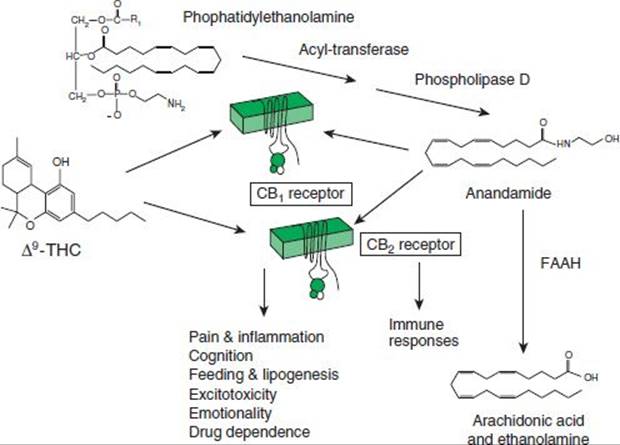
FIGURE 13-1 Endocannabinoid system.
MAGL inactivates 2-AG (Fig. 13-2). MAGL has been cloned from human, mouse, and rat. A second MAGL (4) is distributed in the CNS in the same brain regions as CB1 receptors and, unlike FAAH, is a presynaptic enzyme, consistent with the role of 2-AG as a retrograde signal (see next section).

FIGURE 13-2 Endocannabinoid system–2-AG.
MECHANISM OF ACTION
It is now well recognized that THC and other cannabinoids produce their psychoactive effects through their binding to CB1/2 receptors. Investigations using CB1 knockout mice show that activation of CB1receptors is necessary for antinociception, decreased spontaneous activity, and other psychopharmacologic effects. There is considerable evidence that CB1 receptors are coupled to G proteins, some of which are Gi/Go and others are Gs. Activation of Gi/Go proteins inhibits adenylate cyclase, while activation of Gs proteins by psychoactive cannabinoids activates adenylate cyclase (4). These results may explain the bidirectional aspects of many of the CNS effects of the cannabinoids, but this still remains to be proven. One example of these bidirectional effects is the ability of THC, synthetic cannabinoids, and the endocannabinoids to either stimulate or inhibit nitrous oxide formation. The functional activity of G-protein–coupled receptors can be measured directly using receptor-stimulated binding of the hydrolysis-resistant GTP analog [35S]GTPγS in membranes and tissue sections (60). These studies show cannabinoid receptor–stimulated G proteins in brain regions that contain cannabinoid receptors. Previous studies using agonist-stimulated [35S]GTPγS binding demonstrated cannabinoid receptor–activated G proteins in membrane homogenates and sections of brains from mouse, rat, and guinea pig. The receptor specificity of agonist-stimulated [35S]GTPγS binding has been confirmed by demonstrating (a) specific anatomical localization corresponding to appropriate receptor distribution, (b) antagonist reversibility of the response, and (c) concentration-dependent and saturable nature of stimulation. In addition, agonist-stimulated [35S]GTPγS binding allows the investigation of desensitization of cannabinoid receptors following chronic agonist treatment, receptor efficiency (defined as the ratio of activated G protein to receptor Bmax), and agonist efficacy (maximal stimulation) (60).
Protein phosphorylation plays an important role in the intracellular modulation of enzymes by both cannabinoids and endocannabinoids (61). Mitogen-activated protein kinase (MAPK), which is modulated by CB1 receptor activation, catalyzes protein phosphorylation. This effect, coupled with the inhibition of cAMP-dependent protein kinase A (PKA), is the basis of a number of cannabinoid actions. MAPK kinase activation by cannabinoids may occur independently from inhibition of PKA or be due, at least in part, to inhibition of cAMP formation. The stimulation of CB1 receptors may regulate MAP kinase activity indirectly through its effects on cAMP accumulation. A decrease in cAMP levels, and consequently in PKA activity, may participate in the stimulatory effects of CB1 receptor activation on the MAP kinase pathway. The inhibition of adenylate cyclase and PKA may be involved in the CB1-induced activation of focal adhesion kinases (FAK+) in hippocampal slices. This effect may mediate the modulation of synaptic plasticity and learning processes by cannabinoids. At least two other cannabinoid receptor signal transduction pathways involve activation of MAP kinase by the CB1 receptor (61). The first involves activation of PI3K/PKB, which in turn mediates tyrosine phosphorylation and activation of Raf. The second pathway is initiated by sphingomyelin hydrolysis, release of the lipid second messenger ceramide, and subsequent activation of the Raf MAP kinase cascade. These effects of cannabinoids on multiple families of kinases suggest the importance of alterations in protein phosphorylation in the mechanism of action of cannabinoids (61).
Cannabinoids activate the inositol phospholipid pathway. This pathway involves receptor activation of a G protein that in turn activates phospholipase C. Phospholipase C cleaves phosphatidylinositol 4,5-bisphosphate (PIP2) into inositol triphosphate (IP3) and DAG. DAG activates protein kinase C (PKC); IP3 triggers calcium release from intracellular stores (61). Phosphorylating the CB1 receptor with PKC attenuates N- and P/Q-type calcium currents and the inwardly rectifying potassium currents following cannabinoid receptor activation. Therefore, cannabinoid-induced activation of PKC decreases neuronal excitability and synaptic activity. Cannabinoids inhibit an omega-conotoxin– sensitive, high-voltage–activated N-type calcium channel (62). Cannabinoids also couple to A-type outward potassium channels leading to hyperpolarization of neurons (62).
The CB2 receptor, like the CB1 receptor, is coupled to Gi proteins, inhibits adenylate cyclase, and activates MAP kinase. The proposed pathway is activation of PI3K/PKB, which in turn induces translocation of Raf-1 to the membrane and phosphorylation of p42/p44 MAP kinase (for reviews, see Refs. (61,62)). The CB2 receptor induces the expression of genes through a PKC-dependent activation of MAP kinase.
The endocannabinoids bind both CB1 and CB2 receptors and produce effects on transduction pathways similar to those of the cannabinoids (4). The endocannabinoids are released postsynaptically to have “retrograde messenger” activity, resulting in regulation of the release of neurotransmitters from the presynaptic neuron. CB1 receptors inhibit presynaptic voltage-gated calcium channels. The retrograde diffusion of the endocannabinoids activates presynaptic CB1 receptors, thereby inhibiting presynaptic calcium channels, either by depolarization or activation of Gq/11-linked receptors. This results in decreased presynaptic neurotransmitter release. Depolarization-induced suppression of inhibition is induced when inhibitory transmission is attenuated. Conversely, DSE (depolarization-induced suppression of excitation) is induced when excitatory transmission is inhibited. Long-term inhibition of neurotransmitter release may also occur. The net effect of the ECS is to function as a regulator or “rheostatic” mechanism on neuronal excitability (4,61,62).
Several more recently discovered endocannabinoids act at non–CB1/2 receptors. Olvanil interacts with the vanilloid receptor and N-arachidonoyl dopamine with TRPV1 channels (63). N-arachidonoyl dopamine also has the characteristics of an endocannabinoid. The vanilloid receptor, TRPV1, is widely distributed in the brain and spinal cord, is heat activated, and activated by the application of capsaicin, an ingredient in hot chili peppers. TRPV1 activation gates calcium entry into cells, in particular sensory neurons. Only endocannabinoids appear to interact with the TRPV1 receptor; exogenous or synthetic cannabinoids do not. This may indicate a role for endocannabinoids in the modulation of pain and cardiovascular responses independent of CB receptor activation.
Other non–CB1-/non–CB2-mediated effects of endo-cannabinoids include AEA-induced antinociception in CB1 knockout mice (mice devoid of the CB1 receptor) and the lack of blockade of the effects of AEA and certain other endocannabinoids by the CB1 receptor antagonist SR141716A (4).
The wide array of effects produced by cannabinoids, including effects that appear CB receptor independent, suggest the existence of novel cannabinoid-like receptors such as GPR55 and GPR119 (for reviews, see Refs. (58,59)). Given the plethora of effects of the cannabinoids and endo-cannabinoids, it is likely that such effects are mediated by more than two receptors. The mechanisms associated with these and other novel receptors will provide researchers with multiple preclinical targets for potential clinical therapies.
RELATIVE ADDICTION LIABILITY
Cannabis use can lead to addictive disorders (38). Animals develop physical dependence to the effects of THC on repeated exposure (30). Both the DSM-5 (39) and the World Health Organization recognize cannabis dependence (40). Clinical and epidemiologic evidence indicates that a cannabis dependence syndrome occurs in heavy, chronic users of cannabis, as exhibited by a lack of control over their cannabis use and continued use despite adverse personal consequences. Several longitudinal studies of the risk for cannabis use after initial and short-term exposures and the long-term outcomes have been published and include studies on sex differences in the development of cannabis dependence (64–66). Female cannabis users were more likely than male users to develop cannabis dependence. In addition, the use of rimonabant in research subjects has been shown to decrease the positive reinforcement obtained from cannabis use. (For recent reviews of cannabis dependence, see Refs. (38,41–43).) In animal studies, cannabis is self-administered and acts via the same brain reward circuitry as do other drugs of abuse. Although it is difficult to establish self-administration paradigms for THC (67), rats readily self-administer the THC analog WIN 55,212-2. Self-administration in rhesus monkeys is followed by withdrawal signs upon cessation of the drug, indicating that cannabis dependence can be produced in monkeys. Self-administration of THC and WIN 55,212-2 is abolished by administration of the CB1 antagonist rimonabant (67). Thus, the abuse potential of THC appears to be mediated by CB1 receptor activation.
Cannabis has all of the properties consistent with a drug that is reinforcing, including a fast onset of action after inhalation and rapid entry to brain and spinal cord sites, although cannabis is considered by many to be “safe” in comparison to other drugs of abuse (68,69). Newer strains of cannabis have higher levels of THC that make the effects increasingly rewarding. The majority of the chemical entities present in cannabis, as well as the pyrolysis (burning) products, have not been evaluated for either psychoactive or toxicologic properties. Thus, the effects of prolonged drug use are difficult to predict, although neurochemical changes are observed upon tolerance and dependence to THC (see “Pharmacodynamics” section).
PHARMACOKINETICS
Inhalation produces the most rapid onset and intense “high.” Marijuana and hashish may also be taken orally via food products. However, the kinetics of oral absorption leads to a slower onset of the psychoactive effects (about an hour) and a slower offset of action. The “high” is of lesser intensity but longer in duration. THC is insoluble in water, and so little or no drug is actually present in certain THC extracts that are injected intravenously. The synthetic chemistry of THC and its metabolism have been reviewed (70). THC is metabolized to the active metabolite 11-OH-THC, which is unlikely to contribute significantly to THC’s pharmacologic effects because it is rapidly converted to conjugated 11-nor-9-carboxy-THC (THCCOOH), which is inactive but serves as the primary urinary marker for detecting cannabis use. THC accumulates in fatty tissues for long periods of time after use. However, there is no evidence that THC exerts a deleterious effect when slowly released from fat tissues (70). The relationship between blood levels of THC and pharmacologic effects is not initially linear. A slight delay between the rapid appearance in plasma of THC and the onset of behavioral effects makes the impairment produced by THC difficult to predict based solely on plasma concentrations. Once THC is distributed completely to all body compartments, the behavioral effects of THC are proportional to its plasma concentrations (70). Lack of correlation of blood concentrations and pharmacologic effects is a confounder to the interpretation of impairment following THC use. Complex mathematical models allow for the estimation of time elapsed since marijuana usage based upon THC/metabolite ratios, a topic of importance in criminal and workplace cases in which liability is assessed based on drug use. Human controlled drug administration studies led to the development and validation of two equations for predicting time since last use: model I based upon THC concentration (for infrequent users) and model II based upon the THCCOOH/THC ratio (for all users and oral administration). Both models were found valid for forensic use with 95% confidence intervals of detection (70).
TOLERANCE AND RECEPTOR PHARMACODYNAMICS
Tolerance develops to the pharmacologic effects of cannabinoids in a variety of animal species, including pigeons, rodents, dogs, monkeys, and rabbits (38). Tolerance develops to antinociception, anticonvulsant activity and catalepsy, depression of locomotor activity, hypothermia, hypotension, corticosteroid release, ataxia in dogs, and schedule-controlled behavior. The precise mechanism of tolerance is unknown. Most research focuses on receptor mechanisms such as receptor inactivation or desensitization or decreased receptor number (down-regulation). Tertiary signaling processes and plasticity of other neurotransmitter/ neuromodulatory systems may also play a role, such as those described above for the endogenous opioid system. Desensitization can involve a conformation change in the receptor, internalization of the receptor, uncoupling of the receptor from G proteins, or a combination of such processes. The process of down-regulation includes loss of receptors from the membrane, as evidenced by a decrease in receptor number in binding assays and/or changes in receptor mRNA and protein levels. There is little evidence that chronic administration of cannabinoids alters their disposition or metabolism in the brain or periphery (38), suggesting that tolerance is pharmacodynamic in nature rather than a consequence of reduced bioavailability.
Thus, during tolerance, CB1 receptors lose the ability to inhibit adenylyl cyclase, either through desensitization or switching to Gs-protein stimulation. Receptor desensitization occurs following repeated administration of THC for a minimum of 3 days in rodent studies. Dose-dependent alterations in cannabinoid receptor number and affinity in rat brain regions are detected by autoradiography, with decrease in CB1 receptor mRNA in the caudate (38). Selective down-regulation of receptors following chronic THC administration in rat occurs in striatum and nigrostriatal and mesolimbic areas (38). Conversely, tolerance to THC in the vas deferens model did not involve an alteration in the number of cannabinoid receptors (4,38). The process of cannabinoid desensitization mimics that of the beta-adrenergic receptor and involves several kinase phosphorylation steps and possibly the constitutive activation of several of the kinases. Down-regulation of cannabinoid receptors following tolerance to cannabinoids is still incompletely understood. It is possible that, in distinct brain regions, receptor mRNA and protein levels are altered and that these changes are undetected when measuring whole brain homogenates.
TOXICITY/ADVERSE EFFECTS
Psychomotor Effects
Marijuana dose-dependently impairs a variety of psychomotor functions, including object distance and shape discrimination, reaction time, information processing, perceptual motor coordination, motor performance, signal detection, tracking behavior, and slowed time perception (71). The effects are generally larger, more consistent, and of increased persistence in difficult tasks that involve sustained attention (72). There is an additive effect of cannabis and alcohol on complex psychomotor tasks such as driving. Cannabis alone produces minor impairment of driving performance, in part, because drivers are aware of cannabis effects and drive cautiously to compensate. Eye-tracking performance is disrupted by cannabis smoking, but the residual effects of a single cannabis cigarette on eye-tracking performance are minimal 24 hours later (72).
Behavioral Effects
Cannabis use has been associated with an “amotivational syndrome.” However, there is little rigorous scientific evidence to support its existence (for a review, see Refs. (73,74)). Most studies have been narrow in scope and with small sample sizes. An increased risk of quitting high school and increased job turnover in young adults has been shown, but such studies fail to account for the initial aspirations and goal orientation of the study participants. More rigorous longitudinal studies with appropriate controls for baseline status find residual cognitive impairment beyond the acute intoxication period in current heavy users (15 joints/ week), but similar deficits are no longer apparent 3 months after cessation of regular use, even among former heavy-using young adults (74).
Many confounds are associated with such studies (75). There are marked patterns of individual variability of substance use (e.g., duration, frequency, dosage, type), and, with the exception of a few studies, most researchers cannot definitively isolate the effects of a specific drug due to a history of polysubstance use. It remains to be seen if concurrent use of different substances (e.g., cannabis and alcohol) potentiates the long-term adverse effects of each drug.
Cognitive Effects
Cannabis use is associated with subtle decreases in cognition and memory via alterations in memory, attention, and integration of complex information. Acute cognitive impairments following use of cannabis include loss of concentration and short-term memory and goal-directed activities (76). Other reported effects of THC include disturbances of fine motor control and coordination and problems in visual perception. Complex reaction time, perception, reading, arithmetic performance, recall, and memory were affected in all studies. THC may have more pronounced effects on cognition if a person is using other drugs simultaneously. The effects of cannabis on cognitive behavior are increased profoundly in a synergistic manner with concurrent use of MDMA (“ecstasy”) (77). Given the polypharmacy that accompanies much cannabis use, it is possible that other drugs of abuse would have a similar deleterious effect on cognition in combination with cannabis.
Cannabis users show persistent deficits in specific cognitive functions beyond the period of acute intoxication. Neurobiologic studies indicate involvement of the endogenous cannabinoid system after repeated exposure to cannabis (78) and in the pathology of aging processes leading to dementia and other associated brain disorders (79). In humans, all stages of memory, including encoding, consolidation, and retrieval, are altered. Long-term potentiation, long-term depression, and inhibition of the release of GABA, glutamate, acetylcholine, and dopamine lead to amnestic effects of cannabinoids. Other functions altered are time and space perception and sense of self (“depersonalization”). In a 20-year prospective neurocognitive study, non–cannabis users, persistent users, and dependent users were assessed multiple times from ages 18 to 38 (80). Persistent users and dependent users lost about six IQ points, while nonusers gained about one IQ point. Of more clinical salience, persistent and dependent users had relevant cognitive losses in learning, memory, and executive decision making even when controlling for initial IQ and final educational levels. Heavy cannabis use (subjects smoked marijuana on a median of 29 days in the last 30 days and had cannabis-positive urine) is associated with residual effects on memory and learning, implicating even short-term heavy use with persistent neuronal changes into midlife (80). The longer that cannabis is used, the more pronounced is the cognitive impairment. In human PET studies, acute administration of THC increases activation in frontal and paralimbic brain regions and the cerebellum, consistent with the behavioral effects of THC (81). There is only equivocal evidence that chronic cannabis use causes structural brain changes. Functional magnetic resonance imaging studies in chronic users indicate neuroadaptations of brain networks responsible for higher cognitive functions, which may not be reversible with abstinence. A recent review of longitudinal, some prospective, neurocognitive studies in adolescence concluded that cannabis is neurotoxic when use begins in teen years (82).
Recent evidence in animals indicates that the ECS is a selective and rapid modulator of hippocampal synaptic function via effects on neurotransmitter release (83). CB1 receptors in the hippocampus are a crucial element of this influence. In general, exogenous administration of cannabinoids inhibits neurotransmitter release in hippocampus. Enhanced memory duration in rimonabant-treated mice and CB1knockout mice is consistent with the notion that endocannabinoids are tonically active to dampen memory. However, whether endocannabinoids such as anandamide and 2-AG tonically modulate the neural pathways that underlie cognition remains unclear. Central CB1 receptor– mediated signaling is involved in the facilitation of behavioral adaptation after the acquisition of aversive memories. The cannabinoid analog WIN 55,212-2, as well as THC and AEA, block the formation of new synapses in rat hippocampal cells in culture (83). The changes in the plasticity of the hippocampal system may explain the memory deficits observed in THC users and abusers. Several human psychiatric disorders such as generalized anxiety disorder and posttraumatic stress disorder (PTSD) appear to involve failure to “forget” aversive memories. Thus, modulation of the ECS might be a valuable therapeutic target for the treatment of these disorders.
Compared with matched controls who had used cannabis occasionally, heavy cannabis users had significantly lower educational achievement, lower income, and a subjective self-assessment of impaired cognitive function, social life, and health (40). A New Zealand study found a significant correlation between the level of cannabis use during adolescence and young adulthood and failure to complete school or university programs (40). However, such studies are confounded by the social surroundings of the subjects and lack of baseline neurocognitive testing for all individuals prior to marijuana use. A more recent prospective longitudinal study by Meier et al. (80) assessed multiple dimensions of neurocognitive functions repeatedly in a cohort of over 1,000 children for up to 25 years. All children were assessed prior to using cannabis. The persistent cannabis use group had a decline in overall intellectual functioning compared to the non–marijuana use group. Four domains were most impaired: working memory, perceptual reasoning, verbal comprehension, and processing speed. Even after controlling for persistent alcohol use, tobacco dependence, cannabis use in the last 24 hours or last 7 days, and presence/absence of schizophrenia, the cognitive losses remained significant. Use of cannabis in adolescence was highly predictive of later dependence; onset of use in adulthood was not predictive of dependence. This study suggests marijuana may be neurotoxic in adolescents (84).
Psychopathology
Given the adverse psychiatric effects of the cannabinoid antagonist rimonabant in clinical trials and clinical studies indicating higher levels of endocannabinoids in the cerebrospinal fluid of patients with schizophrenia (85), there has been increased interest in the role of the cannabinoid receptor and the use of cannabis in mental illness. Numerous large, prospective, longitudinal studies suggest that use of cannabis increases the risk for schizophrenia, worsens symptoms, and is associated with a poorer prognosis, effects related to the dose of drug and other risk factors (85). In addition, persons with genetic vulnerability to psychoses or a previous psychotic episode, as well as those who initiate cannabis use in early adolescence, are particularly prone to the development of schizophrenia (85). The causal relationship between cannabis use and schizophrenia is unclear. Given the number of environmental factors that are likely interacting with genetic factors in the development of the disease, cannabis appears to be a risk factor. The use of cannabis increases the risk of non–affective psychotic illness three- to sixfold (85,86). The association between cannabis use and depression is less significant after correction for confounds such as polydrug use (86,87). The association between cannabis use and depression or other affective disorders or suicidality remains unclear. Some reviews find cannabis use associated with “amotivational symptoms” (68), while others find no such symptoms, but do report significant effects on general health and well-being that might account for observed motivational effects (73).
The ECS is altered in preclinical models of neurologic disorders (19,37), with significant change in the synthesis and degradation of endocannabinoids upon chronic administration of THC to rodents. Such changes suggest that chronic THC exposure may alter neuronal plasticity in ways with therapeutic potential in numerous disease states.
Effects on Major Organ Systems
Respiratory
The major adverse health effect associated with marijuana smoking is damage to the respiratory system. Many of the same mutagens and carcinogens in nicotine cigarettes are found in marijuana smoke. Marijuana smoking increases airway resistance and decreases pulmonary function and produces chronic cough, airway inflammation, and abnormal cell growth that may indicate the onset of cancer (88). However, clinical and epidemiologic evidence linking marijuana smoking to chronic obstructive pulmonary disease or respiratory cancer has not been shown. Chronic use of marijuana has been shown to impair alveolar macrophage function. The concurrent use of tobacco by marijuana smokers increases the risk of lung cancers or lung injury (89). Both cross-sectional and longitudinal studies of lung function showed significantly poorer functioning and significantly greater abnormalities in small airways among tobacco smokers (regardless of concomitant cannabis use), while marijuana smokers showed poorer large airway functioning than non–marijuana smokers (regardless of concomitant tobacco use). Many such effects are not reversed upon abstinence (90). However, the International Agency for Research on Cancer found the epidemiologic data inconclusive as to the increased risk of cancer from cannabis use versus that of tobacco smokers (91).
Immunologic
The CB2 receptor is expressed on cells of the immune system, bone, and in the CNS, leading to the hypothesis that the cannabinoid system plays a significant role not only in immune modulation but also in numerous additional patho-logic states. The effects of CB2 receptor activation extend beyond the initial effects on the macrophage to include effects on most modulatory systems involved in neuropathic pain and autoimmune disorders (5,21). The role of both agonists and antagonists of the CB2 receptor is likely to become one of the major new therapeutic “fronts” for drug development, especially because CB2 agonists do not have the psychoactive effects associated with CB1 receptor agonists such as THC. Immunomodulatory effects of THC on macrophage function are abolished in CB2 knockout mice devoid of CB2 receptors (4), which are critical for gene regulation of immune cells, possibly via decreased production of various chemokines such as interleukin-I (IL-I), leading to immune suppression.
Immune suppression by THC protects pancreatic beta cells in an experimental model of autoimmune diabetes (92). These findings contrast with other data indicating a potential stimulation of immune responses via lymphocyte activation (92). Thus, cannabinoid use to decrease inflammation could be accompanied by an increase in viral infections. Overall, it appears that THC decreases macrophage function and natural killer cell activity. THC increases HIV-1 host infection in cell lines (94). Thus, the effects of cannabinoid or endocannabinoid activation of the immune system are complex, but numerous studies are in agreement that host resistance is impaired by THC administration. The increase in mortality following THC administration to animals is highly dependent upon the infectious agent (95).
Cardiovascular
Marijuana increases heart rate and produces orthostatic hypotension, which is blocked by rimonabant (37). Both CB1 and CB2 receptors have been implicated in a number of cardiovascular processes, including vasodilation, modulation of the baroreceptor reflex in the control of systolic blood pressure, inhibition of endothelial inflammation, and progression of atherosclerosis, making cannabinoid drugs potential targets for therapeutic use in a number of cardiovascular diseases (96). Endocannabinoids regulate platelet function and possibly promote thrombogenesis (96) and may also influence hematopoiesis, which can worsen congestive heart failure and increase hypertension. The ECS is implicated in the mechanism of hypotension associated with hemorrhagic, endotoxic, and cardiogenic shock. Endocannabinoids have a protective role in myocardial ischemia (37,96). Recent studies indicate the existence of a novel endothelial and cardiac receptor that mediates certain endocannabinoidinduced cardiovascular effects. Furthermore, cannabinoids have been considered as novel antihypertensive agents (37). Direct stimulation of the cardiac pacemaker by marijuana increases heart rate, making the drug less safe in cardiac patients (90). In healthy young users, these cardiovascular effects are unlikely to be of clinical significance. THC and its analogs have profound hypotensive and bradycardic effects in rats, which are mediated by the CB1receptor (37). The critical role of endocannabinoids in such pathophysiologic states suggests important therapeutic targets for conditions such as endotoxic and hemorrhagic shock.
Liver
Cannabinoid receptors play a crucial role in the pathogenesis of a variety of liver diseases (98). In mice, activation of CB1 receptors contributes to alcohol-induced steatosis, an increase in liver fibrous tissue. Daily cannabis use is a predictor of fibrosis progression via a steatogenic effect. Thus, daily cannabis use in patients with liver disease can have deleterious effects. The predominant liver effects of cannabis (THC, cannabidiol) in healthy human cannabis users are inhibition of liver microsomes, resulting in cannabis-induced prolongation of the action of barbiturates. Cannabis users metabolize and activate or inactivate drugs more slowly than normal. In preclinical studies, hashish induces carcinogen-metabolizing enzymes, potentiating the deleterious effects of N-nitrosamines and aromatic hydrocarbons, for example, benzo(a)pyrene in the liver (99).
Kidney
Renal complications are rare following cannabis use, with only one case of renal infarction documented (100). An additional case of nephropathy associated with marijuana smoking was recently reported (101).
Endocrine
THC alters pituitary hormones (97). Virtually no hormonal system remains unaffected by activation of cannabinoid receptors, although the effects are more often observed in preclinical than clinical studies. Effects of cannabinoids include inhibition of pituitary luteinizing hormone, prolactin (PRL), and growth hormone (GH), with little effect on secretion of follicle-stimulating hormone. Cannabinoids inhibit GH secretion due to stimulation of somatostatin release (97). Mice lacking the CB1 receptor have lower bone density than their wild-type controls, leading to the hypothesis that cannabinoid agonists may improve bone density (37). The synthetic cannabinoid analog WIN 55,212-2 modulates pituitary hormones via the CB1 receptor, particularly in the anterior lobe of the pituitary, site of release of GH and PRL (inhibited by WIN 55,212-2) in normal and hyperactive pituitary states (102). Cannabinoids affect thyroid function via a reduction of iodine accumulation and reduction of levels of thyroxine and thyroid-stimulating hormone in animals. There are no data regarding the effect of cannabinoids on thyroid function in humans (97). Basal and stress-induced plasma levels of adrenocorticotropin (ACTH) and corticosterone are higher in CB1receptor knockout mice versus wild-type controls. Thus, CB1receptor activation plays an important role in stress responses, release of ACTH, and production of cortisol (103). THC-induced increases in ACTH and corticosterone require cannabinoid and opioid receptors. It is hypothesized that human neuropsychiatric disorders, including anxiety and PTSDs, involve abnormal responses to stress, an effect likely due to altered activation of the ACTH/cortisol pathway. Activation of the CB1 receptor by endocannabinoids in rodent models modulates responses to acute, repeated, and variable stress, an effect enhanced by prior stress of the animals. Thus, modulation of the hypo-thalamic–pituitary–adrenal axis via cannabinoids may have therapeutic potential in such disease states (104).
Reproductive
Marijuana can disrupt the female reproductive system and induce galactorrhea (105). Studies using CB1 and CB2 knockout mice indicate that the ECS plays a role in the development and implantation of the embryo by synchronizing the developmental stage of the embryo to the receptive stage of the uterus. Far more research is needed in order to determine the role of the ECS in human reproduction and potential adverse effects of marijuana use on pregnancy. Studies of fetal effects from smoking marijuana during pregnancy are unclear because of common “polypharmacy” (use of several drugs in combination) and other uncontrolled confounding factors (e.g., diet, age) in the mothers. Women who smoke marijuana during pregnancy often have children with low birth weight, possibly due to shorter gestation (105). The lipid solubility of THC allows for rapid transit into the fats in breast milk, where it accumulates and is passed to the newborn. In male animals, chronic administration of high doses of THC disrupts reproductive function, reducing the secretion of testosterone and sperm production, motility, and viability, but effects in human males are unclear (106).
INTOXICATION AND OVERDOSE
Marijuana users frequently report euphoria, hunger, and relaxation and less often panic, anxiety, nausea, and dizziness. In rare instances, marijuana can increase paranoia and panic attacks at oral doses of 20 mg or higher (85). These more severe effects are most often reported by naive users or patients receiving THC therapeutically who are unfamiliar with the drug’s effects. Discussion of potential effects reduces the intensity of such experiences; experienced users rarely report these effects (85).
DRUG–DRUG INTERACTIONS
Cannabis use typically precedes involvement with other drugs such as stimulants. There is no rigorous scientific evidence or known neurobiologic basis for such a “gateway” effect of cannabis smoking. Such an effect may be due to the increased opportunity of cannabis users to associate with users of other types of drugs or the group peer pressure to use other drugs (107,108). A combination of THC and alcohol in humans may result in increased levels of THC due to ethanol-induced increases in THC absorption, resulting in enhanced subjective effects on mood (109). This alcohol–THC interaction may enhance the abuse of the drugs in combination. The chronic administration of THC produces sensitization to the effects of amphetamine and heroin in rats. The rats most profoundly affected by THC sensitization were those “high-responding” rats with high intrinsic levels of drug-seeking behavior. These findings suggest a propensity of THC to increase drug seeking in those individuals particularly sensitive or vulnerable to addictive behaviors (110). The acute euphoric effects of cannabis in human studies appear to be due to CB1 receptor activation and are blocked by the CB1 antagonist rimonabant (111).
CONCLUSIONS AND FUTURE RESEARCH
Cannabinoids are a class of compounds with an ancient and rich history of uses for both recreational and therapeutic purposes. Only within recent decades have the mechanisms underlying cannabinoid actions been ascertained, aided by the discovery of receptors, antagonists and endogenous ligands for those receptors, and new transgenic technology in which the receptors are genetically “removed” from an animal. Despite these advances in the pharmacology and neurobiology of the cannabinoids, considerable controversy remains as to their potential therapeutic uses, as well as the optimum route of administration of THC and other pharmacologically active cannabinoids.
As described in ancient sources, cannabinoids appear to have a variety of potentially useful therapeutic effects. The problem that must be addressed by research is how to develop a cannabinoid or endocannabinoid modulator devoid of undesirable side effects. The hypothesis that the CB1 and CB2 receptors are not the only cannabinoid receptors is supported by several lines of research indicating non-CB1–and non-CB2–mediated effects of cannabinoids. The role of other GPR “orphan” receptors in human physiology is also a target for therapeutic research. The increasing knowledge of the ECS’s role in tonic regulation of analgesia, cognition, food intake, and cardiovascular tone indicates that possible analogs of the endocannabinoids, or modulators of endocannabinoid pathways, may be productive targets for drug development. The discovery of the metabolic pathways of endocannabinoids, which lead to prostanoid-like prostamides and other metabolites similar in function to prostaglandins and leukotrienes, has opened another area of research. Allosteric modulation of activated endocannabinoid binding sites may be an approach to some specificity in the action of endocannabinoids in disease. The use of cannabinoids/endocannabinoids in combination with other drugs has become an area of intense interest. The goal of novel therapeutic interventions will be to decrease thepotential for tolerance and dependence.
In summary, the cannabinoids are a class of drugs with a diverse profile of pharmacologic activities. The endocannabinoids and cannabinoid receptors are highly conserved phylogenically. The research task today remains determining the reasons for the preservation of the cannabinoid system through both invertebrate and vertebrate evolution and the roles such receptors, known and yet to be found, play in diseases, including addictive behaviors.
ACKNOWLEDGMENTS
Dr. Welch acknowledges the Presidential Research Initiative Grant from Virginia Commonwealth University, Richmond, Virginia, which supported this work in part.
REFERENCES
1.Mechoulam R, Hanus L. A historical overview of chemical research on cannabinoids. Chem Phys Lipids 2000;108:1–13.
2.Skaper SD, Di Marzo, V. Endocannabinoids in nervous system health and disease: the big picture in a nutshell. Philos Trans R Soc Lond B Biol Sci 2012;367(1607):3193–3200.
3.Mechoulam R, Gaoni Y. A total synthesis of dl-D1-tetrahydrocannabinol, the active constituent of hashish. J Am Chem Soc 1965;87:3273–3275.
4.Pertwee RG. Targeting the endocannabinoid system with cannabinoid receptor agonists: pharmacological strategies and therapeutic possibilities. Philos Trans R Soc Lond B Biol Sci2012;367:3353–3363.
5.Borgelt LM, Franson KL, Nussbaum AM, et al. The pharmacologic and clinical effects of medical cannabis. Pharmacotherapy 2013;33(2):195–209.
6.Vandrey R, Dunn K, Fry J, et al. A survey study to characterize use of Spice products (synthetic cannabinoids). Drug Alcohol Depend 2012;120:238–241.
7.European Monitoring Centre for Drugs and Drug Addiction. Understanding the Spice phenomenon. Luxembourg, Europe: Office for Official Publications of the European Communities, 2009.
8.Vardakou I, Pistos C, Spiliopoulou Ch. Spice drugs as a new trend: mode of action, identification and legislation. Toxicol Lett 2010;197:157–162.
9.Bebarta VS, Ramirez S, Varney SM. Spice: a new legal herbal mixture abused by young active duty military personnel. Subst Abuse 2012;33(2):191–194.
10.Gunderson E, Haughey H, Ait-Daoud N, et al. Spice and K2 designer drugs: synthetic cannabinoid consumption among marijuana and tobacco users. Subst Abus 2012;33(2):201.
11.Center for Disease Control and Prevention. Acute kidney injuries associated with synthetic cannabinoid use. MMWR Morb Mortal Wkly Rep 2012;62(6):93–98.
12.Parker LA, Rock EM, Limebeer CL. Regulation of nausea and vomiting by cannabinoids. Br J Pharmacol 2011;163(7):1411–1422.
13.Haney M, Gunderson EW, Rabkin J, et al. Dronabinol and marijuana in HIV-positive marijuana smokers. Caloric intake, mood, and sleep. J Acquir Immune Defic Syndr 2007;45(5):545–554.
14.Sanofi Aventis Advisory Committee. FDA Briefing Document, NDA 21–888 Zimulti (rimonabant) tablets, 20 mg, 2007 www.fda.gov/ohrms/.../ac/.../briefing/2007-4306b1-fda-backgrounder.
15.Vasileiou J, Fotopoulou G, Matzourani M, et al. Evidence for the involvement of cannabinoid receptors’ polymorphisms in the pathophysiology of human diseases. Expert Opin Ther Targets 2013;17:363–377.
16.Davis JP, Ramsey HH. Antiepileptic action of marijuana-active substances. Fed Proc 1949;8:284–285.
17.Falenski KW, Blair RE, Sim-Selley LJ, et al. Status epilepticus causes a long-lasting redistribution of hippocampal cannabinoid type 1 receptor expression and function in the rat pilocarpine model of acquired epilepsy. Neuroscience 2007;146(3):1232–1244.
18.Cortesi M, Fusar-Poli P. Potential therapeutical effects of cannabidiol in children with pharmacoresistant epilepsy. Med Hypotheses 2007;68(4):920–921.
19.Bisogno T, Di Marzo V. Short- and long-term plasticity of the endocannabinoid system in neuropsychiatric and neurological disorders. Pharmacol Res 2007;56(5):428–442.
20.Pertwee RG. Cannabinoids and multiple sclerosis. Mol Neurobiol 2007;36(1):45–59.
21.Sagar DR, Burston JJ, Woodhams SG, et al. Dynamic changes to the endocannabinoid system in models of chronic pain. Philos Trans R Soc Lond B Biol Sci 2012;367(1607):3300–3311.
22.Fowler CJ. Anandamide uptake explained? Trends Pharmacol Sci 2012;33:181–185.
23.Ueda N, Tsuboi K, Uyama T, et al. Biosynthesis and degradation of the endocannabinoid 2-arachidonoylglycerol. Biofactors 2011;37(1):1–7.
24.Păunescu H, Coman OA, Coman L, et al. Cannabinoid system and cyclooxygenases inhibitors. J Med Life 2011;4:11–20.
25.Van Sickle MD, Duncan M, Kingsley PJ, et al. Identification and functional characterization of brainstem cannabinoid CB2 receptors. Science 2005;310(5746):329–332.
26.Wotherspoon G, Fox A, McIntyre P, et al. Peripheral nerve injury induces cannabinoid receptor 2 protein expression in rat sensory neurons. Neuroscience 2005;135(1):235–245.
27.Lucas P. Cannabis as an adjunct to or substitute for opiates in the treatment of chronic pain. J Psychoactive Drugs 2012;44(2):125–133.
28.Viganõ D, Rubino T, Parolaro D. Molecular and cellular basis of cannabinoid and opioid interactions. Pharmacol Biochem Behav 2005;81(2):360–368.
29.Smith PB, Welch SP, Martin BR. Interactions between delta 9-tetrahydrocannabinol and kappa opioids in mice. J Pharmacol Exp Ther 1994;268:1382–1387.
30.Mason DL, Welch SP. A diminution of 9-tetrahydrocannabinol modulation of dynorphin A-(1-17) in conjunction with tolerance development. Eur J Pharmacol 1999;381:105–111.
31.Mailleux P, Vanderhaeghen JJ. Localization of cannabinoid receptor in the human developing and adult basal ganglia. Higher levels in the striatonigral neurons. Neurosci Lett1992;148(1–2):173–176.
32.Cichewicz DL, McCarthy EA. Antinociceptive synergy between Δ9-tetrahydrocannabinol and opioids after oral administration. J Pharmacol Exp Ther 2003;304:1010–1015.
33.Cox ML, Welch SP. The antinociceptive effect of delta9-tetrahydrocannabinol in the arthritic rat. Eur J Pharmacol 2004;493(1–3):65–74.
34.Gomes I, Fujita W, Chandrakala MV, et al. Disease-specific heteromerization of G-protein-coupled receptors that target drugs of abuse. Prog Mol Biol Transl Sci 2013;117:207–265.
35.Smith PA, Selley DE, Sim-Selley LJ, et al. Low dose combination of morphine and delta9-tetrahydroncannabinol circumvents antinociceptive tolerance and apparent desensitization of receptors. Eur J Pharmacol 2007;571(2–3):129–137.
36.Mao J, Price DD, Lu J, et al. Two distinctive antinociceptive systems in rats with pathological pain. Neurosci Lett 2000;280(1):13–16.
37.Pacher P, Bákai S, Kunos G. The endocannabinoid system as an emerging target of pharmacotherapy. Pharmacol Rev 2006;58(3): 389–462.
38.Maldonado R, Berrendero AF, Ozaitaa AA, et al. Neurochemical basis of cannabis addiction. Neuroscience 2011;181:1–17.
39.American Psychiatric Association. Fifth edition of the diagnostic and statistical manual of mental disorders (DSM-5). Arlington, VA: American Psychiatric Association publication, 2013.
40.Kalant H. Adverse effects of cannabis on health: an update of the literature since 1996. Prog Neuropsychopharmacol Biol Psychiatry 2004;28(5):849–863.
41.Budney AJ, Hughes JR, Moore BA, et al. Review of the validity and significance of cannabis withdrawal syndrome. Am J Psychiatry 2004;161(11):1967–1977.
42.Hasin D, Hatzenbuehler ML, Keyes K, et al. Substance use disorders. Diagnostic and Statistical Manual of Mental Disorders, fourth edition (DSM-IV) and International Classification of Disease, tenth edition (ICD-10). Addiction 2006;101(Suppl 1):59–75.
43.Budney AJ. Are specific dependence criteria necessary for different substances: how can research on cannabis inform this issue? Addiction 2006;101(Suppl 1):125–133.
44.Budney AJ, Hughes JR. The cannabis withdrawal syndrome. Curr Opin Psychiatry 2006;19(3):233–238.
45.Cooper ZD, and Haney M. Actions of delta-9-tetrahydrocannabinol in cannabis: relation to use, abuse, dependence Int Rev Psychiatry, 2009;21(2):104–112.
46.Vandrey RG, Budney AJ, Hughes JR, et al. A within-subject comparison of withdrawal symptoms during abstinence from cannabis, tobacco, and both substances. Drug Alcohol Depend2008;92:48–54.
47.Copersino ML, Boyd SJ, Tashkin DP, et al. Cannabis withdrawal among non-treatment-seeking adult cannabis users. Am J Addict 2006;15(1):8–14.
48.Copeland J, Swift W, Roffman R, et al. A randomized controlled trial of brief cognitive-behavioral interventions for cannabis use disorder. J Subst Abuse Treat 2001;21(2):55–64; discussion 65–66.
49.Valverde O, Maldonado R, Valjent E, et al. Cannabinoid withdrawal syndrome is reduced in pre-proenkephalin knock-out mice. J Neurosci 2000;20(24):9284–9289.
50.Abel EL. A comprehensive guide to the cannabis literature. Westport, CT: Greenwood Press, 1979.
51.O'Shaughnessy WB. On the preparation of Indian Hemp or Gunjah. Trans Med Phys Soc Bombay 1842;8:421–461.
52.Substance Abuse and Mental Health Services Administration. Results from the 2011 national survey on drug use and health: summary of national findings. NSDUH Series H-44. HHS Publication Number (SMA12-4713). Rockville, MD: Substance Abuse and Mental Health Services Administration, 2012.
53.Substance Abuse and Mental Health Services Administration, Center for Behavioral Health Statistics and Quality. The DAWN report: highlights of the 2010 Drug Abuse Warning Network (DAWN) findings on drug-related emergency department visits. Rockville, MD, 2012.
53a.Johnston, LD, O'Malley, PM, Bachman, JG, et al. Monitoring the future national results on adolescent drug use: Overview of key findings, 2011. Univ. of Michigan Institute for Social Research, http://www.monitoringthefuture.org//pubs/monographs/mtf-overview2012.
54.Howlett AC, Evans DM, Houston DB. The cannabinoid receptor. In: L Murphy, A Bartke, eds. Marijuana/cannabinoids: neurobiology and neurophysiology. Boca Raton, FL: CRC Press, 1992:35–72.
55.Mechoulam R, Feigenbaum JJ, Lander N, et al. Enantiomeric cannabinoids: stereospecificity of psychotropic activity. Experientia 1988;44:762–764.
56.Gerard CM, Mollerearu C, Vasart G, et al. Molecular cloning of a human cannabinoid receptor which is also expressed in testis. Biochem J 1991;279:129–134.
57.Cooper ZD, Haney M. Cannabis reinforcement and dependence: role of the cannabinoid CB1 receptor. Addict Biol 2008;13:188–195.
58.Gasperi V, Dainese E, Oddi S, et al. GPR55 and its interaction with membrane lipids: comparison with other endocannabinoid-binding receptors. Curr Med Chem 2013;20(1):64–78.
59.Console-Bram L, Marcu J, Abood ME. Cannabinoid receptors: nomenclature and pharmacological principles. Prog Neuropsychopharmacol Biol Psychiatry 2012;38(1):4–15.
60.Sim-Selley LJ, Brunk LK, Selley DE. Inhibitory effects of SR141716A on G-protein activation in rat brain. Eur J Pharmacol 2001;414(2–3):135–143.
61.Gomez-Ruiz M, Hernández M, de Miguel R, et al. An overview on the biochemistry of the cannabinoid system. Mol Neurobiol 2007;36:3–14.
62.Mackie K. From active ingredients to the discovery of the targets: the cannabinoid receptors. Chem Biodivers 2007;4(8):1693–1706.
63.Di Marzo V, De Petrocellis L. Endocannabinoids as regulators of transient receptor potential (TRP) channels: a further opportunity to develop new endocannabinoid-based therapeutic drugs. Curr Med Chem 2012;14:1430–1449.
64.Anthony JC. Steppingstone and gateway ideas: a discussion of origins, research challenges, and promising lines of research for the future. Drug Alcohol Depend 2012;123(Suppl 1):S99–S104.
65.Wagner FA, Anthony JC. Male-female differences in the risk of progression from first use to dependence upon cannabis, cocaine and alcohol. Drug Alcohol Depend 2007;86:191–198.
66.Chen CY, O'Brein MS, Anthony JC. Who becomes cannabis dependent soon after onset of use? Epidemiological evidence from the United States: 2000-2001. Drug Alcohol Depend2005;79:11–22.
67.Tanda G, Goldberg SR. Cannabinoids: reward, dependence, and underlying neurochemical mechanisms—a review of recent preclinical data. Psychopharmacology (Berl)2003;169(2):115–134.
68.U.S. Department of Health and Human Services, Substance Abuse and Mental Health Services Administration, Office of Applied Studies. National survey on drug use and health 2006. Research Triangle Park, NC: Research Triangle Institute, and Ann Arbor, MI: Inter-university Consortium for Political and Social Research, 2008.
69.Substance Abuse and Mental Health Services Administration, Office of Applied Studies. Drug Abuse Warning Network, 2005: national estimates of drug-related emergency department visits. DAWN Series D-29, DHHS Publication No. (SMA) 07–4256, Rockville, MD, 2007.
70.Huestis MA, Elsohly M, Nebro W, et al. Estimating time of last oral ingestion of cannabis from plasma THC and THCCOOH concentrations. Ther Drug Monit 2006;28(4):540–544.
71.Armentano P. Cannabis and psychomotor performance: a rational review of the evidence and implications for public policy. Drug Test Anal 2013;5(1):52–56.
72.Hartman RL, Huestis MA. Cannabis effects on driving skills. Clin Chem 2013;59(3):478–492.
73.Barnwell SS, Earleywine M, Wilcox R. Cannabis, motivation, and life satisfaction in an internet sample. Subst Abuse Treat Prev Policy 2006;1(1):2.
74.Fried PA, Watkinson B, Gray R. Neurocognitive consequences of marihuana—a comparison with pre-drug performance. Neurotoxicol Teratol 2005;27:231–239.
75.Yücel M, Lubman DI, Solowij N, et al. Understanding drug addiction: a neuropsychological perspective. Aust N Z J Psychiatry 2007;41:957–968.
76.Grotenhermen F. The toxicology of cannabis and cannabis prohibition. Chem Biodivers 2007;4(8):1744–1769.
77.Croft RJ, Mackay AJ, Mills AT, et al. The relative contributions of ecstasy and cannabis to cognitive impairment. Psychopharmacology (Berl) 2001;153(3):373–379.
78.Puighermanal E, Busquets-Garcia E, Maldonado R, et al. Cellular and intracellular mechanisms involved in the cognitive impairment of cannabinoids. Philos Trans R Soc Lond B Biol Sci2012;367(1607):3254–3263.
79.Bilkei-Gorzo A. The endocannabinoid system in normal and pathological brain ageing. Philos Trans R Soc Lond B Biol Sci 2012;367(1607):3326–3341.
80.Meier MH, Caspi A, Ambler A, et al. Persistent cannabis users show neuropsychological decline from childhood to midlife. Proc Natl Acad Sci U S A 2012;109(40):E2657–E2664.
81.Chang L, Chronicle EP. Functional imaging studies in cannabis users. Neuroscientist 2007;13(5):422–432.
82.Schoeler T, Bhattacharyya S. The effect of cannabis use on memory function: an update. Subst Abuse Rehabil 2013;2013(4):11–27.
83.Melis M, Pistis M. Hub and switches: endocannabinoid signaling in midbrain dopamine neurons. Philos Trans R Soc Lond B Biol Sci 2012;367(1607):3276–3285.
84.Chen CY, Storr CL, Anthony JC. Early-onset drug use and risk for drug dependence problems. Addict Behav 2009;34:319–322.
85.Fiorenentini A, Volonteri LS, Dragogna F, et al. Substance-induced psychoses: a critical review of the literature. Curr Drug Abuse Rev 2011;4:228–240.
86.Manrique-Garcia E, Zammit S, Dalman C, et al. Cannabis use and depression: a longitudinal study of a national cohort of Swedish conscripts. BMC Psychiatry 2012;12:112–119.
87.Manrique-Garcia E, Zammit S, Dalman C, et al. Cannabis, schizophrenia and other non-affective psychoses: 35 years of follow-up of a population-based cohort. Psychol Med2012;6:1321–1328.
88.Tashkin DP. Smoked marijuana as a cause of lung injury. Monaldi Arch Chest Dis 2005;63(2):93–100.
89.Gil E, Kelp E, Webber M, et al. Acute and chronic effects of marijuana smoking on pulmonary alveolar permeability. Life Sci 1995;56:2193–2199.
90.Tashkin DP, Shapiro BJ, Lee EY, et al. Subacute effects of heavy marijuana smoking pulmonary function in healthy young mates. N Engl J Med 1976;294:125–129.
91.Hashibe M, Straif K, Tashkin DP, et al. Epidemiologic review of marijuana use and cancer risk. Alcohol 2005;35(3):265–275.
92.Matias I, Gonthier MP, Orlando P, et al. Regulation, function, and dysregulation of endocannabinoids in models of adipose and beta-pancreatic cells and in obesity and hyperglycemia. J Clin Endocrinol Metabol 2006;91(8):3171–3180.
93.Horvath TL. The unfolding cannabinoid story on energy homeostatis: central or peripheral site of action? Int J Obes (Lond) 2006;30(Suppl 1):S30–S32.
94.Noe SN, Newton C, Widen R, et al. Modulation of CB1 mRNA upon activation of murine splenocytes. Adv Exp Med Biol 2001;493:215–221.
95.Friedman H, Newton C, Klein TW. Microbial infections, immunomodulation, and drugs of abuse. Clin Microbiol Rev 2003;16(2):209–219.
96.Wolff V, Armspach JP, Lauer V, et al. Cannabis-related stroke: myth or reality? Stroke 2013;44:558–563.
97.Brown TT, Dobs AS. Endocrine effects of marijuana. J Clin Pharmacol 2002;42(11 Suppl):90S–96S.
98.Hézode C, Zafrani ES, Roudot-Thoraval F, et al. Daily cannabis use: a novel risk factor of steatosis severity in patients with chronic hepatitis C. Gastroenterology 2008;134(2):432–439.
99.Sheweita SA. Narcotic drugs change the expression of cytochrome P450 2E1 and 2C6 and other activities of carcinogen-metabolizing enzymes in the liver of male mice. Toxicology2003;191(2–3):133–142.
100.Crowe AV, Howse M, Bell GM, et al. Substance abuse and the kidney. QJM 2000;93(3):147–152.
101.Bohatyrewicz M, Urasinska E, Rozanski J, et al. Membranous glomerulonephritis may be associated with heavy marijuana abuse. Transplant Proc 2007;39(10):3054–3056.
102.Pagotto U, Marsicano G, Fezza F, et al. Normal human pituitary gland and pituitary adenomas express cannabinoid receptor type 1 and synthesize endogenous cannabinoids: first evidence for a direct role of cannabinoids on hormone modulation at the human pituitary level. J Clin Endocrinol Metabol 2001;86(6):2687–2696.
103.Barna I, Zelena D, Arszovszki AC, et al. The role of endogenous cannabinoids in the hypothalamo-pituitary-adrenal axis regulation: in vivo and in vitro studies in CB1 receptor knockout mice. Life Sci2004;75(24):2959–2970.
104.Carrier EJ, Patel S, Hillard CJ. Endocannabinoids in neuroimmunology and stress. Curr Drug Targets CNS Neurol Disord 2005;4(6):657–665.
105.Sun X, Dey SK. Endocannabinoid signaling in female reproduction. ACS Chem Neurosci 2012;3(5):349–355.
106.Bari M, Battista N, Pirazzi V, et al. The manifold actions of endocannabinoids on female and male reproductive events. Front Biosci 2011;16:498–516.
107.Kandel DB. Does marijuana use cause the use of other drugs? JAMA 2003;289(4):482.
108.Kandel DB, Yamaguchi K, Klein LC. Testing the gateway hypothesis. Addiction 2006;101(4):470–472.
109.Chait LD, Perry JL. Effects of alcohol pretreatment on human marijuana self-administration. Psychopharmacology (Berl) 1994;113(3–4):346–350.
110.Lamarque S, Taghzouti K, Simon H. Chronic treatment with delta-9-tetrahydrocannabinol enhances the locomotor response to amphetamine and heroin. Implications for vulnerability to drug addiction. Neuropharmacology 2001;41(1):118–129.
111.Huestis MA, Gorelick DA, Heishman SJ, et al. Blockade of effects of smoked marijuana by the CB1-selective cannabinoid receptor antagonist SR141716. Arch Gen Psychiatry2001;58(4): 322–328.